
Most buying advice for the best stretch golf shorts tells you to look for 4-way stretch and stop there. That label doesn't tell you whether the waistband still works on hole 18, whether sweat leaves the fabric, or whether the shorts protect you from sun at all. A stretchy short that bags out, stays clammy, or rides up in a crouch isn't a performance short, it's a distraction you'll adjust all round. Judge pairs by recovery, drying, UPF data, and movement tests you can run yourself, and you'll pick faster and replace less often.
Quick Picks for the Best Stretch Golf Shorts by Use Case
Most quick-pick lists rank shorts from best to worst and leave you to guess which pair fits your round. That order flatters the list, not your decision. A short that wins on mobility can fail a club dress code, and a bold print that earns compliments at a resort course won't help you through 18 humid holes if the fabric dries slowly. Pick the row that matches your next round and verify the one spec that row depends on.
| Use case | Priority spec | Verify before buying |
|---|---|---|
| Mobility and walking rounds | 4-way stretch with strong recovery | Ask for recovery data after repeated extension |
| Hot weather and humidity | Lightweight, quick-dry fabric | Ask for drying-time results and fiber blend |
| Sun protection | Tested UPF rating, not vague claims | Look for a UPF label and the test method behind it |
| Style and bold color | Print or color that works with your polos | Compare the color against your shirts before buying |
| Dress-code courses | Modest inseam and neutral color | Check course policy and run the sit-and-bend test |
| Value and sale racks | Same fabric and construction as full price | Confirm the fabric spec on the product page |
How to Use This Table as a Filter
Pick the row that matches your next round, not your ideal round. If you're walking a hilly course on Saturday, the mobility row decides your shortlist and the style row can wait. If you're playing a guest day at a stricter club, the dress-code row outranks everything else, because a pair that gets questioned at check-in won't get worn again.
Once you've picked a row, check that single spec properly before you look at color or price. Ask the seller for the verification item in the third column, and don't accept a feature list as a substitute for it. A product page that says moisture-wicking without a drying result, or 4-way stretch without recovery data, hasn't answered your question yet. I'd rather buy a plain pair with one verified spec than a sharp pair with five claims and no numbers behind them.
Practical rule: One verified spec beats five unverified features. If a seller can't support the claim in your row, move to the next pair.
Two or three pairs usually survive this filter. At that point, fit and the simple tests you can run in a fitting room or at home decide the winner, so check recovery, drying, and freedom of movement yourself rather than trusting photos.
Fabric and Stretch Tech That Actually Matters
Think of two rubber bands. One snaps back every time, the other stays a little longer after each pull. They look identical on a hanger, but only the first keeps a waistband working by hole 18. Stretch shorts fail the same way, and a 4-way stretch label tells you nothing about which band you're buying.
What Recovery Means and How It's Measured
The ASTM D3107 standard is designed to estimate how woven stretch fabrics behave in use by measuring extension under a specified load and the percentage of growth that recovers after tension is removed, commonly using 1.35 kg or 1.8 kg loads. That's the right framework for golf, because a round loads fabric repeatedly through squatting to read putts, sitting in a cart, walking, and rotating through the swing.
Strong recovery means the shorts return to their original shape after each of those loads. Poor recovery shows up as waistband looseness, seat bagging, and a fit that gets progressively worse across the round. Raw elasticity makes this worse in cheap fabrics, since a material that stretches easily but recovers badly just gives up its shape sooner.
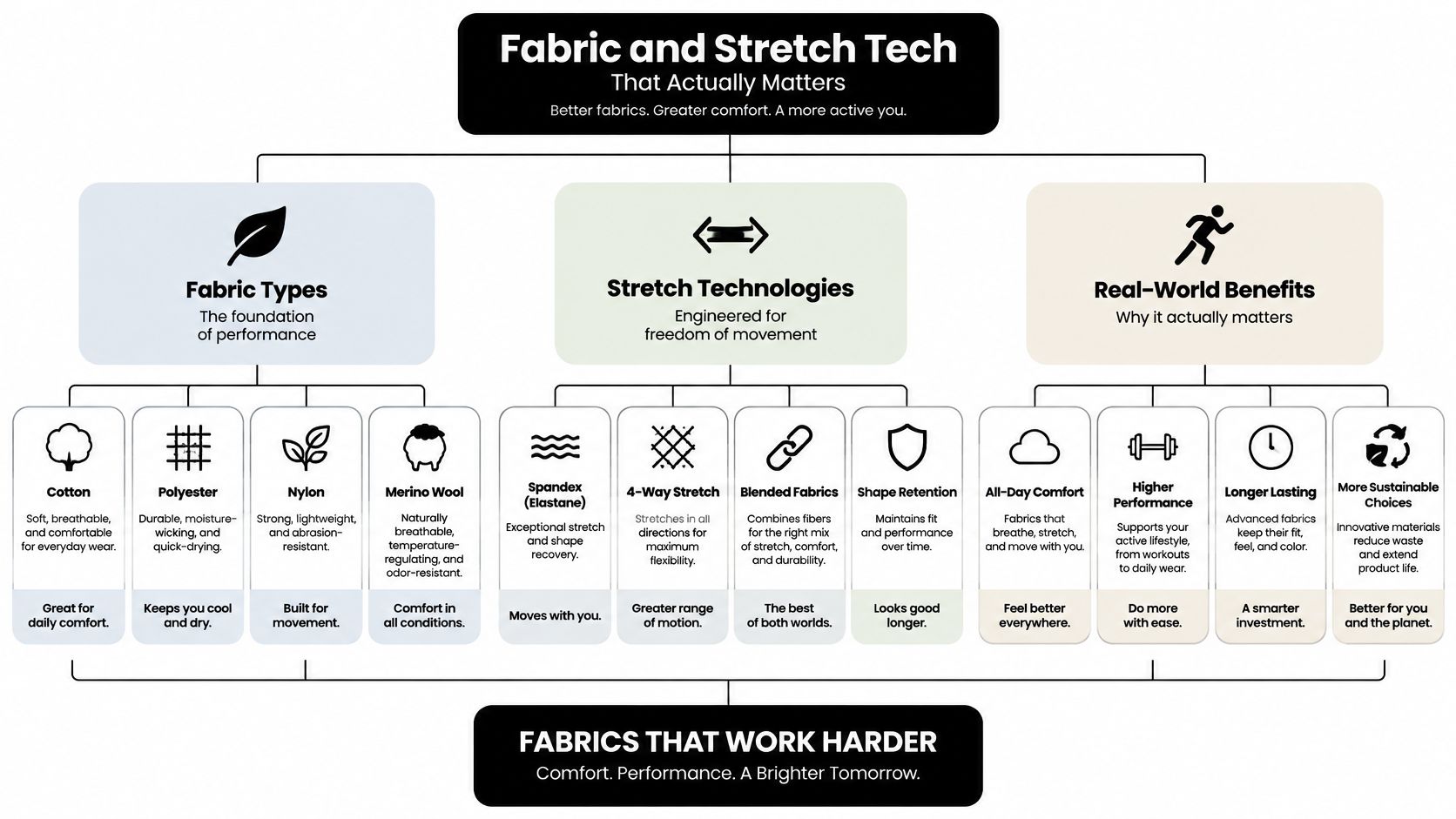
Use 95% recovery after repeated extension as your purchasing target. Treat it as a quality-control benchmark, not a universal ASTM pass or fail requirement, because the standard itself doesn't set that line. What matters is that you ask, and that the answer comes with method details rather than a bare percentage.
| Spec | What it tells you | What to ask for |
|---|---|---|
| Stretch direction | Whether the fabric moves with both the swing and the squat | Stretch in both crosswise and lengthwise directions |
| Recovery | Whether the shorts return to shape after repeated squatting and sitting | Recovery data after repeated extension, with 95% as a quality target |
| Fiber blend | Stretch power and durability | Elastomeric content, for example 8% spandex |
| Fabric weight | Heat load and drape | Weight in oz per square yard, for example 8 oz |
| Laundering | Whether stretch survives repeated washing | Results after repeated laundering, not only new-fabric results |
| Construction | How seams handle loading | Gusseted or articulated crotch and flat-lock seams |
Questions That Separate Real Data From Marketing
Ask for six things: test direction, applied load, extension, hold time, recovery interval, and whether testing was repeated after laundering. A seller who has real lab results can answer most of that quickly. A seller who only repeats the words on the hangtag hasn't tested, and you're the test.
Prioritize a woven fabric with elastomeric yarn or mechanical stretch in both the crosswise and lengthwise directions, paired with a gusseted or articulated construction that reduces seam loading. Bidirectional stretch without that construction still concentrates stress at the crotch seam, which is where shorts pull first during a full turn.
Our Cool-Stretch fabric gives you a worked example of how to read a spec sheet. It's 8 oz with 8% spandex, rated UPF 50+, and built to hold shape after 50+ washes. Read that last point as a claim to verify against your own wear, not as proof. The first three numbers are the useful part, because they're specific enough to compare against any competing pair.
Moisture, Drying and UV Checks Most Reviews Skip
Quick-drying, sun protection, and wicking are three separate properties, so test each one. Most reviews collapse them into a single reassuring phrase, which is how the best stretch golf shorts end up disappointing: a pair that moves sweat across the fabric without ever getting rid of it.
Wicking Is Only Half the System
Wicking describes how liquid is absorbed and spread across fabric. Drying describes how fast that liquid evaporates and leaves. A short can do the first well and the second badly, leaving you in damp fabric that has distributed the problem over a wider area.
Independent textile testing keeps these apart. The James Heal guide to performance testing separates AATCC TM195, which evaluates liquid-moisture-management behavior, from AATCC TM197, which measures vertical wicking, and AATCC TM199 to TM201, which cover drying-rate methods. You don't need to run these tests. You should ask which one backs a claim. For the plain-language version, our guide on what moisture-wicking fabric does walks through it.
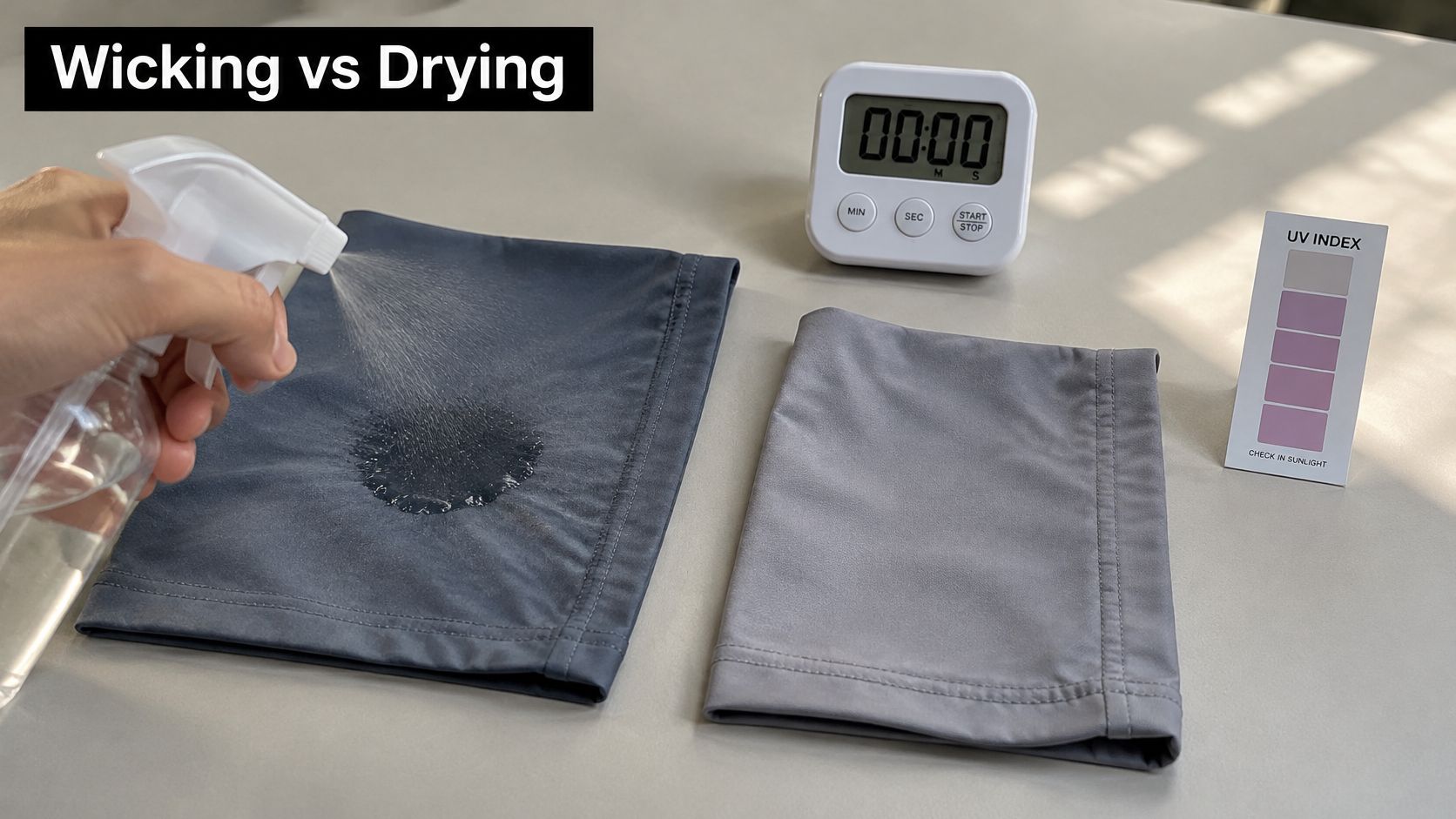
Fiber choice drives much of this. Polyester has relatively low moisture regain, so it holds little water inside the fiber itself. Cotton retains substantially more moisture, which raises perceived wetness and extends drying time in humidity. A polyester and spandex blend is the sensible default for hot rounds. Construction still matters, since ventilated pocketing and minimal internal layering reduce trapped heat.
Ask for results reported with test method, elapsed time, fabric mass, and laundering history. A drying time without those four details can't be compared across brands.
Sun Protection Deserves Its Own Check
A 2025 evaluation of 671 golf-apparel items found UPF labeling on only 7.1% to 16.7% of products, depending on category, and cited evidence that golfers were 2.4 times more likely to report a history of skin cancer than the general population, while only 36% reported always wearing sunscreen. That's a poor combination for a sport played at midday.
Coverage shifts with use. A stretch fabric's protection can change when the material is tensioned, wet, or worn thin, which describes exactly what happens to shorts across a season. A tested UPF rating is a measured number; "sun-resistant" is an adjective. And shorts can't protect your lower legs at all.
A tested UPF rating covers the skin under the fabric. Everything below the hem is still your problem, so keep sunscreen on it.
My recommendation: ask for the test method behind any moisture claim, look for a printed UPF rating instead of a sun-related adjective, and put sunscreen on whatever the hem doesn't reach. A pair that clears those bars earns its price. The rest is hangtag copy.
Fit, Inseam and Dress-Code Test Before You Buy
Inseam is the wrong first question. The useful question is whether the pair in your cart will work at the next course you are playing, on your body, through a full round. Those are different checks, and they often produce different answers.
A 2022 review of 15 highly ranked U.S. courses found that only six published women's shorts or skirt-length guidance, with stated requirements ranging from 2 to 5 inches above the knee, while others used vague terms such as "conservative length." Courses do not share one rule, and many do not publish a rule at all. That gap is why universal inseam advice fails, and why our guide to how golf shorts should fit starts with the course rather than the tape measure.
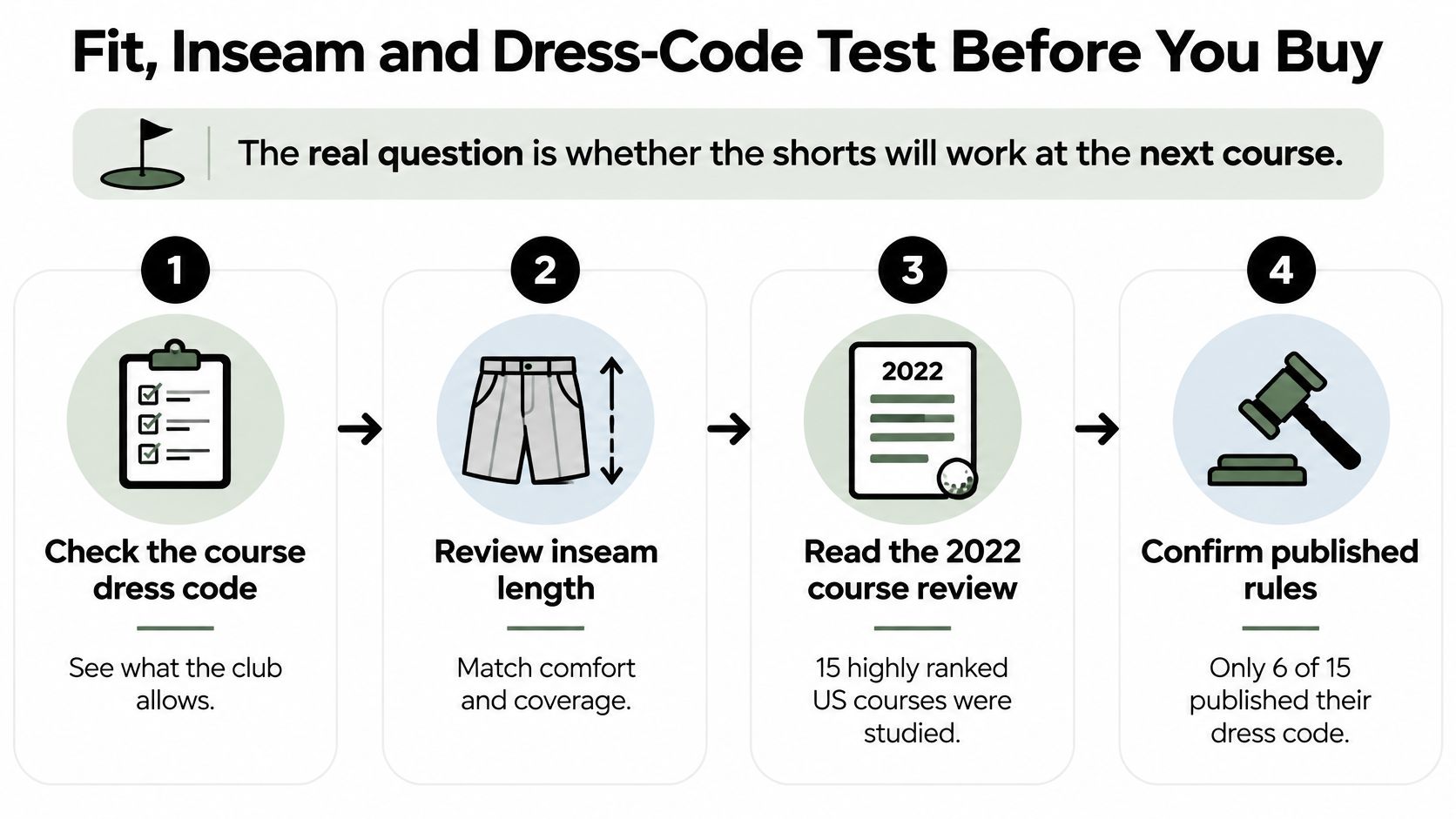
Shorter inseams can be athletic, and near-knee cuts can still move well; rise and thigh ease decide it. Judge rise, thigh ease, leg opening, and stretch recovery together on your proportions. Use the OB ProCool Golf Shorts (Orange) and OB Cool-Stretch Golf Shorts (Charcoal) as fit references inside that checklist, not as length rules. For sizing room, Tattoo Golf's Tiki Cool-Stretch Men's Golf Shorts come in waist sizes 30 through 44, which matters before hem length does: a pair that cannot sit correctly at the waist will fail every movement check below.
The trade-off is real. More thigh ease can look relaxed but reduce pull at the top of the swing. A cleaner leg can read traditional yet bind if the rise sits wrong for your hips.
The Six-Move Test
Run these in order, at home with the tags on, before you commit.
- Address position: Set up to a ball and hold it for ten seconds. The waistband should not dig, slide, or need a tug back into place.
- Full backswing: Turn to the top slowly, then at speed. Watch for fabric riding upward during hip rotation and any pull across the front pocket.
- Squat to read a putt: Drop into your green-reading crouch and stand back up three times. Check coverage at the back and whether the hem stays where it started.
- Cart seat: Sit down, cross one leg, then get up as you would between shots. Look for waistband roll and visible pocket lining, both signs the rise does not suit you.
- Bunker step: Step up onto a stair and down again, leading with each foot. Restricted stride here means the leg opening or thigh ease is too tight for slopes.
- After nine holes: Wear the pair for a practice session and check the seat and waistband afterward. Lasting bagging means recovery is weak, no matter how good the first five steps felt.
Confirming Course Policy
Check the club website first, then call the pro shop if the wording is vague or missing. Ask specifically about shorts length and print or color restrictions, because a neutral pair can still get flagged for length and a bold pair can pass on length but fail on pattern. If the answer is "conservative," ask conservative compared with what. For a guest round at a traditional club, I would choose the more modest option already in the closet and save the sharper pair for a course with a written standard. A pass is a pair that stays put through all six moves and clears the strictest course on your calendar.
Best Stretch Golf Shorts for Mobility and Walking Rounds
If you walk 18, swing hard, and crouch on every green, you're the golfer who exposes weak stretch fastest. Riding golfers can tolerate a mediocre pair because the cart does half the work. You can't, because every step between shots loads the fabric again.
The OB ProCool Golf Shorts (Orange) show what a walking-focused spec sheet should contain. The Cool-Stretch fabric weighs 8 oz with 8% spandex, carries an anti-odor finish, and is rated UPF 50+. The number that matters most to a walker sits further down the page: the fabric is built to hold its shape after 50+ washes, which is the closest thing a product listing gives you to a recovery guarantee.
Construction Details That Matter on Foot
Seams decide whether a long walk stays comfortable. Raised seam allowances are what chafe after several miles, so run a finger along the inside of any pair you're considering and feel for stitching that lies flat against the skin. A smooth interior keeps friction low through the back nine.
Spandex content tells you the shorts can stretch. Recovery tells you they come back. A pair that still holds its seat and waistband shape after repeated washing will survive a season of walking rounds far better than one that only stretches well on the hanger, so weigh the published wash rating heavily when you compare pairs.
- Walk more than you ride: Put recovery data and seam feel ahead of color.
- Swing with a full turn: Check the backswing step of the movement test before anything else.
- Carry tees and a scorecard: Crouch with full pockets before buying to confirm nothing shifts or spills.
The Honest Trade-Off
Bright orange is a statement, and it's a real cost. Some golfers won't wear it, and some clubs create social friction around loud color even when the written code allows it. If that describes your home course, the same construction in a quieter color serves you better than a pair you save for rare occasions.
A UPF 50+ tag earns trust only when the testing behind it is clear. Ask which lab method sits behind it. The answer tells you how much weight the claim deserves.
I would decide this way. If you walk more rounds than you ride and your swing is full rather than compact, prioritize published recovery data and a smooth interior over color and price, because those determine whether the pair still feels right at the 16th tee.
Best Stretch Golf Shorts for Hot Weather, Style and Value
Heat, appearance, and budget pull in different directions, so handle them in that order. A pair that keeps you dry but clashes with every polo you own will sit in a drawer, and a cheap pair with dead stretch costs more per round than a good one.
Hot Weather Comes First
For humid rounds you want a lightweight 8 oz fabric with quick-dry behavior, ventilated construction, and minimal internal layering to reduce trapped heat. The OB Cool-Stretch Golf Shorts (Charcoal) use that same 8 oz Cool-Stretch construction in a dark neutral, which brings up a practical point about color. A neutral charcoal or a lighter tone tends to show sweat patches less obviously than dark, saturated colors, so check how a color looks damp, not just dry.
Style That Earns Its Place
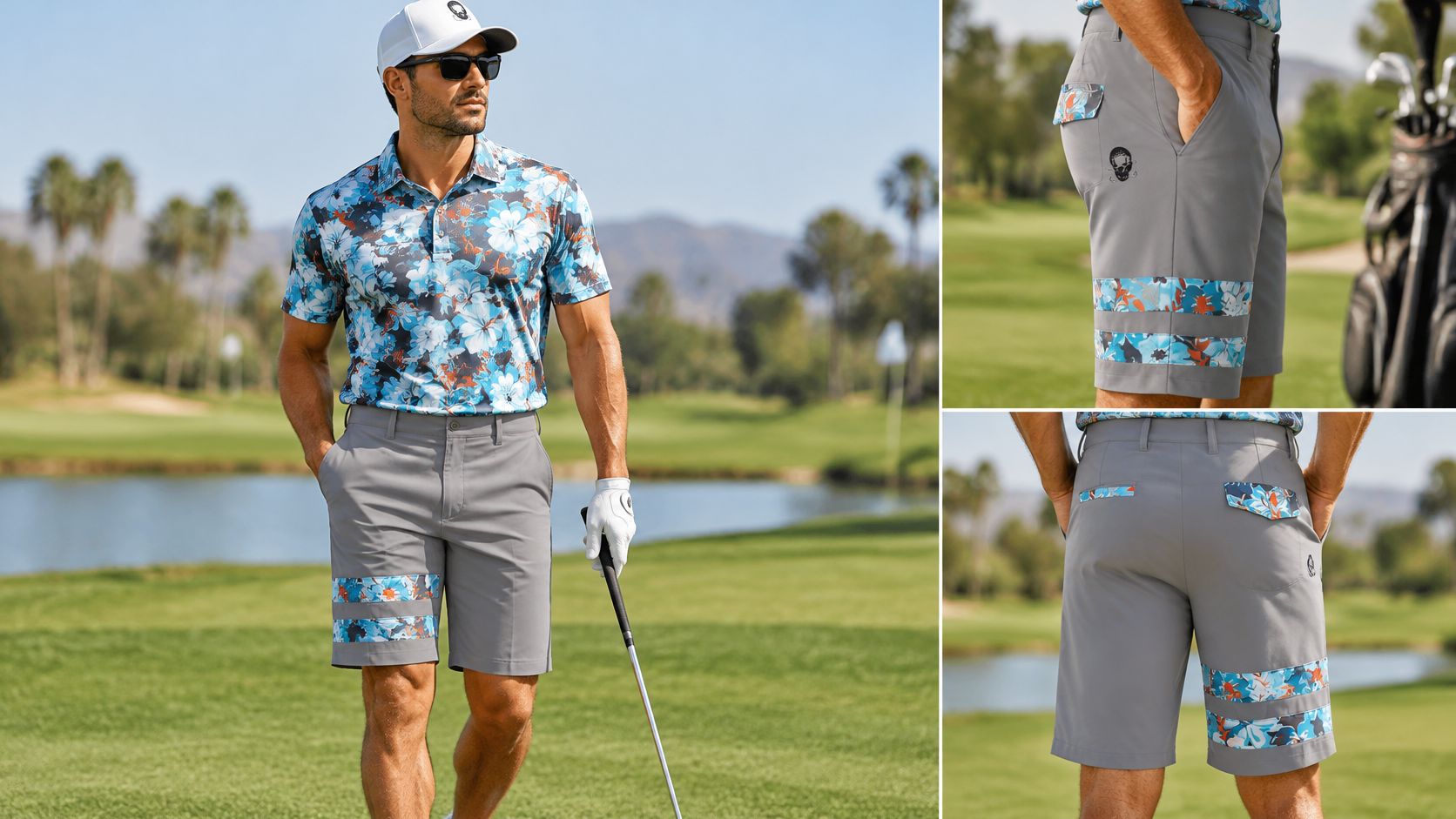
Bold prints such as our Dancing Skulls and Tiki Multicolor shorts work when you already own plain polos to put with them. Charcoal works the other way, pairing with prints and brights that would fight true black, which is why we describe it as the safe choice that doesn't look safe. Before buying a print, hold it against the three polos you wear. If none of them work, you're buying an outfit problem.
Value Means Same Spec, Lower Price
A markdown only counts as value if the product page confirms the same fabric and construction as full-price gear. Our Sales Rack items are first-quality apparel with the same 8 oz Cool-Stretch fabric, UPF 50+ and anti-odor finish, and construction as full-price gear, so the check there is verifying the spec on the individual item page before you order, not assuming it.
| Pick | Best for | Listed price |
|---|---|---|
| OB ProCool Golf Shorts (Orange) | Sunset rounds and bright style | See product page listing |
| OB Cool-Stretch Golf Shorts (Charcoal) | Neutral look and dress-code safety | See product page listing |
| Tiki Cool-Stretch Men's Golf Shorts (Multicolor) | Tropical style and warm weather | $69.99 |
| Dancing Skulls Cool-Stretch Men's Golf Shorts | Bold print statement | $69.99 |
| Sales rack first-quality shorts | Lower cost for the same fabric spec | See product page listing |
Compare the listed price against the spec and fit checks from the earlier topics, not against color alone. Two pairs at the same price can be very different purchases once you know which one recovers and which one doesn't.
Care and Styling That Keep Stretch Shorts Performing
In practice, heat from the dryer is what most often ruins stretch recovery. Care is part of the purchase here: it's how you keep the fit you tested before buying. Our notes on care for your Tattoo Golf clothing cover the wider range, and the shorts routine itself is short.
The Four Care Steps
- Machine wash cold with like colors: Cold water limits stress on elastomeric fibers and keeps prints from fading against darker laundry.
- Tumble dry low or hang dry: High dryer heat weakens elastic fibers over time, so hanging them preserves the waistband and seat recovery you paid for.
- Do not bleach: Bleach attacks both the fiber and the finishes that handle moisture and odor, shortening the useful life of the pair.
- Warm iron only if needed, never over prints or trim: Direct heat on printed areas can crack or lift the design, so iron around them or skip it entirely.
Hang drying is the single habit I'd push hardest. It costs you nothing and it protects the property that is hardest to restore once it is gone.
Rotating two pairs across a golf week also halves the wash cycles each one sees, and wash cycles are where the wear accumulates. Between rounds, fold them or hang them by the waistband rather than wadding them into a bag, since creases pressed into a damp pair tend to set.
Styling Without Overdoing It
Check the loop width before you reach for a belt. A belt that is too narrow lets the waistband bunch and ride, while a ratchet belt adjusts in small increments so the waistband sits flat without hunting between holes.
Pick one bold element per outfit, either the shorts or the polo. Two bold pieces turn a golf outfit into a costume.
Frequently Asked Questions About Stretch Golf Shorts
Does 4-Way Stretch Mean Better Shorts
Not on its own. The label says the fabric moves in four directions, but it says nothing about how well it returns to shape afterward. Ask for recovery data using the questions in the fabric topic before you treat stretch as a quality claim.
When Should Stretch Shorts Be Replaced
Replace them when the waistband rolls where it didn't roll when new, when the seat stays bagged after an ordinary round, or when the fabric shows lasting stretch loss after washing. Any one of those signs means recovery has gone. At that point you're compensating with your belt, and the fit will only get worse.
Does a UPF Rating Last After Washing and Wear
It isn't guaranteed to. Stretch, sweat, and fabric wear can all reduce protection, which is why results after laundering matter more than new-fabric results. Keep sunscreen on exposed skin regardless, as covered in the UV topic.
Can Stretch Shorts Work in Cool Weather
Yes, but don't expect warmth from them. An 8 oz fabric adds limited insulation, so layer a base layer underneath or add long sleeves on top instead. That approach keeps the mobility you bought the shorts for while handling the temperature separately.
Choose Your Pair Before the Next Round
Start from the round you're playing next and pick the quick-pick row that matches it. Walking and a full swing point you toward the OB ProCool spec, hot rounds and a bolder look point toward the Cool-Stretch and print options, and a tight budget points to the sales rack only after you've confirmed that item's fabric spec on its product page.
Then run three checks, in this order, and let any one of them stop the purchase.
- The spec from your row: Recovery data for walkers, drying results for hot rounds, a UPF label for midday golf.
- The movement test: Address, backswing, crouch, cart seat, bunker step, and a post-session check for bagging.
- The size chart: Measure your waist and compare it before ordering, rather than trusting the size you wear in another brand.
Our range suits bold recreational and competitive golfers who want non-traditional style with stretch and moisture-wicking performance, and the Cool-Stretch shorts fit men who walk and swing hard. Women and mixed groups can coordinate from the same range by using the color matching approach in the styling topic, starting with whichever piece is boldest and building the rest of the outfit around it.
Here's your next step. Open the size chart for the pair that matches your row, measure your waist accurately, and order only if the measurement and the movement test both pass. If one fails, change the size or change the pair. Don't hope the course will be more forgiving than your living room.
Our men's and ladies' shorts, polos, and coordinated outfits at Tattoo Golf pair bold prints and solid neutrals with Cool-Stretch fabric built for four-way movement, moisture management, and UPF 50+ coverage. Pick the pair that matches your next round, check your waist against the size chart, and order it in time to run the movement test at home before you tee off.
Share:
Stretch & Mobility: 4-Way Stretch Spandex Allows an Unrestricted Swing