
A right-handed golfer wears the glove on the left hand, and a left-handed golfer wears it on the right hand. The rule behind that is the top hand on the grip, not the hand you write with.
So why do so many couples order two copies of the same glove the moment the shirts match? The shirts can share a print. The gloves cannot share a hand. One partner's top hand is the other partner's lower hand, and a glove sold for the wrong hand sits backward on the grip.
Which Hand Wears the Golf Glove for Each Golfer
Two partners can share one shirt print and still need gloves built for opposite hands. Match each golfer to the hand that sits on top of their grip:
| Golfer | Top hand on the grip | Glove goes on | Glove usually sold as |
|---|---|---|---|
| Right-handed golfer | Left hand | Left hand | Left-hand glove |
| Left-handed golfer | Right hand | Right hand | Right-hand glove |
| Right-handed and left-handed partners | Left hand for one, right hand for the other | Left hand for one, right hand for the other | One left-hand and one right-hand glove |
Gloves are sold by the hand they fit, so the size on the tag is only half the order. A medium left-hand glove and a medium right-hand glove are mirror images. No amount of stretching turns one into the other, because the thumb is cut for one side and the reinforced palm patch sits where the fingers wrap the grip from that direction.
For a mixed-handed pairing, the cart holds one left-hand glove and one right-hand glove, even when both shirts carry the same design. The guide to golf glove materials, fit, and performance explains how that leather or synthetic palm is cut for each orientation.
Why the Glove Goes on the Top Hand
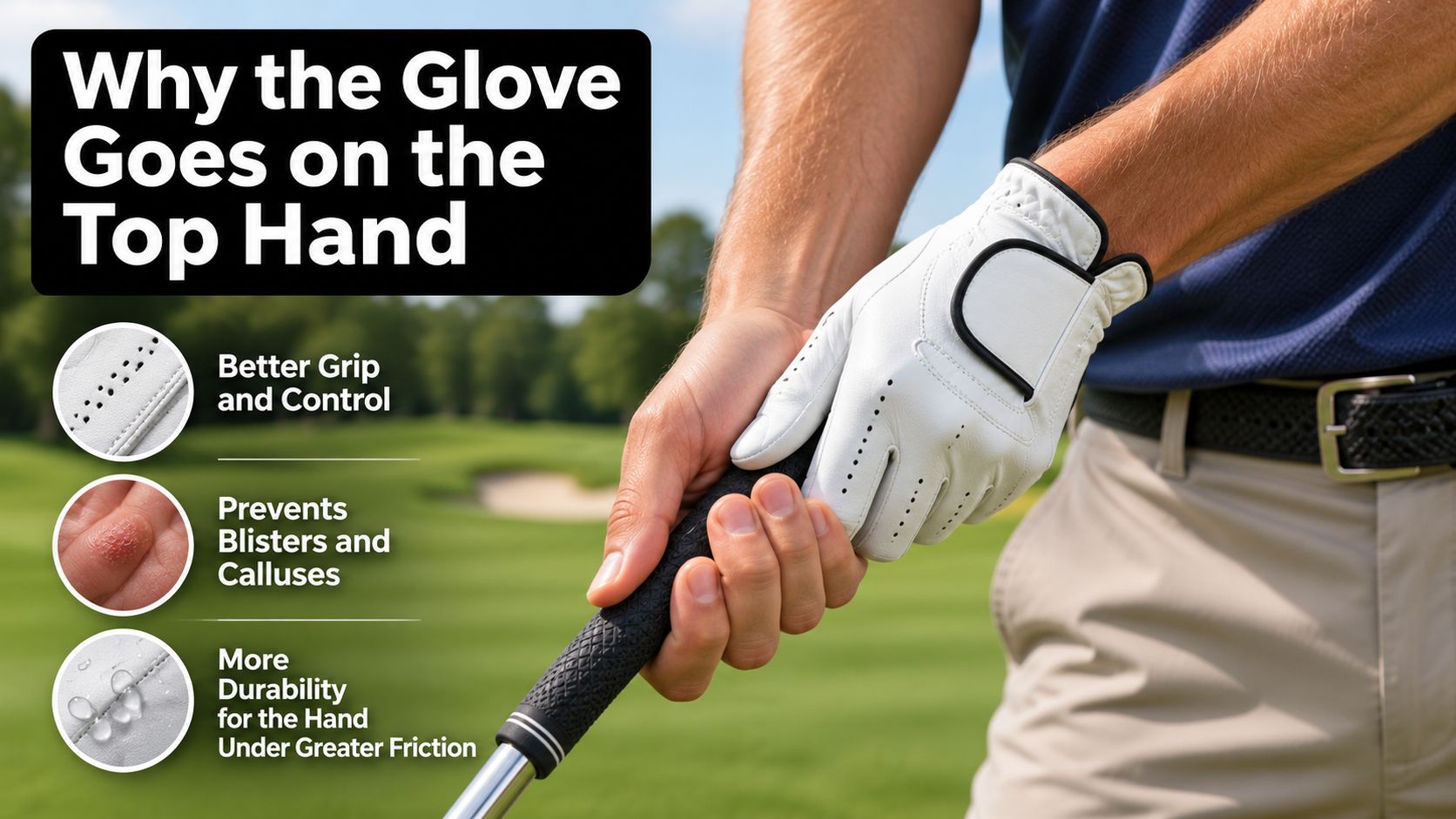
The top hand steers the club like a driver's hand steers a wheel. It holds on, sets the line, and stays in contact the whole time; the lower hand supports the turn.
On the club, the top hand closes around the grip with the fingers and the palm. It keeps the clubface from twisting through the swing, so friction and security matter most there. The lower hand adds speed and rotation, and a looser hold lets it release. A tight lower hand often stalls the club.
The common mix-up is assuming the glove protects whichever hand works hardest. Work and grip contact are different jobs, and a lower hand can ache all round and still barely touch the rubber.
Friction wears the top-hand glove out first. That palm stays clamped through every swing, so the leather shows it: the heel of the palm and the base of the thumb go slick and dark first. A glove on the lower hand barely scuffs there, since that hand slides and rotates on release.
For a mixed-handed couple, the shine is mirrored: one partner's glove wears on the left palm, the other's on the right, even when both shirts carry the same print.
Two gloves make sense for cold, rain, or a healing blister. Otherwise, one glove is the standard setup.
If the leather looks shiny only on the hand that was lower at address, the glove was probably on the wrong hand all along.
How to Find Your Glove Hand Before You Buy
Writing hand and golf handedness split more often than people expect. A left-handed writer can still play right-handed, and the glove follows the swing, not the pen.
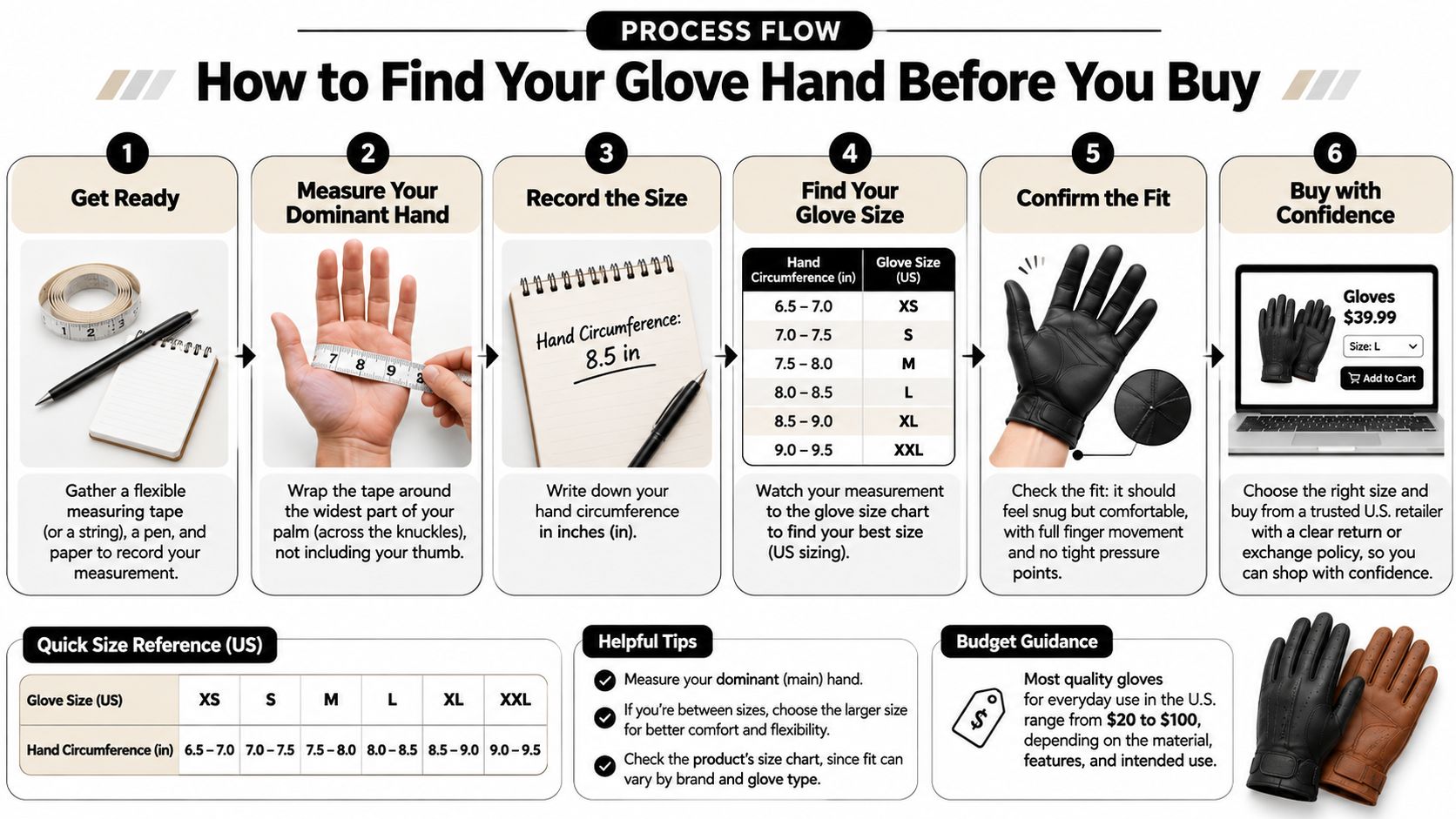
The six-step check
- Stand at address with a club, or with your hands shaped around an empty grip. You need the stance you use, not a pose in front of a mirror.
- Place both hands the way you hold the club on a normal shot. A tired grip often creeps the lower hand upward, so reset if the hands feel stacked on top of each other.
- Look at which hand sits higher on the shaft. That hand is closer to the butt end of the grip.
- Note that hand as your top hand. Do not relabel it as your "strong" hand. Strength and height on the grip are different facts.
- Check it against a filmed swing, or have your partner stand behind you. Driver and iron grips can drift, so confirm the same hand leads on both.
- Buy a glove for the top hand only. A second glove is optional gear for weather, not the default order.
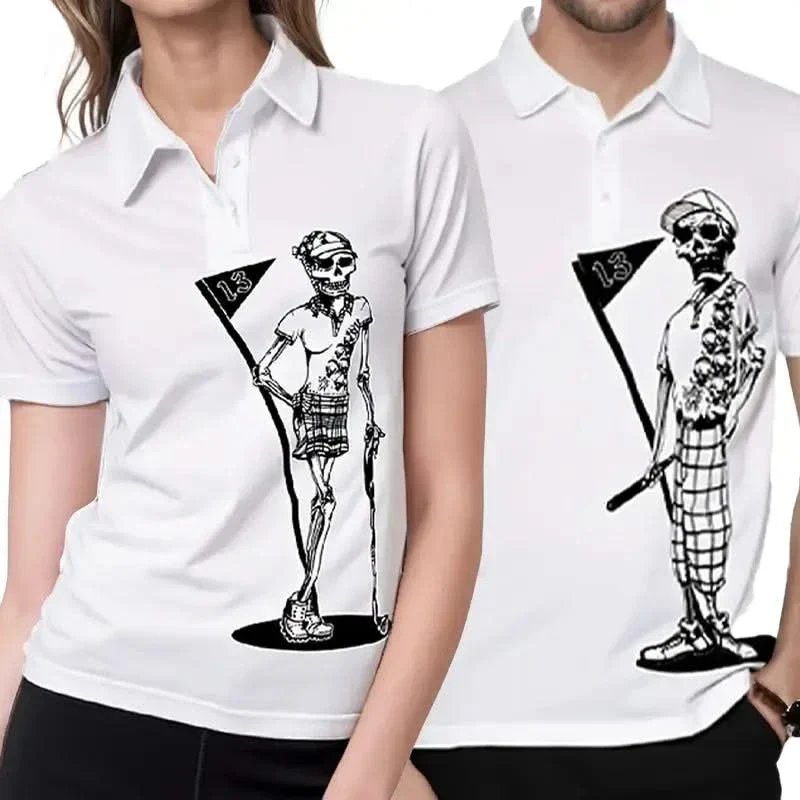
Do this check separately for each partner. One person's top hand says nothing about the other's. If you are also ordering polos, men's and ladies' cuts in our Lucky 13 collection arrive in the same colorway, so the shirts can match while the gloves stay opposite.
Coordinating Matching Shirts and Gloves for Mixed-Handed Couples
Couples matching golf shirts can look right in a photo and still leave the gloves pointing opposite ways. The accessory cannot repeat the shirt exactly, because one glove is a left and the other is a right.
Start with a concrete pair before you chase a perfect clone. One partner wears a left-hand glove in the same navy as the shirt. The other wears a right-hand glove in sky blue that picks up a lighter accent already in the print. The hands do not match. The palette does.
Apparel color-perception research found that hue-difference and brightness-difference ratios increase visual saliency, while similar saturation levels tend to produce higher harmony scores. Adjacent hues were generally preferred for a coordinated appearance. Highly pure complementary colors attracted attention more quickly but scored lower for harmony.
Charcoal with a muted red accent works the same way. Share a colour family or a motif, keep saturation close, and let brightness shift a step. Moderate brightness contrast also separates you in group photos and on the course, which helps when you are sorting handicap and scoring rules for couples in a scramble.
Our notes on how to match golf accessories with your golf shirt cover belts and hats the same way. Three checks before you order:
- Shared colour family: shirts and both gloves live in one palette or one motif.
- Similar saturation: neither glove is a neon next to a muted shirt.
- Glove hand confirmed: one left-hand glove, one right-hand glove, each tied to that partner's top hand.
Gloves for Rain, Cold and Sun Exposure
The top-hand rule holds in most weather. What changes is how many gloves you carry, and what covers the arms the glove never reaches.
| Condition | Glove setup | Why it matters |
|---|---|---|
| Dry, mild round | One glove on the top hand | Standard grip control with no extra gear |
| Wet or humid round | Top-hand glove plus a dry spare in the bag | Wet gloves lose grip, so a dry spare helps |
| Cold morning | Top-hand glove, optionally a second glove | Warmth is a personal choice, not a rule |
| Sun-sensitive golfer | Top-hand glove plus UPF-rated sleeves | Glove coverage alone leaves the arms exposed |
When the bag needs a spare
On a wet or humid round, leather and many synthetics slick up once they soak. Swap to the dry spare instead of squeezing a wet glove harder. For a mixed-handed couple, that means two spares: one left-hand glove and one right-hand glove, since you cannot borrow each other's backup.
Cold mornings work differently. A second glove on the lower hand is comfort, not a correction of the grip rule. Take it off if the release starts to feel muffled.
Sun Exposure Depends on Coverage
The glove only shields one hand. Everything above the wrist is on its own.
A 2025 analysis of 671 golf-apparel items found that UPF labeling was uncommon (only 7.1% to 16.7% of items displayed it), coverage of the arms, hands, and neck was limited, golfers in the associated survey reported a history of skin cancer at 2.4 times the rate of the general population, only 36% said they always wear sunscreen, and 70% of respondents resisted long-sleeve or UV-specialized garments because they saw a style disadvantage.
That last point is the one couples can design around. A sun-sensitive golfer keeps the shared print on the shirt and adds a UPF-rated layer for the arms. Partners with different sun needs do not have to wear identical sleeve lengths for the kit to read as a pair.
Matching Shirt Fit for Each Partner
One partner's polo drapes cleanly across the shoulders while the other's binds at the chest. That split is the usual outcome when two people order the same design in the same nominal size, because men's and ladies' polos are built differently in shoulder width, bust room, waist shaping, torso length, and sleeve proportions.
Measure the person, then the garment
Measure each golfer separately, then compare chest, body length, and sleeve length against the garment chart rather than the letter on the tag. Check the stretch, and watch where the hem lands with both arms raised overhead. A shirt that looks right in the mirror can ride up at the top of the backswing.
Each partner picks a cut that suits their own frame inside the same print. One may want relaxed room through the bust or midsection while the other prefers a fitted silhouette, and the pair still reads as a coordinated kit because the shared design carries the identity. The same logic covers gloves for a mixed-handed couple: a right-handed partner and a left-handed partner wear opposite gloves under one design language.
Tattoo Golf's men's polos run true to standard US athletic sizing with a relaxed cut, so a golfer who prefers a closer fit may want to size down. For a remote order, lay a shirt that already fits flat, record its measurements, and match them to the chart before paying. Our guide to golf shirts for women explains how a ladies' polo is shaped through the waist compared with a men's athletic cut, so each partner can use that difference deliberately.
Buy the Right Glove for Each Partner
A right-handed wife and a left-handed husband can wear the same skull print and still need two different gloves: hers goes on the left hand, his on the right. Buy one glove per person, cut for that person's top hand. A same-hand pair leaves one of you wearing a glove built for the wrong hand.
Size the hand, not the shirt
Glove sizing follows the hand. Each partner measures across the knuckles, in centimetres or inches, and reads that number against the glove chart. A women's shirt size and a men's shirt size do not imply matching glove sizes, so check both measurements even when the shirts already coordinate.
Couples now buy first kits together more often than they used to. Women and girls reached an all-time high in U.S. on-course participation in 2025, exceeding 8 million and representing 28% of on-course golfers, and women accounted for 35% of beginners, according to GolfN's look at golf consumer demographics. A wrong-hand glove on a first order is an easy, avoidable return.
Our lineup includes golf shirts, pants, shorts, hats, and accessories such as gloves, towels, and belts. The A-Game Cool-Stretch Golf Shirt with Matching Golf Glove costs $87.98 if you want a shirt and glove bundled, or you can buy gloves on their own. For the shirts, the Aloha Couples Matching Golf Shirts (Teal) pair a teal Hawaiian print with skull-and-crossed-clubs details on one men's polo and one women's polo, in Cool-Stretch fabric that wicks moisture to keep both players cool and dry.
The purchase decision itself is short. Read each knuckle measurement against the glove sizing chart, pick the hand orientation for each player, then decide whether a bundled shirt-and-glove set or separate gloves gives you the colour match you want.
Tattoo Golf builds coordinated polos, gloves, and the rest of the kit so a couple can share a print without forcing the same cut or the same glove hand. Pick the colour family, confirm each top hand, and size the glove to the hand that grips the club. Visit Tattoo Golf to put the shirts and the gloves in one order.

Share:
Make It a Golf Outfit: Quarter-Zip Guide for 2026