

You're standing on the first tee, the sun is already bright, and your new cap feels fine for the opening holes. By the back nine, the sweatband is damp, the crown feels heavy, and the brim only shades the front of your face. You keep adjusting it between shots, which is exactly when a piece of golf gear stops helping and starts becoming a distraction.
The right hot-weather golf hat works as a heat-management system, not just a sun-blocking accessory. It balances UPF protection, brim geometry, airflow, moisture control, and fit so it can stay comfortable through a long round. Style still matters, especially when your golf wardrobe reflects your personality, but performance determines whether you'll keep the hat on.
Why Your Golf Hat Matters More When Temperatures Rise
A hat can feel comfortable on the first tee and fail by the back nine. A traditional cap may shade your eyes, but a warm crown, saturated sweatband, and narrow brim can leave your forehead clammy while your ears and neck remain exposed. As the round continues, those small annoyances compete with your attention during setup, walking, and club selection.
That's why choosing a golf hat for hot weather requires more thought than picking a logo or color. The crown affects how much heat stays around your scalp. The sweatband determines whether moisture moves away from your face or remains against your skin. The brim controls how much shade reaches your cheeks, ears, and neck as the sun moves across the sky.
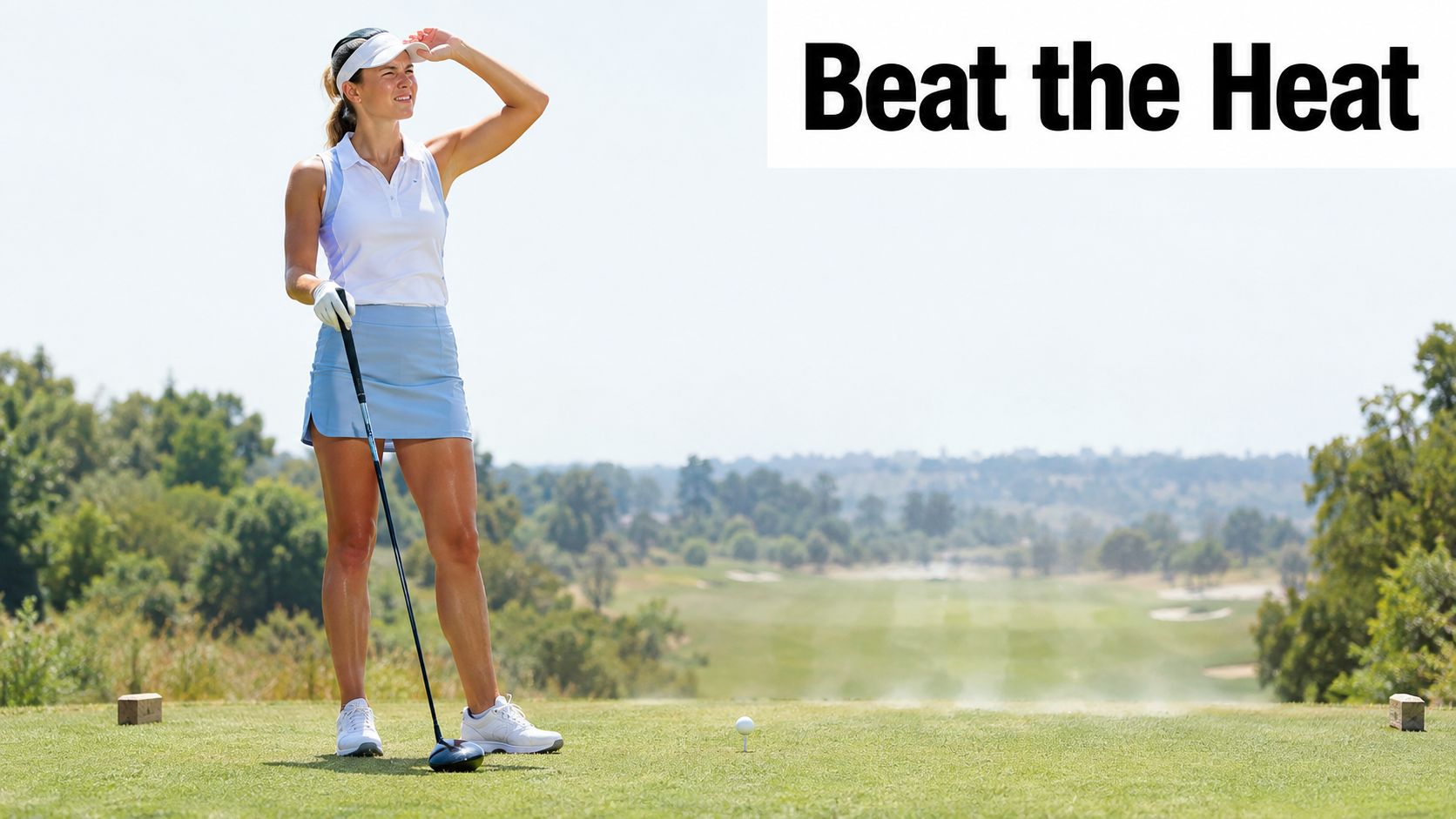
Comfort supports concentration
A hot round creates more than cosmetic discomfort. Sweat can run toward your eyes, glare can make it harder to track the ball, and a hat that shifts in the wind can force repeated adjustments. None of these issues changes your swing mechanics directly, but each one adds friction between you and the next shot.
A good hat removes one more problem from the round. It should stay secure while you walk and swing, keep the sweatband from becoming saturated, and provide enough shade without interfering with forward visibility. For golfers who spend several hours outdoors, that combination helps the hat feel like part of the equipment rather than another item to manage.
Sun protection still includes the skin a hat can't cover. A cap or visor leaves areas such as the ears, neck, and parts of the face exposed, so it makes sense to review practical Skin Perfection sun care tips before a long day outside.
Practical rule: If you notice your hat repeatedly during a round, evaluate its fit, sweatband, ventilation, and brim before blaming the weather alone.
How Sun and Heat Affect You on the Golf Course
Think of your hat as a small shade structure. A front-only cap places that structure over your forehead and eyes, while a bucket or wide-brim design extends shade toward the sides and rear of your head. That difference matters because sunlight doesn't arrive only from directly in front of you. Your ears, cheeks, and neck can receive exposure when the sun is off to the side, and bright surfaces can reflect light upward.
A peer-reviewed study published in 2018 measured the lowest mean ultraviolet radiation dose to the entire face with a wide-brimmed hat, at 1.7 standard erythemal doses. The same study found that no tested hat delivered complete protection across every facial skin zone, and the maximum predicted protection factor was about 76%. The practical lesson is straightforward: brim geometry matters more than appearance alone. The study's findings on hat design and facial UV exposure are available through PubMed.
Shade and airflow solve different problems
A wider brim improves coverage, but coverage doesn't automatically make a hat feel cool. Heat builds when warm, humid air remains trapped beneath the crown, particularly in humid conditions where sweat evaporates slowly. Ventilation works like an airflow system, moving that damp boundary-layer air away from your scalp so perspiration can evaporate more effectively.
The best design balances the two jobs. A broad brim reduces the amount of direct and reflected sunlight reaching exposed skin, while mesh panels, perforations, or laser-cut openings help release heat. A narrow brim with excellent airflow may feel comfortable but leave more of your face and neck exposed. A heavy wide-brim hat may shield well but become unpleasant if the crown traps moisture.
The International Golf Federation identifies rising heat-illness risk at temperatures of 31–37°C, or 87–99°F, with conditions becoming extremely high above 38°C, or 100°F. Its hot-weather guidance recommends a well-vented, mesh-crown, wide-brim hat and roughly 1000 ml of fluid per hour in very hot conditions. You can also review practical guidance on how to treat dehydration on the trail for a broader outdoor perspective.
Sweat is part of the cooling process
Sweat cools your body when it evaporates. If a hat's inner band absorbs moisture but doesn't move it away from your skin, the material can become wet, heavy, and insulating. That's why a moisture-wicking sweatband is more than a comfort detail. It helps manage the moisture that your body is already producing to regulate temperature.
During a walking round, pay attention to whether the band remains soft and reasonably dry, whether the crown feels airy, and whether the brim continues to sit in the position you need. Those observations reveal more about a hat's hot-weather performance than a product photo can.
Comparing Golf Hat Styles for Hot Weather Play
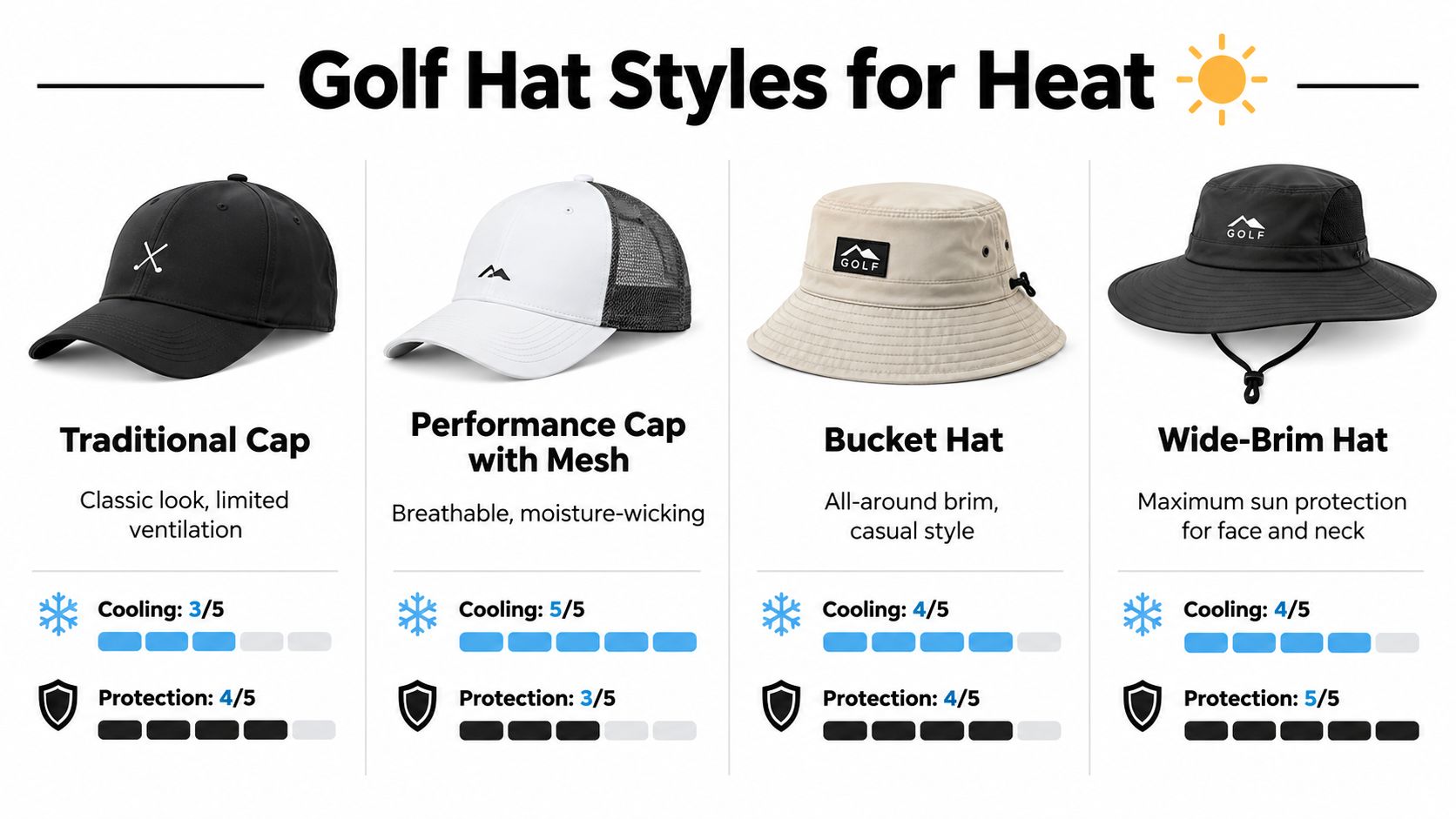
The main silhouettes solve different problems. A traditional cap gives you familiar forward shade and usually works well with sunglasses, but its coverage stops around the sides of the face. A performance cap with mesh adds airflow while keeping the same visual language and swing-friendly brim.
Bucket and wide-brim hats extend protection around the head. That broader shade can help cover the ears and neck more effectively, especially when you're walking in direct sun for several hours. The tradeoff may involve a more casual appearance, greater sensitivity to wind, or a brim that feels less natural when you're addressing the ball.
| Hat Style | Sun Coverage | Airflow and Cooling | Best For |
|---|---|---|---|
| Traditional cap | Forward shade, limited ear and neck coverage | Depends heavily on fabric and crown construction | Golfers who want a classic look and clear forward visibility |
| Performance cap with mesh | Similar front coverage, with some added side or crown ventilation | Stronger airflow and sweat control | Walkers, humid conditions, and golfers who prefer a cap silhouette |
| Bucket hat | All-around brim for face, ear, and neck coverage | Can feel comfortable when the fabric is light and the crown breathes | Casual golfers who want broader coverage without a large sun-hat profile |
| Wide-brim hat | Broadest overall face and neck coverage | Best when the crown is vented and the hat remains lightweight | Long, exposed rounds where protection is the primary concern |
Match the silhouette to your priorities
Choose a traditional cap if forward visibility, wind stability, and a familiar golf appearance matter most. Look for a structured brim that doesn't collapse at address and an adjustable closure that keeps the hat from shifting.
Choose a mesh performance cap if your main problem is trapped heat or a sweat-soaked interior. It keeps the cap format while adding ventilation and moisture management.
A bucket hat suits golfers who want side coverage but prefer a relaxed, casual profile. If you're curious about how that shape works in a golf wardrobe, browsing Tattoo Golf's current men's golf hats collection can offer useful style context.
A wide-brim design makes the most sense when shielding the face, ears, and neck outweighs traditional course styling. It's particularly practical for long periods in direct sun, although you should check that the brim doesn't obstruct your view or move excessively in wind. If you want to compare current options, browse Tattoo Golf's golf hats collection for performance-focused styles built for sunny rounds.
Key Features That Keep You Cool and Protected
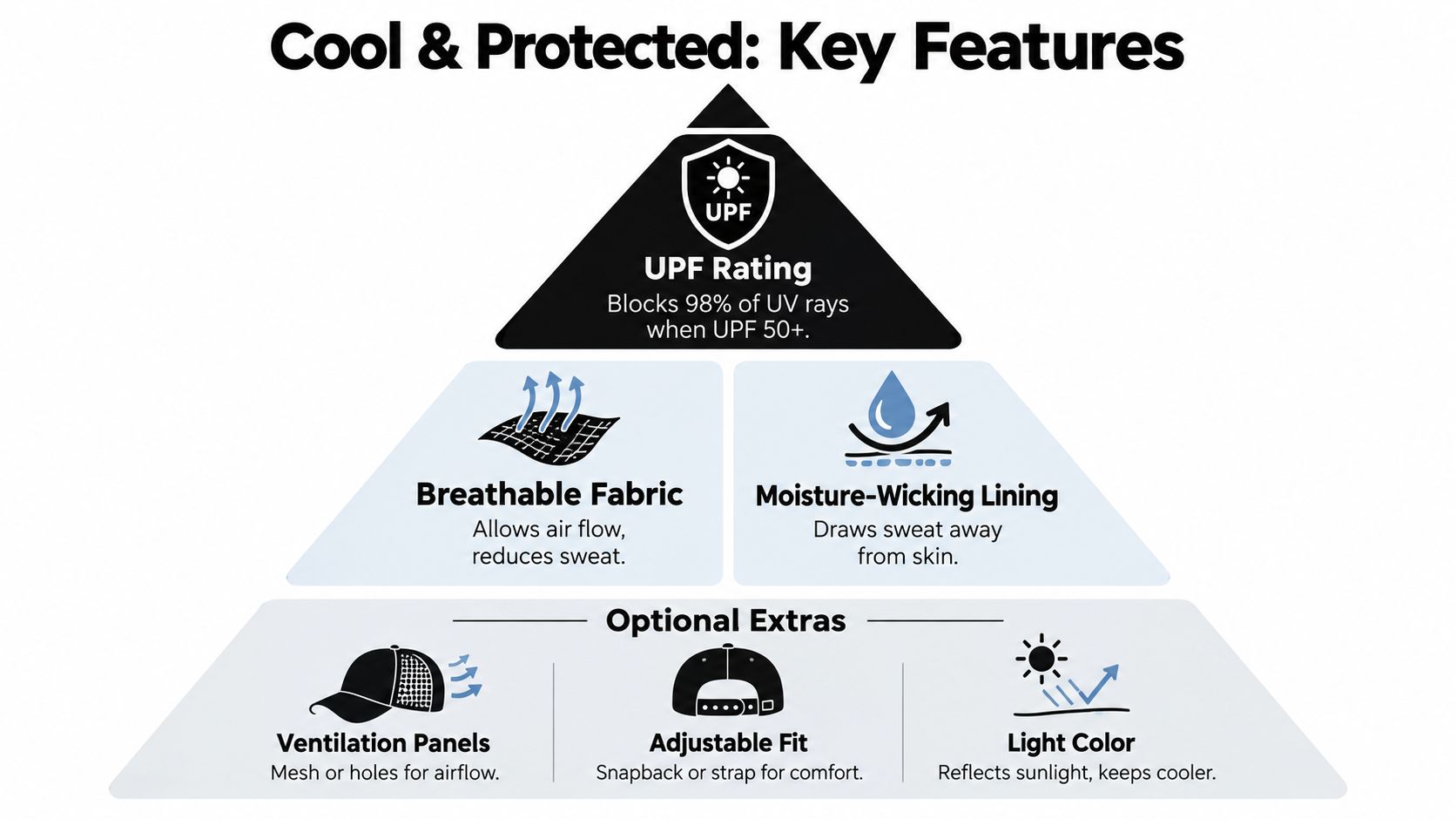
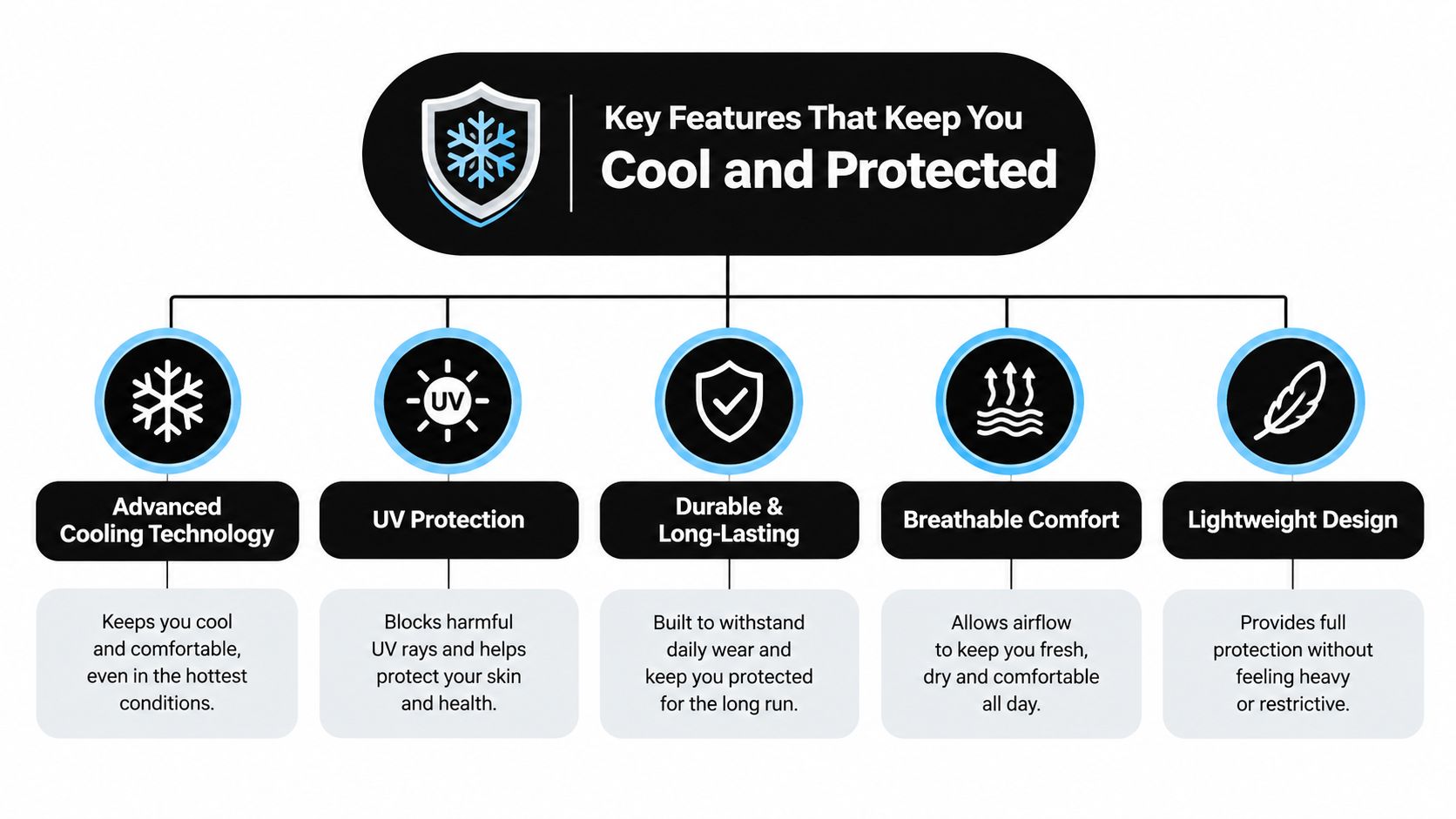
Start with the fabric label, but don't stop there. A hot-weather hat needs a material that blocks ultraviolet radiation, releases heat, manages sweat, and retains its shape after repeated use. Those functions work together, so a high UPF rating alone doesn't guarantee a comfortable round.
Read the UPF rating practically
UPF describes how much ultraviolet radiation passes through fabric. Guidance from Australian sun-protection and cancer-prevention organizations states that UPF 30 blocks about 96.7% of UV radiation, while UPF 50 blocks about 98%. UPF 50+ is widely treated as the top practical rating for sun hats.
That difference may look small on a product page, but the rating is only useful when the material covers the area you need protected and the hat maintains its structure. A brim that folds upward or a crown that collapses can change the coverage you receive. Look for a clearly stated UPF rating rather than assuming a dark color or technical-sounding fabric provides certified protection.
Tightly woven polyester or nylon makes a sensible starting point for hot-weather golf. UPF 50 blocks about 98% of UV radiation, and synthetic fibers generally block UV more effectively than cotton while drying faster after sweat exposure. The same low-water-retention construction can help the hat remain lighter instead of holding moisture throughout the round.
Look inside the crown and band
Ventilation panels, mesh sections, perforated sweatbands, and laser-cut vents give warm air somewhere to go. They're especially valuable when you're walking, playing in humid weather, or wearing the hat continuously from the first tee through the final green.
The inner band deserves equal attention. A moisture-wicking lining should move sweat away from your forehead so it can evaporate rather than pooling against your skin. Practical guidance from Tattoo Golf's article on best golf shirts for hot weather can help you understand why technical fabric performance often affects comfort more directly than the outer logo or trim.
Use this product-page checklist:
- UPF certification: Look for a stated UPF 50+ rating.
- Fabric construction: Favor tightly woven polyester or nylon for quick drying and lower water retention.
- Airflow: Check for mesh panels, perforations, or laser-cut vents.
- Sweat management: Look for a soft, moisture-wicking interior band.
- Structural stability: Make sure the brim and crown won't collapse when damp.
- Care practicality: Choose materials that can be cleaned without complicated maintenance.
A hat is one part of your heat plan. Storage, hydration, and other on-course systems matter too, so a practical golf cart bag cooler guide can help you think beyond headwear.
Finding the Right Fit and Feel for All Day Comfort
A technically strong hat can still fail if it pinches, slides, or blocks your view. Try it on with the sunglasses you normally wear, adjust the closure, and keep it in place for several minutes before deciding. A quick mirror check won't reveal the pressure point that appears after walking and sweating.
Use a simple try-on sequence
First, adjust the hat so it sits securely without leaving a deep pressure mark. You should be able to move your head naturally without the crown shifting, but the band shouldn't feel tight across your forehead or temples. If the hat relies on a closure, make small adjustments rather than pulling it tight immediately.
Next, check the crown depth. The sweatband should contact your forehead comfortably, and the crown shouldn't press against the top of your head. A shallow crown may ride upward, while an overly deep crown can feel warm and interfere with sunglasses or hair.
Then test the brim at address. Bend forward as if you're reading a putt and stand over an imaginary ball. The brim should shade your eyes without dropping into your line of sight. If you wear sunglasses, check that the brim doesn't push the frames down or create pressure around your ears.
Test movement and weather
Turn your head, practice a slow swing, and simulate looking from the ball to the target. A secure hat should remain stable without needing a second adjustment. Wind stability matters on exposed fairways, but a tighter fit isn't always the answer. A structured brim, sensible crown shape, and correct sizing can provide security without squeezing.
Hair also changes the fit. A ponytail, bun, clips, or thicker hair may require an opening designed for the hairstyle or a more flexible closure. Golfers who find a full crown too warm may prefer a visor for maximum airflow, but that choice leaves the scalp uncovered and changes the sun-protection equation.
Fit test: Put the hat on, wear your sunglasses, look down as if addressing the ball, and practice a swing. If you notice pressure or movement before you finish, the hat probably won't disappear during a full round.
Matching Performance With Tattoo Golf Style on the Course
Technical features don't require a bland appearance. A hat can use breathable construction, a structured 6-panel build, and a moisture-wicking band while still carrying a bold graphic, embroidered palm tree, or skull-accented wordmark. The trick is to decide whether the hat should support the outfit or act as the statement piece.
For a vacation-inspired look, pair the Palm Tree Performance Golf Hat with a clean polo and neutral shorts. The palm graphic provides personality, while the rest of the outfit keeps the silhouette easy to wear on the course. A bold hat works especially well when the shirt and bottoms use restrained colors rather than competing prints.
The GOLF Tri-Tech Performance Golf Hat takes a different route. Its tri-layer technical concept can sit comfortably alongside a more graphic outfit, such as pieces from a skull-themed collection, provided the colors share a common thread. You don't need every item to display the same motif. Repeating one accent color can create coordination without making the outfit look like a costume.
Build around one visual anchor
Use the hat as the anchor when the design carries the strongest personality. Keep the polo and shorts relatively simple, then let the crown and brim frame the look. This approach preserves course-appropriate balance while giving spectators and playing partners something distinctive to notice.
If your shirt already has a strong print, choose a hat that echoes one color or uses a smaller logo. Collections such as Aloha or Dancing Skulls can provide coordinated options, but matching doesn't mean copying every graphic across every garment. A consistent palette, clean fit, and functional fabric usually look more polished than a full set of unrelated statement pieces.
Before buying, apply the same performance checklist from the earlier sections. Confirm the hat uses the protection level you want, provides airflow, manages moisture, and fits with your sunglasses. Style earns the first glance, but comfort determines whether the hat stays on through the last hole.
tattoo-inspired golf hats for players who stand out
For more ideas on combining expressive graphics with course-ready construction, explore Tattoo Golf's current men's golf hats collection.
Tattoo Golf Hats Worth Considering for Hot Weather
If you want hot-weather performance without giving up personality, Tattoo Golf offers several hat styles that fit this article's checklist. Look for options with breathable construction, moisture-wicking sweatbands, structured brims, and lightweight materials that stay comfortable through a full round.
A few good places to start include the main golf hats collection, plus performance-focused styles in the men's golf hats collection and ladies golf hats collection. If you prefer browsing by overall apparel and accessory style, you can also explore the full Tattoo Golf store.
When comparing options, use the same standards covered above. Check for practical sun coverage, cooling airflow, a band that manages sweat well, and a fit that stays stable from the first tee to the last green.
Caring for Your Golf Hat So It Lasts Beyond One Summer
Sweat, sunscreen, heat, and storage can gradually change a hat's shape and feel. Care keeps the brim stable, the band comfortable, and the ventilation openings clear. It also helps preserve the structure that makes the original UPF and coverage claims useful in practice.
Clean gently and dry naturally
Spot-clean marks with cool water and mild soap. Use a soft cloth or gentle brush rather than aggressive scrubbing, especially around embroidered graphics and the sweatband. Avoid putting the hat in a dryer, and keep it away from iron heat because high temperatures can deform the brim, crown, or closure.
Let the hat air-dry naturally. Don't leave it crumpled while damp, since moisture and pressure can encourage the brim to lose its intended shape. Place it on a shelf, hat rack, or clean flat surface where air can circulate around it.
Protect the structure between rounds
Don't bury the hat under clubs, towels, or shoes in a crowded golf bag. A compressed brim may no longer shade your eyes correctly, and a collapsed crown can reduce both comfort and airflow. Store it with enough room to retain its shape.
Before a hot round, check three things:
- Shape: The brim still sits level and provides the coverage you expect.
- Fit: The closure adjusts smoothly and doesn't create pressure points.
- Airflow: Mesh, perforations, and the sweatband are clean and unobstructed.
The best hot-weather choice combines certified protection, useful coverage, breathable construction, reliable moisture control, and a fit you'll forget once play begins. Add a design that matches your personality, and you've got headwear that supports the whole round instead of merely completing the outfit.
Tattoo Golf offers performance golf hats with features such as moisture-wicking sweatbands, breathable construction, ventilation panels, and UPF materials alongside bold designs. Visit Tattoo Golf to compare course-ready styles and choose a hat that keeps your hot-weather setup comfortable, protected, and unmistakably yours.

Share:
Best Golf Accessories for Style and Performance
Golf Gloves Explained: Materials, Fit and Performance