
Tee time is twenty minutes out. You're standing in the parking lot with the bag on your shoulder when your playing partner looks down at your legs and asks whether those shorts are allowed here. You've worn them a dozen times at your home course. This is a private club with a written policy you skimmed and half forgot.
The question underneath that moment is the one worth answering before you buy anything: which shorts work with the swing, which ones clear a club's standard, and which ones look right with the shirt you plan to wear. Those are three separate tests, and a pair of shorts can pass one and fail the next.
Shorts are not a side item either. Dataintelo estimated golf shorts represented 14.6% of the global performance golf apparel market in 2025 (performance golf apparel market report). A lot of that spend gets decided in a pro shop mirror, which is exactly why so many pairs fail on the first swing rather than in the fitting room.
How OB Men's Golf Shorts Fit and Hold Up Through a Swing
You've pulled on a pair that looked sharp in the mirror, walked to the first tee, taken one swing, and felt the hem climb, the waistband dig, and the seat pull tight on the follow-through. Fit on a golf short is a movement question, and it comes down to five measurements plus two construction details you can check in about two minutes.
Here's the full checklist in one place.
| Check | Target or reference | Why it matters |
|---|---|---|
| Inseam | About 7 to 9 inches; measure the pair itself rather than trusting the mirror | Sets length, riding up and how the short reads at the clubhouse |
| Waist | Measured with a soft tape at the natural waistline; typical size run 30 to 44 | Waistband has to hold through a full turn |
| Rise | Sits without digging in when you bend | Keeps back and front covered during a squat |
| Thigh room | Enough room through seat and thigh for bending and rotation | Too tight restricts hip turn, too loose breaks the clean line |
| Leg opening | Modern straight fit, neither baggy nor skinny | Gives a clean drape from waistband to hem |
| Stretch and seams | Pattern geometry, gusset placement, waistband recovery | Allows full motion without tension or riding up |
Inseam is where most buying decisions go wrong. General guidance clusters around 7 to 9 inches, and the right number depends on your height, your thigh proportions and how often shorts ride up on you, rather than on one universal figure (what is considered golf shorts). Put a tape on the pair you're buying, because listings don't always state the inseam and you're aiming for the hem to land just above the knee. That spot is the safe middle: long enough to satisfy a club that expects near-knee coverage, short enough that it doesn't catch on the kneecap at the top of the backswing.
Waist is a tape measure job. Run a soft tape around your natural waistline and match it to the size run. Tattoo Golf's Cool-Stretch shorts, for example, run waist sizes 30 through 44. Don't size up to buy room in the seat. That drops the waistband under your belt instead of onto it, and you'll spend eighteen holes hitching it back up.
Rise and thigh room decide whether you can squat to read a putt without the back gaping. Leg opening decides drape. A skinny leg grips the thigh, a baggy one billows on the downswing, and both look wrong at a club that expects a clean line.
Then there's the load the swing puts through the garment. A swing-load study measured roughly 25 to 31 degrees of knee axial rotation and peak knee compression force near 329% of body weight at impact (published swing-load measurements). That load travels through the seat, crotch and upper thigh, so the short has to give there first, before the waistband does.
The part the hangtag skips: stretch percentage tells you little on its own. Pattern geometry, gusset placement, waistband recovery and seam orientation decide whether the fabric actually moves with you or fights you.
Fabric pulled tight across a working thigh also behaves differently than the same fabric hanging loose in a shop. Air and moisture move through it differently under tension, so a pair that felt fine standing still can feel clammy by the fourteenth. Judge that on a range session, because no tag will tell you.
Run this test before the first round:
- Pull the waistband out an inch and let go. It should snap back flat, not pucker.
- Do ten deep squats. Watch for pulling at the seat and check the back rise.
- Take five slow mock swings. Any crotch strain or hem lift means the cut is wrong, whatever the size says.
- Walk two minutes. If the hem rides up, the leg opening is too tight or the rise is too short.
- Check every seam at the crotch, gusset and waistband for opening or distortion while stretched.
Fabric Features That Actually Affect Comfort
Two shorts with the same "quick-dry" tag can behave nothing alike by the back nine. Drying speed comes from fiber type and fabric construction working together, and the label usually tells you only the first half.
A 2025 comparison of nine activewear fabric samples measured drying rates in milliliters per hour, and the gap between fibers is not subtle.
| Fabric | Drying rate (mL/h) | What it means on a round |
|---|---|---|
| 100% polyester | 2.73 | Highest rate in the study; dries fastest after sweat |
| 91% polyester and 9% spandex | 2.62 | Stretch blend close to pure polyester, so movement costs little drying speed |
| 50% cotton and 50% polyester | 0.90 | Dries slowly and holds moisture for longer |
| 100% cotton | 0.67 | Slowest; stays damp and clammy through a hot round |
That gap is what you feel at the turn. A cotton short can feel comfortable through the opening holes and then stay damp and heavy on the back nine, because its drying rate sits at less than a quarter of pure polyester's. The stretch blend is the practical middle ground: it gave up almost nothing in drying speed while adding the give a swing needs. This is also why performance golf shorts lean on synthetic and stretch blends rather than cotton.
Fiber is only one variable. Textile research modeling wicking and drying found that higher air permeability significantly improves drying, while fabric thickness had a negligible effect under the tested conditions. A short with a breathable weave and an outer surface that spreads sweat over a larger area can out-dry a thicker short with a better fiber label. A highly absorbent fabric can still feel wet if air cannot move through it.
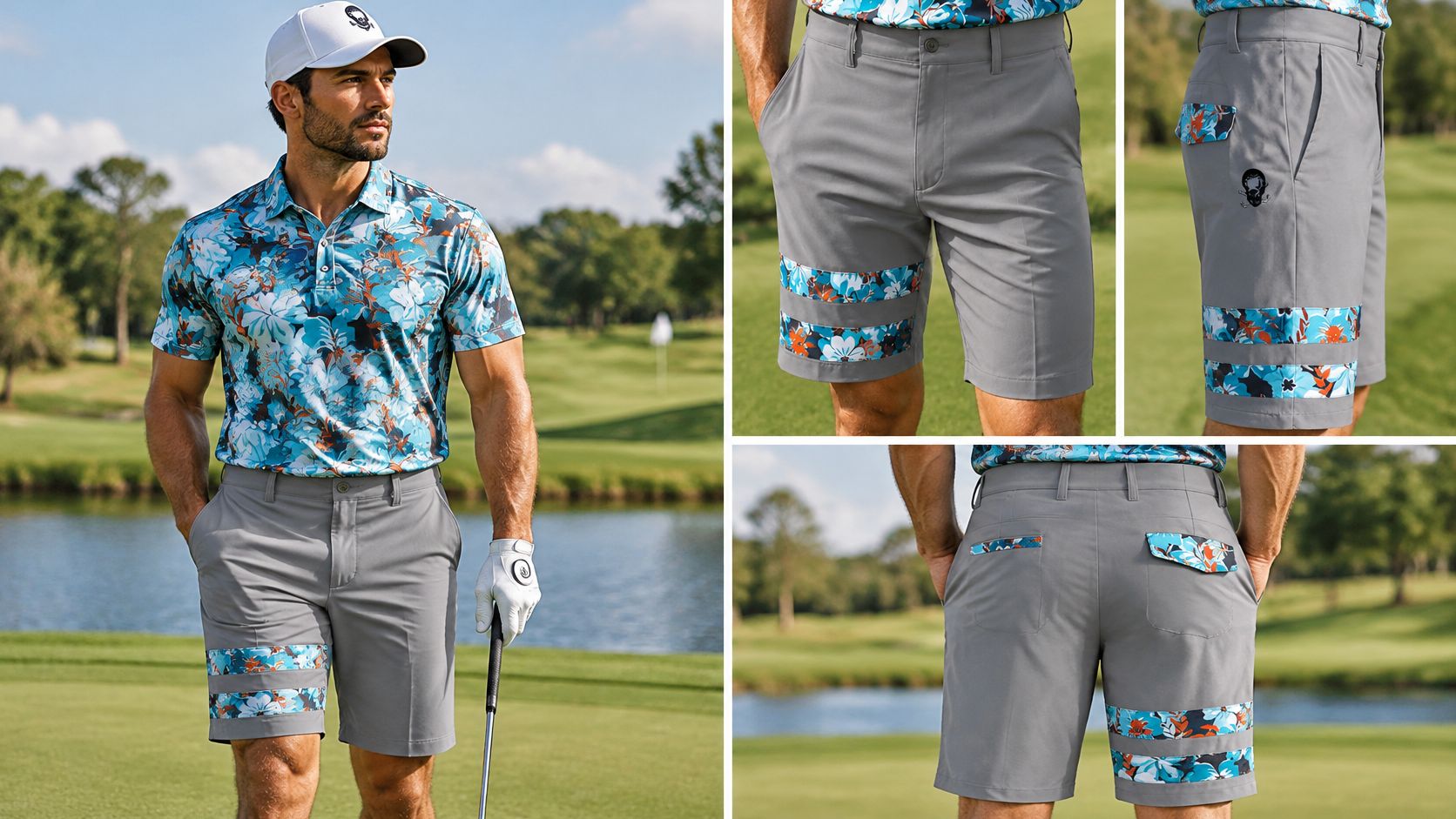
Our Zuma Cool-Stretch Men's Golf Shorts put the signature Zuma print on a grey ground, and the listed performance features are the ones that matter here: 4-way stretch, moisture-wicking and quick-dry construction. No drying rate in mL/h has been published for that specific fabric, so read the table as a fiber-level comparison and judge the garment by how its construction handles airflow and sweat spread. If you want the mechanics in more detail, our breakdown of what moisture-wicking fabric actually does covers the wicking process step by step.
When you ask a seller about a short, ask for air-permeability or drying-time figures and a named moisture-management test method. "Quick-dry" on its own is a marketing phrase. A drying rate, a permeability figure or a test method name is a measurement.
Whether the Shorts Pass a Course Dress Code
A pair of shorts can be perfectly legal under the Rules of Golf and still get you sent back to the car. The game's governing rules don't universally prohibit shorts; appearance standards came from clubs, not from the rulebook. Early players wore the fitted everyday clothing of their era, jackets, ties and trousers included, and as the sport moved into American private clubs, many of those clubs wrote their own appearance rules, with shorts a frequent point of restriction (why golf shorts have always been a dress code flashpoint).
That split is the whole issue. Legality and acceptability are two different tests, and individual clubs may set their own requirements on length, tailoring, cargo pockets, shirt tucking and fabric appearance (what to wear golfing).
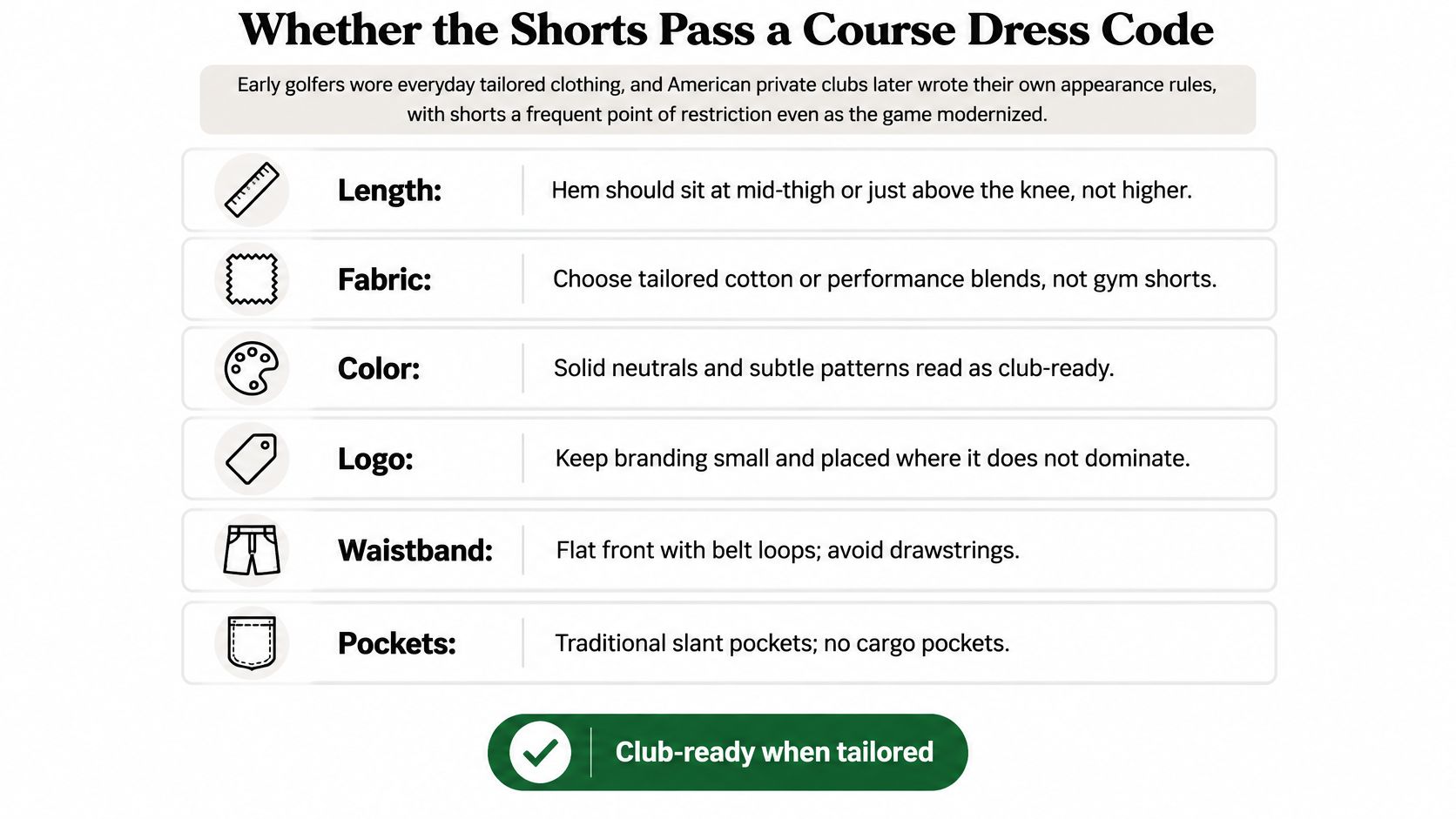
The course acceptance checklist:
- Length near the knee rather than well above it.
- A straight cut, not baggy and not skinny.
- A clean pocket layout with no bulky cargo pockets.
- A belt-compatible waistband with real belt loops.
- A fabric and finish that reads as athletic golf wear, not beachwear.
- A polo tucked in wherever the club expects it.
A bold print is rarely what gets a player pulled aside. The cut, the pockets and the overall read do the work, which is why an expressive short with a clean leg, slash pockets and a belted waistband clears most standards without anyone noticing the pattern. Our golf dress code explained guide goes deeper on the tuck and collar rules.
Where each item matters most: at a public course, length and a clean pocket layout cover nearly everything; at a resort, the fabric read matters more than the print, because resort play skews casual and beachwear is the failure mode; at a private club, tailoring, belt loops and the tucked polo carry the most weight; in event or tournament play, check the entry sheet, since competition organizers often add their own requirement on top of the host club's.
Check the written policy or call the pro shop before you travel to a course you don't know. A two-minute call beats changing in the parking lot.
Choosing a Floral Polo That Carries the Pattern
The polo carries the pattern. Once you accept that, the shorts get easy: they become the calm half of the outfit and the shirt takes all the risk.
Start with fit. Our men's golf shirts run true to standard US athletic sizing with a relaxed polo cut, and golfers who want a closer fit usually size down. A polo that's relaxed through the chest gives you room to turn through the ball; one that's tight across the shoulders will pull at the top of the backswing and stay pulled.
Fabric follows the same logic as the shorts. A performance knit dries based on fiber and construction together, and air permeability matters as much as absorbency, because sweat has to escape as vapor, not just spread across the surface. A cotton polo with a beautiful print will look great in the parking lot and heavy by the ninth hole.
Then print scale, which is where floral shirts succeed or fail:
- A bold floral across the full chest reads loud and needs a quiet short underneath.
- A small repeat or a print placed mainly on the sleeve reads closer to a solid from three feet away.
- A tonal floral, say red on burgundy, gives you pattern without competing for attention.
The three-step polo check:
- Lay it flat. Read where the print repeat falls and where the largest bloom sits. If a big flower lands across your stomach, you'll notice it every time you look down.
- Raise your arms in a mock swing. The hem should stay tucked under a belt, not climb out of the waistband on the follow-through.
- Check the collar and the recovery. The collar should lie flat without curling, and the fabric should return to shape after washing rather than staying stretched.
The tuck matters at clubs that expect it, so the hem has to stay put under a belt for eighteen holes, not five. A floral polo works best when the shorts stay calm underneath it, which is the next decision.
Pairing Shorts With Polos and Floral Prints
Walk the practice green at any busy club and the outfits that work share one feature: a single loud piece. Either the shorts carry the pattern or the polo does, and the other half stays quiet. Stack a busy print over a busy print and the outfit reads as noise, which is a style problem long before it becomes a dress-code problem.
How the pairings break down.
| Short | Polo pairing | Why it works |
|---|---|---|
| Zuma print on grey ground | Black, white, red or navy polo | Grey works with almost every color, so the print carries the outfit on its own |
| Zuma print on white ground | Black, navy, or any print polo with white in it | Light and summer-forward; the white in the print ties top and bottom together |
| Plain or low-contrast short | Floral polo | The pattern sits up top while the short stays calm |
| Busy printed short | Solid black, white or navy polo | Only one pattern competes for attention |
A grey-ground print is the most flexible option, because grey sits comfortably next to black, white, red and navy without any effort on your part. A white-ground print is the summer call: brighter and cleaner, best paired with a navy or black polo so the white in the pattern has something to echo.
Two situations show where the line sits. On a warm resort round, a bright floral polo over a white-ground print short looks intentional, because the setting carries the color and pattern is part of the dress. At a members' club, flip the order. A solid navy or white polo over a grey-ground print short stays inside both the written dress code and the stricter standard the first tee enforces, while the print still does its work at the 19th hole. That distinction matters: a printed short can be technically legal and still draw looks, and the quiet polo is what moves it from barely allowed to plainly right.
A standard 1.5-inch golf belt is the safe pick to finish it. It suits the dress-code end of the scale and keeps the waistband sitting flat under a tucked polo. If the top half is still undecided, this guide to choosing a polo shirt by fit, collar and print scale goes deeper on each check. For a louder option on resort and public rounds, the Tiki Cool-Stretch Men's Golf Shorts - Multicolor runs a bold tropical print at $69.99 in waist sizes 30 through 44, and it pairs cleanly with a solid black, white or pink polo so only one half of the outfit is busy.
Practical rule: the print on the short starts conversations only when the shirt isn't arguing with it.
Confirm Your Waist Size and Pick Your Pair
The right pair clears three bars at once: it fits the swing, it passes the course's standard, and it works with the polo you plan to wear. Run the final checks in this order.
- Size by the tape, not the tag. Match your measured waist to the size chart rather than to the size printed on your jeans.
- Test the leg in motion. If the hem climbed during the walk test from the fit section, a longer inseam or a wider leg opening fixes it.
- Pick the polo before you commit. A relaxed-cut shirt worn in a print the shorts can carry keeps only one half of the outfit busy.
- Repeat the swing test. Waistband snap, a few squats, a few mock swings, then a look at the seams. The fit section has the full sequence.
- Check the seller's posted return policy before the first round. Once the tags come off and the shorts see the course, those terms decide whether they can go back.
Do the last two checks early in the week, not the night before tee time. A size that turns out wrong still has room to be exchanged, and a pair that fails the swing test can go back in the bag before it costs you a round.
Tattoo Golf has been making tattoo-inspired golf apparel from Burbank, California since 1999, so the bold prints and the performance fit come from the same design house. Start with a Cool-Stretch short in a grey or white ground, pair it with a solid polo that lets the print lead, and finish it with a standard 1.5-inch golf belt. Browse the full Tattoo Golf collection against your tape measurement, and walk to the first tee knowing the shorts fit the swing and the shirt fits the shorts.
Share:
Men's Golf Hats: How to Choose by Sun, Heat and Fit