
You've got a 9:04 tee time, the forecast says 88 by noon, and the purple floral polo in your hand looks like the right call. Then you flip the tag and read the usual wall of words: cool-stretch, moisture-wicking, quick-dry, UPF 50+, four-way stretch, odor-fighting. Each one describes a real property. None of them tells you whether the shirt will still feel dry when you're standing over a wedge on the 14th.
That's the gap that catches most buyers. A performance word is a description, not a measurement. The shirt either moves sweat or it doesn't, and the only way to know before you pay is to find the spec behind the word and check whether anything backs it up.
This purple Aloha polo is a useful test case because it carries nearly every performance word at once: a fiber blend, a fabric weight, a stretch direction, a sun rating, and a finish for odor. Read it the way a fitter reads it, one line at a time, and you'll know exactly which questions to ask on the next shirt you buy.
Choosing a Golf Polo Fabric for Your Round
Fabric decides how a polo behaves on the course. The print decides how it looks in the group photo, and nothing more.
Six fabric families cover almost every golf shirt on a rack. The comparison below scores them on what happens between the first tee and the 19th hole rather than on what the hangtag promises. Treat the cells as typical behaviour, not lab results, because two brands can build the same fiber blend very differently.
Golf polo fabrics compared on the criteria that matter on course
| Fabric | Typical makeup | Moisture handling | Stretch | Drying speed | Best for |
|---|---|---|---|---|---|
| Cotton pique | 100% cotton | Absorbs and holds sweat | Low | Slow, can stay damp for hours | Cool days and casual rounds |
| 100% polyester performance knit | 100% polyester | Wicks sweat to the surface | Low to moderate | Fast | Hot, humid rounds |
| Poly-spandex blend | 92% polyester / 8% spandex (Cool-Stretch build) | Wicks sweat to the surface | High, four-way | Fast | Full swings and all-day play |
| Nylon-spandex | Nylon with roughly 10 to 15% spandex | Wicks sweat to the surface | High | Fast | Slim fit and lightweight play |
| Merino blend | Merino wool blended with polyester or nylon, often close to 50/50 | Absorbs moisture vapor and retains warmth | Moderate | Moderate | Cool mornings and shoulder seasons |
| Bamboo-viscose blend | Bamboo viscose blended with cotton or polyester, often around 70/30 | Absorbent and soft | Low to moderate | Moderate | Soft feel in mild climates |
Read the moisture column first. Sweat handling separates a shirt you forget about from one you're peeling off at the turn. Stretch and drying speed come next, and the last column is where most rounds get decided.
The Three-Line Verdict
- Cotton pique for dry, cool days and casual play. It feels great in 65 degrees and low humidity, and it stops working the moment you sweat through it.
- Polyester and poly-spandex for heat and full swings. The synthetic yarn moves moisture off the skin, the spandex lets the torso rotate, and both dry fast enough to matter.
- Merino for cold mornings and shoulder seasons. It holds warmth when damp, which cotton does not, and it resists odor over a long day.
The blend in the middle of that table is where most modern polos land: polyester for the sweat work, a small share of spandex for the swing. A 92/8 poly-spandex build, the same ratio the Cool-Stretch fabric uses in this purple Aloha shirt, sits in the practical sweet spot for warm-weather golf because each fiber does a different job.
Match the Fabric to the Conditions
Weather and club rules decide more rounds than personal taste does. Work down this list until you hit the condition that matches the round you're playing.
| Round condition | What the fabric must do | What to look for |
|---|---|---|
| Hot, humid coastal course | Move sweat and let air through | Polyester knit with mesh panels under the arms or down the back |
| Walking 18 holes | Stay comfortable against skin for four hours | Poly-spandex knit with flat-lock seams |
| Cool, windy morning | Hold warmth without trapping sweat | Merino blend or a denser knit, plus a packable layer |
| Long sun exposure | Physically block ultraviolet light | A stated UPF 50+ rating with test documentation behind it |
| Club with a dress code | Satisfy collar, sleeve and placket rules | Pique or structured-collar knit with a three-button placket |
| Casual social round | Feel soft and look deliberate | Any soft poly-spandex blend in a print you'll wear twice |
Rank the Constraints Before You Shop
Rounds rarely match one row. A walking round on a windy morning at a club with a dress code hits three at once, and the order you solve them in matters.
Start with the constraint you can't change on the day. That's almost always the dress code: collar, sleeve and placket first, because a shirt that fails those rules never gets out of the car.
Then match fabric to heat, and treat wind as a layer problem rather than a fabric problem. A merino blend on a 75-degree afternoon will cook you faster than the breeze cools you. A light poly-spandex with a thin outer layer handles both ends of the day.
Shortlist one or two fabrics for the weather you play in most. If eight of your ten rounds are warm and humid, you're a polyester or poly-spandex buyer and the rest of that table is background reading. If you play through a cold spring, keep one merino piece and stop there.
How Fabric Moves Sweat and Dries
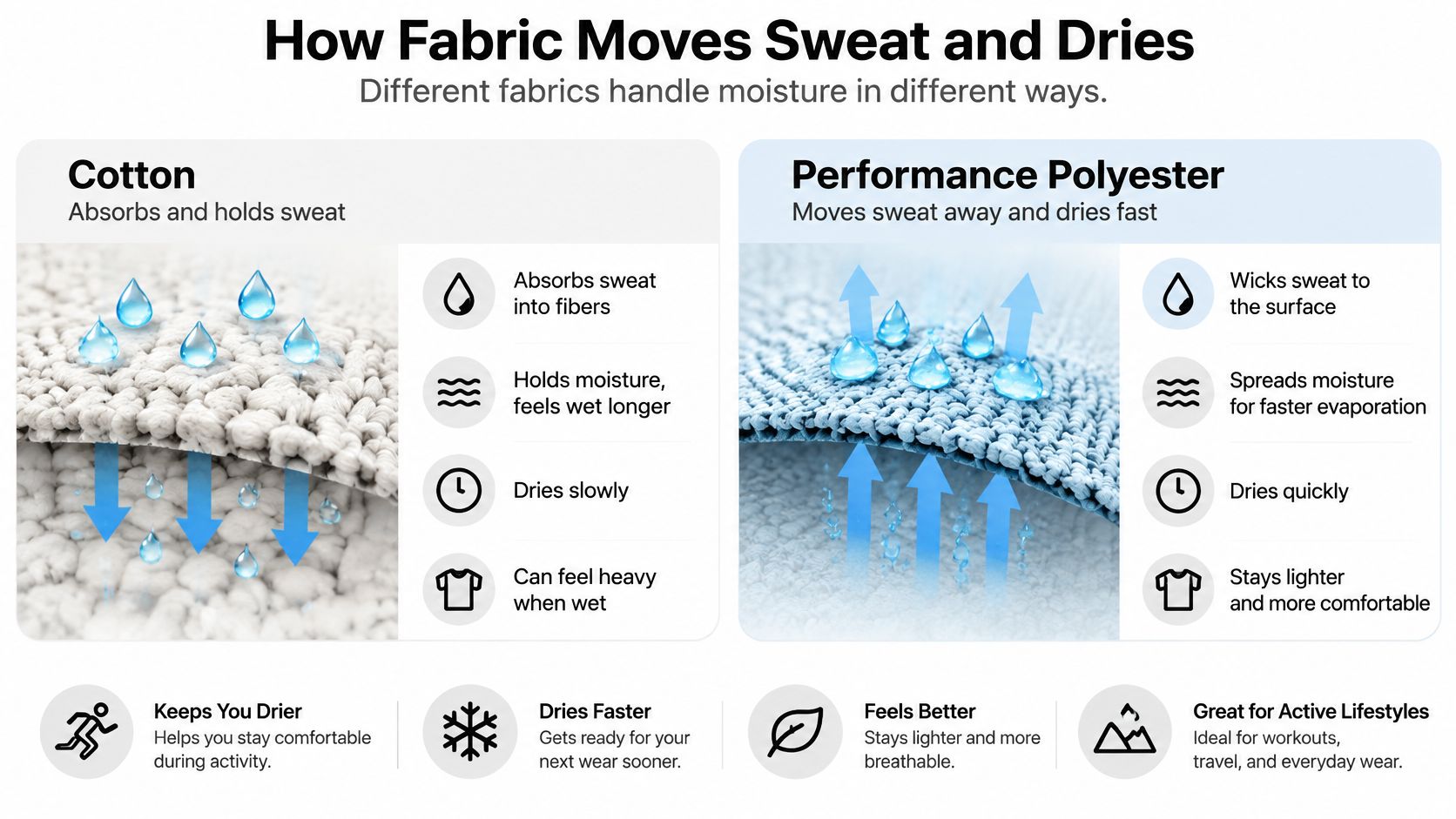
Think of cotton as a sponge and a performance knit as a set of narrow channels. The sponge soaks sweat into the yarn and holds it there until the whole shirt dries, which is why a cotton polo gets heavy and cold. The channels pull moisture outward and spread it thin across the surface, where moving air takes it away.
Here's the same process in the order it happens on your skin.
- Sweat forms on the skin and has nowhere to go until the fabric touches it.
- The yarn draws moisture along the gaps between fibers, moving it away from the body instead of holding it against you.
- The moisture spreads across the outer surface, which is why a good performance shirt feels damp on the outside and dry on the inside.
- Evaporation carries heat away with the water, and the shirt cools as it dries.
That fourth step is the whole point. A wicking shirt isn't a shirt that never gets wet. It's a shirt that gets wet on the outside and dries fast enough that you notice the cooling rather than the damp.
What Four Hours in Humid Heat Looks Like
Say you tee off at 8:30 in July with humidity hanging in the air. By the turn, a cotton shirt is still damp across the back and starting to cling at the belt line. A polyester knit in the same conditions has been wet and dried several times over, and ten minutes sitting in the cart leaves it feeling dry again.
Knit structure decides how much of that happens through airflow alone. Open mesh and pique weaves let air pass between the yarns, while a tight jersey knit traps warm air against your back even when the fiber itself wicks well.
Three things override the fabric. An anti-odor finish controls smell, not sweat, so the shirt can stay fresh while still being wet. In air that's already heavy with moisture, evaporation slows for every fabric, natural or synthetic. And a breeze dries a shirt faster than a still morning does, which is why a cart round often feels stickier than a walking round in the same weather.
The kitchen-table test: put a single drop of water on the fabric and time how long it takes to spread out and disappear. A fast, wide spread means the yarn is doing its job. A bead that sits on top means you're looking at a shirt that will hold sweat against your back.
The mechanics get a fuller treatment in this guide to moisture-wicking golf shirts and what the claims actually mean.
Stretch, Fit and Swing Freedom
Your torso and shoulders rotate hard on the backswing and unwind through impact, and your hips resist most of that turn. A woven cotton shirt fights the movement. A knit with spandex follows it.
Spandex content in performance polos usually runs somewhere between 5 and 10 percent, and the 8 percent in the Cool-Stretch build is a good reference point. More spandex gives stronger recovery, meaning the fabric snaps back to shape instead of staying stretched. It also tends to cut breathability a little and can make the shirt feel snugger after a wash, so more isn't automatically better.
Two-Way Stretch Versus Four-Way Stretch
Two-way stretch moves across the width of the shirt only. Four-way stretch also moves along the length, which is the direction your shoulders pull on the backswing. That difference shows up in the follow-through, where a two-way knit starts to ride up.
Two checks settle it, and neither one needs a launch monitor.
- Pinch the fabric at the shoulder seam and pull it about an inch in both directions, then let go. A decent four-way knit springs back without leaving a stretched mark. If the mark stays, the recovery is weak and the shirt will sag by the back nine.
- Take ten slow practice swings, in the fitting room or at home in front of a mirror. Watch the shoulders and the hem. Fabric that bunches at the waist or pulls tight across the chest is telling you the cut is wrong, not the size.
The size you actually need: an athletic cut has to leave enough room in the chest for your shoulders to rotate without the fabric pulling sideways. A shirt that fits perfectly standing still can still be one size too small in a golf swing.
Heat is the quiet enemy of recovery. Repeated trips through a hot dryer break down the elastic behaviour faster than anything else you do to the shirt, so low heat or a hanger preserves the stretch that made it comfortable. A shirt sized too small loses recovery fastest of all, because every swing stretches it past where it wants to go.
For the mechanics behind four-way construction, see this breakdown of 4-way stretch golf polos.
Reading a Real Label Using the Purple Aloha Shirt
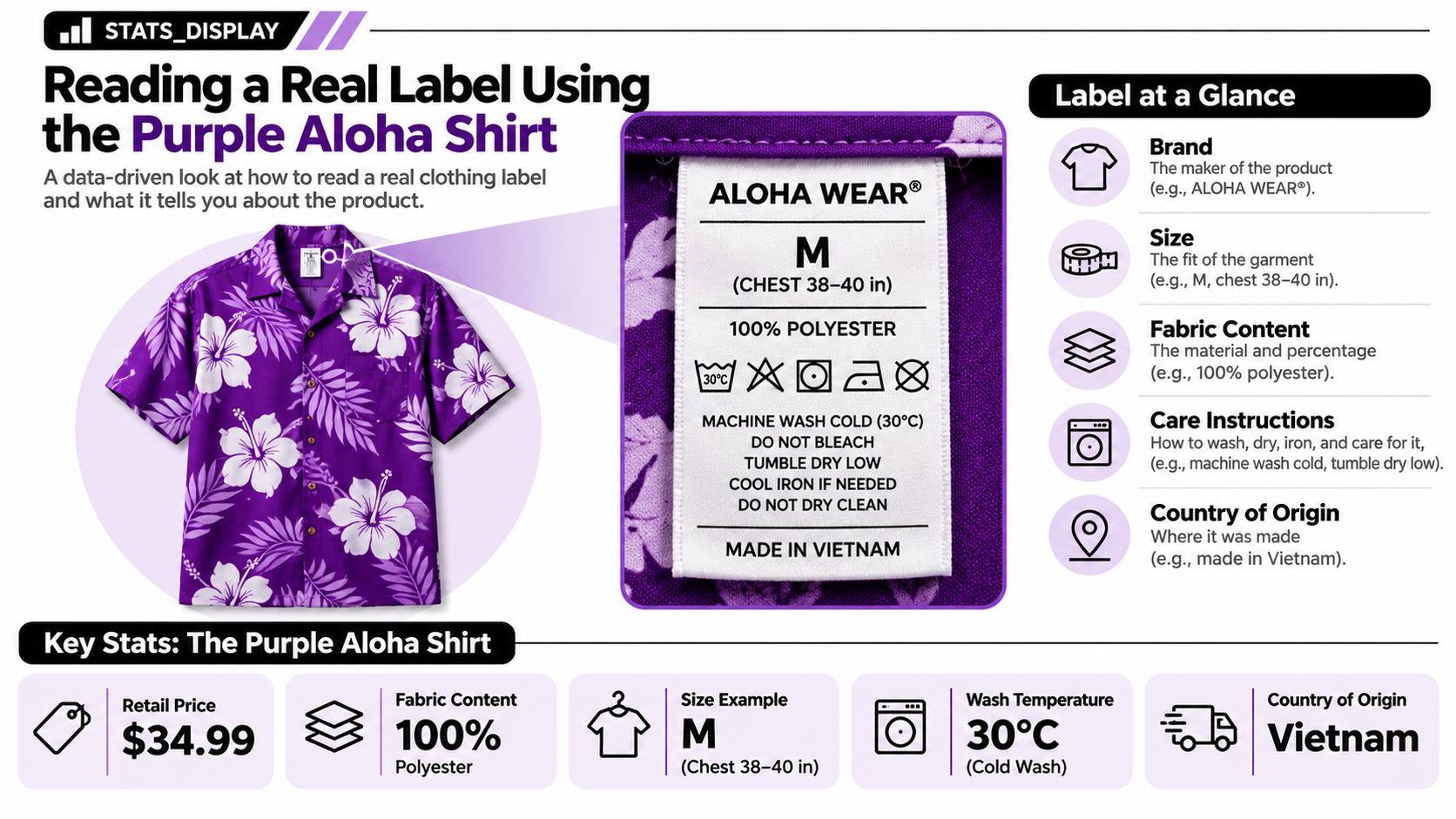
Take a real spec sheet and read it the way you'd read a contract. This one belongs to the Aloha Cool-Stretch Men's Hawaiian Golf Shirt - Purple, a Hawaiian print built on performance fabric, and every line translates into something that happens on the course.
The product listing gives you the fiber blend first: 92% polyester and 8% spandex, with four-way stretch aimed at the rotational movement of a golf swing. Then the weight, an 8-ounce Cool-Stretch fabric, followed by moisture-wicking, quick-dry, wrinkle-resistant and odor-fighting properties. The sun line is a UPF 50+ rating described as blocking 98% of UVA and UVB radiation, and the construction notes run to a three-button placket, structured collar, flat-lock seams and an athletic cut through the chest and shoulders.
Purple Aloha Shirt Spec Sheet as Listed
| Spec | Listed value | What it means on course |
|---|---|---|
| Price | $69.99 | Retail listing; confirm before checkout |
| Fabric makeup | 92% polyester, 8% spandex | The stretch fiber enables four-way movement for rotation |
| Fabric weight | 8 oz Cool-Stretch | Lighter weight usually dries faster; ask for test data |
| Stretch | Four-way | Moves across and lengthwise during the swing |
| Moisture handling | Moisture-wicking, quick-dry | Drying time isn't published; verify it |
| Sun protection | UPF 50+ (blocks 98% UVA and UVB) | Valid only with a test report behind it |
| Wrinkle and odor | Wrinkle-resistant, odor-fighting | The odor finish controls smell, not sweat |
| Construction | Three-button placket, structured collar, flat-lock seams, athletic cut | Collar and placket suit club standards; flat-lock seams reduce chafing |
| Sizes | M, L, XL, 2XL, 3XL, 4XL | Catalog shows M to 4XL; S isn't confirmed |
Two details in that table deserve a second look. First, the spec sheet lists sizing from S through 4XL with chest measurements from 41.5 inches in small to 54 inches in 4XL and body lengths from 28.5 to 34.5 inches, each with a stated ±1-inch variance, while the catalog shows M through 4XL. If you need a small, check the size chart on the page for that specific size before you assume it's stocked. Second, wrinkle-resistant and odor-fighting are maintenance claims, not performance claims. They keep the shirt looking and smelling acceptable; they don't move a single drop of sweat.
The rest of the label holds up to plain reading. Flat-lock seams sit flat against the skin at the shoulders and sides, which is the seam type you want on a walking round. A structured collar and a three-button placket are what most club dress codes ask for. And the hybrid positioning is honest: the print carries the recreational look, while the stretch, drying and sun figures address a long day outdoors.
Testing Performance Claims Before You Buy
Here's the assumption worth challenging: that performance language on a hangtag is evidence of sun safety. It isn't. "Cool-stretch," "breathable" and "moisture-wicking" are performance descriptions, not standardized benchmarks, unless a test method such as an ASTM or AATCC procedure sits behind them.
The Aloha collection catalog page makes the gap visible. It lists the shirt and its sizes, but the catalog evidence doesn't publish measurable fabric composition, fabric weight, stretch percentage, drying time, or an independently verified moisture-vapor transmission rate. Those missing measurements are exactly the numbers a tournament player would want before treating a marketing line as a technical spec.
A UPF rating is a different animal, and it's worth understanding what it measures. The number compares how long skin under the fabric takes to burn against bare skin, so a higher number means less ultraviolet radiation gets through. A UPF 50+ rating is the top band on the standard scale, which is why it appears on so many outdoor garments. The important part is that the rating only exists when a lab test produces it. Without the report, a shirt has no rating, just a word.
Why Sweat Management and Sun Protection Are Separate Questions
A shirt can move sweat beautifully and carry no tested UV claim at all. It can also be a saturated colour that looks protective in the mirror and blocks nothing you can measure. The purple golf shirts shop page doesn't state an ultraviolet-protection rating, fabric weight, fiber composition, drying time, or performance after repeated washing, and that gap matters when you're outdoors for four hours or more.
Three practical variables get lost in the marketing:
- Print opacity under stretch. A large graphic can thin out over the shoulders when the fabric pulls. Hold the shirt up to a window and stretch it to see whether light passes through the printed area.
- Ventilation. Mesh panels and open knits move air. A tightly woven face fabric with a big print may not.
- Covered versus exposed skin. No fabric protects what it doesn't cover, so the collar height and sleeve length on your shirt decide how much sunscreen the back of your neck needs.
The Verification Checklist
Run these in order before you commit to a shirt for a tournament or a hot-weather trip.
- Ask for the fiber blend and the care label. Those two documents tell you more than the marketing copy ever will.
- Request the UPF test documentation for the specific colourway and print you're buying. A rating on one fabric doesn't automatically transfer to another.
- Ask which ASTM or AATCC methods support the wicking and drying claims. If nobody can name one, treat the claim as a description.
- Confirm drying time and wash durability. A shirt that wicks on day one and stops after ten washes isn't a performance purchase.
- Check the live size selector before checkout, because apparel inventory moves independently of the listed price.
The honest position: treat a listed sun rating as a starting claim, not proof, until the paperwork confirms it. That's not cynicism, it's how you buy technical gear.
This matters most for players in high-UV markets, older golfers, and anyone entering tournaments who spends long hours outside and prioritizes protection over appearance. Ask the question once and you'll know what you own.
Care and Wash Durability
Performance fabric doesn't stay performance fabric by accident. Stretch recovery weakens with repeated heat, so a hot tumble dry is the main risk to a four-way stretch knit. Fabric softener coats fibers and can reduce wicking. Odor finishes fade over many washes, and the print itself can lose contrast.
Tattoo Golf lists Cool-Stretch as built to hold its shape after 50+ washes, which is the standard your routine should protect. What isn't published is wash-test data for this specific purple print, so if colour retention matters to you, ask the seller for it before the first wash.
Run this routine from day one, and keep the care guidance for Tattoo Golf clothing handy for the pieces in your rotation.
- Wash inside out in cool or warm water on a gentle cycle. Turning it inside out protects the print from abrasion against zippers and other garments.
- Skip fabric softener and bleach. Both work against the fabric, one by coating the fibers and the other by breaking down the dye.
- Air dry flat or on a hanger, away from direct heat. If you must machine dry, use the lowest heat setting.
- Rotate two or three shirts so each one rests between rounds. A shirt worn three times a week never fully recovers its shape.
- Keep the care label with the shirt after the first wash, since it's the document you'll need for any warranty question.
A shirt that's too small works harder at every seam and loses recovery faster than one with room in the chest, so the fit checks you ran in the fitting room are also a durability decision.
Tattoo Golf has been putting prints on performance fabric since 1999, and the men's Cool-Stretch line runs from S to 4XL with the same 8 oz blend, four-way stretch and UPF 50+ spec across the range. If you're building a hot-weather kit, start with a shirt that lists its fiber blend and weight, then ask for the test documentation behind the sun rating and check your chest measurement against the size chart for that exact style. Browse the Aloha prints and the rest of the course-ready range at Tattoo Golf.


Share:
Premium Bucket Golf Hat W/ Skull (White): Fit Guide 2026