
Yes, at most courses you can wear a Hawaiian shirt if it has a collar, performance fabric, and is tucked in, but you still need to check the venue's dress code first. If you show up at the wrong club in a loose vacation shirt, you'll be the guy changing in the parking lot.
You've probably been there already, standing by the trunk with your shoes on, looking at a bold print and trying to guess whether the starter will shrug or stop you cold. The right answer is simple, the shirt itself isn't the issue, the course's rules are.
The Short Answer From the Parking Lot
If you want the blunt version, here it is, yes, a Hawaiian shirt can work for golf when it looks like golf clothing and the venue allows it. The safest formula is a collared, performance-fabric shirt that sits cleanly when tucked, because that matches what most courses treat as acceptable golf attire and avoids the resort-shirt look that gets rejected fast.
The problem starts when the shirt reads like beachwear. Traditional clubs often expect golf shirts with collars and may treat Hawaiian style shirts as inappropriate, which is why the same print can be welcome at one course and refused at another. The actual ruling belongs to the club, not the pattern.
The two places that usually say no
Strict private clubs are the first red flag. Their standards lean traditional, and they care about the shirt's structure as much as the print.
Tournament golf is the second. If the event is tied to formal guidelines or a stricter host venue, don't assume a loud aloha shirt will pass just because it's neat. Bring a polo if you're unsure, because the starter doesn't need a style argument.
A useful field rule is this, if the shirt has a true collar, enough length to tuck, and fabric that behaves like sportswear, you're in much better shape. If it hangs like vacation wear, leave it in the car.
For a practical reference on how golf apparel is usually interpreted, see the dress-code breakdown at Tattoo Golf's golf dress code guide. If you're planning to stand over the ball in sun and heat.
Practical rule: if you'd be comfortable wearing it into the clubhouse after your round, you're much closer to course-legal than if it only works at the pool.
What Golf Dress Codes Actually Require
Golf dress codes are stricter than casual wear, but they're not mysterious. They usually revolve around the same four ideas, collar, sleeves, tuck, and fabric. If your Hawaiian shirt misses two of those, it stops looking like golf apparel and starts looking like a theme night.
The four things that decide the call
A structured collar is the easiest pass. A self-fabric collar or polo-style collar says golf, while a soft camp collar without shape often reads as resort wear and gets blocked at more conservative clubs.
Sleeves matter too. Municipal and relaxed resort venues may be fine with short sleeves and looser styling, but private clubs tend to care more about a clean, conventional profile. A shirt with proper sleeve length looks intentional, while a boxy cut can feel sloppy even when the print is good.
The tuck is where a lot of golfers get lazy. A shirt designed with enough length and a finished hem tucks cleanly, which keeps the outfit in the golf lane. A flowy camp shirt with a straight, loose hem usually looks wrong once it's tucked, and it often looks worse left out.
The last piece is fabric. Traditional golf clothing is built to handle heat, movement, and long hours outdoors, so a shirt that behaves like a t-shirt or souvenir top usually fails the smell test. The course doesn't care that the print is cool if the shirt collapses, clings, or wrinkles the second you sweat.
The shirt isn't judged only by color, it's judged by shape, finish, and whether it can survive a full swing without looking like it was borrowed from a beach bar.
| Dress Code Foundation | What Passes | What Gets Rejected |
|---|---|---|
| Collar | Structured polo-style or self-fabric collar | Camp collar with no shape |
| Hem and tuck | Finished hem that tucks cleanly | Loose resort hem that bunches |
| Shoulders and sleeves | Neat short sleeves that sit well in motion | Oversized or sloppy drape |
| Fabric | Breathable knit or woven sports fabric | Heavy, clingy, or tee-like material |
If you want the quick test, look at the shirt and ask whether it could pass as golf gear before anyone notices the print. If the answer is yes, you're close. If it screams vacation, it's a risk.
Why Some Courses Ban Hawaiian Shirts and Others Welcome Them
Course identity drives the decision more than the shirt does. Traditional private clubs protect a certain look, and that look usually starts with a solid or subtly patterned collared polo. Relaxed venues, especially resort and island markets, are far more open to aloha prints when the rest of the outfit stays sharp.
The contrast is obvious in actual policy language. The PGA of Canada's dress code calls for golf shirts with collars, while some clubs list Hawaiian style shirts among improper examples, which tells you exactly where the line sits at conservative venues. Oahu Country Club, by contrast, explicitly allows golf shirts, aloha shirts, dress shirts or sports shirts, and that's the kind of language that gives bold prints room to breathe.
Where the shirt usually lands
Private clubs and tournament settings still treat tradition as the default. If the venue's culture is built around “traditional golf attire,” your shirt has to look like it belongs there, not like it came from a luau.
Public courses are looser, but even there the starter can still send you back if the shirt reads too casual. The broad trend is simple, the more formal the venue, the more it wants restraint. The more relaxed the venue, the more personality gets through.
Here's the practical map.
| Venue Type | Typical Policy Language | Hawaiian Shirt Status |
|---|---|---|
| Strict private club | Traditional golf attire, collared shirts, no beachwear | Usually refused unless it looks like a polo |
| Resort course | Golf shirts, relaxed smart casual, aloha shirts accepted | Often accepted |
| Municipal course | Collared shirt preferred, flexible casual standards | Usually accepted if neat |
| Tournament venue | Host policy controls, stricter event rules possible | Depends on the event |
| Island or tropical club | Aloha shirts or flexible resort dress may be allowed | Often embraced |
The culture shift is real, but it doesn't erase the venue rulebook. Fashion coverage around golf has moved toward personality-driven looks, and the retail side is splitting between bold print and cleaner styles. Even so, the course decides whether your print feels current or out of place.
Use the shirt where the venue wants personality. Avoid it where the club wants uniformity. That's the whole game.
Resort Shirt vs Performance Polo Cut
Not every Hawaiian shirt is built the same, and that's why some work on course while others don't. The boxy camp-collar resort shirt and the trim performance polo cut can look related at first glance, but they behave very differently once you make a backswing.
Shape tells the truth
A resort shirt usually has a flat camp collar, a wider body, and a looser hem. That cut hangs nicely off the shoulders at brunch, but it can flap around the trail arm when you rotate hard through impact. It also looks less polished when tucked because the fabric wants to billow.
A performance polo cut is tighter through the chest and shoulders, with a collar that stays in place and a hem built to tuck. It reads as golf apparel first, print second. That matters on private or tournament-adjacent courses where appearance gets judged quickly.
Fabric changes the feel
Rayon and cotton lawn feel soft and airy, but they can sag, wrinkle, and hold moisture in ways that make a long round uncomfortable. Polyester-spandex blends feel more athletic, recover better after movement, and stay cleaner-looking when you're walking, sweating, and loading clubs in and out of the cart.
Bottom line: if the shirt is cut like vacation wear, it's a style choice. If it's cut like a performance polo, it's golf clothing with a print.
| Feature | Resort Camp Shirt | Performance Polo Cut |
|---|---|---|
| Collar | Flat camp collar | Structured polo-style collar |
| Fit | Boxy and relaxed | Trim and athletic |
| Hem | Loose, often untidy when tucked | Designed to tuck cleanly |
| Swing feel | Can ride and flap | Stays closer to the body |
| Best pairing | Casual shorts | Tailored shorts or trousers |
The smartest pairing is simple. Camp shirts go best with the most casual settings, while the performance cut handles stricter courses without drama. If you want one shirt to do real golf duty, pick the cut that behaves like sportswear.
The Performance Tech That Makes a Hawaiian Shirt Work on Course
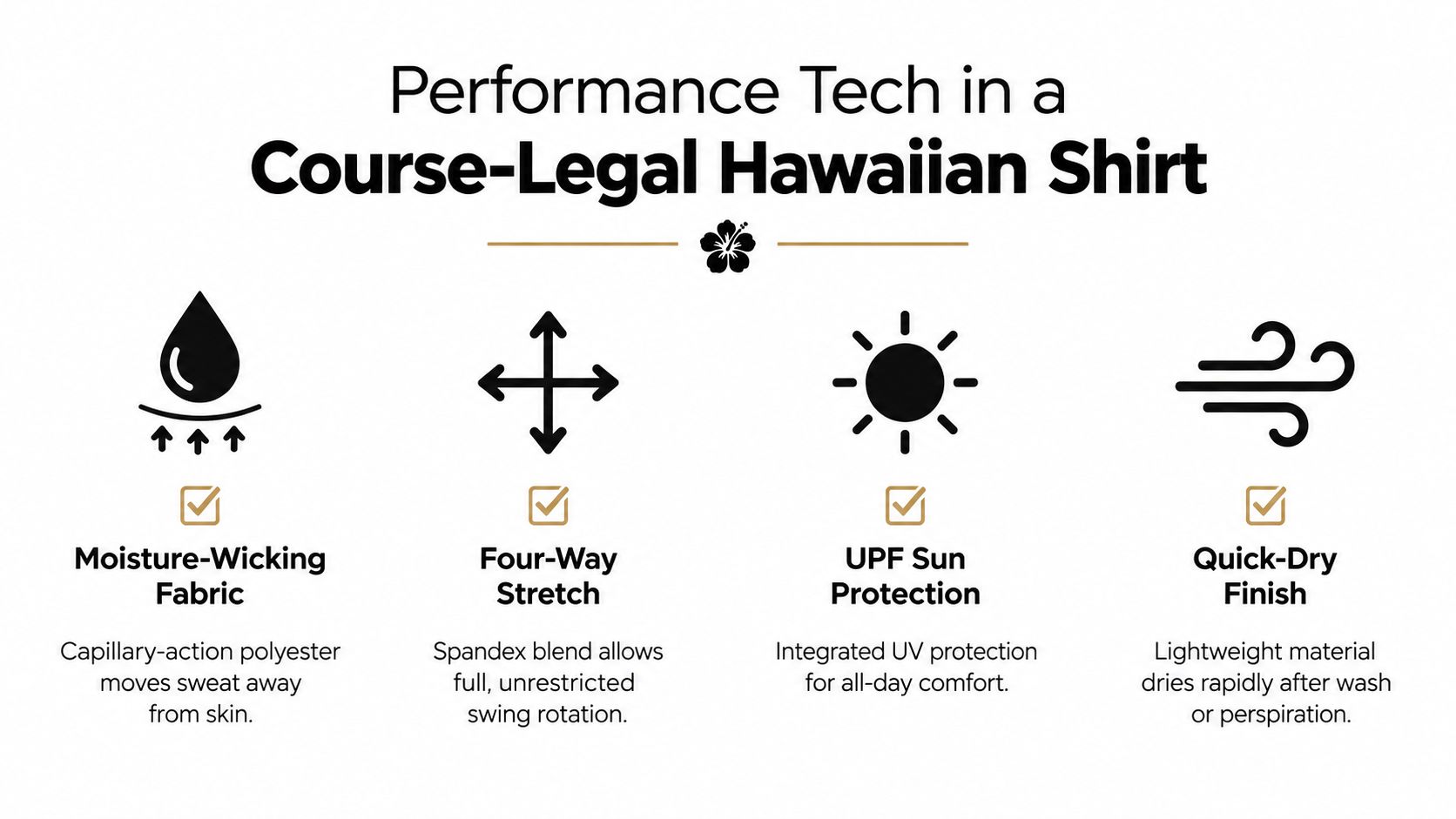
The print is only half the story. If you want a Hawaiian shirt to survive 18 holes, the fabric has to manage sweat, movement, and sun without turning into a swamp.
What the fabric needs to do
Moisture-wicking polyester pulls sweat away from the skin so it can evaporate faster, which matters on hot days when the shirt sits against your back for four straight hours. That's the difference between feeling dry through the turn and feeling like your shirt has become part of your skin.
Four-way stretch is also essential. When the fabric includes spandex or elastane, it can move with shoulder rotation and hip turn instead of fighting you during the driver swing. If the shirt binds across the chest at address, it's the wrong shirt.
Quick-dry treatment helps the shirt recover after sweat or washing. A golf shirt that dries fast feels lighter during the round and is easier to wear again the next day, which is why performance prints beat souvenir cotton almost every time.
Then there's weight. Lighter fabrics feel better in the heat, while slightly heavier fabrics can drape better in cooler weather. If the shirt is too heavy, it traps moisture and starts to feel like a heat source instead of a layer.
Choose the shirt that disappears in the swing. If you notice it every time you move, it's not doing its job.
| Tech Feature | Why It Matters |
|---|---|
| Moisture-wicking | Moves sweat off the skin so the shirt feels drier |
| Four-way stretch | Allows full shoulder and hip rotation |
| Quick-dry finish | Reduces cling after sweat or washing |
| Sun protection | Helps the shirt work as part of your heat-management plan |
For a deeper look at fabric behavior, this moisture-wicking golf shirts buying guide covers why synthetic blends outperform heavy cotton on course. If you're shopping for a playable print, look for the shirt that acts like gear, not souvenirs.
How to Style a Hawaiian Shirt So It Looks Intentional in 2026
A Hawaiian shirt works on course only when the rest of the outfit stays disciplined. If the print carries the personality, everything around it should stay quiet. That means clean bottoms, simple shoes, and no extra visual noise.
Anchor the outfit with neutral pieces
Start with khaki, stone, charcoal, or white bottoms. Those shades frame the print and keep the shirt from drifting into costume territory. Flat-front shorts or well-fitted trousers look sharper than loose gym-style cuts because they give the outfit shape.
Pick one color from the print and repeat it once in a belt, cap, or shoe detail. That small echo makes the shirt look chosen, not random. It is the fastest way to make a floral top feel intentional.
Keep the shirt fully tucked. Half-tucking a Hawaiian print reads sloppy on the course and even worse in the clubhouse. If it cannot sit cleanly tucked in, it does not belong in a golf outfit.
Pick the right print level
Muted florals, tonal prints, and smaller tropical motifs work far better in 2026 than neon novelty graphics. Current golf style is cleaner, so the loudest versions belong after the round.
If the weather turns cool, layer a solid quarter-zip or vest over the shirt. That keeps the print under control and preserves the look instead of fighting it.
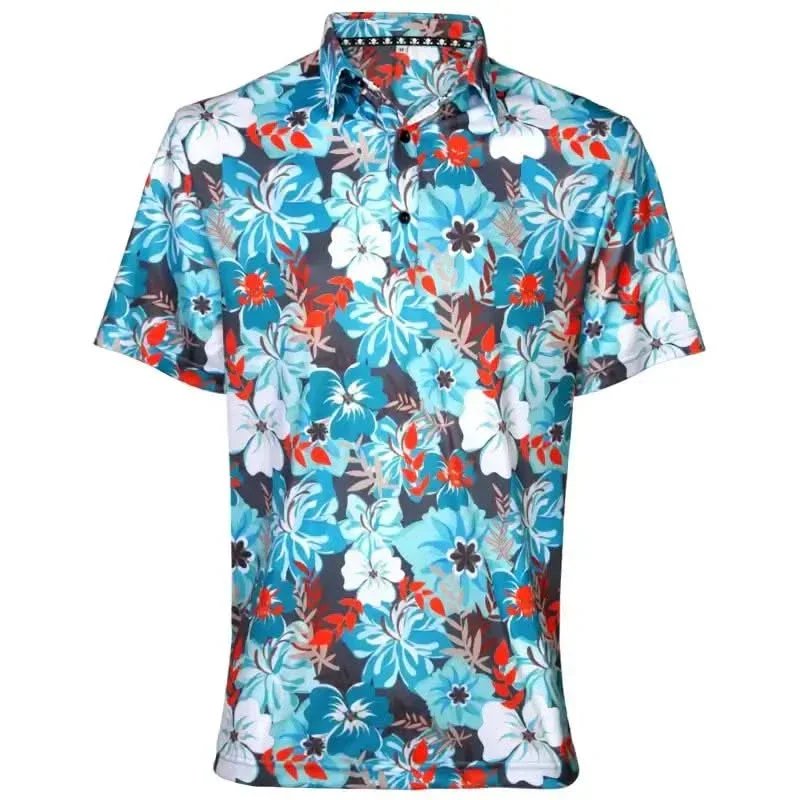
I would wear a sharp performance aloha shirt from a golf apparel brand, including the Tattoo Golf Aloha-style collection, before I would wear a souvenir shirt that looks better by the pool.
Buying and Caring for a Hawaiian Golf Shirt
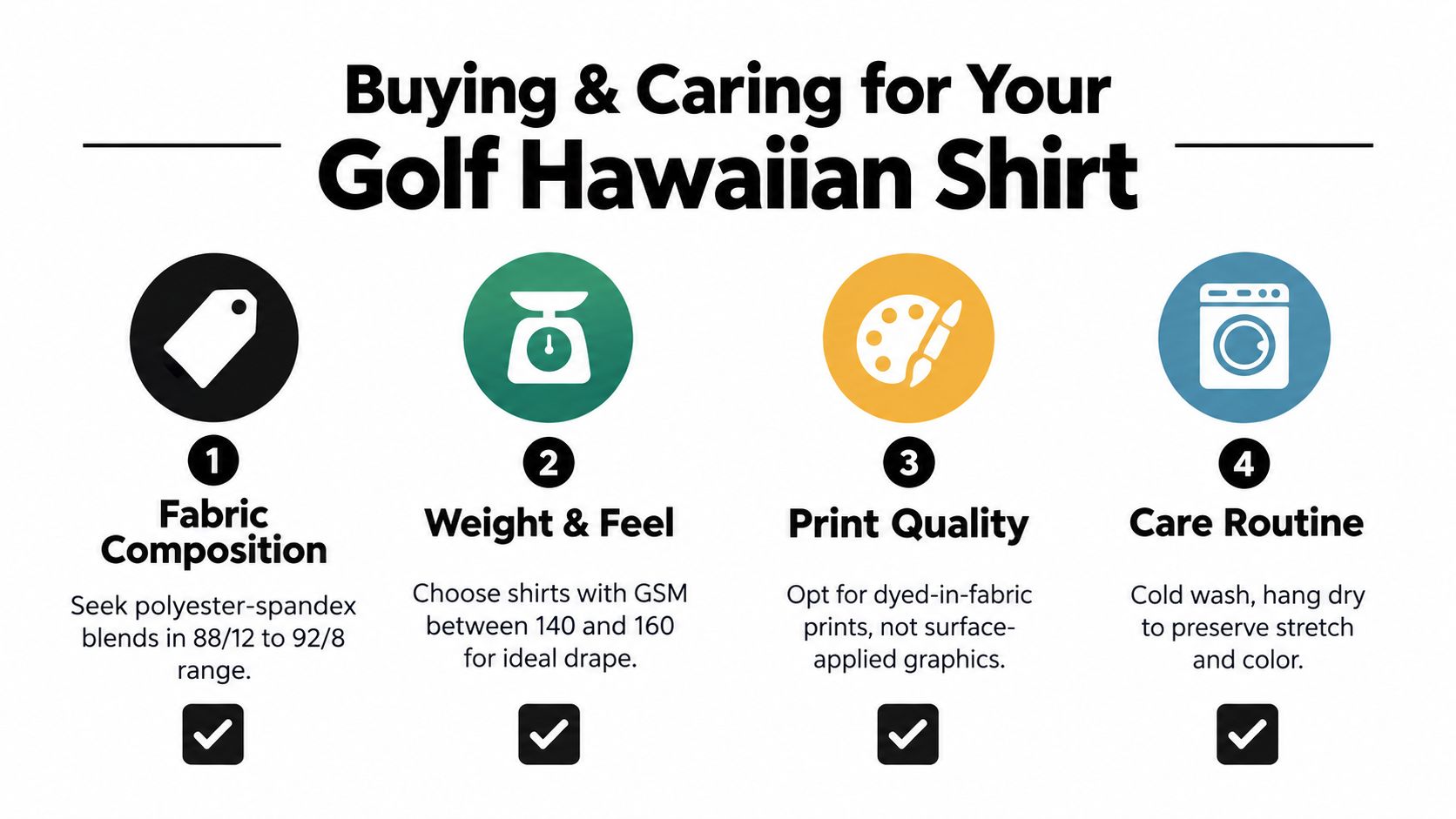
Buy the shirt like you plan to wear it repeatedly, not like you want one fun photo. The difference between a one-round novelty and a real golf shirt is usually in the fabric, the collar, and the recovery after washing.
What to check before you pay
Look for polyester-spandex construction, because that blend usually gives you the stretch and recovery you need. Make sure the collar stands up on its own and doesn't collapse into a soft lounge-shirt shape after one wash.
Check the hem length. A golf shirt should tuck cleanly without ballooning at the waist, and the shoulder seam should sit where your shoulder ends, not halfway down the bicep. If the fabric feels tired when you pinch and release it, skip it.
The print quality matters too. A shirt that looks rich in the fabric usually wears better than one with a graphic sitting on top of the material.
Care keeps the shirt course-ready
Wash it cold, inside out, with similar synthetics. Skip fabric softener because it can dull the performance feel and interfere with how the material moves sweat.
Hang dry when you can, or tumble low if the label allows it. Most performance prints don't need an iron, and high heat can flatten the shirt's structure fast.
For shopping ideas, the best Hawaiian golf shirts guide is a useful way to compare cuts before you commit. If you want one shirt to keep its shape round after round, treat it like the rest of your golf gear.
Owning the Look Without Apology
Confidence is the difference between a bold golf shirt and a costume. A Hawaiian shirt on the course says you're comfortable enough with your game to let your clothes have some personality.
The formula is simple. Tuck it in, wear fitted shorts or trousers, add a clean belt, and keep the rest of the outfit controlled. A neat cap or visor helps too, because the shirt should be the statement, not the whole act.
Half-measures are what make the look embarrassing. An untucked hem, wrinkled collar, old sandals at the cart path, or a shirt that fits like it was borrowed from a beach rental shop will get you mocked. The print isn't the problem, the execution is.
Final call
Wear the Hawaiian shirt when the course allows it and the shirt itself looks like golf apparel. Leave it behind when the venue is strict, when the collar collapses, or when the print reads more vacation than fairway. If the fit is right and the fabric performs, you're not making a statement for attention, you're dressing like someone who knows exactly what he's doing.
Tattoo Golf builds performance golf apparel for players who want personality without giving up function, which makes it a natural fit for bold prints that still need to pass on course. If you want shirts, shorts, and accessories that bring attitude to the first tee and still hold up through 18 holes, visit Tattoo Golf and build the look around gear that plays as hard as you do.

Share:
Golf Gloves Explained: Materials, Fit and Performance
Women's Performance Polo: Fabric, Fit, and How to Choose