

The usual advice about loud golf polos is to wear them with confidence. Confidence won't fix a collar that collapses or a hem that pulls out when you swing. Start with the venue: a properly constructed polo, tucked where required, is a better bet than a quiet-colored shirt with the wrong cut.
Then judge the shirt as golf equipment. The print should look deliberate, but the fabric still needs to release heat, recover after rotation, and survive the wash without leaving you with a twisted souvenir.
What Makes a Golf Polo Loud
A loud golf polo is a collared golf shirt designed to be noticed through high color contrast, a large-scale print, or a recognizable signature motif. It retains the golf-polo silhouette: a structured collar, short sleeves, and a traditional placket.
Say you're choosing between a navy club shirt and a red polo covered in oversized palms. The navy shirt is like a street-name sign you read up close; the palm print is readable from the tee. Both belong on the same road when their collars, hems, and overall construction still look like golf clothing.
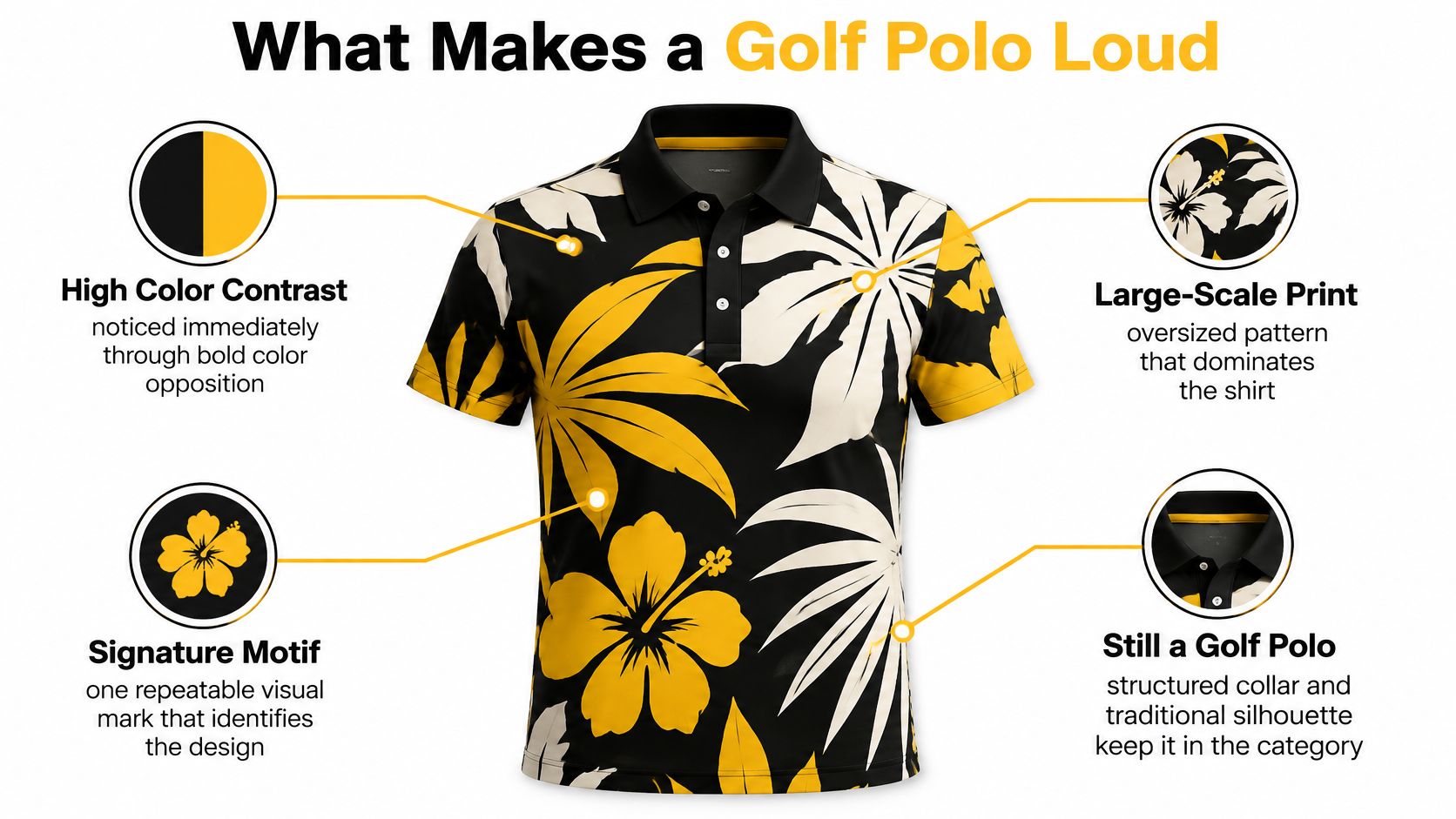
Color isn't the whole story
A bright solid can be less visually demanding than a subdued shirt covered in huge skulls. Contrast determines how sharply the design separates from its background; scale determines how much of the garment each motif occupies. Density matters too: closely packed shapes can read almost like a texture, while isolated oversized graphics look more like signage.
Use these distinctions when looking at product photography:
- High contrast: Light shapes against a dark ground remain conspicuous at a distance.
- Large scale: A motif that spans much of the chest becomes the outfit's focal point.
- Signature motif: Repeated skulls, palms, or animals give the shirt a recognizable theme without requiring every color in the palette.
Bold golf clothing has a history
ESPN's history of golf clothing traces the progression from cooler, collared René Lacoste-style polos in the 1930s to widespread course use in the 1950s, followed by brighter colors and polyester and nylon in the 1960s and 1970s, when Doug Sanders's coordinated colorful shirts and socks helped establish his “Peacock of the Fairways” identity. Alongside bright sweaters, argyle, and plaid, the 1970s “color explosion” established much of the visual vocabulary modern performance prints still use.
Today's loud shirt isn't necessarily a rejection of golf clothing. Often, it's an expressive version of a familiar garment. Whether that expression suits your booking is a venue question, not a confidence test.
Which Courses Accept a Loud Polo
Check the collar, hem length, tuck, and motif scale before brightness. Course rules vary, and the same shirt can suit a resort round but feel out of place at a private-club event.
Loud polo risk by venue
Use this table as a conservative guide. The venue and host set the final standard.
| Venue | Must-have details | Print risk | Safer choice |
|---|---|---|---|
| Private club | Structured collar, traditional button placket, hem that stays tucked, room under a sweater | High if the motif is billboard-scale or densely contrasted | Strong color with a modest motif |
| Public course | Real collar and golf-length hem, not a fashion tee; clean tuck where required | Medium, especially with oversized logos | Print that tucks cleanly and works under a plain quarter-zip |
| Resort course | Collar, secure hem, vacation-appropriate color, layer-ready fit | Low to medium; dense tropical prints can suit the setting | Tropical or high-contrast allover print with quiet bottoms |
| Golf-entertainment venue | Real collar for a polo outfit, comfortable cut, practical hem | Low, though offensive graphics remain a poor choice | Full statement graphic; a layer is mainly for comfort |
| Tournament | Event-compliant collar and tuck, neat fit for photographs and presentations | High for novelty chest graphics or dominant sponsor-style logos | Lower-contrast pattern under plain outerwear |
| Corporate outing | Host-approved collar, tidy hem, restrained branding, businesslike layer | High when clients or senior hosts expect conventional dress | Strong color with a modest motif unless the invitation welcomes themed outfits |
At private clubs, a neat placket helps the shirt look finished, but button count is not a universal entry requirement. A manufacturer's club-compliant label cannot override the club's own policy.
For public and resort bookings, consider the course separately from the rest of the property. A print may suit the pool bar while still needing a tucked hem on the first tee. Tournament organizers and corporate hosts may also set expectations beyond the course's everyday rules.
The guide to whether bold golf shirts are allowed at country clubs offers useful context for judging the venue. Let the table guide your choice: a clean collar and tucked hem reduce dress-code risk, while oversized, high-contrast graphics are harder to place in formal settings.
Fabric Features That Matter More Than the Print
Before judging a bold polo by its print, check whether the venue allows it and whether the collar can stay tucked for play. Then assess the fabric: a striking pattern earns its place only if the shirt breathes, moves, and holds up to washing.
A product photo can show a sublimated monkey, skull, or palm, but fabric performance depends on knit construction and finish. The Sports Medicine - Open article on polyester sportswear describes how larger knit openings and more open warp-knit structures can reduce skin temperature and humidity while improving thermal comfort. Look for construction details, not just a polyester label.
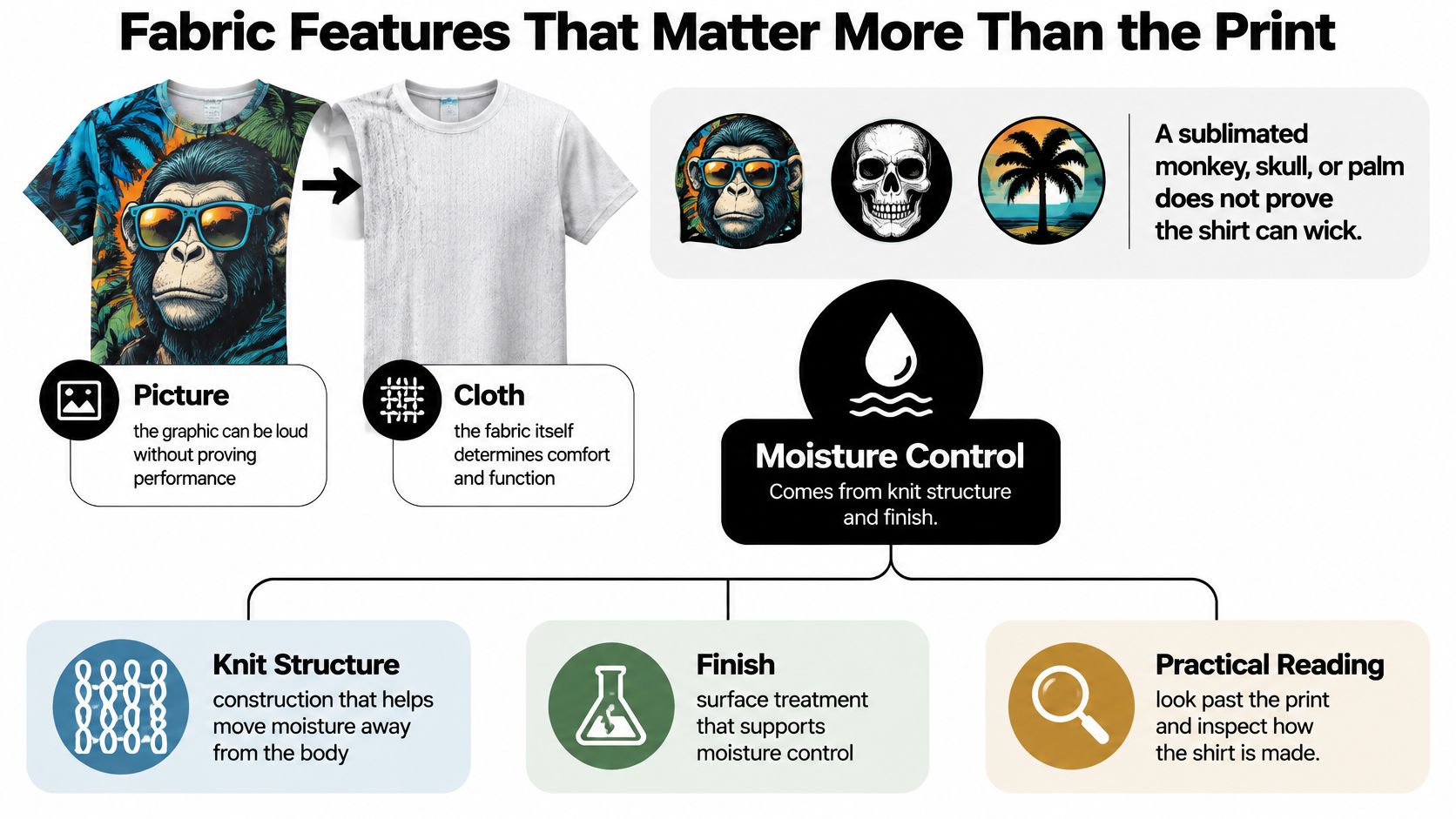
Performance specs to check on a loud polo
| Spec | What it does | Shopper cue |
|---|---|---|
| Open breathable knit | Helps heat and humidity escape | Look for a description of knit construction and avoid dense coated chest panels |
| One-way moisture transfer | Moves sweat from the skin-facing surface toward the outside | Look for directional wicking details, not just polyester content |
| Drying rate | Helps the shirt shed retained moisture | Compare drying information alongside fabric construction and weight |
| Multidirectional stretch and recovery | Allows rotation while helping the garment return to shape | Check whether the listing describes stretch direction and recovery |
| Rated sun protection | Indicates tested protection through the fabric | Look for an explicit UPF rating rather than relying on color |
| Colorfastness and anti-odor treatment | Addresses separate concerns about print fading and odor | Check care guidance and any named treatment; avoid assuming freshness lasts indefinitely |
Quick-dry wording alone does not explain whether moisture moves away from the skin. Anti-odor treatment and colorfastness are separate specifications, too. If a listing makes broad performance promises without describing the fabric, look for those details before buying.
Read weight and construction together
The Party Animal Cool-Stretch Men's Golf Polo – Monkey is one example of a bold allover print. Check its product listing for fabric weight, fiber content, stretch, drying details, and any UPF rating, then compare those claims with the construction features that matter for your conditions.
Weight needs context. Check the measurement basis before comparing ounce figures across brands. A more substantial knit may drape cleanly and support a collar; a lighter, more open knit may feel better in heat but can reveal an undershirt or cling when damp.
Stretch should give during a swing and recover afterward. Dense coatings or heavy applied graphics can also limit vapor transfer across the chest and back, even if the underlying fabric is designed to wick. Inspect close-up product images, then use this moisture-wicking golf shirt buying guide to assess the material and performance claims.
How Loud Polos Should Fit
A bold print makes fit mistakes easier to spot. A stretched motif reveals chest tension; a diagonal repeat exposes a twisted side seam. The target is a classic athletic silhouette: shaped through the shoulders and chest, with enough ease to rotate and enough length to remain tucked.
Start with a polo you already play comfortably in, a flexible tape measure, and the retailer's garment chart. Measure the shirt flat without stretching it, and check whether the chart gives body measurements or finished-garment measurements. Confusing those systems is an easy way to order a shirt that's too tight.
Fit checks before ordering a loud polo
| Check | Problem a print exposes | What to do |
|---|---|---|
| Shoulders and sleeve | Graphic pulls during the backswing | Check seam placement and sleeve opening; try more room if the shoulders bind |
| Chest or bust | Placket gaps or motif stretches | Match the fullest measurement and allow movement ease |
| Torso length | Hem escapes when tucked | Choose a hem that remains secure through the finish |
| Waist ease | Print twists, clings, or bunches above the belt | Allow room without buying excessive torso volume |
| Stretch recovery | Fabric remains distorted after movement | Choose a stable knit that returns rather than staying elongated |
| Women's upper body | Sleeve and shoulder fit poorly despite adequate bust room | Compare shoulder, sleeve, and torso dimensions independently |
A shoulder seam hanging beyond the joint usually indicates excess width, not a reason to size up again. Conversely, binding can come from a narrow shoulder, a restrictive sleeve, or an unsuitable armhole. Diagnose the location before changing the size.
If the chest fits but the waist balloons, another cut may work better than another size. If the print visibly spreads across the waist, don't expect extra spandex to disguise insufficient room.
Women's fit needs its own measurements
A study indexed by the Korean Citation Index involving 300 women using a golf-apparel platform identified shoulder width and sleeve length as concerns for tops, with more experienced users expressing stricter upper-body fit expectations. That's a reason to measure, not a reason to assume every woman needs the same silhouette.
Compare bust, waist, sleeve, and torso length against the chart for the exact style. If those dimensions aren't published, ask customer service rather than borrowing values from a men's shirt or an unrelated collection. Choose fitted or relaxed according to where the cloth hangs cleanly, not according to the label's fashion language.
A normal-size recommendation is a starting point, not a substitute for this check. The men's golf shirt fit guide can help you assess ease and proportion, but your movement test decides whether the cut works.
Make a full backswing, hold the finish, and take your putting posture. Then inspect the collar, placket, side seams, and hem without rearranging them first. A shirt that needs resetting after every motion isn't fitting properly.
How to Wash Prints Without Fading Them
A good laundry routine protects more than color. It also protects the collar's shape, the fabric's recovery, and the finishes you chose for warm-weather play. Use the garment's care label as the limit, especially if it prohibits tumble drying or ironing.
A practical laundry routine
- Turn the polo inside out. Keep the printed face from taking the direct rubbing of the drum, zips, and other garments.
- Wash cold on a gentle cycle with like colors. This reduces unnecessary heat and abrasion while limiting color transfer from other clothing.
- Skip bleach and fabric softener. Bleach can damage color and fibers; softener can leave residue that interferes with moisture management.
- Hang dry or tumble dry low if permitted. Avoid prolonged high heat, which can damage elastic fibers and applied graphics.
- Keep the iron off the print. If the label permits ironing, use the appropriate low setting on unprinted fabric and avoid pressing a glossy graphic.
- Fold or hang once dry. Straighten the collar and placket so they aren't stored crushed or folded under.
Use enough detergent to clean the shirt, not enough to leave it feeling slick. If odor persists, check detergent dosing and whether you're overloading the machine before reaching for a heavier fragrance. An anti-odor treatment isn't a replacement for washing.
Travel and warning signs
Wrinkle-resistant fabric is useful in a golf bag, but it shouldn't live damp in a trunk. Let the shirt dry before packing it, and unpack it promptly after the trip. Keep wet towels and dirty shoes away from clean polos.
For matching patterned shorts, check their own label rather than assuming the outfit shares identical care instructions. Cold washing, restrained drying heat, and keeping an iron off graphics are sensible defaults when the label permits them.
A cracking graphic, rippled collar, or permanently twisted body calls for a care and construction check, not a smaller size.
Stop the current washing or drying method if damage appears. If the fabric no longer returns to shape, reserve the shirt for casual use or replace it rather than trying to shrink it back into line.
Style, Pick and Buy a Loud Polo You Will Wear
Check the venue first. For a guest round or a traditional clubhouse, choose a shirt that meets the booking's dress policy, including its collar and tuck rules. Then judge the polo as golf gear: the print should work with your existing clothes, and the fabric and cut should hold up through a round.
Three kits with different jobs
Pick the kit that matches the tier you chose for your booking. For a restrained setting, pair a high-contrast polo with plain dark shorts or trousers, a simple belt, and an unpatterned hat. Keep visible branding modest so it doesn't compete with the print.
For a relaxed resort round or social day, an allover print can carry the outfit. Pair it with plain bottoms that pick up one of the shirt's colors. A red-and-white animal pattern, for example, works with black shorts; patterned shorts make the outfit harder to reuse.
For couples or groups, coordinate the motif rather than requiring identical fits. Each golfer can choose a suitable cut and preferred bottom length, while neutral bottoms keep the group visually connected. A shared print should not mean accepting tightness across the bust, oversized shoulders, or a hem that comes untucked during play.
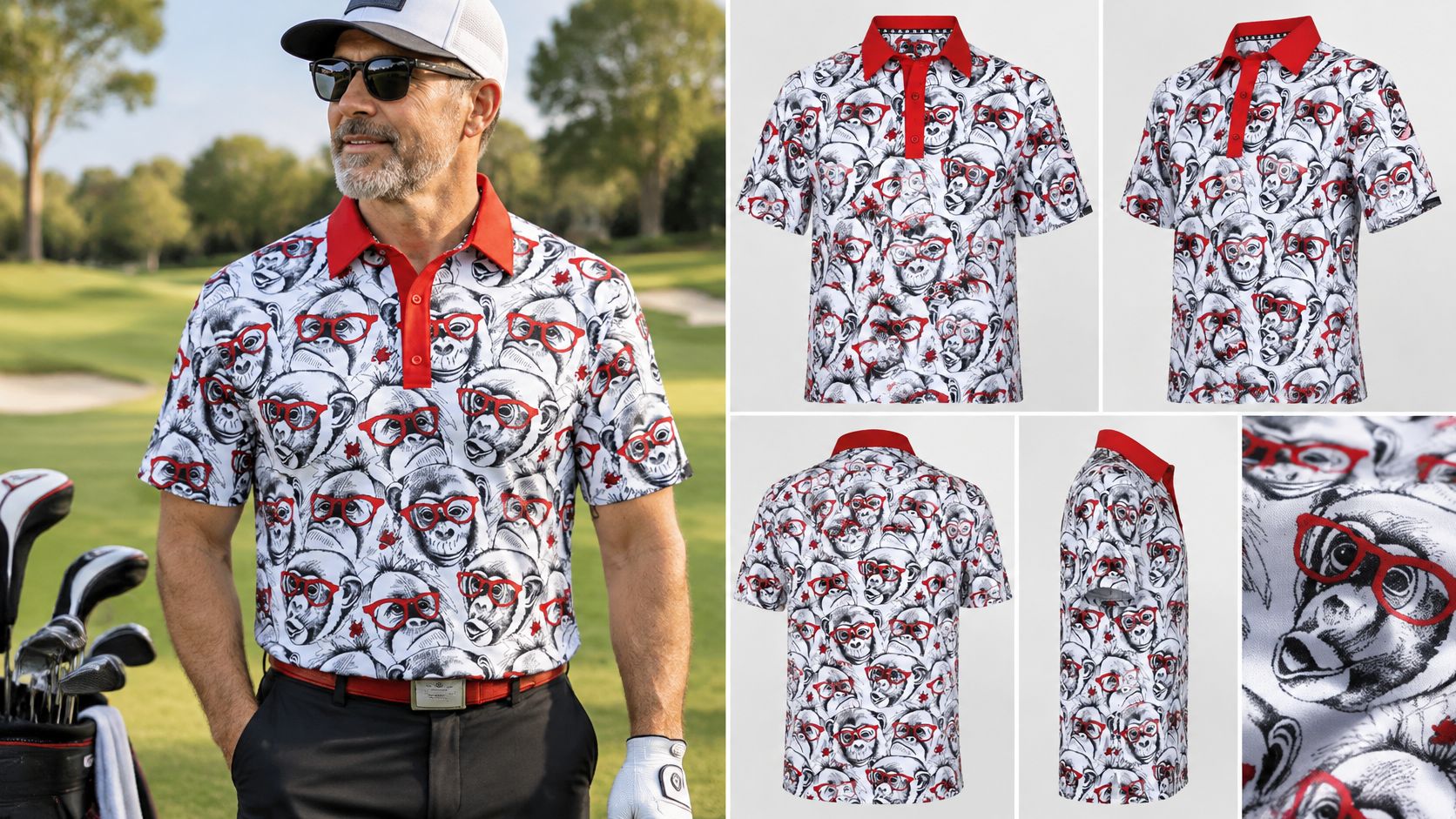
Aloha, Cocktail, Camo, and Dancing Skulls are among the available theme families. Match the motif to the occasion, then keep shoes and headwear straightforward so the shirt remains the main graphic. Tattoo Golf offers high-impact prints and coordinated options for couples and groups.
Make the purchase in the right order
- Check the booking's dress policy. Confirm the course or event rules before choosing a design, including any collar and tuck requirements.
- Read the product specifications. Check fabric construction, stretch, moisture management, recovery, care instructions, and rated sun protection when exposure matters. Performance wording alone does not show how the shirt will feel or hold its shape.
- Compare measurements with the size chart. Check the style-specific chart and upper-body dimensions if you're between sizes. For coordinated orders, read the return conditions before buying.
- Build the outfit before checkout. Confirm that the polo works with bottoms, a belt, a hat, and any weather layer you already own. A print that pairs with dark trousers and plain shorts is likely to get more use than one that requires new accessories.
For group orders, confirm each person's measurements and size individually. Allow time to check the fit before an event, especially whether the collar sits neatly and the hem stays tucked during movement.
The National Golf Foundation figures cited by Fashion Week Online put total U.S. on- and off-course golf participation above 40 million people in 2022. That figure covers different playing settings; venue rules still determine what to wear for a particular booking.
Before buying, check four things: the course policy, the size chart, the fabric and care details, and at least one outfit using clothes you already own. Then choose a print you'll wear often enough to justify the purchase.
Tattoo Golf's polos feature performance fabrics, high-impact prints, and signature skull-and-clubs motifs. Browse Tattoo Golf to compare designs and size guidance.
Share:
Funny Custom Golf Shirts: How to Wash and Care for Them