
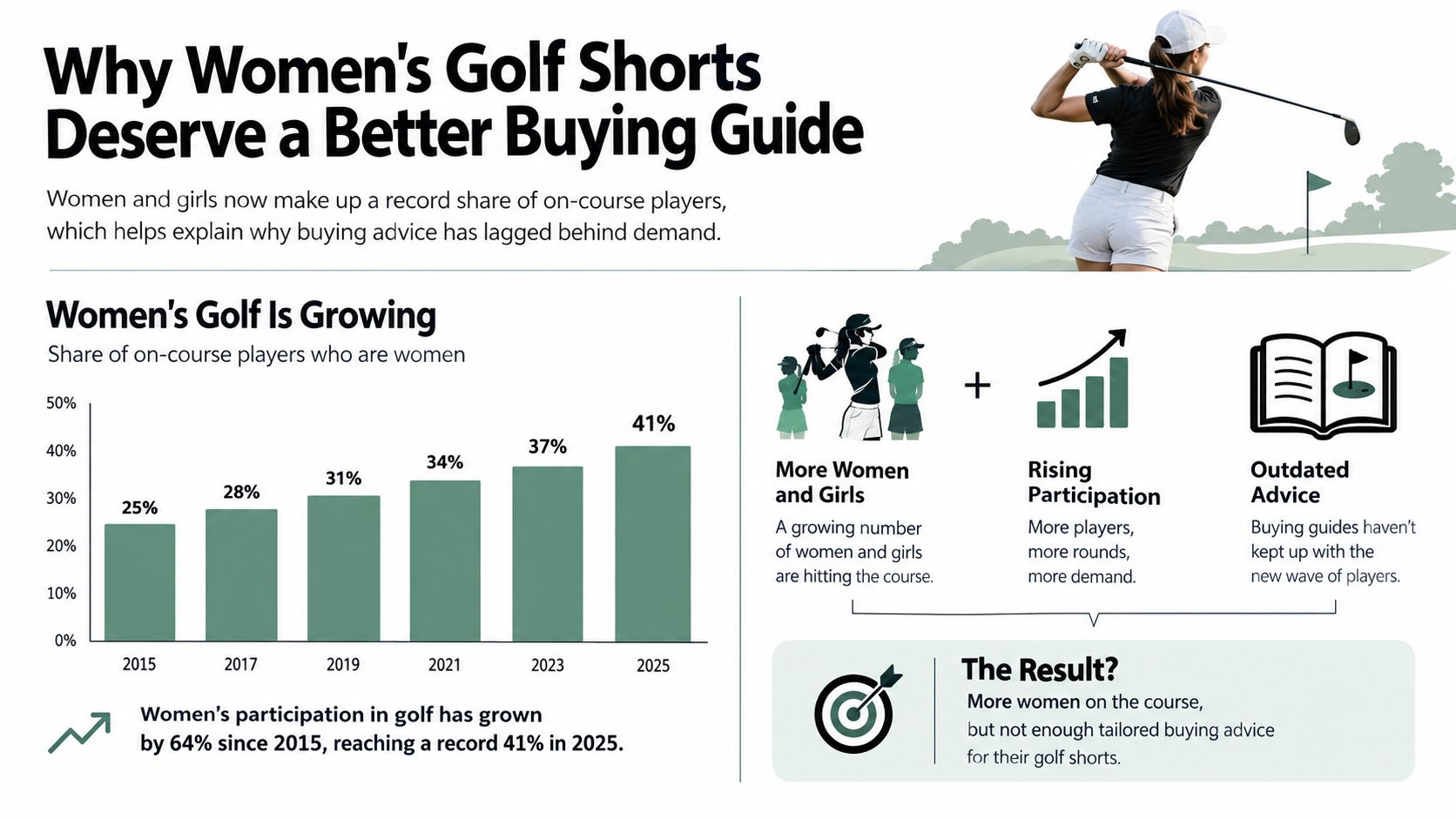
Women and girls are no longer a side note in who tees it up. The National Golf Foundation reported 28.1 million Americans played golf on a course in 2024, and women and girls were 28% of them, about 7.9 million participants, an all-time high. Female golfers also drove about 60% of the net increase in green-grass players since 2019.
That changes the short. It has to turn with a full swing, clear a real club rule, and still look right at lunch. A lot of shop talk still treats golf shorts women buy as a smaller men's short with a softer waist. The checks below start with movement, then fabric, length, the skort question, measurements, outfits, and wash habits.
Why Women's Golf Shorts Deserve a Better Buying Guide
Picture a Saturday league player who already owns three pairs labeled performance. The fitter still opens with stretch, pockets, and wicking. She nods, because those words are on every hangtag. Then she asks the questions that decide the purchase. Will the waistband stay put through a full turn? Does this length pass her club? Can she walk into lunch without looking like she changed in the parking lot?
Those questions got louder because the player base got bigger, and not only in the United States. The R&A's 2023 Global Golf Participation Report estimated 61.2 million adults engaged with golf across markets excluding the United States and Mexico, with women at 23% of adult registered golfers worldwide. Women were at least 25% of registered adult golfers in 42 markets. In the nine largest participation markets, women were 25% of adults playing traditional nine- and 18-hole golf, and 50% of people in other formats such as driving ranges and entertainment venues.
Where the old advice breaks
Registration numbers only catch part of who is playing. Plenty of women show up first at a range, a resort nine, or a short social format. They still need a bottom that walks, bends, and doesn't announce itself as gym wear. A scaled-down men's block rarely accounts for hip spring, a shorter torso, or how a hem behaves when she marks a ball.
A short earns a spot in the bag only if it holds through a swing, breathes on a hot back nine, clears the club's length rule, and still looks intentional after the round.
Treat the short as equipment. Fit comes first, then the cloth, then the hem you can defend at the starter's window. Sizing, styling, and care finish the decision so you're not guessing again next season.
Fit and Silhouette That Move With Your Swing
Waist size and inseam get you into the right pile. They don't tell you if the short survives 18 holes. Women golfers report that golf clothing often fits poorly, lacks femininity, or gets stuck in stereotypical colors, and that dress codes themselves affect the desire to play, as noted in research on engaging women golfers. The variables that matter in the mirror are rise, waistband stability, thigh ease, leg opening, and coverage when you bend or sit in a cart.
A straight, clean drape from waist to hem is the shape you're comparing against, not a second-skin tight or a baggy board short. If the leg balloons or the cloth pulls into horizontal lines across the thigh before you even move, stop there.
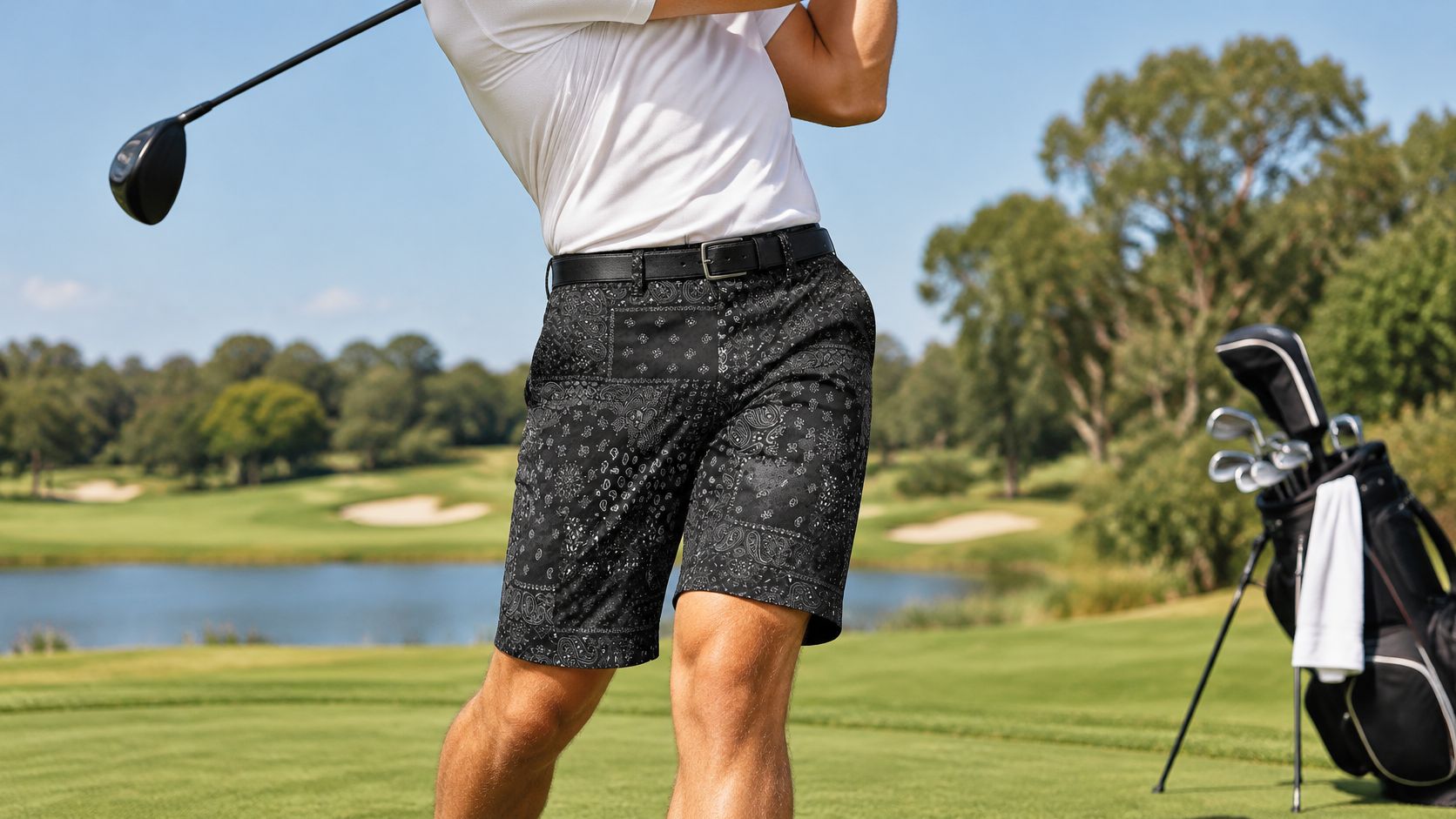
Five moves, five failure signs
Do these in the dressing room, in the order you'd play.
- Squat to tee height. Heels down, knees out. A rolling waistband or a sudden yank at the crotch means the rise is wrong for your torso, or the elastic has no recovery.
- Rotate at address. Hands on an imaginary club, turn until your back faces the target. Cloth that locks across the hip will fight you on every full swing.
- Hinge to read a putt. If the hem climbs and stays up, coverage fails the modest-length test the moment you mark a ball.
- Walk briskly for twenty steps. Thighs that hiss, pockets that gape, or a waistband that slides says the ease is off.
- Sit as if you're in a cart. The back waist shouldn't fold down, and the front pockets shouldn't dump a tee into your lap.
One women's fit doesn't exist
Curvier hips usually need more ease through the seat than the waist label suggests, or the side seams twist. Fuller thighs need a leg opening that doesn't tourniquet when you sit, even if the waist feels perfect standing still. A shorter torso often does better in a mid rise. Low rise dives when you hinge. High rise can stack under a tucked polo if the rise is longer than your torso.
More stretch isn't automatically better. Ultra-soft, low-recovery cloth feels lovely for the first three holes, then the waistband creeps, slash pockets sag, and the short looks tired by the turn. You want stretch that returns, not stretch that gives up.
Fabric and Performance Features That Matter
"Performance" on a hangtag isn't a measurement. A textile study of woven constructions found that moisture and thermal comfort varied a lot by fiber blend, and it pointed to air permeability, water-vapour permeability, wetting time, and wicking speed as the properties that decide how fast heat and sweat leave the skin during repeated movement, as detailed in research on air, moisture, and thermal comfort. That same work found bamboo and pro-modal fabrics shared similar air and moisture comfort and suggested them for golfer garments. Fiber names still aren't enough on their own.
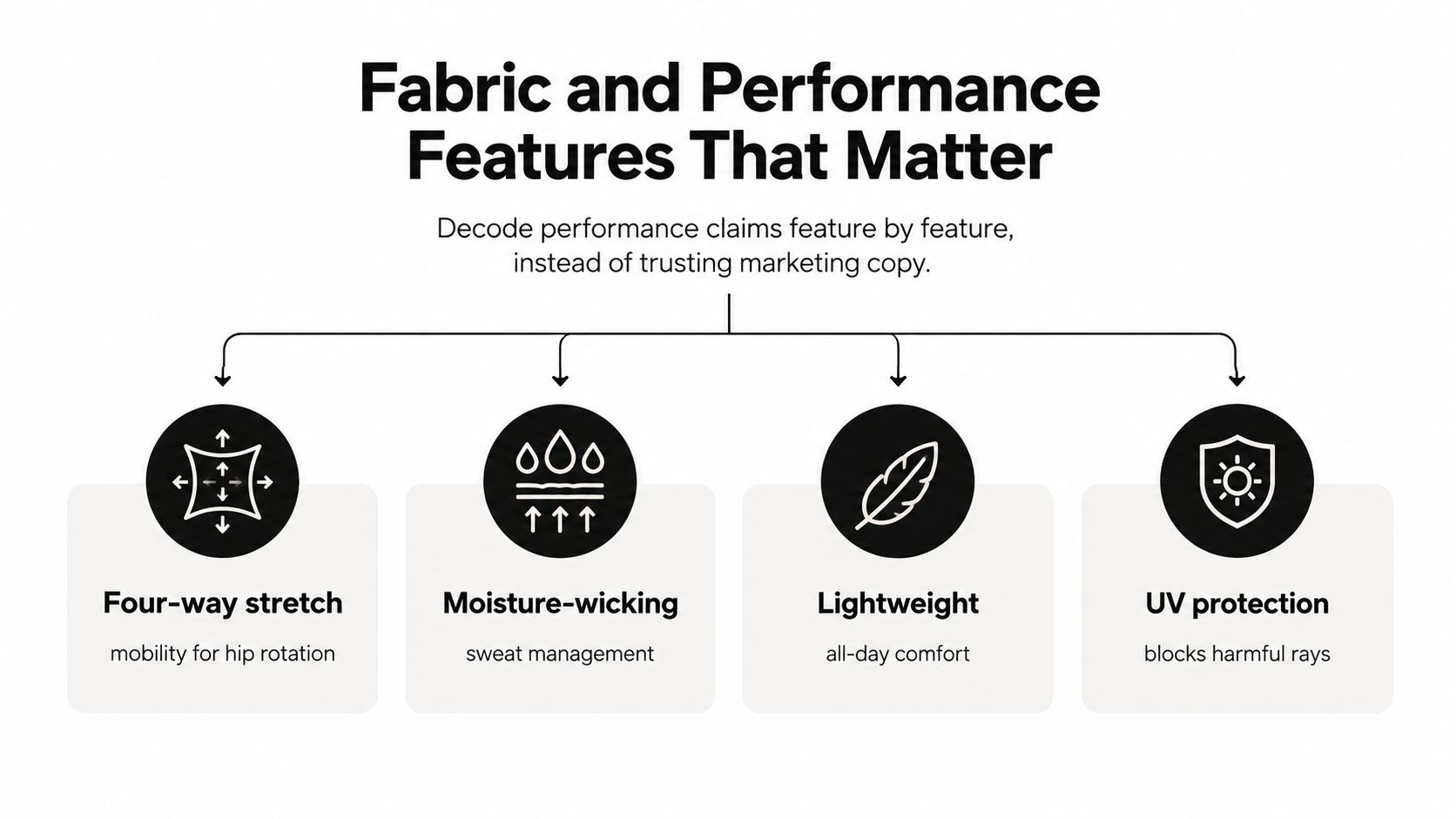
What each claim does on a hot back nine
Four-way stretch is about hip rotation, not a party trick. The cloth should give along the waist and down the leg, then spring back so pockets don't droop. If it only stretches one way, you'll feel a tug when you clear the left hip on the through-swing.
Moisture-wicking moves liquid off the skin. It isn't the same as drying. A useful plain-language breakdown sits in this explanation of what moisture-wicking fabric actually does. Quick-dry is the outer-surface half of the job, evaporation after the sweat has moved. A cloth that wicks but barely lets air through can stay clammy. A very open weave that doesn't transport moisture can feel wet against you for the whole inward nine.
UPF-rated cloth is measurable sun cover, separate from color. Dark prints don't automatically protect you. Lighter colors can still carry a real rating if the construction is dense enough.
A concrete reference point is an 8 oz polyester-spandex blend. Dancing Skulls Cool-Stretch Men's Golf Shorts (Black/Charcoal use an 8 oz Cool-Stretch cloth at 92% polyester and 8% spandex, with UPF 50+, four-way stretch, quick-dry moisture management, and an anti-odor finish. You don't have to buy that pair to use the spec. Ask whether a women's short lists weight, fiber split, and a UPF number, not just "cooling."
Finishes walkers actually notice
Anti-odor treatments matter on a walking round when you can't change at the turn. Wrinkle resistance matters if the short lives in a travel bag. Flat-lock seams matter where the inner thigh rubs for four hours. None of those replace the two-part test. Pinch the cloth, breathe through it, then wet a corner and see whether water spreads and the surface lightens as it dries. If only one of those happens, keep looking.
Choosing the Right Length and Hem Style
"Appropriate length" isn't a USGA or R&A equipment rule. Golf dress codes are set by each club, and women's policies commonly allow shorts, skirts, or skorts while expecting modest coverage. The usual refusals are short shorts, cutoffs, denim, and gym shorts, which golf dress-code guidance lays out in plain terms. A technically great short can still be turned away. A fuller walk-through of what clubs tend to allow is in this golf dress code explainer.
Match the hem to the courses you play
Think in three decisions, not one magic inch.
Where it lands. Bermuda-leaning cuts that finish near the knee read as sensible at traditional clubs and member-guest events. Shorter cuts can be fine at relaxed resort courses, but "fine at the resort" isn't a promise at your home club next Tuesday. If you play both, own two lengths instead of gambling on the shorter one.
How the hem is cut. A notched or slightly curved hem frees the front of the leg so you can walk without shortening the side coverage. A straight, heavy hem can look polished and still ride up if the leg opening is tight. Scalloped edges are a style choice. They don't add coverage.
Whether it stays. A secure waistband plus a leg opening that isn't a rubber band keeps the hem where you set it through walking, bending, and rotation. If you have to tug the short down after every bunker shot, the length on the tag is a fiction.
Check the destination club before a trip or a competition. Screenshot the dress page, or call the shop. Five minutes beats a starter sending you back to the car.
Try the hinge test in the length you plan to wear, not in a longer size "to be safe" that you'll roll. Rolled hems read as cutoffs, which is exactly what many handbooks ban.
Shorts, Skorts or Pants for Real Playing Conditions
Bottoms are a real slice of the wardrobe, not an accessory. They represent about 29.8% of women's golf-apparel demand, skorts are among the fastest-growing bottom categories, and an estimated 62% of female golf-apparel purchases in 2025 were meant for both on- and off-course use, up from 44% in 2019, according to ladies' golf apparel market reporting. Growth doesn't mean a skort wins every round.
Shorts win specific days. Hot, windy afternoons when a skirt flaps into your line. Walking-heavy layouts where an extra layer holds heat. Repeated crouches to read greens. Courses with a strict minimum length, where a short liner under a short outer skirt still looks too brief when the wind picks up.
The details that flip the answer
On a skort, separate liner length from outer length. A modest skirt over a very short liner fails the moment you hinge. A long liner under a light skirt can feel like two garments in humid heat. Fabric weight changes heat retention. A heavier woven skort looks sharp at 70 degrees and cooks at 90. Pockets have to hold tees, a glove, a scorecard, and a phone without dragging the waist down. If the phone pull shows through the skirt, you're adjusting all day.
| Option | Best Conditions | Coverage and Modesty | Pocket Storage | Dress-Code Fit |
|---|---|---|---|---|
| Shorts | Heat, wind, lots of walking, repeated crouching | Set by inseam and a stable hem | Usually the most usable if pockets are deep | Strong when length is modest, weak if they're gym-short |
| Skorts | Mild days, clubhouse-to-course looks, less wind | Outer layer plus liner, check both | Often shallower, phone weight shows | Commonly accepted if the outer length looks sensible |
| Pants | Cool starts, long rough, sun on the legs | Full leg, least debate | Depends on cut, can be excellent | Safest at strict clubs, warmest to wear |
Dual-purpose buying favors a short you can wear to the grill. If the only short that plays well looks like practice gear, it won't get the off-course miles those purchase numbers describe. If you want a print, put it on a length your starter already accepts.
Sizing Up With Measurements and a Size Chart
Guessing from a favorite jean size is how shorts fail on hole 4. Two minutes with a tape beats a return label.
Natural waist. Stand relaxed, tape above the navel where you want the band, not sucked in. Write the number in inches.
Fullest hip. Tape around the widest point of seat and hip, feet together. This number matters more than waist on pull-on styles.
Rise you already like. On a short that doesn't dive or stack, measure from the crotch seam straight up to the top of the waistband. That's your rise target, low, mid, or high, in a number instead of a vibe.
Inseam on the leg. Measure from the crotch down the inside leg to where you want the hem to stop. Don't guess "mid-thigh." Clubs judge where cloth ends, not where you hoped it would.
How to read the chart
Match hip first on pull-on shorts, because the hip is what has to pass over your body and then recover. Match waist first on belted styles with a zip, then confirm the hip ease so the seat doesn't strain the fly. If you're between sizes, size up in a firm, low-stretch weave. Stay with your true measurement in a high-recovery stretch blend, or the waist will be loose by the back nine. The earlier point about low-recovery cloth still applies. Stretch on the chart isn't the same as stretch that returns.
A product page you can trust lists garment measurements next to body measurements, shows model height and the size she's wearing, and publishes the inseam. Tattoo Golf's size chart is the kind of page to expect from any brand you're buying without a fitting room. If a page offers only S, M, L and a single model photo with no numbers, you're gambling.
Styling and Care From First Tee to 19th Hole
One anchor keeps an outfit from looking accidental. If the short is a bold print, the polo should be solid and should borrow one color already in the print. If the short is black, navy, or khaki, the top can carry the statement.
Three rounds, three exits:
A summer league look starts with a printed short, a white performance polo, and a visor. White photographs cleanly, reflects heat, and lets the print stay the point. Swap the visor for a simple cap if your club is fussy about logos, and you're still dressed for the card game afterward.
An evening nine wants less flash from a distance. A tonal print with a dark polo reads as one outfit under floodlights, not a costume. Keep the belt a standard width so the loops aren't doing gymnastics, and skip a loud shoe if the short is already busy.
Couples and group events are easier when bottoms and polos share a motif. Collections built that way, such as Aloha, Camo, Lucky 13, and Dancing Skulls, let a pair or a foursome match without everyone wearing the same solid navy. Pick the shared accent, not a matching every logo.
Wash habits that keep the cloth honest
Cold machine wash with like colors. Tumble dry low, or hang dry if the elastic is already a few seasons old. No bleach. A warm iron is fine on plain cloth, but don't iron across prints or trim, or you'll flatten the graphic and sometimes the stretch. Those four habits are what keep wicking, recovery, and the print intact past a single summer. A short that only looks right the day you unboxed it was a costume, not a piece of your rotation.
Your Golf Shorts Buying Checklist
Buy against the round you play, not against the tagline. Screenshot this and take it to the rack.
- Fit: Passes squat, rotate, hinge, walk, and sit. No waistband roll, no pocket gape, no hem that stays climbed.
- Shape: Rise matches your torso. Thigh ease matches how you sit in a cart, not just how you stand.
- Recovery: Stretch returns. Soft cloth that stays stretched is a no.
- Fabric: Wicking and real airflow together. You can feel air through the cloth, and a wet spot spreads then lightens.
- Sun: A stated UPF rating for bright, exposed courses, not a guess based on color.
- Length: Clears your home club and the trips you take. Hem stays put when you bend.
- Storage: Pockets hold a phone, tees, and a glove without dragging the waist.
- Numbers: Waist, hip, rise, and inseam measured, then matched to the brand chart. Between-sizes rule applied.
- Style: Works with at least two tops you own, and doesn't look like gym wear at the grill.
- Care: Machine washable on cold, low dry or hang, no special spa treatment.
Do the tape routine today, open a size chart that publishes real measurements, and shortlist two pairs. One for the stricter course you play, one for heat and personality. If both fail the hinge test, neither one comes home.
Tattoo Golf builds course shorts and coordinated polos around stretch, moisture control, and prints that still have to pass a real round, from subtle tonal patterns to louder motifs you can share with a partner or a group. If you're ready to match a length and a cloth to the courses you play, start with the ladies' and men's collections at Tattoo Golf and run the five-move test before you commit.

Share:
Golf Clothing for Cooler Weather: A Guide to Layering