
You're standing beside the first tee with a polo you love, clean shoes, and shorts that fit properly. Then you look down: the belt tail hangs awkwardly, the buckle feels heavy, and the color seems borrowed from another outfit. Choosing a golf belt that fits your outfit starts before the mirror. Get the fit right, then make the styling deliberate.
Why the Right Belt Changes the Entire Outfit
A belt sits at the meeting point of your shirt and bottoms. That makes it hard to ignore, even when you want an understated look. In my view, a bulky buckle against lightweight shorts can look just as disconnected as a dressy leather strap against an otherwise athletic outfit.
Consider a golfer wearing a graphic polo and black shorts. Add a bright belt, an oversized buckle, and multicolored shoes, and there's no clear focal point. Keep the same clothes but simplify the belt, and the print becomes the obvious feature rather than another competing detail.
The belt is the hinge between fit and style. It needs to secure the waistband during walking, bending, and rotation before it earns its place as an accessory. That fit-first approach follows the practical priorities in Druids' golf belt sizing guidance.
Start with the whole outfit
Don't shop for the belt as though it'll be worn alone. Put the shirt, bottoms, and shoes together, then decide whether the waistband needs a quiet finish or a visible accent. For broader wardrobe planning, 2ndShotMVP's golf attire guide is a useful companion when considering the complete course outfit.
I'd make the initial choice this way:
- Traditional clothing: Favor a clean, restrained belt that doesn't interrupt fitted lines.
- Technical clothing: Look for a construction that feels compatible with the garment's flexibility.
- Expressive clothing: Decide which piece gets the attention, then give the belt a supporting role or a deliberate starring role.
Practical rule: A belt shouldn't require you to tolerate discomfort for the sake of finishing the outfit.
There's room for both conservative and rebellious golf style. The mistake isn't wearing a skull buckle or a bright strap. It's choosing either without considering the clothes around it, or accepting an awkward fit because the color looks right.
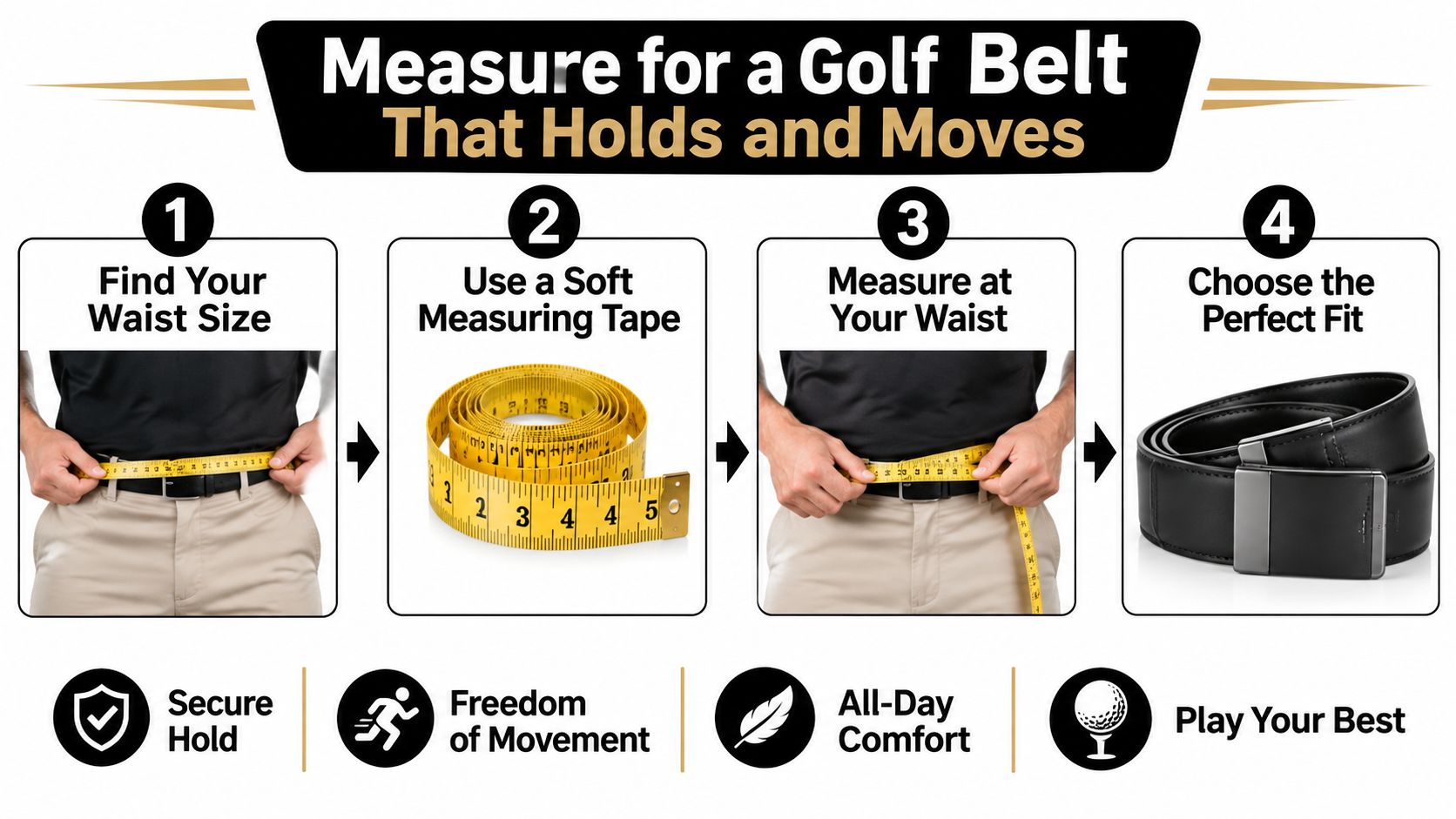
Measure for a Golf Belt That Holds and Moves
Buying a belt by trouser size alone is like buying trousers without checking the cut. The label gives you a starting point, not a dependable fit.
Apparel sizing deserves that skepticism. A 2024 apparel-fit study found that 64.8% of participants purchased the incorrect shirt size and 50% purchased the incorrect pants size more often than the correct size. That isn't a belt-sizing result, but it's a clear reason not to treat a clothing label as a body measurement.
Measure the outfit you'll actually wear
Use a flexible measuring tape and wear the intended golf trousers, shorts, or skort. Include the shirt or base layer you normally tuck in, rather than measuring over unrelated clothing.
- Find the actual waistband position: Measure where the garment sits, not where you assume your natural waist should be.
- Keep the tape level: Follow the waistband without pulling it into your body.
- Record the circumference: Use that measurement when reading the manufacturer's chart.
- Compare the usable range: Look for the span the belt can fasten around, not the strap's end-to-end length.
Total belt length and wearable size aren't interchangeable. A seller may measure to a fastening point, describe a waist range, or list the entire strap. If the chart doesn't explain its method, ask before ordering.
The waistband position matters beyond golf, too. Kilts4Less's kilt belt wearing tips for Highlandwear offer a separate garment-specific reference. Don't transfer Highlandwear placement rules to golf clothing; use the waistband of the garment in front of you.
Leave room to adjust
Aim for a fastening point near the middle of the available range. You want somewhere to go in either direction when the tucked fabric changes or you need a small comfort adjustment.
A multiple-hole design or adjustable ratchet is worth considering when your measurement falls between labeled sizes. Don't automatically size down to avoid excess strap. Don't size up and assume a long tail will disappear neatly, either.
Choose a belt that fits comfortably within its adjustment range, not one that merely manages to close.
Look at the buckle's position as well as the fastening point. It should sit centrally without dragging the waistband sideways. If you have to pull hard, bunch the shirt, or use an extreme setting to make the belt work, change the size or design rather than negotiating with a poor fit.
Compare Leather Woven and Performance Belts
A belt can fit perfectly and still sink the outfit if the strap fights the clothes. Pair a stiff, polished leather belt with lightweight athletic shorts and the waistband reads wrong before you even swing. The material guidance from Golf Pro Advice cited earlier supports matching conservative leather with form-fitting garments and more flexible constructions with technical apparel.
Start with the garment, then pick the strap. Structured trousers call for structure. Movement-focused clothing calls for give.
Choose the strap for the clothing
| Construction | What to evaluate | Where I'd use it |
|---|---|---|
| Leather | Structure, finish, and how it feels when bent | Tailored trousers and structured shorts |
| Woven | Texture and actual flexibility | Relaxed outfits needing subtle surface interest |
| Stretch or performance | Secure support without uncomfortable tension | Athletic shorts and movement-focused clothing |
| Ratchet fastening | Adjustment range, release operation, and buckle profile | Outfits where precise adjustment is the priority |
Check what the weave does. A woven strap can be rigid, and a stretch label can wear out fast. Inspect the material description and handle the belt when you can. Treat the weave as a visual choice first, then confirm separately whether it gives you the flex the outfit needs.
Braided texture isn't restricted to one wardrobe category. California Cowboy's women's braided belt guide is a useful reference when exploring that style. For golf, decide based on the actual waistband and outfit in front of you rather than the gender label on the accessory.
Evaluate the mechanism separately
Leather describes the strap. Ratchet describes how it adjusts. You can get a polished leather appearance with a no-hole click system, so never treat material and mechanism as one decision.
A ratchet solves an adjustment problem, but it leaves the styling question open. Check whether you like operating the release, whether the buckle sits flat and comfortable, and whether its scale suits your clothes.
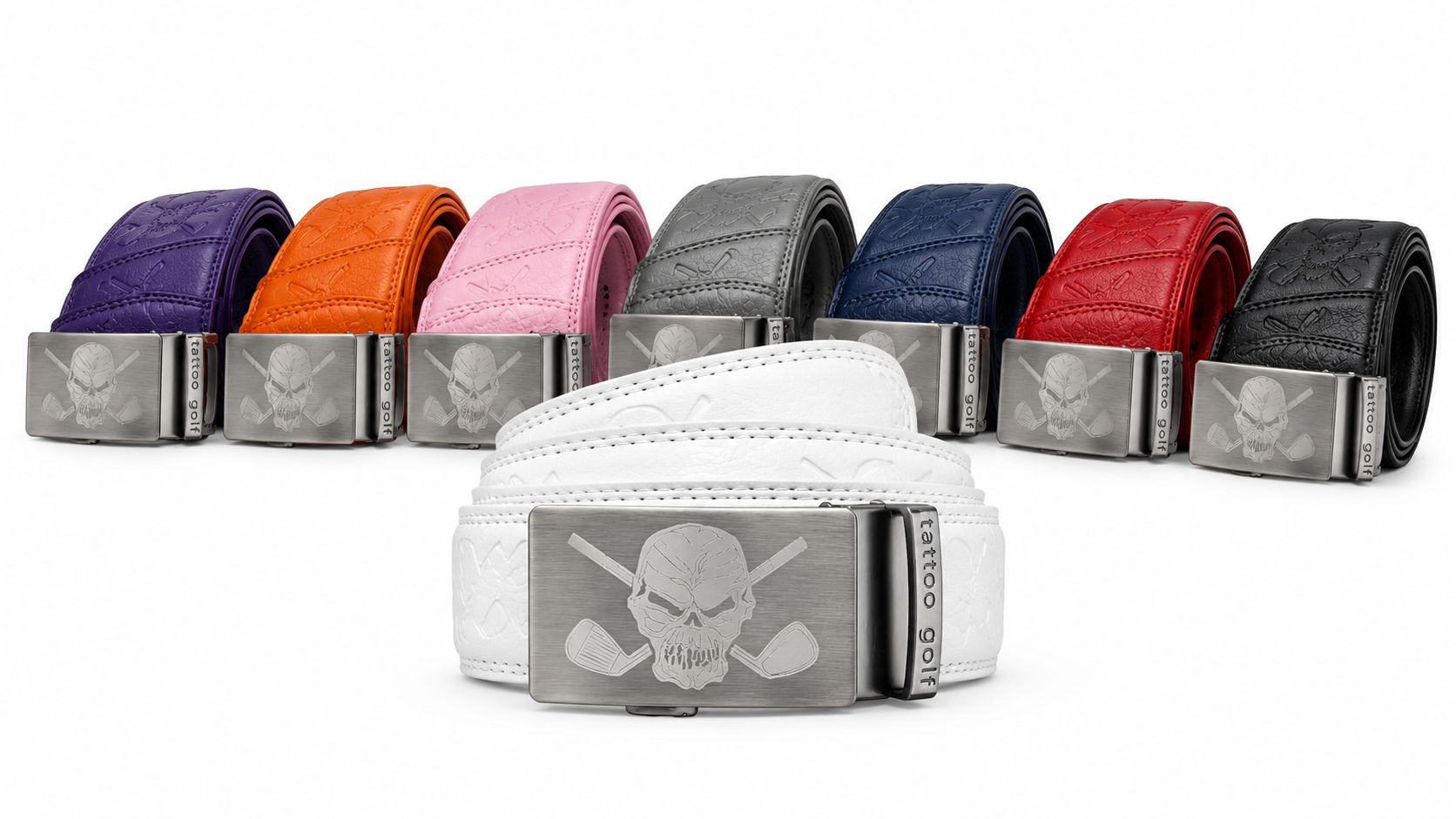
One example is the Leather Ratchet Golf Belt – No-Hole Click Belt with Skull Buckle, which pairs a genuine-leather, trim-to-fit strap with a no-hole fastening system and a zinc-alloy skull buckle. Precise fit and a statement accessory in one piece. That combination shows the trade-off: the mechanism can be purely practical while the hardware does the talking.
Care requirements differ by construction. For the leather option above, the listed routine is wiping with a damp cloth, periodic conditioning, and avoiding prolonged moisture exposure. Read the instructions for whatever you buy rather than assuming a woven or performance label means zero upkeep.
My recommendation: pick the strap for the garment, the fastening for your adjustment needs, and the buckle for the visual impact you want. No single construction wins all three categories automatically.
Match Belt Features to Shorts Skorts and Pockets
A belt can fit your waist perfectly and still fight your outfit. Loop clearance, waistband structure, and pocket placement all need a hands-on check.
Start with width. The belt-width range cited earlier from Golf Pro Advice covers most golf straps, but a common measurement is no guarantee of compatibility. Your garment's loops make the final decision. Thread the belt through every loop before you commit: if the strap twists a loop flat or drags it out of position, the pairing fails no matter how good it looked on a hanger.
Golf Belt Feature Decision Guide
| Garment or priority | Belt feature to check | Why it matters |
|---|---|---|
| Structured trousers | Strap structure and buckle scale | Keeps the finish consistent with the garment |
| Lightweight technical shorts | Flexibility and fastening profile | Helps avoid an unnecessarily rigid waistband feel |
| Narrow loops | Strap width and thickness | Prevents forcing the belt through |
| Skort with a flexible waistband | How the complete waistband behaves | Reveals gathering or uncomfortable stiffness |
| Front or zippered pockets | Clearance around pocket openings | Keeps access convenient |
| Frequent comfort adjustments | Accessible fastening mechanism | Lets you make changes without disrupting the outfit |
Technical shorts punish rigid straps more than any other garment. A stiff leather belt on a flexible waistband creates a hard shelf across your hips, and it gets worse over 18 holes. If you're weighing garment cuts alongside accessories, the guide to choosing golf shorts covers the fit variables that decide how a belt sits.
Test pockets as part of the waistband
A pocketed skort raises two separate questions: can the pockets hold what you carry, and can a belt coexist with a loaded waistband? A garment can answer yes to the first and still demand a narrower strap, a lower-profile buckle, or no belt at all.
Load the pockets the way you play, then run a movement check. Reach into the front pockets. Close the zippers. Sit down on a bench. If fabric bunches beside the buckle or a pocket opening turns awkward to reach, change the combination rather than tightening harder.
The styling cues above only earn their place after the physical fit works. A well-proportioned buckle still has to clear the rise, loops, and pocket openings of the garment on your body.
My verdict: a belt should never hold a waistband hostage. If the garment only feels secure when the strap creates deep gathering, the garment's fit is the problem, not your belt choice. Wear the combination you can adjust normally, with your hands free and your pockets usable.
Balance Color Formality and Visual Weight
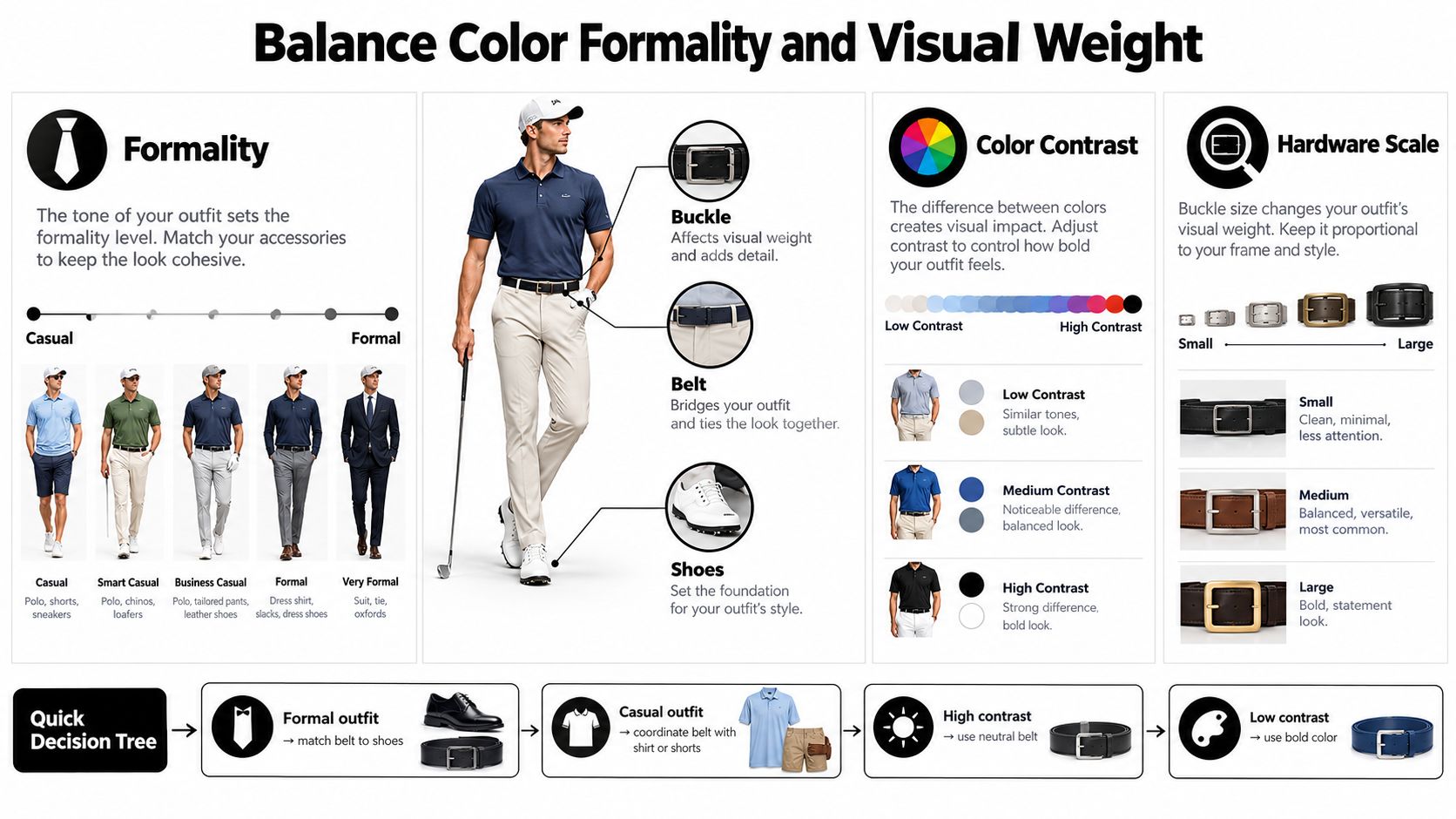
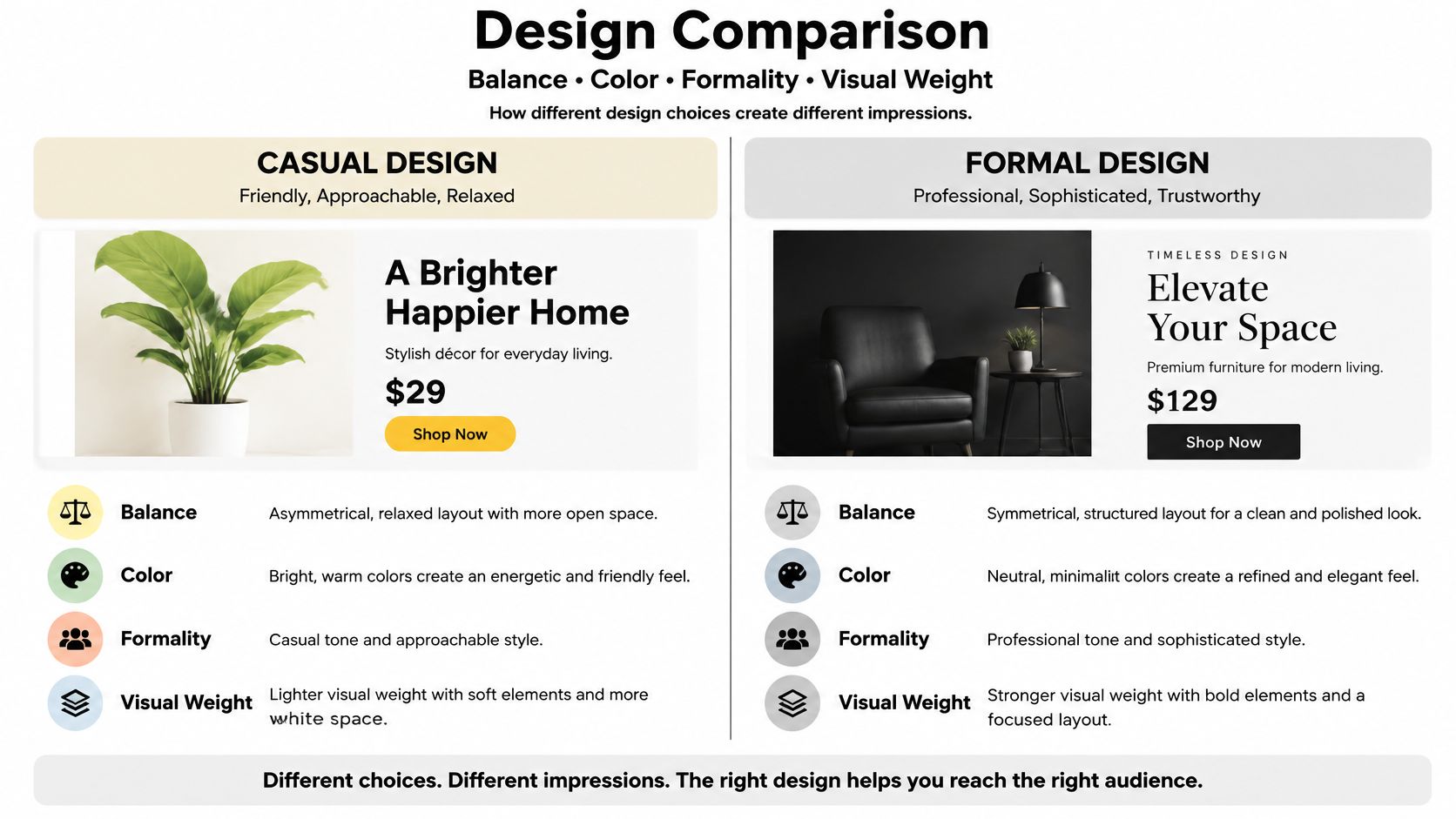
Your belt doesn't have to match your shoes exactly. That rule is a convenient shortcut for traditional clothes, not a universal requirement for white trainers, multicolored footwear, and printed golf shirts.
There's evidence for balanced coordination rather than absolute matching. A 2014 PLOS ONE study of outfit color combinations found that moderately coordinated combinations received the highest fashionability ratings. It wasn't a golf-specific study, so treat it as support for a styling principle, not a formula for course clothing.
Decide how formal the outfit should look
Start with the setting and the garment's construction. A slim leather strap and understated hardware make sense with well-fitted trousers. A woven or performance belt can feel more coherent with athletic clothing and expressive prints.
The golf apparel guidance from Gong Golf supports considering formality, color contrast, hardware scale, and course context rather than relying only on shoe matching. Check the venue's actual requirements instead of assuming that a particular belt style guarantees acceptance.
Use these styling roles to make a deliberate choice:
- Blend: Choose a belt close to the bottoms for an uninterrupted waistband.
- Connect: Repeat a secondary color from the shirt, cap, or another accessory.
- Punctuate: Use a contrasting strap or noticeable buckle when the surrounding clothes are restrained.
Keep visual weight proportional
By visual weight, I mean how strongly the belt draws your eye. Contrast, shine, buckle size, and surface detail all influence that impression. A small bright buckle can attract more attention than a larger low-contrast one, so don't judge scale in isolation.
Let one accessory make the strongest statement. The others don't need to repeat it at full volume.
For example, I'd put a matte black belt with a vivid printed polo when I want the shirt to dominate. With a plain polo and quiet shorts, I'd consider a colored strap or more expressive hardware. Neither choice requires duplicating every color elsewhere.
The same editing approach applies to caps and gloves. Use the guide to matching golf accessories with your shirt when you're choosing those pieces alongside the belt.
Before leaving, look at the full outfit from farther back. If your eye jumps between several competing details, remove a contrast or simplify the hardware. Personality looks more deliberate when you choose where to concentrate it.
Style Complete Looks with Confidence
For a traditional round, try a pale polo, navy trousers cut with a classic fit, and dark leather shoes. I'd choose a restrained leather belt here, with hardware that doesn't become the centerpiece. The result should feel considered without making the waistband the most memorable part.
For a technical outfit, take lightweight shorts, an athletic polo, and white golf shoes. A flexible tonal belt is my preference. You don't need to introduce a bright white strip at the waist just because the shoes are white.
Adapt the finish to the focal point
A printed polo changes the decision. If the shirt already provides movement, contrast, and detail, black shorts and a quiet belt give the pattern space. If you prefer a stronger accent, choose it deliberately and keep the remaining accessories controlled.
For a pocketed skort, I'd make the styling decision while wearing the complete outfit rather than holding a belt against it. Choose the visual direction you want, then use the garment checks already established. Don't sacrifice an easy-moving silhouette to copy a trouser-based look.
- White footwear: Consider whether the outfit needs that brightness repeated at the waist.
- Multicolored footwear: Pick a usable accent rather than trying to reproduce the entire shoe.
- A statement cap: Keep the belt quieter if the shirt is already expressive.
- A plain outfit: Give yourself permission to make the belt the accent.
The complete golf outfit guide from shirt to hat is useful when you want to plan these choices together instead of adding accessories at the last moment.
Use coordinated outfits as styling references
The May Outfit combination pairs a Party Animal monkey-print polo with black performance shorts and a red premium leather belt; the June Outfit pairs a donut-print polo with black shorts and a purple leather belt.
My takeaway from those combinations is the division of attention. The printed shirt supplies character, the black bottoms provide a consistent base, and the colored belt adds a distinct accent.
You can borrow that composition without copying the exact colors. Keep the garment carrying the strongest pattern in charge, then decide whether your belt should support it subtly or provide a controlled contrast. Bold dressing doesn't require every piece to shout.
Verify the Belt Before You Buy
A good product photograph can't tell you whether a buckle presses into your abdomen or whether the strap works with your favorite shorts. Separate the purchase check from the wearing check. Both matter.
Check the listing
For an online order, look for details that let you make a decision rather than infer one from a size name.
- Measurement method: Confirm what the seller means by belt length or waist size.
- Adjustment range: Make sure your recorded measurement sits comfortably within it.
- Construction: Identify the strap material, width, fastening, and any trimming requirements.
- Care instructions: Decide whether you'll follow them.
If those details are missing, ask the seller. A generic size label and an attractive photograph aren't enough to resolve a fit question.
Check the complete outfit
Try the belt with the clothes you'll play in. Stand, sit, walk, bend toward an imaginary ball, and rotate through a relaxed practice swing. Judge the combination in motion, not just while standing square to a mirror.
- Inspect the waistband: Look for pinching, gathering, shifting, or an uncontrolled strap tail.
- Operate the fastening: Make sure you can secure and release it comfortably.
- Use the pockets: Confirm that normal access remains convenient.
- Review the appearance: Check that the buckle sits centrally and the belt suits the outfit's intended formality.
Don't excuse a problem because the belt looks good from the front. Choose secure fit first, compatible construction second, and coordinated visual weight third. Keep your personality in the decision, but insist that the finished outfit works when you move.
Tattoo Golf offers leather ratchet belts, expressive polos, and coordinated outfit combinations for golfers who want a deliberate look with personality. Visit Tattoo Golf with your waist measurement and intended outfit in mind, then choose a belt that finishes the look without compromising the fit.
Share:
Cocktail Print Golf Shirts for the Course and the 19th Hole