
You arrive for a morning tee time in a light jacket, expecting the chill to disappear after the first few holes. Instead, the wind picks up, your sleeves feel restrictive over the ball, and by the back nine the sun has turned that same outfit into a portable sauna. The problem isn't that you need a separate wardrobe for every forecast. You need a few dependable pieces that can be added, removed, and recombined while you play.
That approach matters because golf clothing follows the rhythm of the game and the weather. The global golf clothing market was estimated at USD 4.89 billion in 2025, with nearly 60% of sales taking place in spring and summer, according to Global Growth Insights' golf clothing market report. Participation follows a similar seasonal pattern. Data cited in golf apparel literature recorded 14.2 million rounds in January 2021 compared with 36.5 million in July 2021, a difference of more than 22 million rounds as reported in the market research reference.
This guide treats men's golf outfit ideas for every season as a decision system, not a collection of disconnected style lists. You'll learn how to build layers, read fabric labels, handle mixed weather, and keep expressive pieces polished enough for the course. By the end, you should be able to dress for a changing forecast without overpacking, overheating, or sacrificing your swing.
Introduction Why Seasonal Golf Outfits Matter More Than You Think
A golf round can pass through several conditions before you reach the turn. The first tee may feel cold, exposed holes may bring steady wind, and the final greens may sit under bright, warm sun. Dressing only for the opening temperature creates the same bad choice every time. Keep everything on and you overheat, or remove one thick garment and suddenly you're underdressed.
Seasonal outfit planning solves that problem by separating warmth, moisture control, and weather protection. A polo handles movement and ventilation. A vest adds insulation without trapping your arms. A wind shell blocks gusts when the course opens up. Each item has a job, so you can adjust the outfit instead of fighting it.
Golf participation makes this flexibility especially useful. The National Golf Foundation reported 48.1 million total U.S. golf participants, with total participation up 50% over the past decade in its participation coverage. The same report noted more than 8 million women and girls playing on course, a 46% increase since 2019, which reflects a broader and more varied golf community with different playing schedules, climates, and style preferences.
The crossover wardrobe principle
The most useful pieces don't belong to only one season. A lightweight vest can warm a cool spring morning, sit over a long-sleeve polo in fall, and travel easily in a golf bag. A breathable performance polo can work on a humid summer day, under a quarter-zip during a shoulder-season round, or with casual trousers after play.
That crossover idea also fits the direction of current golf apparel. Coverage of spring 2026 points toward lighter fabrics and flexible layering, while fall 2026 previews emphasize textured knitwear, lightweight vests, and weather-resistant outerwear. The practical lesson is simple: buy pieces that can change roles.
Practical rule: Dress for the warmest part of the round, then carry the layers needed for the coldest and windiest part.
How Golf Layering Works From Base to Outer Shell
Think of your outfit as a breathable thermostat. You don't turn the thermostat up by wearing one enormous sweater. You add controlled insulation, then remove it when your body starts producing more heat. Golf layering works the same way.
Start with the base layer
The base sits against your skin, so its first responsibility is moisture transport. A performance polo or lightweight long-sleeve top should move perspiration away from your body rather than hold it against you. That matters during a walking round, but it also matters between shots. Damp fabric can feel cold while you wait, then heavy and uncomfortable once you start swinging again.
The base should fit close enough to move moisture outward, but not so tightly that it pulls across your chest or shoulders. Polyester blends and polyester-spandex fabrics are common choices because they can combine quick drying with stretch. In cooler conditions, use a long-sleeve thermoregulating layer under a polo or lightweight pullover.
Add warmth without blocking movement
The mid layer provides insulation. A quarter-zip, light sweater, or vest can trap warmth while remaining easier to remove than a thick jumper. A vest is especially useful because it protects the torso while leaving the arms free for rotation. That makes it a strong choice when the air feels cold but your swing generates heat.
The mid layer should breathe. If it seals in perspiration, the insulation becomes less effective during pauses, and you'll feel clammy when the wind returns. A breathable piece with four-way stretch can follow the movement of your shoulders, torso, and hips instead of fighting them.
Finish with the outer shell
The outer shell handles wind and light weather. A packable wind jacket or soft shell doesn't need to be worn for the entire round. Keep it available for exposed fairways, shaded holes, or a forecast that changes faster than expected.
The full mental model is:
- Base layer: moves moisture away from the skin.
- Mid layer: adds adjustable warmth.
- Outer shell: blocks wind and weather.
- Bag strategy: stores the layer you're not wearing.
This breathable stack outperforms one thick garment because you can adjust it as conditions change. Industry guidance for cold-weather golf similarly recommends a moisture-wicking base, a light breathable mid layer, and an outer layer that protects against wind while preserving range of motion from Adidas' cold-weather golf layering guidance.
Performance Fabrics and Features That Actually Affect Comfort
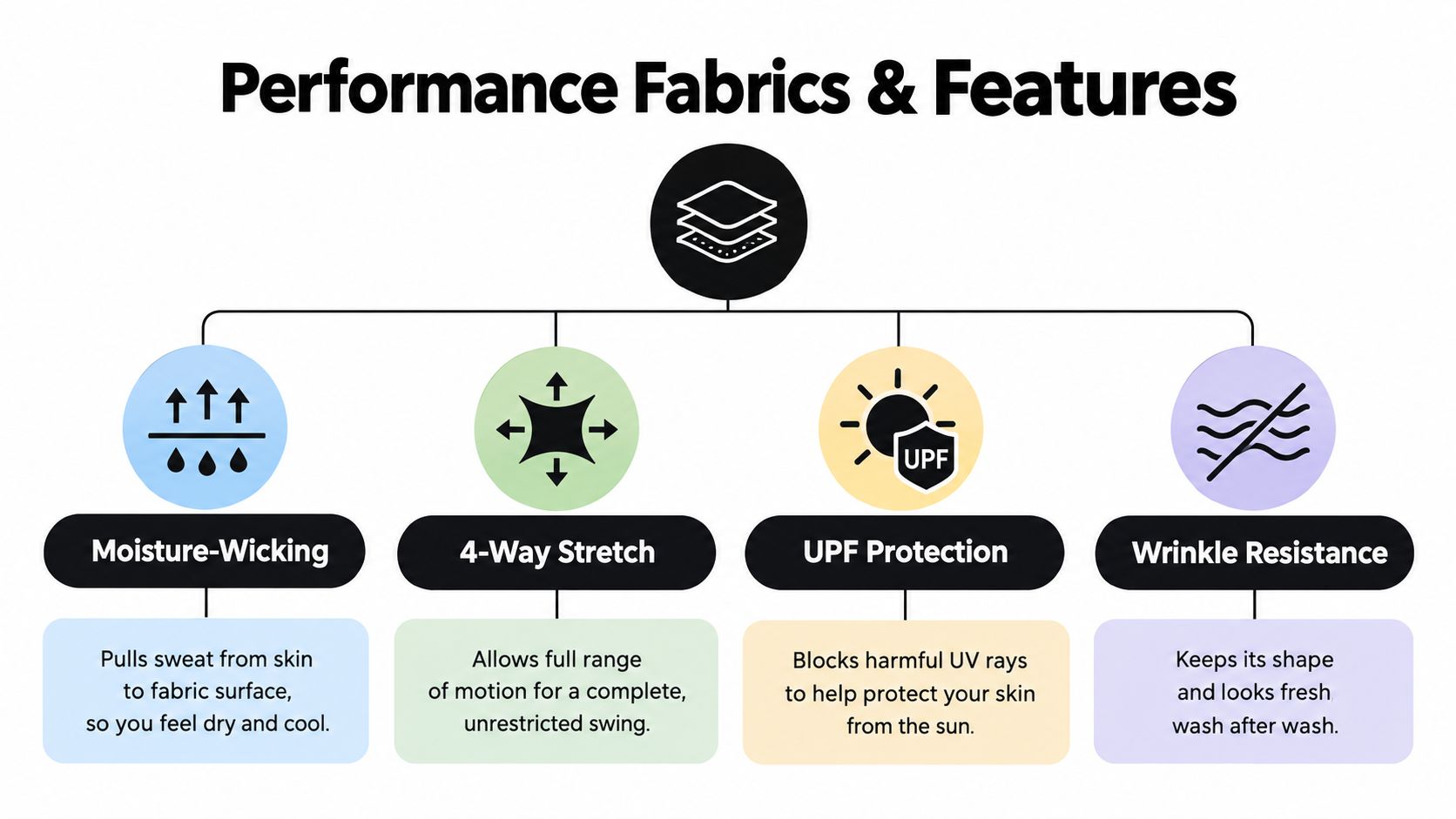
Fabric labels can sound interchangeable until you're standing over a shot with a damp collar, restricted shoulders, and a jacket that won't fit in the bag. The useful question isn't whether a garment says “performance.” Ask what the fabric does during heat, movement, sun, and storage.
Moisture-wicking and quick-dry construction
Moisture-wicking fabric moves sweat from the skin to the outer surface, where it can evaporate more quickly. That reduces cling and helps the garment stay comfortable through a long round. Quick-dry construction supports the same goal, especially when a shirt gets damp from humidity or repeated movement.
For a straightforward explanation of the mechanism, see this guide to what moisture-wicking fabric does. The buying implication is practical. For hot or humid golf, favor a thin, breathable knit over a heavy fabric that absorbs moisture and stays wet.
Stretch and recovery
Golfers don't move in a straight line. The backswing raises the arms, the torso rotates, and the hips shift before the follow-through finishes the motion. Four-way stretch allows fabric to move across and around the body rather than only lengthwise.
Recovery matters too. A shirt may stretch during the swing, but it should return to shape afterward instead of sagging across the back. Check the shoulder area, upper back, waistband, and seat of the trousers. Those are the places that reveal whether a garment was designed for golf movement or merely labeled for it.
UPF and sun exposure
UPF describes how much ultraviolet radiation a fabric blocks. A UPF 50 fabric blocks about 98% of UV radiation. That makes it useful for golfers who spend extended periods outdoors and want lightweight coverage without adding a bulky layer.
Choose breathable performance knits or polyester-spandex blends with UPF 30 to 50+ for shirts when sun protection is a priority. Pair them with light-colored shorts or trousers, which can help reduce heat absorption while keeping the garment easy to move in.
Key concept: Moisture control keeps the garment from becoming clammy, while UPF protection reduces ultraviolet exposure. In summer, those features solve different problems and work best together.
Wrinkle resistance rounds out the travel advantage. A shirt that recovers after being folded is easier to pack for a golf trip, move from the car to the clubhouse, and wear again after a quick refresh. Breathability, moisture-wicking, stretch, sun protection, and wrinkle resistance aren't decoration. Each feature answers a specific problem you encounter during a round.

Men's Golf Outfit Ideas for Every Season Made Simple
A seasonal golf wardrobe works best when the core stays familiar and the layers change. Start with a collared performance shirt, fitted bottoms, golf shoes, and a hat. Then adjust sleeve length, insulation, and weather protection according to the round.
Four dependable seasonal kits
Spring: Wear a breathable polo or lightweight long-sleeve top with stretch golf pants. Add a quarter-zip or light vest, and keep a wind shell in the bag. Spring is less about maximum warmth than about managing a morning that may feel very different from the afternoon.
Summer: Choose a lightweight, moisture-wicking polo, well-fitted shorts, breathable golf socks, and a brimmed hat. Light-colored bottoms can help reduce heat absorption, while UPF-rated fabric adds useful coverage without requiring a heavy overshirt. If the course permits it, shorts are the natural choice. If the club expects a more formal look, lightweight trousers can provide the same mobility with a sharper finish.
Fall: Begin with a polo or long-sleeve performance shirt, then add a textured quarter-zip, lightweight vest, or breathable knit. Stretch golf pants provide more coverage as the air cools. A wind shell earns its place when the forecast includes exposed holes or changing gusts.
Winter: Use a moisture-wicking long-sleeve base, a light breathable mid layer, and a flexible outer shell. Stretch trousers or weather-resistant golf pants help maintain movement, while a vest can add torso warmth without compressing the arms. The aim isn't to wear the thickest item available. It's to preserve heat and moisture transfer at the same time.
The mixed-weather round solution
When the forecast changes, use three decisions:
- If the temperature rises: remove the outer shell first, then the mid layer if needed.
- If wind increases: add the shell before adding insulation. Wind protection often solves the immediate comfort problem more efficiently than a thicker sweater.
- If perspiration builds: open the quarter-zip or remove the mid layer during walking, then put it back on before a long pause.
A golfer starting cold and finishing warm might wear a long-sleeve base, stretch polo, lightweight vest, and packable wind shell. The vest handles the early chill, the shell handles exposed fairways, and both can move into the golf bag as the day develops.
Seasonal outfit matrix
| Season and Condition | Core Outfit Formula | Key Fabric and Layer Tip |
|---|---|---|
| Spring, cool start and mild finish | Polo, stretch pants, quarter-zip, packable shell | Use a breathable base and removable layers |
| Summer, heat and direct sun | Moisture-wicking polo, tailored shorts or light trousers, hat | Choose breathable fabric with UPF protection |
| Fall, cool air and variable wind | Long-sleeve polo, vest or knit mid layer, golf pants | Favor stretch, recovery, and a wind-resistant shell |
| Winter, cold and damp conditions | Wicking base, breathable insulation, flexible outer shell, trousers | Keep moisture moving outward and avoid bulky restriction |
| Any season, changing forecast | Base, adjustable mid layer, shell in the bag | Add protection based on wind and moisture, not temperature alone |
Coordinated outfits can work well for couples, leagues, or team events when the group shares a color family rather than wearing identical head-to-toe clothing. Matching polos with different neutral bottoms usually look intentional without becoming costume-like.
How to Choose Fit Fabric and Mobility Without Guesswork
A good garment can have the right fabric and still fail if the cut restricts your swing. Fit should support movement first, then create the clean silhouette expected on a golf course.
Use the swing-reach test
Try the garment with the motions it needs to survive. Raise both arms, rotate your torso, reach toward the floor, and mimic a full swing. Watch for pulling across the upper back, a collar that presses into the neck, or a hem that rides up when you turn.
A polo should skim the chest rather than cling. Sleeves should allow the arms to move freely, and the shoulder seams shouldn't sit directly on the points that rotate through the swing. For trousers, bend, squat slightly, and rotate. A waistband that digs in during setup will become distracting before the round is over.
Read the fabric by the conditions
Use this quick filter when shopping:
- For heat: Choose lightweight, breathable, moisture-wicking fabric.
- For mild weather: Select mid-weight stretch fabric that can sit under a vest or quarter-zip.
- For cold: Look for a breathable insulating layer rather than one rigid, heavy garment.
- For strong sun: Prioritize UPF-rated fabric on exposed upper-body areas.
- For travel: Favor wrinkle-resistant materials that recover after packing.
Fit also needs to match the venue. Public and municipal courses may be relaxed, while resorts and private clubs can expect collared shirts, well-fitting bottoms, and more polished styling. Check the dress code before you leave, especially if you're playing somewhere unfamiliar. A bold pattern can still look appropriate when the fit is clean and the rest of the outfit stays controlled.
Bold style without visual overload
Current golf fashion is moving toward quieter branding, athletic tailoring, richer textures, and earth tones, while restrained microprints and personality-led details remain relevant in this overview of men's golf fashion. That doesn't mean expressive golfwear has disappeared. It means the strongest bold looks use contrast deliberately.
Pair a statement polo with solid navy, black, stone, or olive trousers. If the shirt carries a strong print, keep the hat and belt quiet. If you want a more restrained outfit, use texture or a small motif as the expressive element.
Styling and Layering Tips for On Course and Off Course Looks
A polished golf outfit doesn't have to stop at the clubhouse door. The easiest crossover looks use one technical statement piece, one neutral foundation, and accessories that connect the colors.
A patterned polo becomes more versatile with solid trousers or well-fitting shorts. A neutral polo can carry more personality through a printed hat, textured quarter-zip, or distinctive belt. Keep the color relationship simple. If the shirt includes several colors, repeat only one of them in an accessory rather than matching every detail.
For a broader foundation on choosing and wearing this essential piece, explore Tattoo Golf's guide to polo shirts. A polo with four-way stretch and moisture control can look appropriate on the course, then pair with casual trousers or clean sneakers after play.
Two easy outfit formulas
A course-to-clubhouse look might combine a bold polo, solid stretch shorts, a matching or neutral belt, and a low-profile hat. Add a lightweight vest for the morning, then remove it after the round. The same polo can work with chinos or casual trousers for lunch.
A quiet base with one loud accent uses a solid polo, well-fitted trousers, and a patterned outer layer or hat. This keeps the silhouette club-friendly while allowing personal style to show through. Tattoo Golf offers performance apparel and accessories built around stretch, moisture management, quick drying, and distinctive prints, so those pieces can occupy either the statement role or the coordinated role.
Couples and teams can coordinate without looking identical. Choose a shared polo color, motif, or accent, then let each person select different bottoms and layers. That approach works for group outings, charity events, and friendly matches because the wardrobe reads as connected while preserving individual fit and comfort.
Care Travel and Seasonal Storage That Keeps Outfits Ready
Performance clothing works best when its care routine protects the fibers and finishes. Wash garments according to the label, use a gentle cycle when recommended, and avoid fabric softener when the care instructions warn against it. Residue can interfere with moisture management, while excessive heat may damage stretch and graphic details.
Air-drying is a useful default for many performance pieces, especially polos, lightweight layers, and printed garments. Don't leave damp clothing compressed in a golf bag. Let it dry fully before storage, and keep seasonal pieces clean and completely dry before placing them away.
Pack for adjustment, not excess
For travel, build outfits around interchangeable layers. Roll or fold polos with the collar protected, place a vest or shell where it can be reached quickly, and keep one neutral bottom that works with several tops. A small garment folder can help separate clean course clothing from worn pieces.
Before leaving for a round, check the forecast for temperature changes, wind, and moisture rather than looking only at the morning reading. Put the removable layer in the bag before you need it. That small habit prevents the most common mistake in mixed-weather golf, dressing for one moment instead of the entire round.
For detailed garment-specific guidance, follow Tattoo Golf's clothing care information. A compact collection of breathable polos, stretch bottoms, a vest, and a weather shell can cover the year more effectively than a closet full of single-purpose outfits.
Tattoo Golf offers men's and ladies' performance polos, shorts, pants, hats, belts, outerwear, and accessories with bold prints and coordinated options for couples, teams, and individual golfers. Visit Tattoo Golf to build a season-ready outfit that combines adjustable layering with the personality you want to bring to the first tee.


Share:
What to Wear Golfing: A Complete Guide for Men
Matching Couples Golf Shirts for Your Next Golf Trip