
You packed the wrong shirt. Saturday morning, the starter glances at the skulls across your chest, points at the posted rules, and tells you the tee time stays if the shirt changes. The print felt funny in the mirror. It reads as a problem at the bag drop. Inappropriate golf polos aren't a yes-or-no category. They're a match between the graphic, the construction, and the place you're playing. Pick for the venue in front of you, then check the shirt before you leave the house.
Where Bold Polos Get You Turned Away
Say you walk a private club in a skull-print polo. The starter doesn't debate fashion. The starter asks whether the shirt has a traditional collar and a quiet pattern. Acceptance depends on the venue, not on how much you like the print.
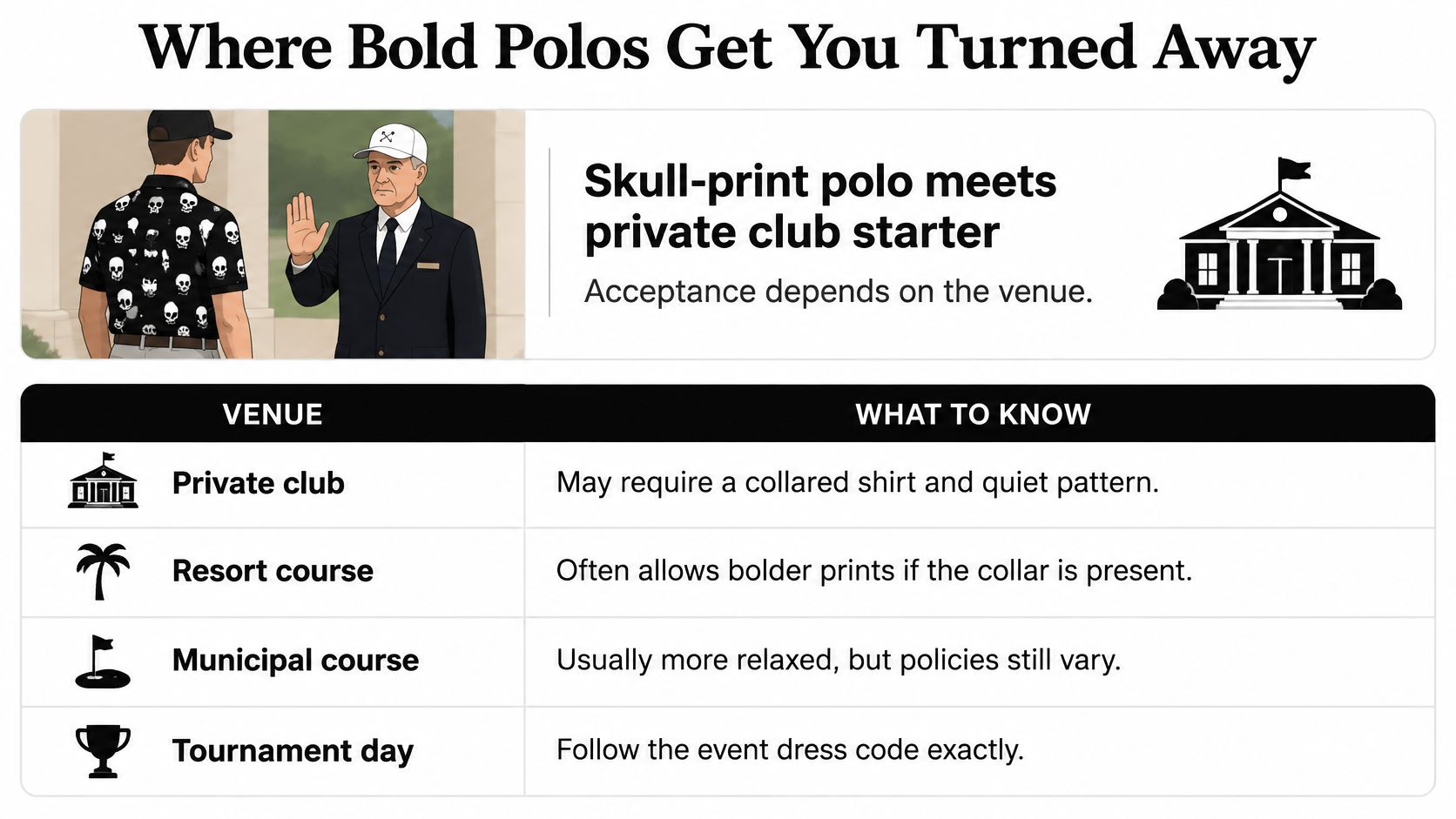
| Venue | Loud Print Tolerance | Collar Requirement | Typical Verdict |
|---|---|---|---|
| Private club with strict dress code | Low | Traditional collar required | Skulls, camo and cocktail graphics usually refused |
| Public course | Medium to high | Collar expected, not always required | Most bold performance polos accepted |
| Resort or tourist course | High | Collar usually expected | Tropical and Aloha prints typically fit the setting |
| Charity scramble or themed event | High | Set by the organizer | Novelty graphics accepted when the event allows them |
| Casual league or weekday play | Medium to high | Relaxed | Clean, fitted bold polos fine |
| Corporate or client event | Low | Collared and restrained | Save the loudest polo for social rounds |
A 2025 survey of 3,250 golfers found that 71.9% considered club dress codes important or very important, while 25.6% considered them unimportant or irrelevant. That split is the whole decision. Loud prints can be fashionable and still get you parked in the lot.
How each stop treats a loud shirt
Private clubs still want a traditional collar and restrained color. High-contrast skulls, camouflage, and cocktail graphics usually fail there, even when the shirt is otherwise neat. Public courses expect a collar more often than they police the artwork, so a clean bold polo usually plays. Resort and tourist courses already live in tropical and Aloha territory, so those prints fit the setting when the collar is obvious.
Charity scrambles follow the organizer, not the club's everyday habit. If the invite says themed shirts, novelty graphics are the point. Weekday leagues pass a fitted bold polo that isn't stained or stretched out. Corporate and client rounds are the opposite. Wear the quiet shirt while the client is in the group.
Hoodies and smart casual pieces show up more often as clubs try to widen who feels welcome. That shift doesn't erase a written rule. Read the host course's posted policy before you arrive. Unwritten norms change from starter to starter, and the written line is the one that decides the tee time.
Practical rule: If the invite names a company, a membership committee, or a private host, leave the loudest polo in the car.
Why a Polo Counts as Inappropriate
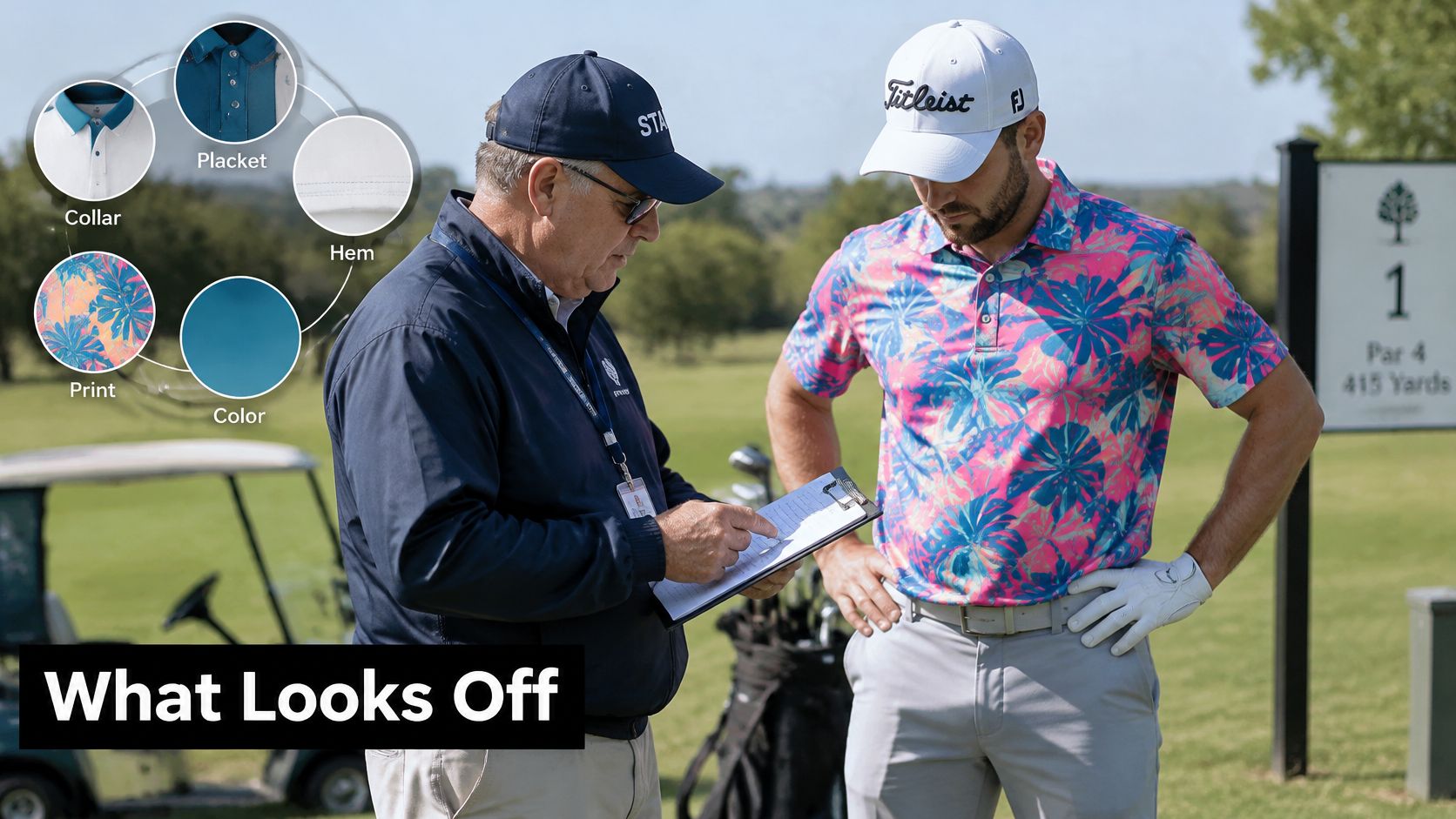
Treat the polo like a uniform with one dial you control. Collar, placket, and hem are the fixed settings a starter checks in a glance. Print and color are the dial you turn. Golf polos became the sport's top layer because they keep a collared, course-approved look while still letting a swing move. A bold polo has to keep that bargain.
A course official isn't grading your sense of humor. They're checking whether the shirt still reads as golf wear.
The conservative job is simple. The shirt should look like it belongs on a course. The newer job is lifestyle. Humor, identity, and attitude now sit on the same silhouette that used to signal country-club restraint. An inappropriate golf polo keeps the recognizable shape and drops the quiet styling around it. That's a choice, not a costume, when the structure holds.
The three-second test
Run this before you buy, and again before you leave.
- Collar: It should stand and stay shaped, not flop into a crew neck.
- Placket: Buttons should close square, with no gap when you stand straight.
- Hem: It should be long enough to tuck and stay tucked through a full turn.
If those three hold, a loud print reads as intent. If the collar has collapsed or the hem rides up, the same print reads as a mistake. Staff don't need to dislike skulls to refuse a shirt that no longer looks like a polo.
Polo and other top-wear products represented 38.32% of U.S. golf-apparel revenue in 2024, the largest category share in that market, according to Grand View Research. The same market was valued at approximately $1.67 billion in 2024 and is projected to reach $2.95 billion by 2033, a 6.5% compound annual growth rate from 2025 through 2033. Tops are the commercial center of golf clothing, so the polo is the most visible place to break the old palette without abandoning the uniform.
Keep the collar, placket, and hem clearly defined. Let the print carry the personality.
Print Risk From Tonal Stripes to Cocktail Graphics
Rank the artwork before you rank the joke. A published evaluation of 671 golf-apparel items found labeled UPF on only 7.1%–16.7% of products, depending on the body site examined. The same evaluation treats tightly woven fabrics and darker hues as stronger barriers to ultraviolet radiation. Bold graphics can challenge club culture. A missing collar, thin coverage, or an untested sun claim creates a compliance problem the print can't fix.
Collared polos remain the most broadly accepted top because many private clubs require collars, while relaxed public facilities allow more alternatives. Skulls, camouflage, cocktail imagery, and high-contrast patterns still need a recognizable collar, a secure placket, and a course-length hem.
The ladder, safest first
| Risk Tier | Works Best At | Adjustment to Lower Risk | |
|---|---|---|---|
| Solid or tonal stripes | Low | Any course and event | None needed |
| Tropical or Aloha | Low to medium | Resorts and public courses | Keep graphics on the front with a muted base |
| Houndstooth | Low to medium | Club-adjacent and social rounds | Pair with solid shorts |
| Camouflage | Medium | Public courses and leagues | Choose tonal camo over high-contrast |
| Skull motifs (tonal, such as Dancing Skulls) | Medium to high | Public courses and casual rounds | Stay with a tonal palette |
| Cocktail or party graphics | High | Social events and themed days | Keep off corporate and private club play |
Solids and tonal stripes clear almost every starter. There's nothing to negotiate.
Tropical and Aloha prints belong at resorts and public courses when the art stays on the front and the base stays muted. A full-bleed neon field is a different shirt.
Houndstooth sits in the middle and looks deliberate next to solid shorts. It reads as pattern, not a slogan.
Camouflage is medium risk. A tonal camo in charcoal or olive passes more often than a high-contrast military print that photographs like outerwear.
Skull motifs climb to medium-high. A tonal palette, including a quiet Dancing Skulls treatment, lowers the volume without deleting the motif. Bright skulls on a white ground don't.
Cocktail and party graphics are the top rung. They belong on social rounds and themed days. They don't belong in a client foursome or a jacket-and-tie club.
What gets refused before the print matters
Three failures beat any ladder. Offensive or political slogans, sheer or revealing fabric, and a hem or collar that has lost its shape are the first things a starter or organizer checks. Screen those before you pick a rung.
For a first purchase, buy a tonal stripe or a front-only tropical on a dark base, then add one skull or cocktail polo for rounds that aren't hosted. Keep the print on the chest or sleeves, choose a dark base, and wear solid bottoms. Publish or demand a tested UPF rating. Don't treat print density as sun protection, and confirm the written dress code before an unusually loud design leaves the closet.
Performance Specs That Keep a Loud Polo Playable
A rebel print still fails if the shirt stays wet. Published textile research finds that micro-denier polyester generally outperforms cotton, cotton/polyester blends, and conventional spun polyester in water absorption, wicking height, and evaporation rate. Hydrophobic synthetic filaments move liquid across a larger surface, so sweat spreads and leaves instead of sitting on your skin. Cotton's hydroxyl groups pull moisture in, and that wetness lingers longer as cotton content rises.
What to read on the label
| Spec | Target | Why It Matters |
|---|---|---|
| Fabric | Polyester or polyester-spandex knit, micro-denier where stated | Moves sweat across the surface and dries faster than cotton |
| UV protection | UPF 50+ tested rating | A tested rating proves coverage instead of implying it from color |
| Stretch | Four-way stretch | No pull across the shoulders on the backswing |
| Weight | Lightweight knit, such as 8 oz Cool-Stretch | Stays cool and drapes cleanly without clinging |
| Graphic coverage | Print on front or sleeves, not dense across chest and back | Dense coating traps vapor and creates wet spots |
| Collar and placket | Defined collar, secure three-button placket | Meets club dress codes and keeps the silhouette |
| Care | Wrinkle resistant, machine washable | Keeps shape and print after repeated rounds |
A useful benchmark is an 8 oz Cool-Stretch knit at 92% polyester and 8% spandex, with a tested UPF 50+ rating, four-way stretch, and an anti-odor finish. That's the spec to hunt, not a brand slogan. Skip dense coatings across the chest and back. Added coating mass blocks vapor and leaves a wet patch exactly where a bag strap sits.
Look for documented moisture-management testing and enough recovery that the shirt returns to shape after washing. A lightweight, tightly knitted polyester blend does that job. Cotton-heavy novelty shirts often don't, no matter how sharp the graphic looks on a hanger. The same checklist you'd use for a plain performance polo applies here, and a guide to performance golf shirts walks through stretch, dry time, and collar construction in more detail.
If the base fabric can't move sweat, the print is decoration on a shirt you won't want by the ninth hole.
Fitting Bold Polos for Women's Bodies and Swings
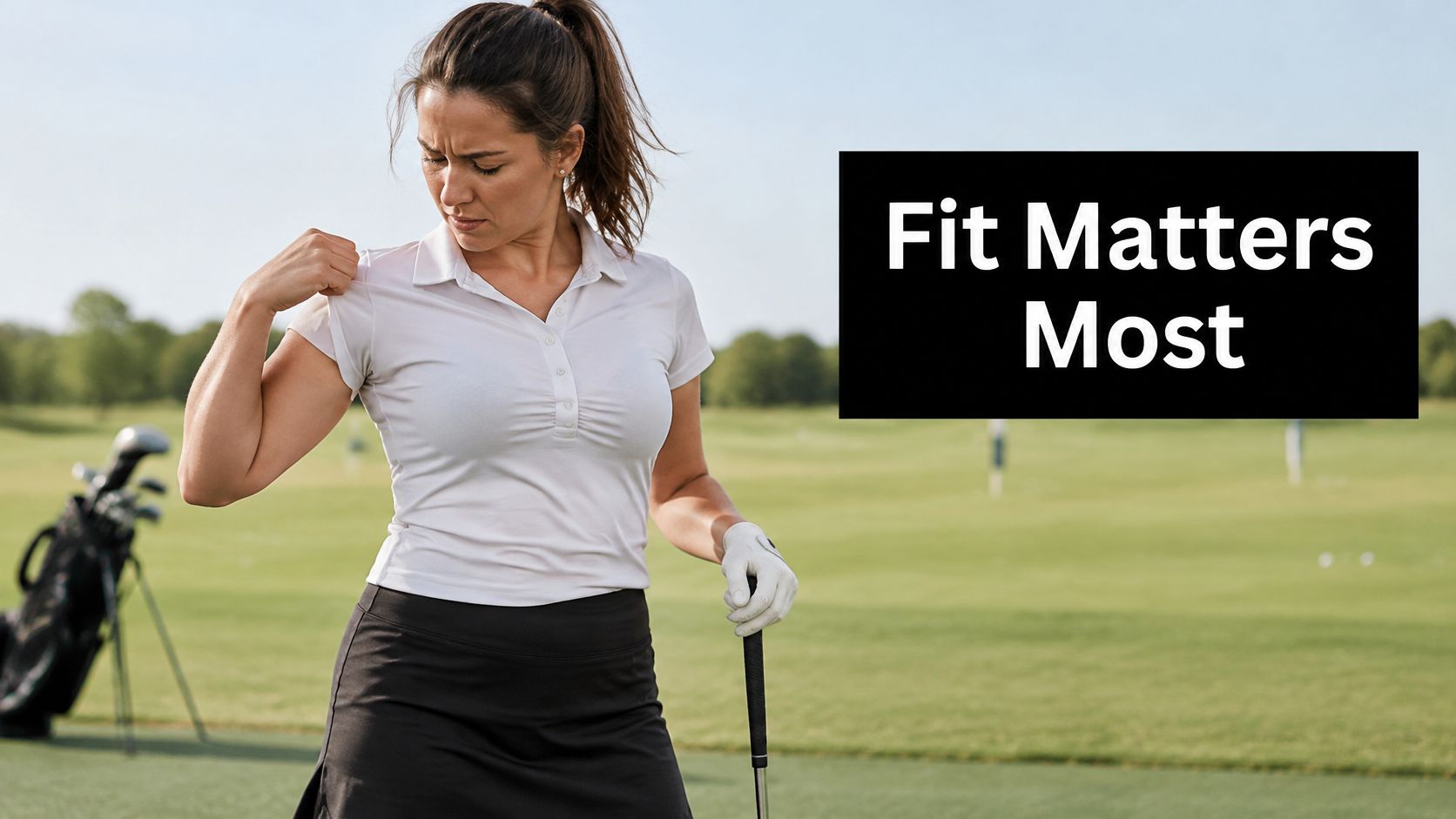
The most inappropriate polo is often the one that fits badly, not the loudest one. A shirt that rides up, locks the shoulders, or gaps at the buttons looks wrong before anyone reads the graphic. A 2026 report on retaining women golfers names price, comfort, and fit as top apparel priorities and says 41% prefer modern athletic golf styles. Performance and a modern print can live on the same shirt. Buyers still need numbers, not a generic S–XL guess.
Men's and women's cuts aren't interchangeable. A men's medium is not a women's medium. Compare the chart for the cut you're buying, including how stretch recovery and opacity hold after washing.
Measurements that beat a size letter
| Check | How to Test | Warning Sign |
|---|---|---|
| Bust room | Measure across the chest at the fullest point and compare with the chart | Placket gapes when the arms are raised |
| Shoulder seam | Lay the shirt flat and align the seam with your shoulder point | Seam sits on the arm or pulls on the backswing |
| Torso length | Measure from shoulder to hip and compare with the hem length | Hem rides up or will not stay tucked |
| Armhole depth | Raise both arms overhead and rotate through a practice swing | Pull across the shoulders or a restricted turn |
Also check upper-arm room and sleeve coverage. A sleeve that ends too high, or a knit you can see through in direct sun, fails a modest-coverage rule even when the print is tame. More fit notes for women's cuts sit in this women's golf shirt guide.
The swing test
Put the shirt on. Raise both arms overhead. Rotate through a practice swing. Watch the placket and the shoulder seams. Pull at the top of the backswing means the armhole or the stretch is wrong. A gaping placket means the bust measurement doesn't match the chart.
If that restriction shows up in every size, the shirt may not be the only limit. A golf screening at Aspen Falls Wellness can separate a tight knit from a mobility issue before you blame the polo. A well-cut bold polo should hold shape and color through a four-hour round, in humidity, and under a rain layer. If it only looks right in a photo, it isn't the shirt to pack.
Matching a Bold Polo to Real Rounds
Saturday at a public course, black shorts and a red-and-white monkey print do the talking. The Party Animal Cool-Stretch Men's Golf Polo – Monkey carries the outfit. Its structured collar and three-button placket keep the same shirt looking like golf wear when you walk into the snack bar. One loud piece. Everything else stays neutral.
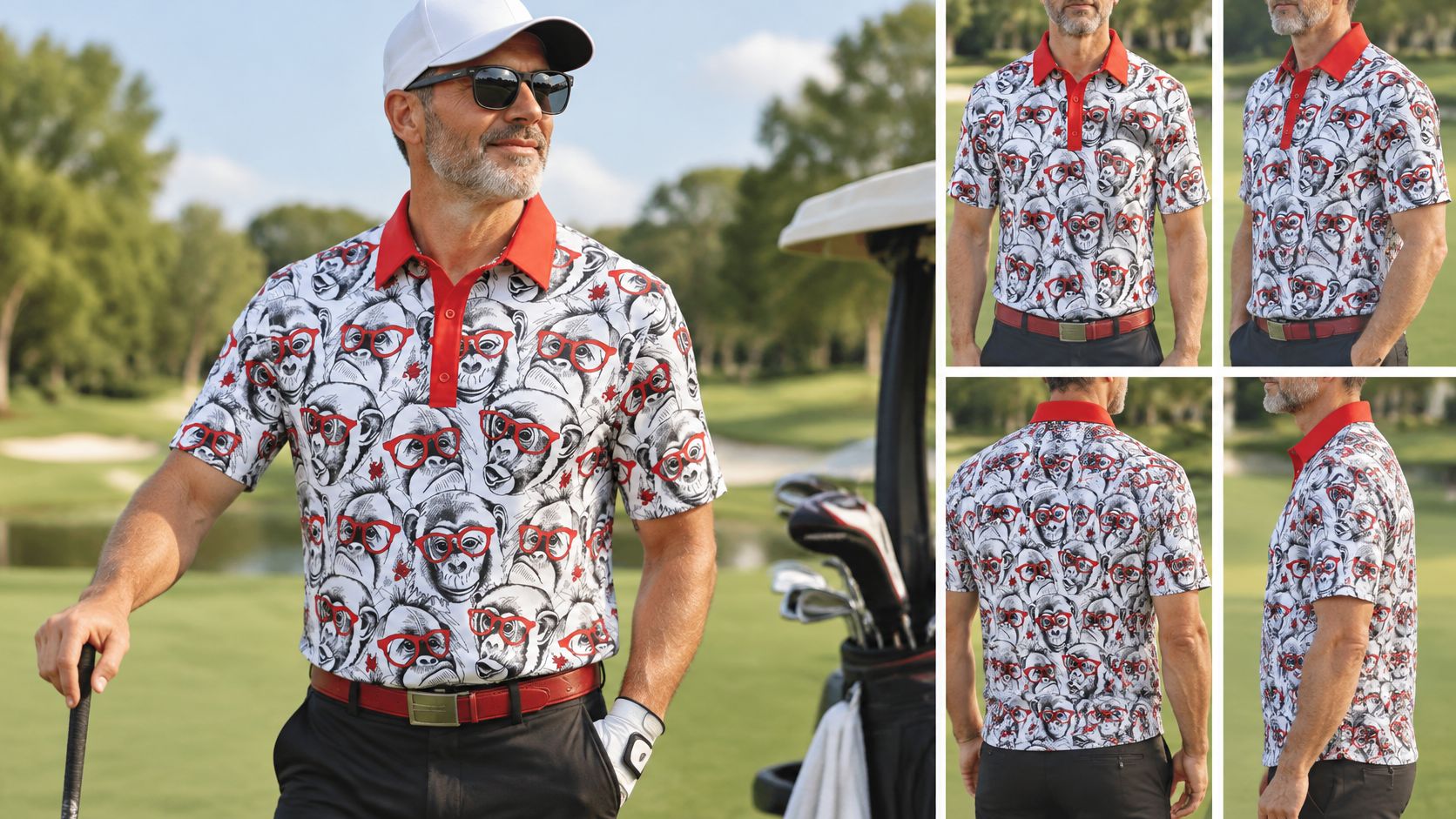
Same golfer, different calendar. A corporate charity starts at noon. The monkey print stays in the car. A tonal or solid polo goes on for the hosted round, and the loud shirt comes out only if the group moves to a casual nine afterward. Nothing about the personality changed. The audience did.
Build the outfit, not a costume
Dancing Skulls shorts in black and charcoal pair cleanly with black, white, or grey polos. The skull detail stays small from across the tee, so the bottom doesn't compete with the shirt. If both pieces shout, the outfit stops looking chosen.
Cool mornings and light rain get a solid layer over the print. A quiet vest or pullover lowers the visual risk without forcing a full change when the sun comes out. Peel it at the turn if the group is social. Leave it on if a host is still in the cart.
Pack two polos, not a suitcase of graphics.
- Casual kit: One bold polo, solid shorts, and a belt that matches the shoes.
- Hosted kit: One restrained polo in the same size and fabric, ready if the invite tightens.
- Rule: One loud element per outfit. The rest stays neutral.
That two-polo bag covers a public Saturday and a client scramble without a pro-shop emergency.
Confirm the Dress Code Before You Tee Off
Decide before you drive. A posted rule beats a guess at the bag drop, and the same habit helps clubs that also turn footgolf inquiries into bookings by answering the dress question before anyone arrives.
- Read the written code. Check the course policy and any event sheet before you leave.
- Name the venue. Match it to private, public, resort, scramble, league, or corporate play.
- Pick the rung. Choose a print whose risk tier fits that stop.
- Read the spec label. Confirm tested UPF, four-way stretch, and a defined collar.
- Swing in it. Arms overhead, then a practice turn. No pull, no gaping placket.
- Pack a solid layer. Use it for cool air or rain so the print isn't the only option.
- Keep a restrained polo. Corporate and private club days use that shirt, not the party graphic.
A bold monkey-print polo and tonal skull shorts fit public and social rounds when the collar is real and the second piece stays quiet. They aren't the hosted-round uniform. For the wording courses post, this golf dress code explainer is worth reading next to the starter's sheet. Finish with the two-polo kit. One bold polo for public courses, one tonal polo for events, and bottoms matched to the venue.
Tattoo Golf builds performance polos with real collars, stretch knits, and prints that run from tonal skulls to full party graphics, so you can match the shirt to the tee time instead of guessing at the starter's window. Browse the men's and women's cuts, check the size chart, and build a two-polo kit before the next round. Visit Tattoo Golf and pick the polo that gets you on the tee.
Share:
Loud Golf Polos: Fit, Fabric and Where They Work