
28.1 million Americans played golf on a course in 2024, the highest on-course participation level since 2008, according to the National Golf Foundation. That's a much broader audience than the traditional country-club stereotype suggests, and not everyone wants the same uniform.
Tattoo Golf jackets appeal to golfers who want personality without giving up practical outerwear. But the useful buying question isn't how bold a jacket looks or how much insulation it carries. It's whether you can swing, walk comfortably in the forecast, and enter your chosen venue wearing it.
What Sets a Tattoo Golf Jacket Apart
A Tattoo Golf jacket combines tattoo-inspired styling with the functional demands of golf outerwear. The defining idea is an athletic layer with visual attitude, rather than a conventional dress jacket repurposed for the course.
Say you're leaving for a cool morning round followed by lunch at a private club. A substantial jacket feels reassuring beside the car, but you'll judge it differently after walking uphill, reaching the top of your backswing, and approaching the clubhouse.
Your purchase comes down to competing requirements:
- Weather protection versus heat release. A protective shell shouldn't leave you clammy once you start moving.
- A clean silhouette versus layering room. A jacket must work over the clothing you play in.
- Personal expression versus venue policy. A golf label doesn't grant permission to wear every graphic everywhere.
The commercial interest in versatile outerwear is substantial. Straits Research projects 5.86% compound annual growth for golf jackets and vests within the global golf-apparel market, not specifically for Tattoo Golf.
That doesn't make a heavier or more technical jacket the better purchase. The right shortlist matches your weather, your layering habits, and your clubhouse, with no requirement doing all the work.
Fabric, Stretch and Moisture Performance Compared
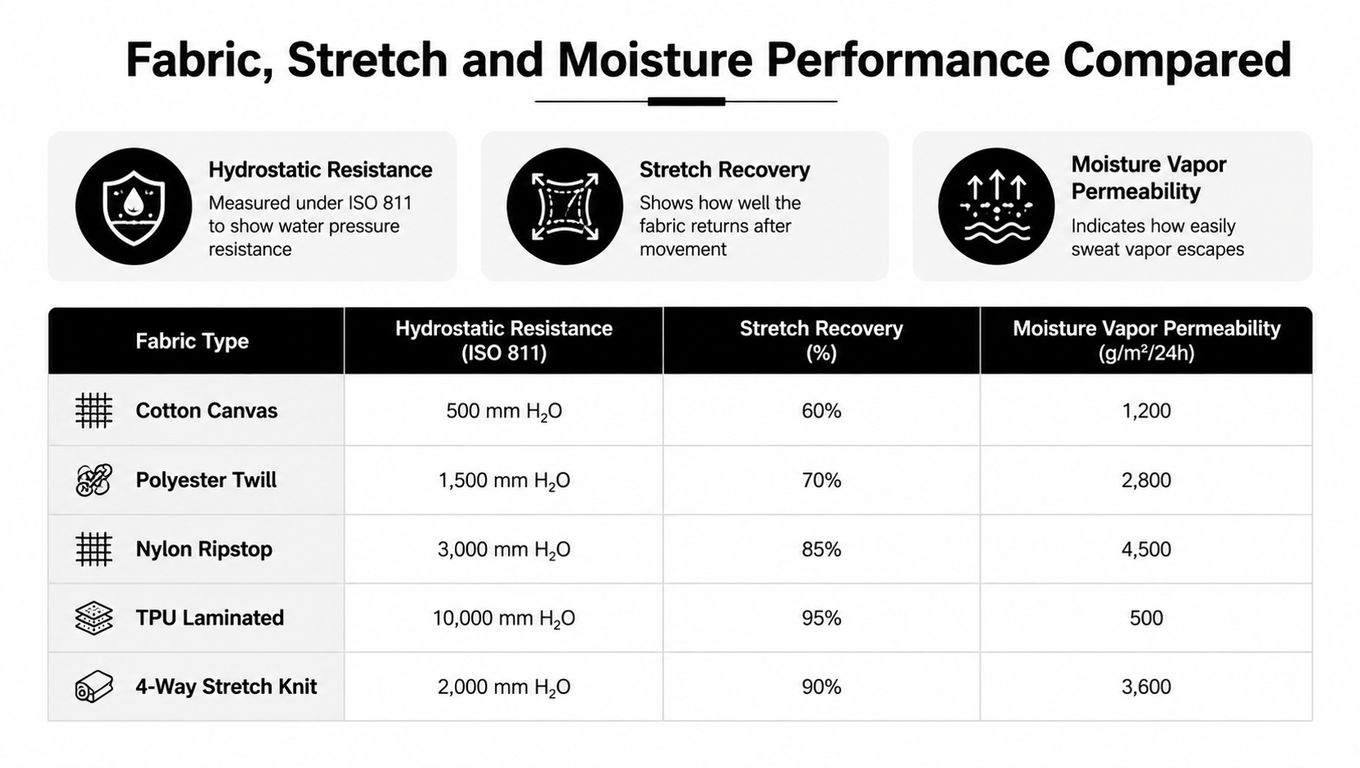
Waterproof and breathable are incomplete descriptions without a test method. Neither word tells you how the fabric was evaluated, whether the result applies to the finished garment, or how comparable it is with another jacket's claim.
A fabric-panel rating doesn't prove that the finished jacket will keep rain out.
Performance metrics to request before buying
The textile-performance paper published through Wiley identifies ISO 811 for hydrostatic-pressure resistance, ASTM E96 for moisture-vapor transmission, and ISO 11092 for evaporative resistance, with practical RET benchmarks shown below.
| Metric | What it measures | Benchmark or what to ask |
|---|---|---|
| Hydrostatic resistance (ISO 811) | Water pressure a fabric holds before leaking | Ask for the figure and test method; higher means greater resistance under the test |
| Moisture-vapor transmission (ASTM E96) | Vapor passing through fabric, in grams per square meter per 24 hours | Compare only results produced using the same procedure |
| Evaporative resistance, RET (ISO 11092) | Resistance to sweat vapor escaping | Below 6 highly breathable; 6 to 13 generally comfortable for active use; above 20 relatively poor |
| Four-way stretch | Movement across and along the fabric during the swing | Confirm that the shell stretches in both directions, then test it while wearing it |
| Wind resistance | Restricting air penetration through the shell | Ask whether the claim concerns the fabric or the finished garment |
| Moisture-wicking interior | Moving liquid sweat away from contact areas | Check the fabric description and assess comfort during a warm walk |
Lower RET means sweat vapor can escape more easily. Don't confuse that with moisture-vapor transmission rate, or MVTR, where the measurement describes how much vapor passes through the fabric.
MVTR results from different procedures aren't reliably interchangeable. If one seller supplies a number without the procedure and another provides a documented test, you don't yet have a fair comparison.
The distinction between these properties matters more than a cluster of performance badges.
Check construction alongside the numbers
Stretch recovery deserves attention alongside stretch itself. Gently extend the fabric across the upper back, release it, and check whether it returns cleanly rather than remaining rippled or baggy.
A moisture-wicking lining answers a different question from breathability. It may spread liquid sweat away from your skin, but that doesn't establish how easily vapor escapes through the outer shell.
Inspect the likely entry points for rain. Look inside for seam protection, examine the main zipper's backing or covering, and check whether pocket openings expose their contents to runoff.
Don't treat a water-repellent surface as evidence of sustained rain protection. Surface beading is useful, but it doesn't answer what happens at stitched seams, open pockets, or the collar when you bend into address.
If the seller supplies no standardized results, treat the garment as unrated for those properties, not automatically poor and certainly not proven high-performance. Buy it for conditions its documented construction supports.
How to Test Fit and Swing Mobility Before You Buy
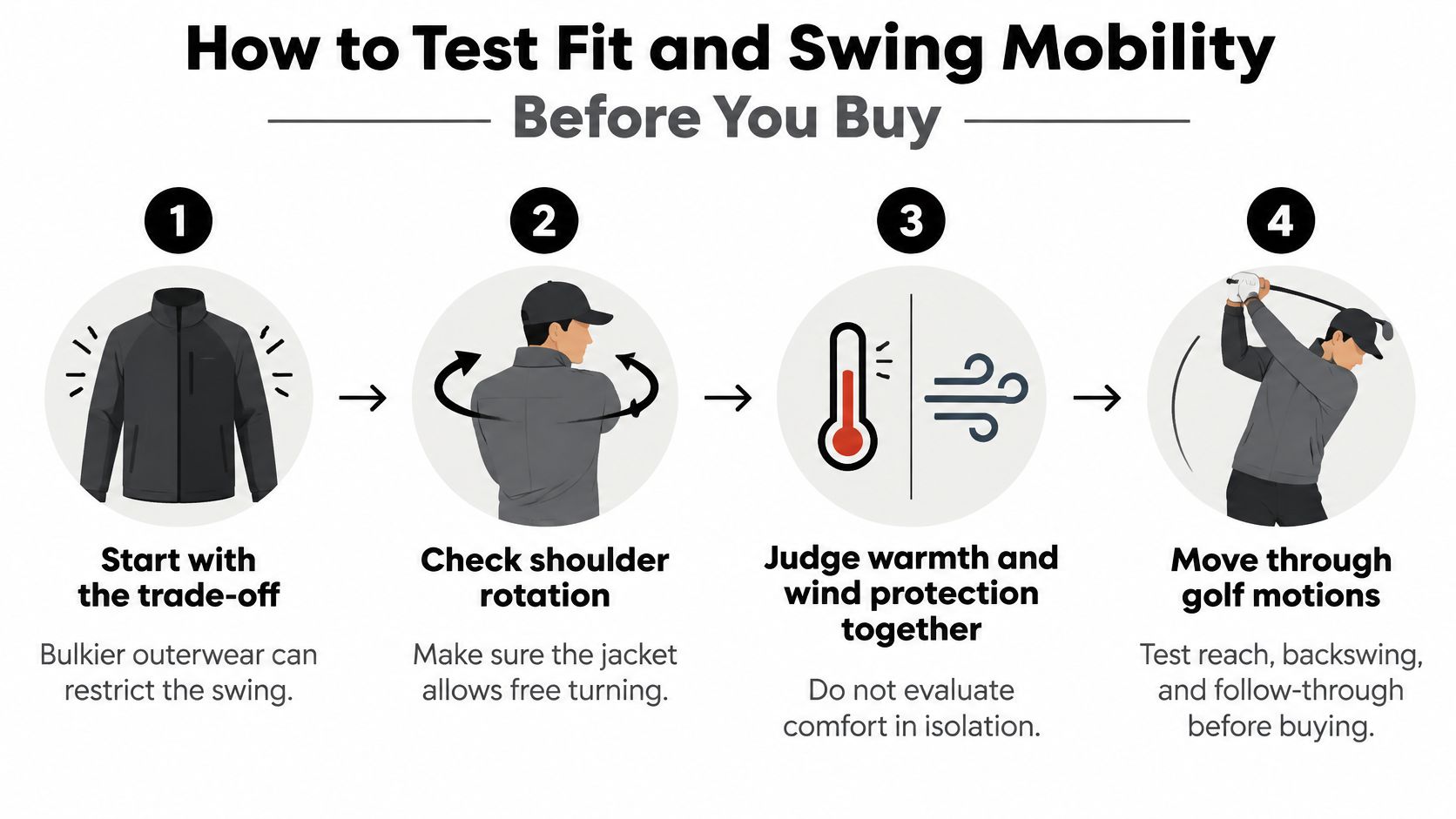
Bulky outerwear can restrict rotation even when it feels comfortable standing upright. Judge warmth, wind protection, and movement together, because improving one by adding material can compromise another.
The golf clothing guidance from adidas recommends lightweight layering and stretch materials rather than relying on bulky clothing. A proper fitting should reproduce your golf movements, not just your posture in a mirror.
Run the movement test
- Wear your normal underlayers. Start with your usual polo or thermal base layer. If you regularly play in a sweater, bring that too, because its sleeves and shoulder seams change the available space.
- Take your address posture. Let your arms hang naturally and hinge forward as you would over the ball. Check for pulling across the shoulder blades, folds pressing into the armpits, or a zipper that bows into your hands.
- Make a full backswing. Use a club where the shop or fitting area permits it, otherwise reproduce the movement carefully without one. Pause at the top and notice sleeve tension, then complete the follow-through without shrugging to accommodate the jacket.
- Bend to retrieve a ball. The back hem should maintain useful coverage rather than climbing immediately above your waistband. Watch whether the front zipper strains or the collar presses against your throat.
- Close the collar and adjust the openings. Extend your arms with the jacket zipped, then set the cuffs and hem. A wind flap shouldn't bunch under your chin, and cuff closures shouldn't interfere with your grip.
- Check sleeves in both positions. With arms relaxed, the cuffs shouldn't swallow your hands. With arms raised, they shouldn't pull so far back that the forearms feel exposed or the sleeves tug across the elbows.
- Choose size by function, not habit. Don't automatically size up because a jacket has a trim cut. Try the larger size when your intended mid-layer creates tension, but reject it if the extra fabric flaps, bunches, or gets in your way.
Don't solve the wrong fit problem
A larger torso won't necessarily fix a restrictive armhole or poorly positioned shoulder seam. If the jacket fits your middle but still fights your backswing, try another cut instead of accepting excess fabric everywhere else.
For dry conditions where sleeves are the main obstruction, a windproof golf vest is worth considering as an alternative layering approach. It isn't a substitute for arm coverage in rain.
Fitting rule: Reject a jacket that makes you change your normal movement to keep it comfortable.
A brief warm-up can reveal binding. Walking, sitting, and repeated swings reveal whether you'll want to keep wearing it through the round.
Golf Jacket vs Dress Jacket
A golf jacket uses an athletic silhouette intended for movement. A dress jacket uses structure, lapels, and a more formal cut to look composed indoors, particularly with well-fitted trousers.
Neither is a universal replacement for the other. A subdued performance layer can look polished at an informal lunch, but it doesn't become a blazer because its color is dark.
| Detail | Golf jacket | Dress jacket |
|---|---|---|
| Shoulder construction | Prioritizes reach and rotation | Often prioritizes a defined shoulder line |
| Front closure | Commonly zipped for adjustable coverage | Commonly buttoned with an open neckline |
| Styling | Athletic proportions and optional graphics | Lapels, formal pockets, and structured shaping |
| Buying test | Address, backswing, bending, and walking | Shoulder fit, lapel drape, seated comfort, and occasion |
Don't assume every wool or cotton blazer is unbreathable, or that every golf shell stretches well. Fabric composition alone doesn't settle comfort, and some tailoring includes stretch. The practical distinction is whether the whole garment accommodates golf movements and outdoor exposure.
Inspect the details that get handled
Run the zipper while wearing a glove. A pull that's difficult to find with cold fingers becomes irritating when you need to open the jacket between shots.
Examine pocket corners for secure stitching and check the cuff lining for exposed edges or rough joins. On decorated pieces, inspect embroidery backing, loose threads, printed edges, and attached logos rather than assuming the decoration will outlast the shell.
Anti-odor treatment doesn't establish durability, and wrinkle resistance doesn't prove stretch recovery. Those are separate features, each requiring its own product description or practical assessment.
Keep care specific to the garment
Use the sewn-in label as the final authority. Where machine washing and low-heat drying are permitted, a sensible routine is:
- Prepare the jacket. Empty pockets, close zippers, and wash with similar lightweight garments.
- Keep washing gentle. Use cold water and avoid bleach unless the label explicitly permits it.
- Control drying heat. Tumble dry low only when allowed, otherwise air dry.
- Protect decoration. Avoid direct ironing over prints, embroidery, and attached logos.
For wardrobe versatility, I'd choose a neutral shell with a restrained graphic before a fully printed outer layer. That's a judgment about how often it will coordinate with your clothes, not a claim that quieter decoration makes the fabric last longer.
Dress Codes and Where a Bold Jacket Works
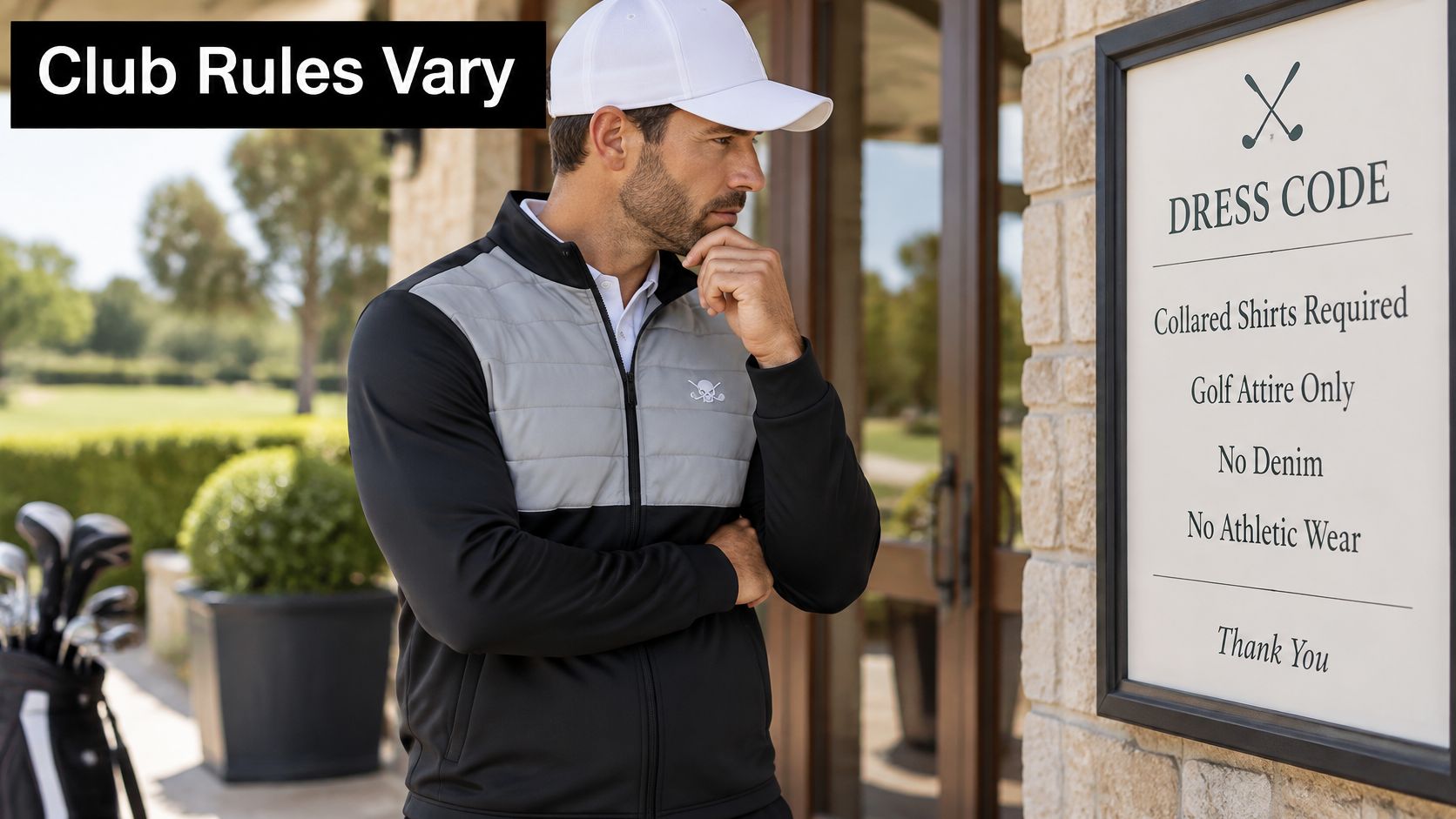
Golf branding doesn't guarantee acceptance at every golf venue. A jacket can be technically suitable for play and still conflict with a club's rules about graphics, hoods, or dining attire.
The Golf Lounge dress-code guide explains that dress requirements are set by individual venues rather than the Rules of Golf. Course access, practice facilities, terraces, and formal dining should therefore be treated as separate clothing decisions.
Venue policy matters more than fabric technology when the question is whether you'll be admitted.
Jacket fit by venue type
Use this as a checking guide, not permission to bypass a venue's published policy.
| Venue type | On the course | Clubhouse or dining | Practical move |
|---|---|---|---|
| Public municipal course | Check posted rules for graphics and hoods | Confirm any separate indoor requirements | Carry a solid layer for indoor areas |
| Resort course | Follow the resort's golf-attire policy | Restaurants may apply separate standards | Check the specific restaurant, not just the golf page |
| Private club | Follow member and guest clothing rules | Formal dining may require a jacket and tie | Ask the host or club before packing |
| International club | Obtain the individual club's requirements | Each club sets its own policy | Request the written policy before travelling |
| Practice facility or range | Follow the facility's own clothing rules | Check any attached clubhouse separately | Don't assume range permission extends indoors |
Ask about the feature, not the brand
A question such as whether golf jackets are allowed is too broad. Ask whether the club permits skull graphics, high-contrast prints, hoods, or athletic quarter-zips in the areas you'll use.
A collared polo underneath may satisfy a requirement for a collar, but it won't necessarily override a prohibition on the outer layer. Likewise, a water-resistant shell can be appropriate during play without qualifying as the jacket required for formal dining.
A smaller chest mark and dark color reduce visual prominence, but they don't create an exemption. If dinner requires formal tailoring, taking off a bold shell is only useful when the clothes underneath also meet that requirement.
The guide to golf dress codes provides additional context for separating general golf attire from venue-specific restrictions.
Before leaving, use a simple routine:
- Read the current policy. Check guest information, golf attire, and restaurant requirements.
- Call about ambiguity. Describe the actual jacket and ask specifically about your dining plans.
- Pack a suitable backup. Bring a solid athletic layer for conservative casual settings, or proper tailoring when formal dress is required.
Don't rely on what another golfer wore there previously. Enforcement, event requirements, and published policies can change.
Matching Your Jacket to the Round
For a typical cool, windy morning, I'd start with a full-zip golf jacket, provided its construction supports the conditions. The full opening makes it easier to release heat or remove the layer without pulling it over your head.
Choose differently when the round demands it. A light pullover suits mild wind; a documented rain shell belongs in an uncertain forecast; an insulating mid-layer suits cold, dry conditions. Cold and wet calls for a coordinated layering system, not the thickest outer jacket.
Jacket types and where each one works
These are construction categories, not guarantees that every garment carrying the name has the same features.
| Jacket type | Typical construction | Best conditions | Main limitation |
|---|---|---|---|
| Full-zip clubhouse jacket | Full front zip, often with a wind-resistant stretch shell | Cool mornings and windy shoulder-season rounds | More substantial versions take up bag space and can feel warm in sun |
| Quarter-zip windbreaker pullover | Short front opening, often with a stand-up collar and lightweight shell | Mild wind and adjustable layering | Smaller opening limits ventilation and makes removal less convenient |
| Lightweight rain shell | Packable shell, with weather protection determined by fabric and construction | Uncertain forecasts and rain within its documented capability | Limited insulation; humid conditions can feel clammy |
| Insulated mid-layer | Fleece or quilted construction worn alone or beneath a shell | Cold, dry mornings | Excess bulk can crowd the shoulders beneath outerwear |
| Dress blazer (reference) | Tailored woven fabric, often with lining and structured shoulders | Indoor dining and formal occasions | Not designed around repeated golf movements or rain protection |
A quarter-zip does not automatically provide less chest or wrist coverage than a full-zip. Judge collar height, sleeve length, cuff construction, and hem position on the actual garment.
Similarly, wind resistance isn't waterproofing. A windbreaker is a reasonable choice for a dry, breezy forecast, but don't make it your only wet-weather layer unless its specifications justify that use.
Build around how you'll play
For a walking round, prioritize manageable warmth and convenient ventilation. Start with underlayers that don't bunch, and leave enough room to move without making the shell oversized.
For a cart-based round, consider the periods when you'll be sitting still and exposed. An adjustable hem and collar can be useful, but keep the fit test honest: extra warmth isn't helpful if it crowds your shoulders when you step onto the tee.
For cold, wet weather, separate the jobs. Let the base layer manage next-to-skin comfort, the mid-layer supply warmth, and the outer shell handle exposure. The cold-weather golf clothing guide can help organize that system.
A private-club round followed by dinner adds another packing decision. Keep playing clothes and dining clothes distinct when the venue requires it, rather than expecting a dark sports jacket to serve both purposes.
Apply the checklist to a specific jacket
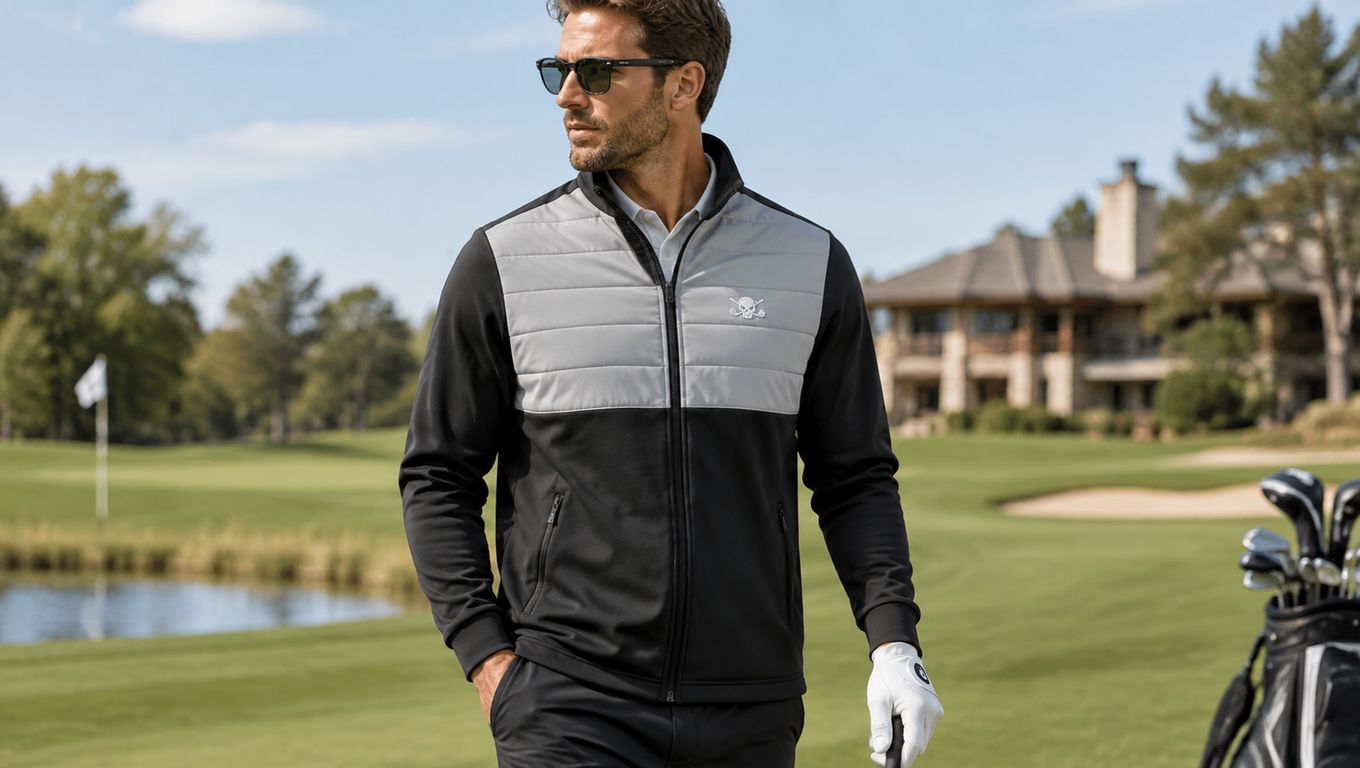
The Men's Clubhouse Golf Jacket (Black) is described with a wind-resistant, water-repellent stretch shell, moisture-wicking interior, full-length zipper with wind flap, elasticized cuffs, and an adjustable hem. That makes it a candidate for cool tee times and shoulder-season play, but the description alone doesn't establish sustained-rain performance or universal clubhouse acceptance.
In 2025, the jacket was listed at $79.99 in Tattoo Golf's men's apparel collection; confirm the current price before ordering. Also verify the current construction details rather than assuming every catalog description applies unchanged.
Before placing an order, check the purchase against your actual next round:
- Venue approval. Confirm the graphic, hood, collar, and dining requirements that apply.
- Layered fit. Use your normal playing clothes during the movement test.
- Weather evidence. Review any hydrostatic, moisture-vapor, or evaporative-resistance results and inspect seam protection.
- Practical ownership. Check the size chart, care instructions, and return policy before committing.
Buy for the conditions you regularly play, not the most extreme forecast you can imagine. A jacket that stays comfortable and gets worn is more useful than an impressive specification sheet left in the locker.
Tattoo Golf offers tattoo-inspired golf apparel and cold-weather layers for players who want expressive style alongside practical movement. Visit Tattoo Golf to compare current outerwear descriptions and size information, then choose a layer that fits your usual round and your venue's rules.



Share:
Why Wear Golf Gloves? Grip, Blisters and When to Skip One
19th Hole Cocktail Collection Golf Shirts from Tattoo Golf