
“Wear a collared shirt and khakis” is technically serviceable golf advice, but it's incomplete. A course-ready outfit has to satisfy the venue, protect you from changing weather, and let your body rotate without fighting the fabric. If your polo traps sweat, your waistband digs in, or your shoes lose traction on damp turf, the dress code won't be the problem. Your clothing will be.
Think of men's golf attire as a layered playing kit, not a collection of clothes you happen to wear near a fairway. Every piece should manage moisture, preserve movement, hold its shape, or solve a specific weather or dress-code problem. This approach also fits the size of the audience. The R&A estimated about 66.6 million golfers across 206 countries and territories in 2023 (Dataintelo golf apparel market overview), so there isn't one universal golf uniform. A strict private club, a municipal course, and a tournament round can demand very different decisions.
Why the Polo-and-Khakis Mentality Is Leaving Strokes on the Table
The old polo-and-khakis formula treats golf clothing as a dress-code exercise. It can pass a casual check-in, yet heavy cotton holds sweat, rigid chinos restrict your turn, and worn sneakers compromise traction on damp turf. The better approach is a layered playing kit built for course conditions and venue rules.
A polo should move with your torso, shorts should stay secure while you walk slopes, and an outer layer should stop distracting you once you address the ball. Collar shape, waistband tension, and hem length matter because poor fit can affect both comfort and how polished the outfit looks.
Men make up a large share of golf's audience, and the men's segment also represents a substantial part of golf apparel revenue, according to the Dataintelo golf apparel market overview. That demand has pushed stretch fabric, moisture control, and comfortable construction into ordinary golf clothing. Treat those features as the baseline, not a luxury tied to a famous logo.
Practical rule: If a garment distracts you during the swing, it has failed, even if it looks acceptable in the clubhouse.
Build around conditions, not logos
Start with the venue and forecast. A municipal course may allow a more relaxed outfit, while a strict club can require a tucked-in collared polo, neat shorts or trousers, and proper golf shoes. Choose the pieces that satisfy the dress code first, then adjust insulation, ventilation, and rain protection for the round. For personality without sloppy styling, this guide to why plain golf polos are out offers a useful direction.
Layering principles also apply to long outdoor efforts. A marathon layering strategy reinforces the value of managing moisture, movement, and changing conditions. Golf adds repeated torso rotation and course-specific clothing rules, so each layer must work during the swing and at the clubhouse.
Build your wardrobe around a dependable base, a weather layer, and venue-specific alternatives. Put fit and fabric ahead of brand prestige. An inexpensive performance polo that sits correctly across your back will serve you better than a costly shirt that pulls at the shoulders.
The Core Pieces Every Men's Golf Wardrobe Needs
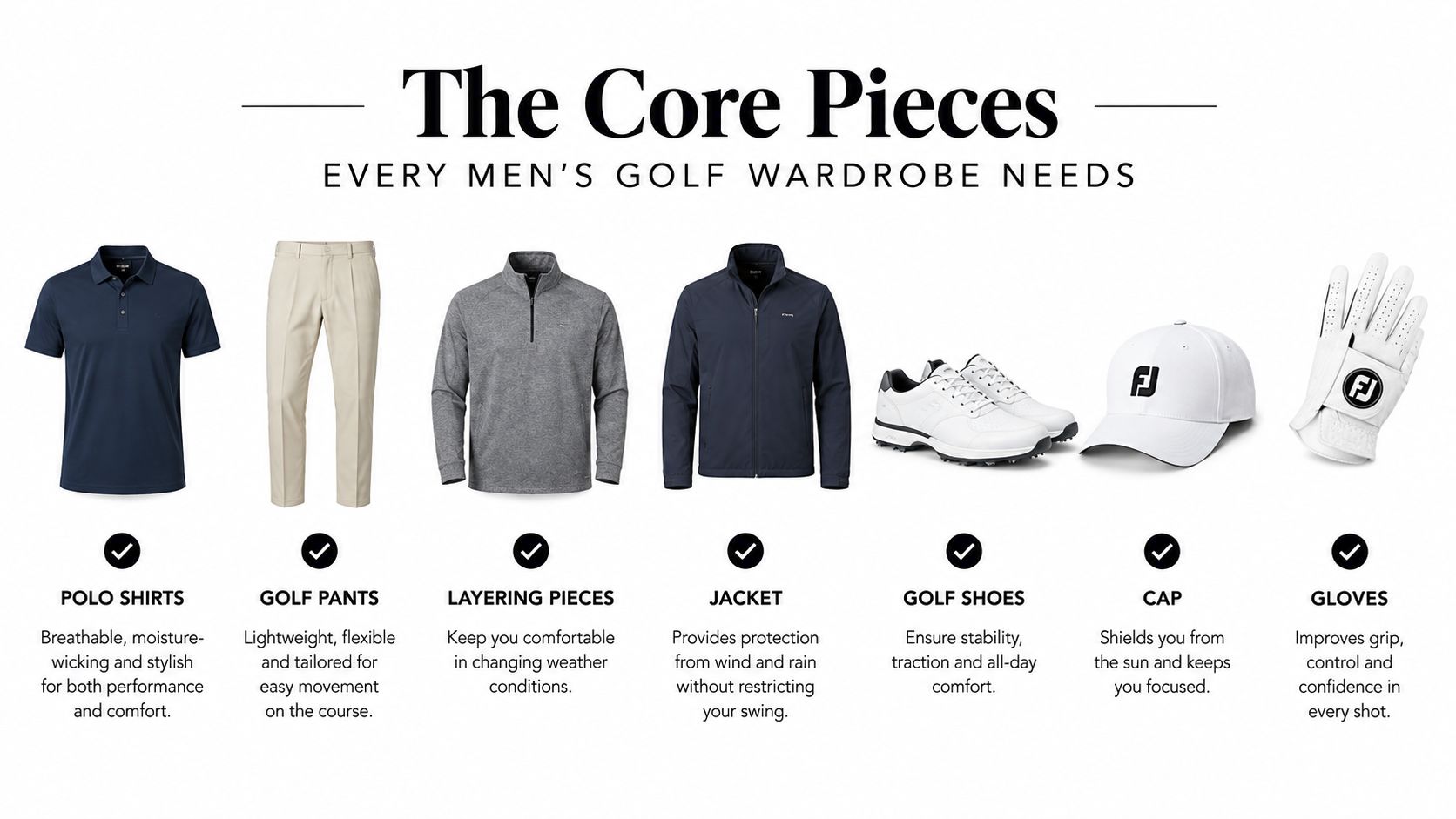
A functional golf kit starts with a few pieces that earn their place. The collared polo remains the safest upper-body choice because many courses still enforce collar requirements, tuck-in expectations, and restrictions on casual tops. A four-way stretch polo that sits at the hip gives you room to rotate without billowing when tucked.
Bottoms should look crisp without behaving like office clothing. Choose flat-front shorts with a 9-inch inseam for warm rounds, or stretch trousers when the venue, temperature, or formality calls for them. Bermuda-length shorts are the safer default at traditional facilities, while casual courses may allow more relaxed athletic options. The golf dress-code baseline from Golf Pro Advice explains why collared shirts, non-denim bottoms, and appropriate golf shoes remain dependable choices.
The small pieces still matter
A belt finishes the outfit and keeps the waistband stable through the swing. Use a leather or woven belt with a low-profile buckle. A rigid dress belt can pinch when you bend, while a stretch construction follows your movement better. Match the belt's formality to the venue, not necessarily to the price of the trousers.
Socks should stay secure inside the shoe and avoid unnecessary bulk. At a traditional club, choose a length that won't expose bare ankle when you sit or bend. At a casual municipal course, a clean low-profile pair may be acceptable if local rules permit it.
Footwear carries the greatest technical load. Golf shoes with soft spikes or spikeless soles provide the traction expected across major markets, and the right choice depends on turf, walking distance, and weather. Don't use worn lifestyle sneakers as a substitute when the surface is damp or the round demands a stable base.
Core doesn't mean expensive. It means every item solves a clear problem, from keeping your collar presentable to maintaining grip through the downswing.
Performance Fabrics That Change How You Play
Fabric choice becomes decisive once heat, humidity, or rain enters the round. Cotton looks clean and feels familiar, but it holds perspiration and grows heavy against the skin. A moisture-wicking polyester blend moves sweat away from the body, dries faster, and usually keeps its shape through repeated swings. Learn what moisture-wicking fabric means for golf before trusting a label that only says “performance.”
Stretch matters just as much. Elastane adds give, while mechanical stretch in the knit or weave can provide mobility without making the shirt cling. Test the garment in a golf stance. Your shoulders should turn freely, the fabric should recover after the swing, and the hem should not hang loose around your waist.
Textile research on sportswear examines thermoregulation and moisture buffering as ways to keep the skin climate more stable during sustained activity. Merino wool is reported to buffer moisture more effectively than polyester and can absorb up to one-third of its weight without feeling wet (Journal of Natural and Technical Sciences textile research). That makes merino useful in selected base layers. For many hot rounds, lightweight synthetic blends remain easier to wash, dry, and wear.
Match the fabric to the forecast
Hot, humid golf calls for strong wicking, open ventilation, and a light build. A vented back panel, mesh underarm section, or breathable knit can matter more than a decorative print. UV protection earns its place on exposed fairways, especially during long stretches without shade.
Shoulder-season golf needs a layer-friendly fabric. Wear a light or midweight knit under a quarter-zip, and leave bulky cotton fleece at home if it restricts your arms. Rain calls for a water-resistant or waterproof shell with enough stretch for a full follow-through. A windbreaker that soaks through is not rain gear.
| Feature | What It Does | Best For |
|---|---|---|
| Moisture wicking | Moves perspiration away from the skin and supports faster drying | Hot and humid rounds |
| Four-way or mechanical stretch | Preserves rotation and walking comfort | Full swings and long walking days |
| UV protection | Helps reduce exposure on uncovered parts of the body | Bright, open courses |
| Mesh ventilation | Increases airflow through heat-prone areas | Midday summer play |
| Water-resistant shell | Sheds light moisture while preserving mobility | Drizzle and changing weather |
| Lightweight knit | Adds coverage without restricting movement | Cool mornings and layered rounds |
Set your buying priorities in order: wicking and stretch first, UV and thermoregulation second, brand prestige last. A well-fitted performance layer improves the kit more than a famous logo.
Choosing Shorts, Pants, Belts, and Footwear for Your Rounds
The bottom half of the outfit should reflect how you play. For a hot walking round, choose 9- to 11-inch stretch shorts that stay just above the knee and don't bunch at the rise. For cooler mornings or formal clubs, stretch-woven trousers provide coverage while preserving movement. Jogger-style technical pants can work as a middle ground, but only where the course permits them and the taper looks intentional rather than athletic-wear sloppy.
Belts deserve more attention than they usually get. A woven belt or leather stretch belt follows your torso through the swing better than a stiff office belt. Reversible designs are useful when you move between venues with different expectations, but keep the buckle low profile and avoid anything that clatters against the club or looks costume-like. More guidance on choosing pants for golf can help you compare cut and movement before buying.
Footwear divides into three practical categories. Spiked shoes suit soft, wet turf and rounds where maximum grip matters. Spikeless shoes are the versatile default for travel, walking, and casual wear after the round. Players who need more stability should look for a broad, supportive base rather than choosing solely by appearance.
| Option | Best For | Comfort Range | Dress Code Fit |
|---|---|---|---|
| Stretch shorts | Hot walking rounds and relaxed venues | Excellent in warm weather | Strong when tailored |
| Technical trousers | Cool mornings and traditional clubs | Strong across changing temperatures | Safest formal option |
| Jogger-style pants | Modern casual courses | Excellent for mobility | Check local rules first |
| Spiked shoes | Damp turf and maximum traction | Supportive, sometimes firmer | Standard at traditional venues |
| Spikeless shoes | Travel, walking, and versatile use | Comfortable across surfaces | Accepted at many courses |
| Wide-base trainers | Stability-focused players | Supportive and grounded | Depends on venue policy |
Choose bottoms and shoes by where you play, how far you walk, and what the ground is doing. The cleanest item on the rack isn't automatically the right one.
Dressing for the Weather From the First Tee to the 19th Hole
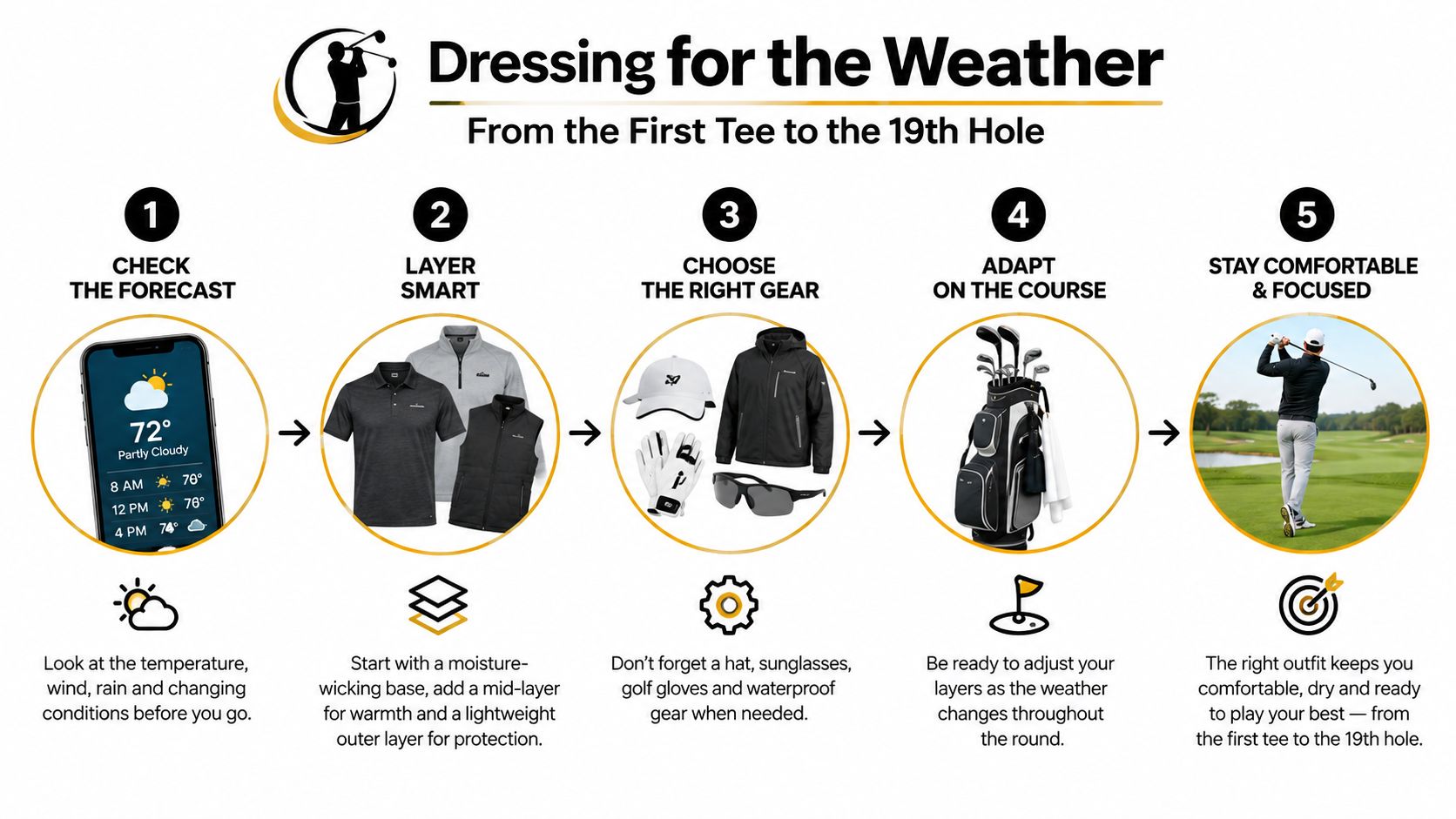
Golf weather changes faster than your outfit can if you leave the house in one layer. Build a system that lets you remove or add protection without disturbing your swing.
Four conditions, four solutions
Early-morning chill: Start with the polo and add a midweight quarter-zip or technical pullover. Choose one with a breathable knit and a zipper that lets you vent as the sun rises. A sleeveless wind vest can warm the core while leaving both arms clear for the swing.
Midday heat: Wear a lighter-color polo with strong moisture management, vented shorts, and a cap with a sweat-wicking band. UV sleeves make sense on open courses where your arms remain exposed for hours. They're easier to remove than a long-sleeve layer once the temperature rises.
Rain: Carry a fully seam-sealed waterproof shell, not a casual windbreaker. Add a rain grip glove and a hat with a structured brim that sheds water without collapsing over your eyes. The shell should stretch across the shoulders and pack down without becoming a noisy, restrictive layer.
Wind: Coastal and hilly courses call for a wind-resistant vest or lined jacket. Block gusts across the torso, but avoid heavy insulation that traps heat and limits rotation. A clean fit through the shoulders matters more than extra pockets.
Weather gear should be easy to remove, easy to pack, and quiet during the swing.
The best setup is modular. Keep the polo as the constant base, then select the mid-layer or shell according to the forecast and the course's exposure.
Three Outfits You Can Build Right Now
A good outfit isn't a random set of technically capable pieces. The colors, proportions, and formality need to work together, while each garment handles a real playing condition.
Casual municipal round
Start with 10-inch stretch shorts, a heathered performance polo, spikeless shoes, and a webbed belt. Add a single-strap glove for quick access and a breathable cap if the course has little shade. This combination handles walking comfort and relaxed venue standards without looking like gym clothing.
The heathered polo hides minor perspiration better than a stark solid and gives the outfit some visual texture. Keep the shorts flat-front and clean through the thigh. If the course allows untucked shirts, make sure the polo still finishes near the hip rather than hanging like a casual tee.
Country club day
Choose performance pants, a solid polo with a restrained stripe or subtle pattern, a leather stretch belt, and spiked shoes. Add a structured cap or visor only if it fits the club's stated rules. Tuck the polo, keep the buckle quiet, and avoid novelty graphics unless the venue clearly welcomes them.
Fit does the heavy lifting here. The pants should follow the leg without clinging, and the shirt should stay tucked while you bend to read a putt. The outfit can still use performance fabric, but the technical features should remain visually discreet.
Hot-weather summer match
Use a lightweight vented polo, 9-inch shorts with a stretch waistband, and spikeless knit shoes that allow airflow. Pack a cooling towel, sunscreen, and a structured cap with a sweat-wicking headband. Choose light or mid-tone colors that don't make heat feel more oppressive.
The match outfit should remove friction. You shouldn't need to adjust the waistband after every tee shot, and your shoes shouldn't feel heavy during the final stretch. A spare glove is sensible if humidity makes the grip slippery.
These builds aren't rigid uniforms. Swap the spikeless shoes for spikes when turf is soft, replace shorts with trousers when the venue requires them, and add a quarter-zip when the first tee feels cold.
Fit, Sizing, and Care That Make the Kit Last
Performance fabric can't rescue a bad fit. Start with the polo. The shoulder seam should land near the shoulder bone, the collar should leave roughly a two-finger gap, and the waist should follow your shape without billowing when untucked. You need enough room across the chest and upper back for rotation, but extra fabric around the midsection creates a sloppy silhouette and can pull when tucked.
Shorts should sit securely at the waist and finish just above the knee. The rise shouldn't bunch when you squat to read a putt, and the leg opening should allow movement without flaring. Pants should break once at the ankle, with stretch panels that recover after walking, bending, and repeated swings.
Buy for the body you actually have
Don't assume your pant size tells you the correct belt size. Measure your waist and choose the belt around that measurement, especially if the belt uses stretch material. Golf shoes may need a little additional room for downhill walks and thicker socks, but don't size up so far that your heel slips during the swing.
Wash performance garments in cold water and skip fabric softener. Softener can coat the fibers and interfere with moisture transport. Hang polos to dry instead of cooking the stretch and shape in high heat.
- Rotate shoes: Alternate two pairs when possible, and use cedar inserts to help them dry and retain shape.
- Inspect traction: Replace worn spikeless outsoles when the tread no longer gives dependable grip. The care schedule should follow wear, not the calendar.
- Protect stretch: Avoid harsh heat, overloading the washer, and leaving damp garments in a closed bag.
- Check recovery: If a waistband or collar stays stretched after washing, that piece has stopped doing its job.
Care is cheaper than constant replacement, but only if you begin with the right cut.
Your Course-Ready Wardrobe Checklist
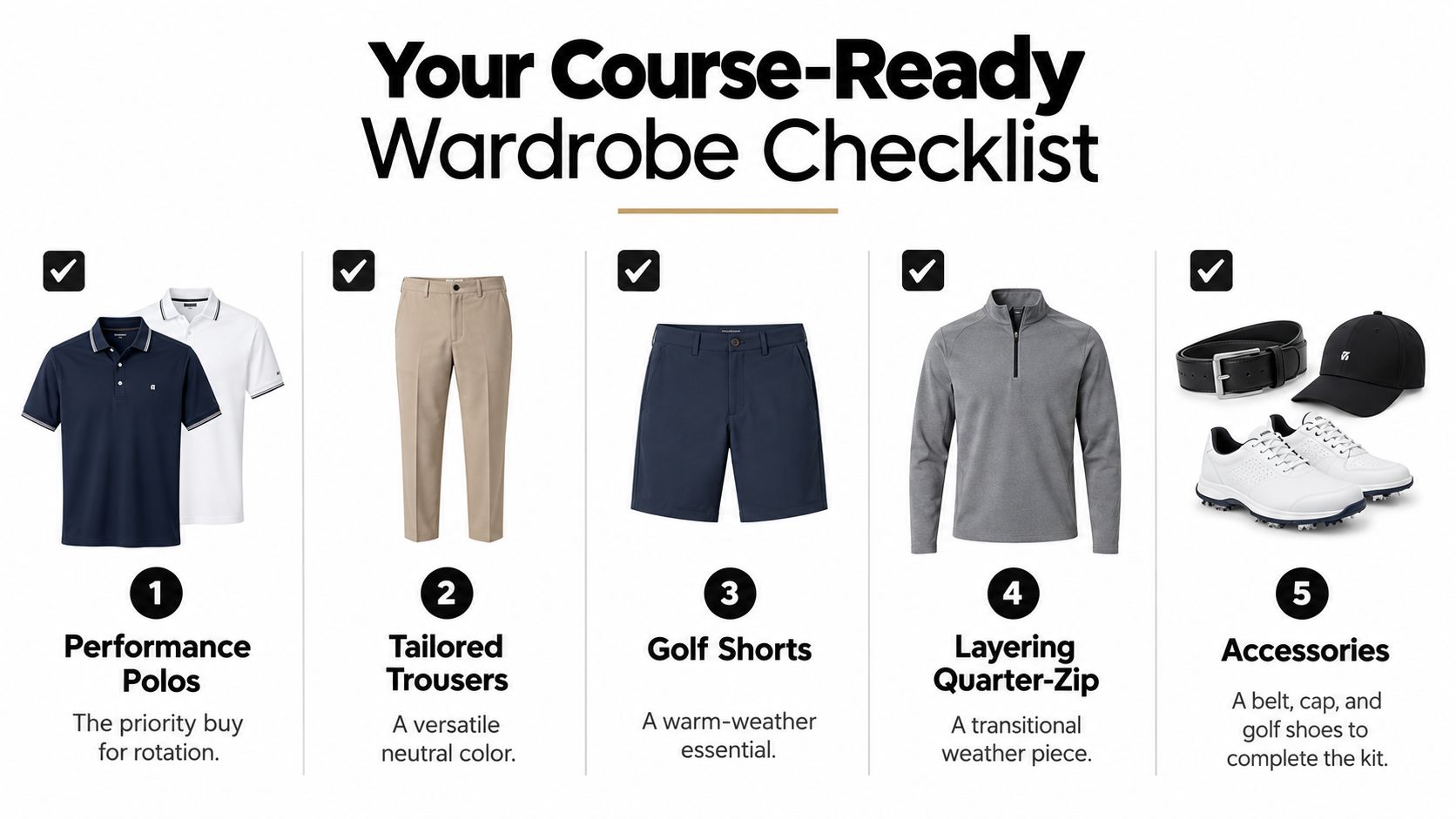
Build the kit in priority order instead of replacing everything at once. Start with two performance polos so one can rotate while the other is in the wash. Add one pair of stretch shorts, one pair of technical trousers, spikeless shoes, a rain shell, and a breathable mid-layer. That combination handles most ordinary rounds while giving you options for changing conditions and venue expectations.
The next purchases should solve narrower problems. A sun hoodie or UV sleeves help on exposed summer courses. A second glove prevents a damp round from turning into a grip problem. A backup belt belongs in the bag if you regularly play at courses with different dress standards.
Use a 60-second departure check
Before leaving, run through the conditions rather than grabbing the same outfit by habit.
- Confirm the venue: Check whether the course requires collars, tucked shirts, fitted shorts, trousers, or specific footwear.
- Read the weather: Choose the base layer and pack the appropriate mid-layer, shell, or wind protection.
- Check the fit: Swing once in the full outfit. If fabric pulls across your back or the waistband shifts, change it before you arrive.
- Pack the backup: Bring a dry glove, an extra layer, and a cap suited to the forecast.
- Inspect the shoes: Make sure the outsole is clean and the traction remains dependable.
Your golf wardrobe doesn't need to be large. It needs to be layered, properly fitted, and built around the conditions you face. The polo-and-khaki formula is only the starting point. Choose performance fabric before a famous logo, stretch before rigid tailoring, and venue-appropriate footwear before casual sneakers.
Visit Tattoo Golf to browse men's performance polos, shorts, pants, hats, belts, outerwear, and accessories that combine stretch and moisture-wicking construction with bolder golf graphics. Pick one outfit around your next course condition, verify the fit with the size chart, and build the rest of the kit piece by piece.

Share:
Best Golf Pants for Comfort, Stretch and Performance Guide
Men’s Golf Outfit Ideas for Every Season That Work