
The most common cooler-weather advice is simple: put on something warmer. That advice feels safe in the parking lot and surprisingly expensive on the first tee. A puffy jacket, a thick sweater, and a second shirt can leave you comfortable while you wait and clumsy the moment you swing. Golf clothing for cooler weather: a guide to layering starts from a different goal. Stay dry, stay able to turn, and change the outfit as the round changes.
Why One Heavy Layer Costs You Distance
Warmer is not the same as better. One oversized insulated garment traps heat, and it also changes the path of your arms. A stiff outer jacket shortens the shoulder turn. Loose fabric bunches at the trail elbow. A thick collar lifts the chin and shortens the finish. You feel warm. The club does not travel the same way.
Restricted rotation shows up as an early release, a shorter arc, and a slower strike. The jacket is doing part of the work your shoulders used to do. You compensate without noticing, then you start steering the club instead of swinging it.
A controlled golf clothing test put numbers on that feeling. Six bulky layers reduced driver ball speed by 6 mph, equal to 3.7%, and shortened carry by 15 yards, according to findings summarized alongside clothing research in a U.S. Geological Survey open-file report on cold-weather clothing. That is not a tiny miss. It is a club and a half of distance given away before the ball leaves the face.
What the swing actually needs
The useful benchmark is unrestricted movement, not maximum warmth. Before you tee off, rehearse three positions in the outfit you plan to wear.
- Full shoulder turn: Both shoulders should clear without the collar or sleeve pulling.
- Trail-arm extension: The back arm should straighten through impact without the cuff grabbing.
- Follow-through: The finish should feel the same as it does in a polo alone.
Practical rule: If you have to fight the garment to finish the swing, take a layer off before you take a club out.
Cotton-rich bases, several thick garments stacked together, and a rigid shell are the usual mistakes. Thin stretch fabric wins. Add insulation a little at a time, and keep the weather layer in the bag until the wind shows up.
Building a Three-Layer System in the Right Order
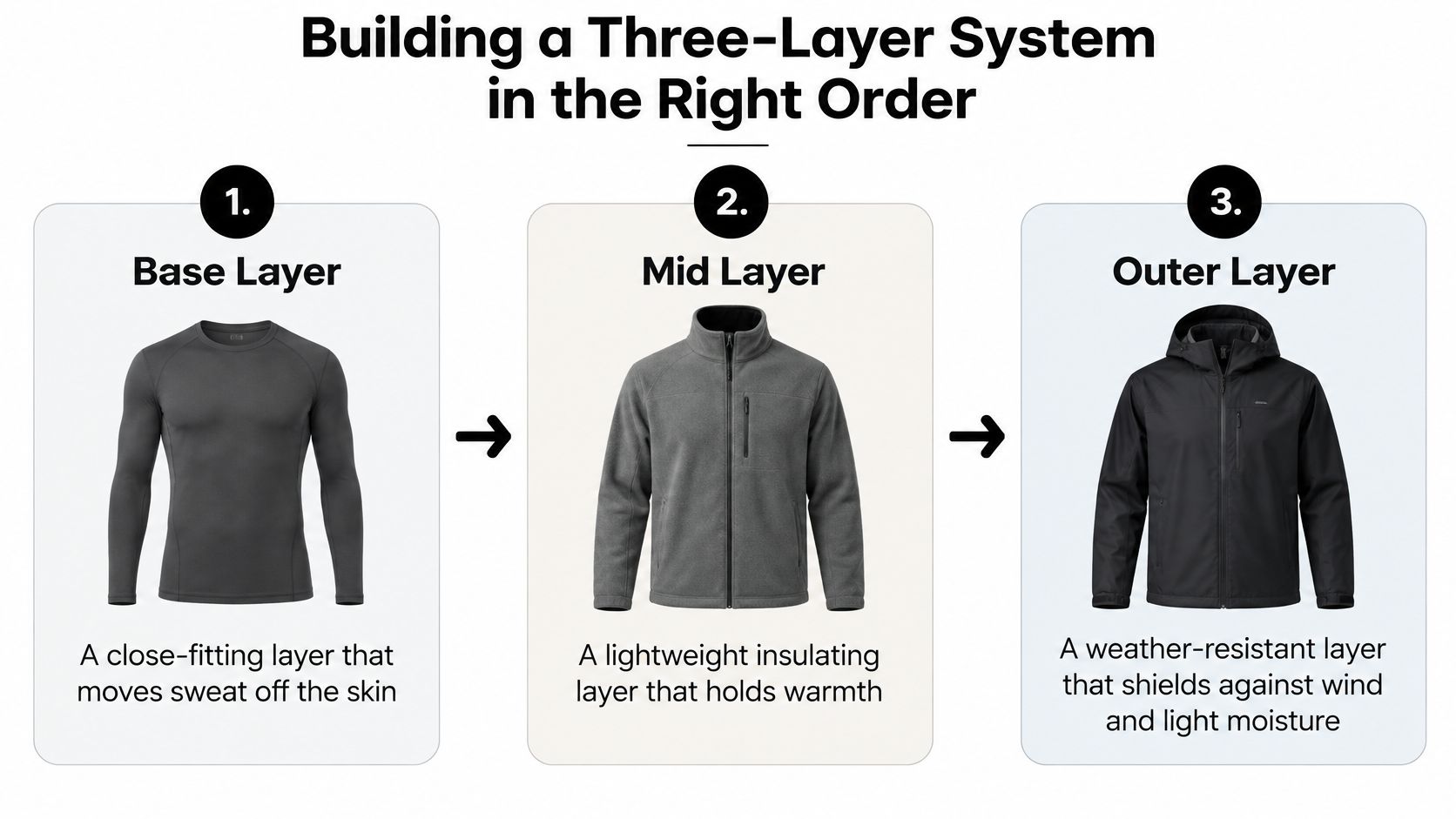
Build the outfit from the skin outward. Moisture control comes before insulation. Humidity raises thermal conductivity, so wet fabric steals the warmth you thought you packed, a point developed in clothing research on moisture and insulation. Air gaps above 8 mm can also start convection currents that move heat and moisture between layers. Fit is part of the system, not a style choice.
Base, then loft, then shell
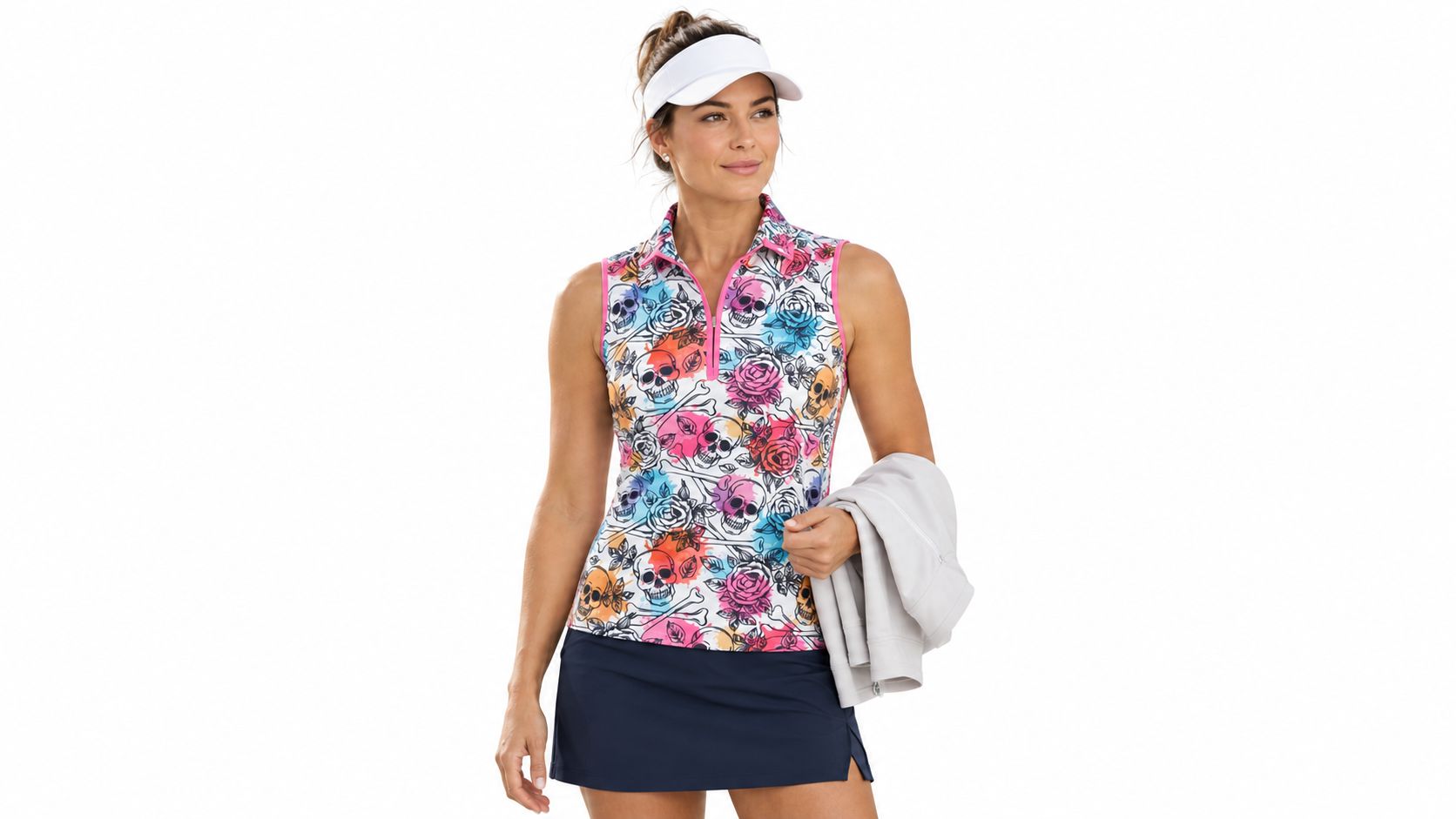
Start with a dry, close-fitting base. Its job is to move sweat off the skin. A snug synthetic or wool-blend shirt does that. A loose cotton tee holds water against you. A Ladies Skull & Roses Cool-Stretch Golf Shirt (Multicolor) is built as a warm-round shirt, with 6 oz Cool-Stretch fabric (92% polyester, 8% spandex), four-way stretch, moisture-wicking, and quick-dry. Worn under a light mid-layer, that stretch and thin cut keep the torso free instead of adding a bulky second shirt.
Add a lightweight mid-layer with modest loft. A thin quarter-zip traps still air without opening big loose cavities under the arms. If you can pinch a wide empty pocket of fabric at the ribs, the gap is too large. Zip it for standing around. Open it the moment you start walking hard.
Finish with a lightweight shell. Wind protection is the outer layer's job, and the shell should let water vapor out. A sealed raincoat with no vents will cook you on a long par 5. Pack it. Do not live in it.
The dry-skin check
Walk or hit practice swings for 10 to 15 minutes, then touch the base layer at the lower back. Damp means you vent or peel the mid-layer before you add anything else. Research on wet clothing ensembles found effective insulation dropped as moisture rose, while fit had only a minimal effect once the clothes were wet. Extra thickness over sweat does not rescue you. It holds the chill in place when you stop swinging.
Adjusting Layers Through a Changing Round
A four-hour round is not one temperature. You walk, stand, swing, ride, and wait on an exposed tee. Sports-medicine guidance says to match layers to ambient temperature and exercise intensity so you do not overheat and soak the base, as discussed in cold-weather performance and injury guidance. A chart that assigns one outfit to one forecast misses that rhythm.
Decision rules that beat a temperature chart
Overdressing is the quiet failure. You sweat on the walk, then you chill on the next tee when the effort drops. Warmer felt right at the car. It costs you later.
| Situation | What to change |
|---|---|
| Long walk, little wind | Open or remove the mid-layer before you start |
| Exposed tee, gusts picking up | Shell on, mid-layer optional |
| Cart round, lots of sitting | Keep the shell handy, wear less insulation while riding |
| Calm cold morning turning windy | Shell in the bag beats a thicker sweater |
| Light rain, mild air | Ventilated shell, not another fleece |
Walking players run hotter than cart players on the same card. If you walk, start one layer lighter than the morning feels. If you ride, the wind on an open cart path will feel colder than the same air on foot, so the shell earns its pocket space.
A forecast that shifts from a cold, calm morning to a windy afternoon belongs in the bag as pieces, not as one heavy top. A packable wind layer, covered in more detail in this golf jacket guide, is often worth more than a thicker sweater you cannot take off without rebuilding the outfit. Fabrics should wick, dry quickly, hold a manageable amount of moisture without feeling icy, and lose as little warmth as possible when they get damp.
If your base is already damp at the turn, do not add a layer. Vent, walk a hole lighter, and put the shell back on only when the wind returns.
Protecting Hands and Feet Without Losing Feel
Cold hits the hands and feet harder than the chest, and most layering talk treats gloves and socks as extras. They are not. A numb grip changes face angle. Cold feet change how you stand. Cold-weather exercise guidance calls for real attention to the extremities, including mitts or over-mitts and enough insulation, while warning that outdoor kit should not choke circulation.
Hands during the swing, warmth between shots
Maximum insulation is the wrong default once you take the club back. A bulky winter glove dulls feedback. You squeeze harder. The face opens or shuts without a clear signal.
Use a modular setup instead.
- During the swing: A thin, grip-compatible golf glove. Leather or a performance synthetic that still lets you feel the ridges.
- Between shots: An insulated cover or mitt you pull off before you address the ball.
- In wind or rain: The shell and a dry glove matter more than a thicker sweater, because wet skin and moving air make the air feel colder than the thermometer.
That split is the whole point of a golf glove fit and materials breakdown. One glove for contact. One cover for the wait. Do not ask a single mitten to do both jobs.
Socks, shoes, and balance
Sock thickness has to match the shoe. A heavy pair stuffed into a summer shoe pinches the forefoot, slows blood flow, and changes how the sole meets the ground. Outdoor guidance is plain on this: socks should not be tight enough to restrict circulation, and cold-weather footwear may need extra volume.
If your toes go numb only after you tie the shoes, the sock is too thick or the shoe is too small for the day. A moisture-managing sock at a normal thickness, with room to wiggle the toes, beats a double pair that leaves you rocking on the outside of the foot. Walking rounds punish a tight shoe faster than cart rounds, because each step keeps the pressure on.
Measuring for a Golf Belt and Reading the Size Chart
Layers change the waist you think you have. A belt sized over a T-shirt in July will sit differently over a base layer and a thin mid-layer in October. Measure the body you will dress, then read the chart. Do not guess from the tag in your shorts.
Measure where the belt will sit
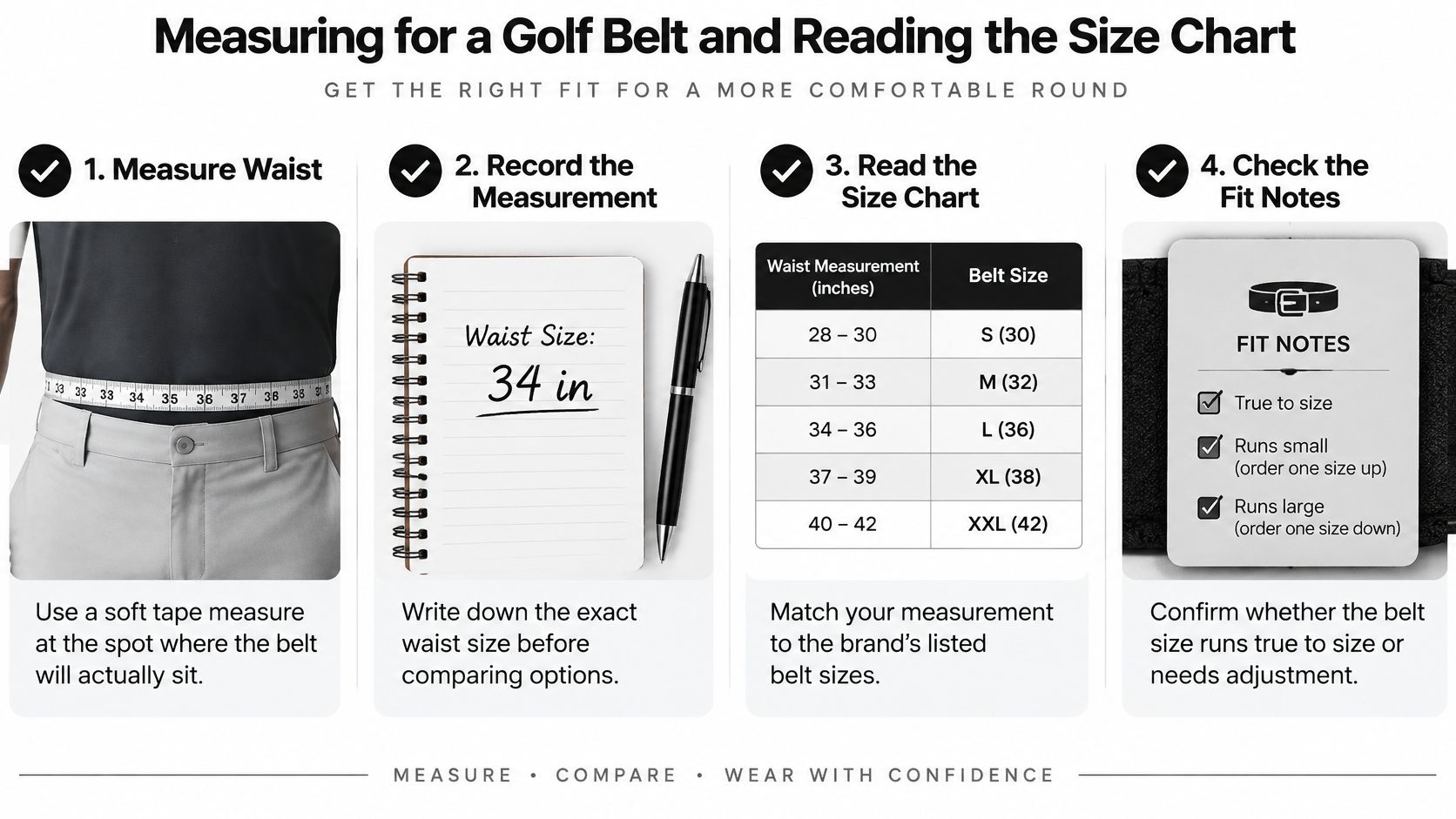
Use a soft tape, not a rigid carpenter's tape. Stand the way you stand on the tee, not sucked in. Place the tape at the spot where the belt will ride, which on most golf pants is at or just above the hip bones, not up under the ribs.
- Dress the layer you will wear. Note whether the tape is over a base layer only or over a base plus a thin mid-layer. Write that down next to the number.
- Keep the tape level and snug. Two fingers should slide under it. If the tape dents the fabric, it is too tight, and the belt will be too.
- Record the number before you shop. Compare that figure to the brand chart. Do not round down because you plan to "wear it loose."
How to read the chart
Shorts and pants are sold by waist size. A belt is often sold by length or a strap range. Those are not the same label. A 34-inch pant waist does not automatically mean a belt marked 34 will land on the hole you want once a mid-layer is tucked in.
A ratchet belt adjusts inside a range, so your measurement picks a starting setting, not one perfect hole. A fixed belt has set holes. If your layered waist sits near the end of that hole pattern, size up so you are not on the last hole with no room left.
Tattoo Golf's genuine-leather ratchet belts are built for that kind of small reset, and the brand's golf belt notes are the place to start before you match a strap to a chart. Use the detailed size chart on the Tattoo Golf website for the actual ranges. Do not invent a size from a different brand's table.
Checklist before you buy:
- Waist, layered: Tape at the actual belt line, number written down.
- Chart type: Waist size for pants, length or range for the belt.
- Style: Ratchet if you will add or drop a mid-layer. Fixed if your outfit barely changes.
- Room: One step of adjustment left after a normal tuck, not zero.
Choosing Belts and Layers That Fit Together
The belt is part of the layering system. If it cannot move when you peel a mid-layer, you spend the back nine fighting the waistband.
Ratchet versus fixed
| Ratchet belt | Fixed-size belt | |
|---|---|---|
| Adjustment | Many small steps inside a range | A few holes, often half an inch apart |
| After a layer change | Reset in a few seconds on the tee | May land between holes once a fleece comes off |
| Under a jacket | Low-profile strap stays flatter if the buckle is slim | A thick buckle can print through a light shell |
| Everyday wear | Easy to micro-adjust as you warm up | Simple, fewer moving parts, less range |
Choose the ratchet when the round will swing from a cold start to a milder walk. Choose a fixed belt when you wear the same two layers all day and you already know which hole sits cleanly.
Fit checks that matter on the course
Center the buckle on the waistband. Run the strap through every belt loop so the mid-layer cannot bunch the fabric into a ridge under the shell. Then test two positions before you leave the house: a full shoulder turn, and a seated position like a cart seat. If the belt digs when you sit, it will dig on every ride between holes.
Tattoo Golf pairs genuine-leather ratchet belts with golf shorts and pants cut for a standard 1.5-inch belt loop. The Dancing Skulls Cool-Stretch Men's Golf Shorts (Black/Charcoal) use that loop size on an 8 oz Cool-Stretch fabric (92% polyester, 8% spandex) with a stretch waistband, about a 9-inch inseam, and waist sizes from 30 to 44. A 1.5-inch strap fills those loops without folding. A wider fashion belt bunches. A skinny strap slides and lets the tucked base layer creep out.
A belt that only fits the clubhouse outfit will fail the moment you remove the mid-layer. Size and style should survive that change.
If the waistband gaps at the back once the fleece is off, move the ratchet one step, or pick the next hole inward. If it gaps only when you swing, the pants are too big for the base layer and the belt is being asked to hide a fit problem.
Your Next Step Before the Next Cool Morning
Treat the outfit as a kit you can change, not a single warm coat. Dry skin first. A thin stretch base. A light mid-layer you can open. A shell that stays in the bag until wind or rain earns it. Hands get a thin glove for the swing and a warmer cover between shots. Feet get a sock that does not pinch. The belt gets measured over the layers you will wear, then checked against the brand's own size chart.
Do that work before the next cool tee time, not in the parking lot. Measure your waist where the belt sits, write the number down, and compare it with the detailed size chart on the Tattoo Golf website. Pick one base, one mid-layer, and one shell. Hit a small bucket or walk the range in that stack. If the shoulder turn shortens, remove bulk before you remove loft from the driver.
A wind shift at the turn should be a zipper decision, not a lost sleeve of distance. Set the kit today so tomorrow's round only asks you to open, close, or pocket a layer.
Tattoo Golf builds course-ready layers and genuine-leather ratchet belts for golfers who want stretch, moisture control, and a fit that still lets the swing through. If you're sorting a cooler-weather kit, start with a thin performance shirt, shorts or pants cut for a 1.5-inch belt, and a belt you can reset when a layer comes off. Visit Tattoo Golf to compare those pieces and check the size chart before your next cool morning.

Share:
How to Choose a Golf Belt That Fits Your Outfit