
You're standing in the pro shop at 8:40 on a Saturday, print shirt in hand, and the assistant is looking at your collar rather than your face. The forecast says 91 by noon. Between "nice shirt" and "we do ask for a collared shirt, sir" sits every decision that matters when you buy a Hawaiian golf shirt: whether the collar clears check-in, whether the fabric is still dry on 14, and whether the print survives August.
Print is the easy part, and it's the part most buyers get right. Fit, fabric weight and the venue's posted policy are where these shirts get rejected or retired early, and none of that shows up in a product photo.
Golf apparel is a serious category now. Grand View Research estimated the U.S. golf apparel market at USD 1.67 billion in 2024 and projected it to reach USD 2.95 billion by 2033, in a report published in 2025 (Grand View Research). More money means more prints on more courses, and more pro shops deciding what walks through the door.
Read the Fabric Specs That Decide Comfort
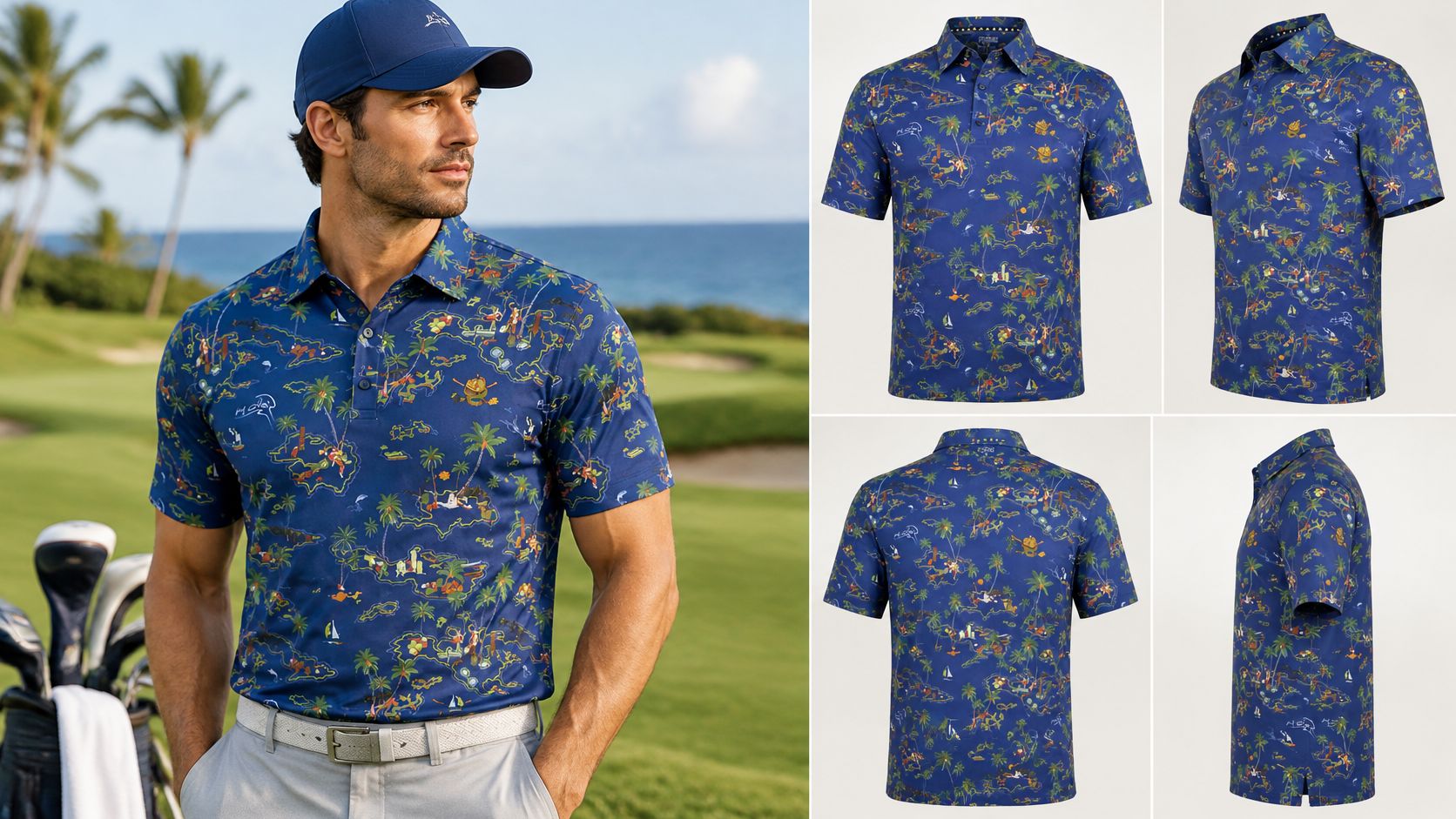
The two Vintage Hawaiian men's shirts in Tattoo Golf's Aloha range look like siblings on the rack and read very differently once you start asking questions. Both use the brand's Cool-Stretch fabric, and on a hot afternoon with a push cart the differences that matter are the ones the print hides.
| Feature | Vintage Hawaiian (Yellow) | Vintage Hawaiian (Ocean Blue) |
| Fabric | Cool-Stretch knit; blend ratio not listed, check the product page | Cool-Stretch knit; blend ratio not listed, check the product page |
| Fabric weight | Described as lightweight; no figure published | Described as lightweight; no figure published |
| Sun protection | Not listed; ask before you buy if UV matters | Not listed; ask before you buy if UV matters |
| Stretch | Four-way stretch | Four-way stretch |
| Odor control | Not listed on the product page | Not listed on the product page |
| Collar and seams | Confirm collar and placket construction on the listing | Confirm collar and placket construction on the listing |
| Sizes | S through 4XL | S through 4XL |
What the spec gaps mean on a hot round
The Vintage Hawaiian Men's Golf Shirt - Ocean Blue shares its core build with the Yellow version: a lightweight, moisture-wicking Cool-Stretch knit with four-way stretch. That's the working baseline, and it's a good one for summer golf. What's missing from both listings is the detail that separates a decent hot-weather shirt from a great one: fabric weight, the exact poly-spandex ratio, and any published sun rating.
Treat those gaps as questions, not dealbreakers. If you're buying one shirt for a season of midday tee times, message the seller and ask for a UV rating before you commit, because nobody can infer sun protection from a floral print.
Spandex content is where the trade-off hides, whatever the exact ratio turns out to be. More elastane buys stronger recovery, so the fabric snaps back after a long day of swings instead of staying bagged across the chest. The cost is that a denser, more elastic knit holds warm air closer to the body. Stretch and cooling pull against each other, and the right balance depends on how you play.
Practical rule: if you run hot, favor the lighter knit over the stretchier one. If you play 36 in a day, take the recovery.
What the AATCC tests actually measure
A wicking test under AATCC TM195 measures how moisture moves through fabric. It says nothing about how fast the shirt dries, because drying rate is measured separately under AATCC TM199 or the heated-plate AATCC TM201 method, as the golf apparel breathability testing breakdown lays out. A shirt can pull sweat off your skin on the front nine and still feel clammy coming in, because wicking and drying are two different scores.
Class 5 on the AATCC moisture-management scale is the benchmark for excellent wicking. Ask for the test method, the fabric composition, and whether the result applies to the finished shirt or only a lab swatch. Bold Hawaiian prints are exactly where that distinction bites, since dense print areas, collar panels and seams all change airflow. The stronger protocol tests three locations, plain body, printed body and collar or placket, after laundering. For the fiber-level mechanics behind the numbers, this explanation of what moisture-wicking fabric actually does covers it well.
Match the fabric to the round you play, and let the spec sheet decide before the print does.
Size and Fit the Shirt for an Active Swing
Sizes run S through 4XL, and the listing advises ordering your normal size. That advice holds for most builds. The variable is the cut: a classic athletic fit, shaped through the chest and shoulders without clinging. A golfer with broad shoulders and a lean waist can nail the chest measurement and still come up short on body length, so check both numbers before you commit.
| Size | Fit note |
| S | Check shoulder width if you are a slim build |
| M | Standard athletic cut for most players |
| L | Size up for layering or humid rounds |
| XL | Check body length for a full reach |
| 2XL | Confirm chest room before ordering |
| 3XL | Test arm range for shoulder pull |
| 4XL | Measure your chest first; larger cuts can sit closer through the torso |
Run this fit test before you commit
- Measure your chest at the fullest point, tape level under the arms, and write the number down.
- Compare it to the published chart and note which band you sit in, plus how close you are to the next size up.
- Raise both arms overhead and watch the shoulders. Fabric that pulls hard across the chest is telling you the cut is wrong for your build.
- Take a slow practice swing and watch the armpit and hem. Bunching at the waist or riding up at the shoulder means size up.
- Between sizes, take the larger one for a hot round. Airflow beats a snug silhouette once the humidity climbs.
Treat the 4XL with the most care. Bigger sizes often add chest room without adding the same proportion of torso length, so measure your chest band and check the size chart on the Aloha Cool-Stretch product page rather than assuming a bigger label means more room everywhere.
Size up if you run warm, plan to wear a base layer on cool mornings, or want more air moving through the torso in humid heat. Shoulder mobility work before the round helps too, since a tight upper back makes any shirt feel restrictive on the backswing. A short routine from MEDISTIK's pre-training warm-up guide loosens the same joints the fabric has to move with.
The Aloha Cool-Stretch Men's Hawaiian Golf Shirt (Tiki) uses the same Cool-Stretch fabric and athletic cut, so the same measuring rules apply across the prints. Finally, confirm the shirt covers your waistband through a full reach, not just standing still.
Check the Dress Code Before You Tee Off
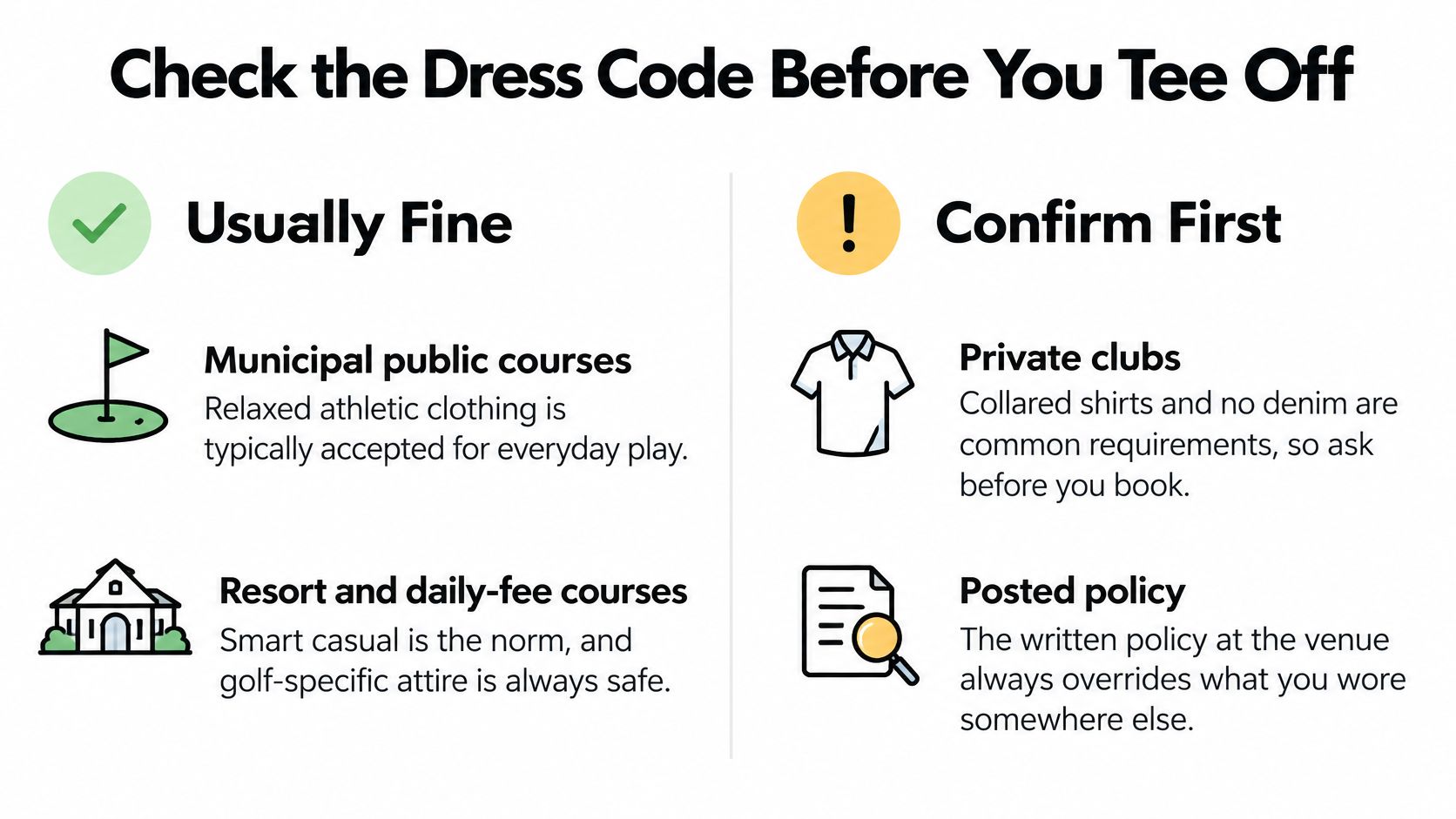
The shirt rarely gets refused for being a print. It gets refused for being untucked, uncollared, or paired with something the club reads as beachwear. Where you play decides the answer far more than the pattern does.
| Course type | Typical expectation | What to do |
| Municipal public course | Relaxed athletic clothing; posted policy controls | Check the course website before you go |
| Resort course | Visitors in island prints are common; staff may still ask | Call ahead if the wording is unclear |
| Private club | Collared shirt usually required | Tuck the shirt if the club requires it |
| Championship venue | Stricter rules on collars and graphics | Follow the policy in the event information |
| Tournament or member-guest event | Event-specific rules in entry materials | Confirm with the organizer |
Golf attire guidance supports that split: public courses may allow more relaxed athletic clothing, while private clubs and championship venues commonly hold collared-shirt requirements, and the posted policy at each course controls, according to the golf outfit guide from Golf Launch Lab. A traveler can't infer acceptance from the shirt's construction, and dress rules shift by country as well as by club.
Polish beats print intensity
The assumption worth challenging is that a loud print is the risk. In practice, bold prints are generally fine when the shirt stays collared, clean, properly fitted and free of offensive imagery. A crisp collar, a sharp tuck and neutral shorts do more for your case at the desk than choosing a muted colorway.
- Read the written policy first. Whether the club bans large graphics or only non-collared tops changes what you pack.
- Call the pro shop when the wording is vague. One question on the phone beats an argument at check-in.
- Quiet everything else. Conservative bottoms and neutral shoes let the shirt carry the outfit.
- Keep a plain collared shirt in the bag. It's a two-minute fix and it saves the round.
If you want the full breakdown of what's accepted where, start with this guide to golf dress codes and what you can actually wear.
Style the Shirt Around Its Print
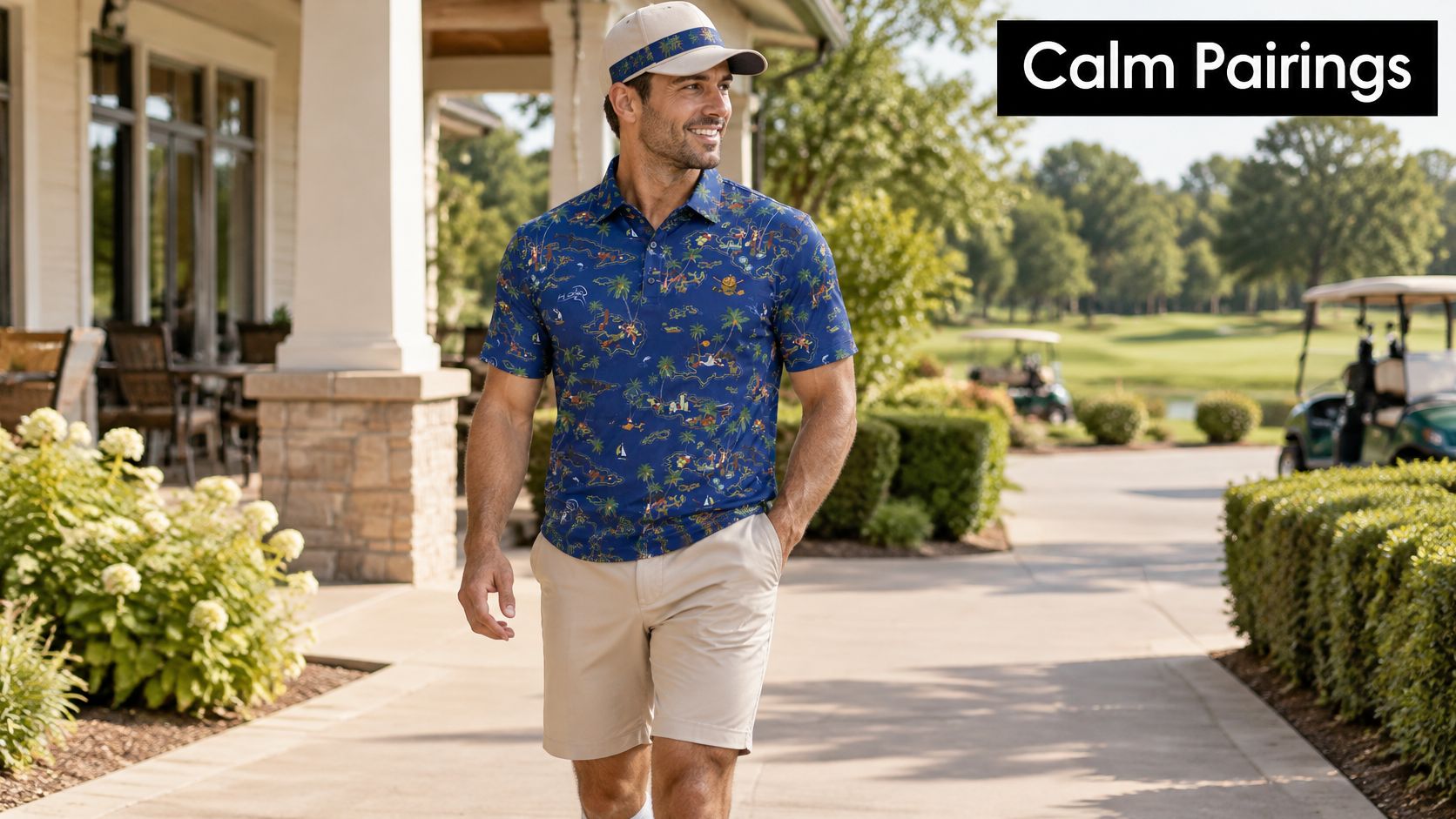
Take the Teal/Orange Aloha shirt as the working example. Orange is the accent, teal is the field, and every other piece you wear should answer one of those two colors. Solid shorts or pants in navy, khaki, white or charcoal give the eye somewhere to rest, and repeating one print color in a sock or cap band makes the outfit read as a decision.
One loud element per outfit, always. A bold print worn with a patterned belt and a patterned hat splits attention three ways. When the print sits on a shirt cut for golf, with a collar that stands and a hem that tucks or hangs clean, it carries the outfit by itself.
There's history behind that. The U.S. National Park Service dates the rise of knit polos, T-shirts and short-sleeved sport shirts to the 1930s, the decade the "Aloha Shirt" name was trademarked in 1937, and describes menswear shifting toward looser, more colorful clothing once wartime fabric restrictions lifted (National Park Service). A shirt born as a hybrid of tailoring traditions takes to a performance cut without strain. The modern version swaps the fabric and keeps the idea.
The person who judges the outfit is standing at the check-in desk, so style it for that ten-second look.
Tuck the shirt where the club requires it and leave it out where relaxed tops are allowed. With the Teal/Orange colorway, white shoes echo the print's lighter accents and tan shoes sit underneath it; black reads heavier than this shirt wants. Check the mirror from the side before you leave: collar sitting clean, hem tidy at the belt, nothing gaping through a full reach.
Choose and Wear a Matching Cap
The cap is the second-loudest item most golfers own, so choose it as a quieter layer than the shirt. A solid or tonal cap in a color pulled from the print works with almost anything.
- Match the quietest color in the print. Not the brightest. The cap should echo, not compete.
- Set the crown by face shape. Round faces look balanced with some height in the crown; longer faces suit a shallower crown and a slightly wider brim.
- Sit the brim flat and level, front edge just above the eyebrows, so the cap reads as one clean line under the collar.
- Adjust the strap so it stays put on a full backswing without pressing on your ears.
- Manage the hair. Short hair sits under the cap; longer hair tucks behind the ears so it doesn't push the crown up at the front.
Test the fit by bending forward and taking a slow swing. If the cap lifts or slides, go down a size or tighten the strap. On hot rounds, choose a breathable crown with a moisture-wicking band so sweat doesn't stain the front panel, and keep a spare in the bag the way you keep a plain collared shirt. The details that separate a cap you forget about from one you keep adjusting are covered in this guide to what makes a great golf hat fit.
How to Wash and Dry the Shirt Without Fading It
Sun protection is a starting claim, not a permanent property. Laundering, abrasion, perspiration and wetness all change how much ultraviolet light a fabric lets through, which is why UV testing under AATCC TM183 with specimen prep under ASTM D6544 is run before and after conditioning rather than once on a new swatch.
The same logic applies to fit and color. AATCC TM61 covers accelerated laundering and AATCC TM135 covers dimensional change, with a commonly cited screening target of no more than ±3% dimensional change after washing for active knits. Colorfastness grades around 4 or better suggest a high-contrast print will hold its contrast, and ASTM D1683 seam-strength testing catches weak armholes and plackets before they fail mid-swing, as the fabric testing standards reference sets out. None of that is a regulatory requirement; it's the standard a shirt should meet if you plan to keep it.
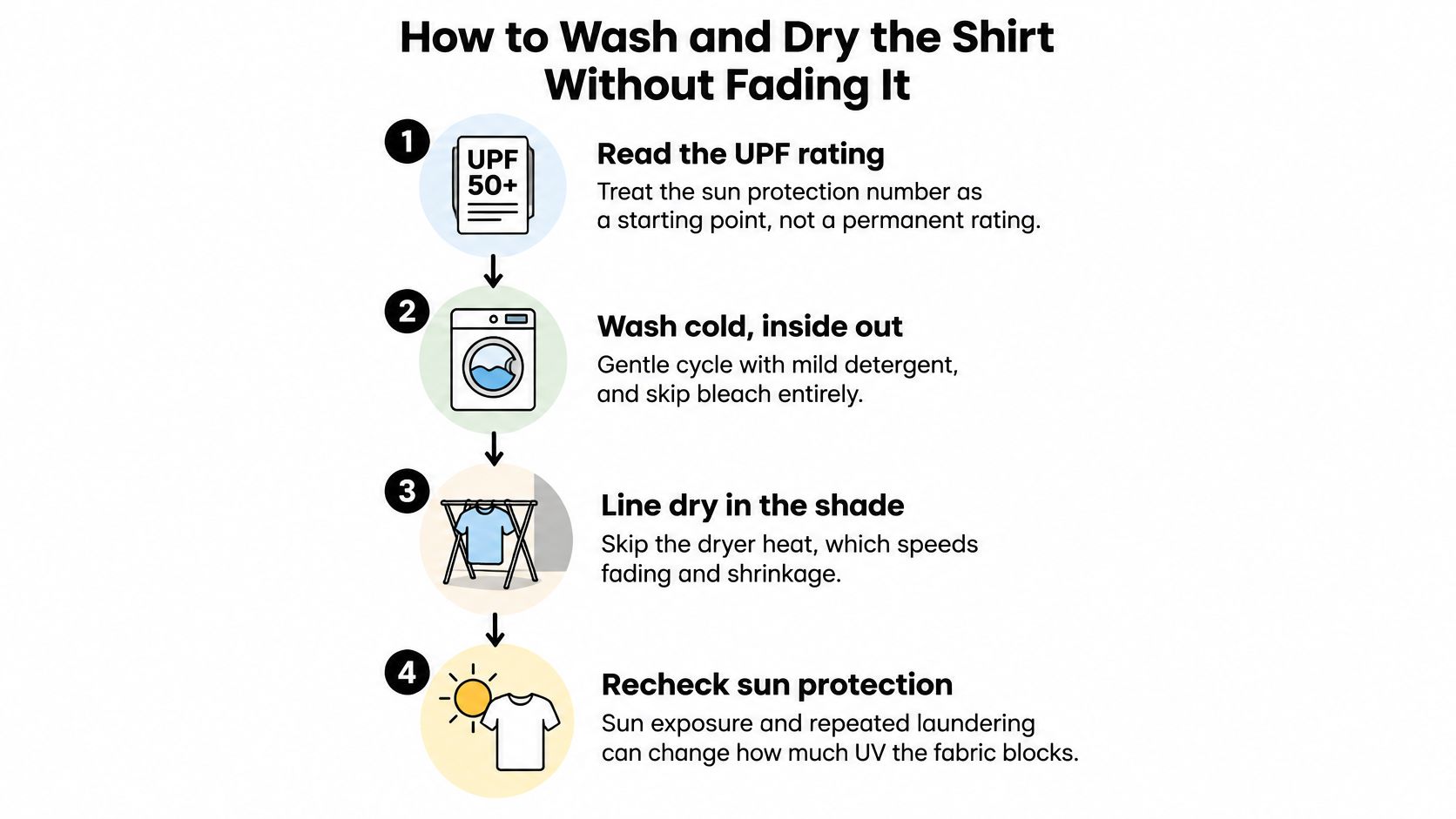
The routine that protects print, stretch and sun rating
- Turn the shirt inside out before it goes in the machine, so the print rubs against less fabric and fewer zippers.
- Wash cold on a gentle cycle with a mild detergent. Heat is what breaks down spandex and dulls dye.
- Skip bleach and fabric softener. Bleach attacks the color; softener coats the fibers that are supposed to move moisture.
- Tumble dry low or hang it. A hot dryer shortens the life of the stretch more than anything else you do to the shirt.
- Iron inside out, if at all, and keep the soleplate off the graphics entirely.
Sweat left sitting in the fabric is the main cause of odor that survives a wash, so rinse the shirt after a sweaty round when you can and hang it rather than balling it into a bag. Rotate two or three shirts through the week so each one recovers its shape between rounds.
Fix Problems and Check Before the Round
A printed performance shirt fails in predictable ways. Most complaints trace back to one of five causes, and each has a fix you can apply before the next tee time.
| Symptom | Likely cause | Fix |
|---|---|---|
| Still damp by the back nine | The knit wicks sweat but dries slowly in humidity | On humid days pick the lightest shirt you own, and expect a slower dry |
| Hem climbs out of the waistband mid-swing | Body length too short for your torso | Wear it untucked where the course allows, or check the length measurement before reordering |
| A snagged thread across the print | Velcro on a glove or a bag zipper caught the knit | Ease the pull through to the inside with a needle instead of snipping it |
| Collar points curl after drying | Dryer heat warped the collar | Press them flat with a cool iron from the inside while the shirt is still damp |
| Packed-in wrinkles survive unpacking | Folded damp or warm into a travel bag | Hang the shirt in the bathroom during a hot shower and let the steam relax the knit |
The four-step pre-round check
- Look the shirt over the night before. Collar sitting flat, placket straight, no loose threads at the armholes or hem. Small problems are cheap to fix at home and miserable at the first tee.
- Take one full practice swing in it, tucked exactly as you will play. The hem should stay down and the shoulders should move without resistance.
- Do the touch and sniff test. The shirt needs to be completely dry and neutral-smelling before it goes in the bag. Packed damp, it will announce itself by the third hole.
- Check the forecast against the fabric. Humidity is what asks the most of a moisture-wicking knit, so on the stickiest days a second shirt in the car is cheap insurance for the back nine.
A shirt that stays in rotation for years is the point. Tattoo Golf has been making golf apparel since 1999, and the Aloha Collection alone holds 30 products of Hawaiian golf apparel, so the sizing and fabric details are worth learning once and applying across every print you buy.
Tattoo Golf builds its Hawaiian prints on Cool-Stretch, moisture-wicking knits, so the performance is part of the shirt from the start. Fit the shirt to your swing, match the fabric to the day, and the print does the rest. Browse the prints and the rest of the course-ready range at Tattoo Golf.
Share:
Performance Quarter Zip: What to Look for in Big and Tall