
The popular advice is simple. Buy the polo with the most spandex and you'll swing freely. That's backwards. More stretch in the fabric can mean more cling, more pressure at the armhole, and a hem that climbs every time you rotate. Stretch and mobility work together only when the cut lets the fabric do its job, because 4-way stretch spandex allows an unrestricted swing as a fit outcome, not as a label promise. Pull the fabric in the shop if you want, but judge the shirt in golf posture.
What 4-Way Stretch Spandex Does and Doesn't Do
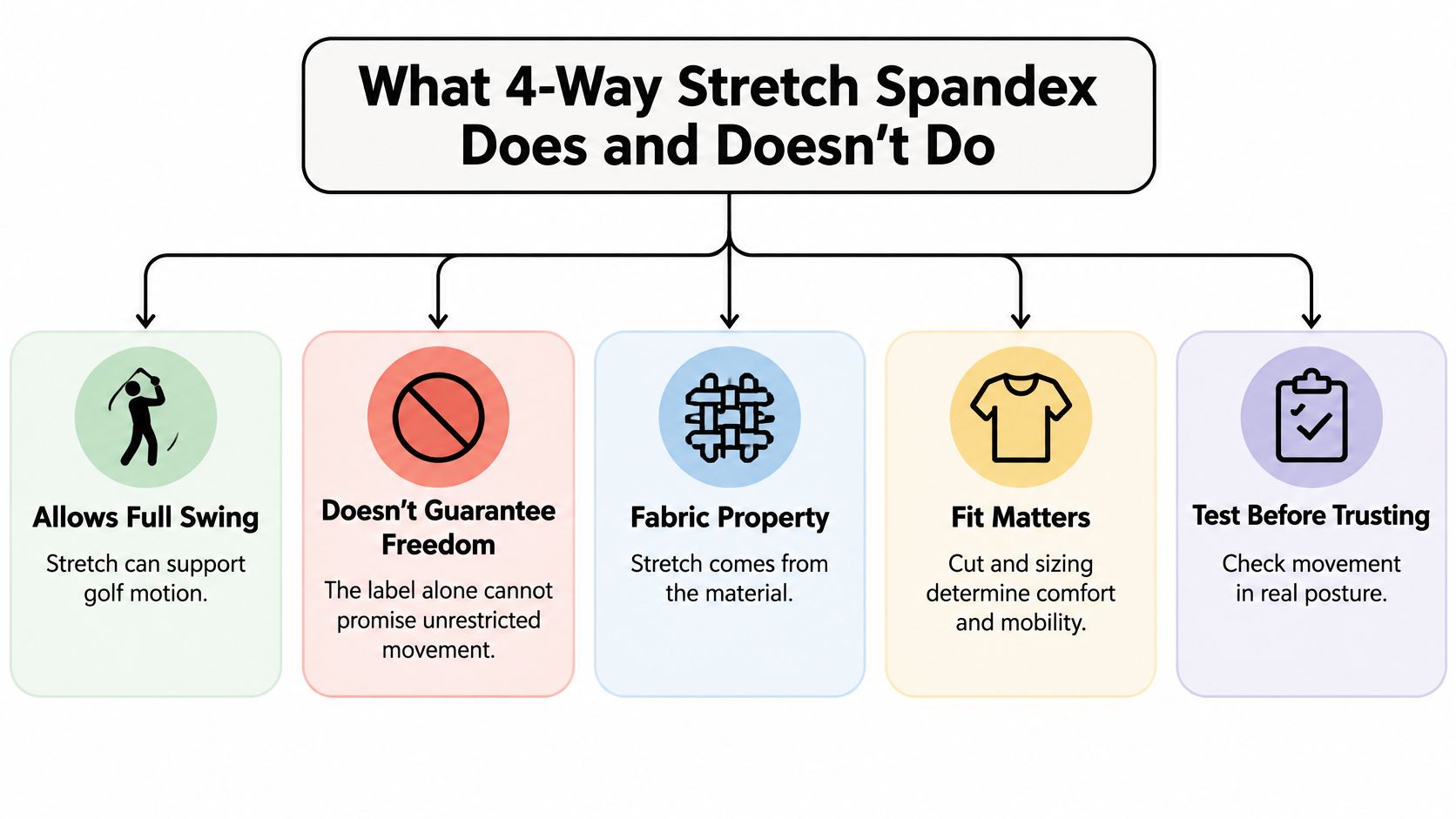
A 4-way stretch polo can allow a full swing, but the label alone can't guarantee it. Stretch describes what the fabric does under load. Unrestricted movement describes what happens when that fabric, the pattern, the seams, and your body move together. If the armhole is cut tight or the upper back has no ease, elastic yarn won't fix the bind. You'll feel the shirt work against you at the top of the backswing, even though the material itself stretches easily by hand.
Spandex, also called elastane, is a segmented polyurethane fiber. Rigid segments give it strength, and soft segments act like molecular springs that extend and recover. Think of a thin rubber band woven through a knit. It lengthens when you reach, then pulls back when you relax. That recovery is why a small share of spandex changes fit retention far more than its weight suggests, and why a polo can hold its shape through repeated rotation instead of going slack.
The fiber itself was developed by DuPont chemist Joseph C. Shivers, with the invention dated to 1958-1959, first called "Fiber K" and later marketed as Lycra, according to the George Mason University spandex history, which also notes spandex can stretch approximately 500% to 600% of its original length and then recover toward its initial dimensions. A finished polo never stretches that far. The base yarns, knit structure, and seams limit travel long before the elastane reaches its limit, which is exactly what you want for control rather than a loose, baggy shirt.
Four-way stretch means elasticity runs both lengthwise and crosswise. That matters because a swing isn't one direction. Your shoulders rotate, your back lengthens, your lead arm reaches, and you still have to crouch to read a putt and walk the next fairway. Two-way stretch handles part of that. Four-way handles the diagonal pull across the shoulder blades that shows up in the follow-through.
Judge the fabric on recovery. Judge the garment on dynamic fit.
What spandex doesn't do is correct pattern mistakes. Armhole height, sleeve geometry, seam placement, and body length decide whether the shirt rises, twists, or presses into the underarm. Your measurements also change between standing still and swinging, so a shirt that looks perfect in a mirror can still pull once you set up to the ball. Run two checks, not one. Confirm the fabric snaps back, then confirm the cut stays quiet through a full turn.
Fabric Specs That Predict Real Stretch
A spec sheet can look exact and still oversell the shirt. Stretch is a fabric property. Unrestricted movement is a fit outcome, so these numbers only predict the first half.
| Specification | Typical Range | What It Tells You |
|---|---|---|
| Elastane content | Read the labeled share (Cool-Stretch knits use 8% spandex) | Recovery for collar, cuffs, and body without heavy cling |
| Garment-level elongation | 10-30% functional range | Swing travel without the shirt sliding on the torso |
| Permanent elongation after recovery | Below about 2-3%, per University of Oradea textile research on elastane fabrics | Whether the polo still matches your build after repeated loading |
| Elastic recovery | Up to about 95% at fiber level, per University of Oradea textile research on elastane fabrics | How fully the knit returns after each motion |
| Stretch direction | Warp and weft (true 4-way) | Stretch both along and across the garment |
Start with elastane content, then stop shopping by that number alone. Spandex in a performance knit pulls the collar, cuffs, and body back into shape. Too much of it in a close cut adds cling, and the shirt holds you instead of moving with you. I read the labeled percentage, then judge hand and drape in the same pass. Tattoo Golf Cool-Stretch fabric is 8 oz with 8% spandex, rated UPF 50+, and built to hold shape after 50+ washes, so you have a known blend to set beside any other polo on the rack.
Elongation You Can Actually Use
Fiber numbers overstate what you feel once the knit and seams are in the way. The useful band is garment-level elongation of about 10-30%: enough for a shoulder turn and a hip shift, not so much give that the body drifts around your torso. The Oradea figures in the table put fiber-level elastic recovery as high as about 95% and permanent elongation below about 2-3% after recovery testing. That second number is the one that protects fit. Peak stretch does not.
Recovery matters more than peak stretch because you repeat the motion all day. A polo that gives easily and returns slowly bags at the elbows. On pants and shorts, the seat and knees follow, and the shirt body starts to hang by the back nine. On a striped knit, a slow return also bends the lines, so the shirt looks tired while it is still clean. Bagging is a fit problem first. The wavy stripe is how you notice it.
Direction and Durability Checks
A true 4-way claim needs warp and weft, lengthwise and crosswise. A label that only prints "4-way stretch," with no figure for either direction, is a phrase without measurements. Look for stretch and recovery after repeated loading and laundering. A new shirt almost always feels springy. The question is whether it still comes back after a season of washing and wearing.
You can check that in under a minute. Pinch the chest, pull gently sideways, then along the sleeve, and let go. It should settle within a second or two, with no ripple and no dent where your fingers were. Repeat five times on the same spot. If each pull returns slower, expect bagging in play.
Wet fabric changes the same math. A stretchy shirt that stays damp gets heavy and drags at the hem and sleeves. Our guide to moisture-wicking golf shirts and how to buy them covers the drying half of this shortlist. Specs narrow the rack. The swing still has to approve the cut.
How to Test a Striped Polo's Fit in Golf Posture
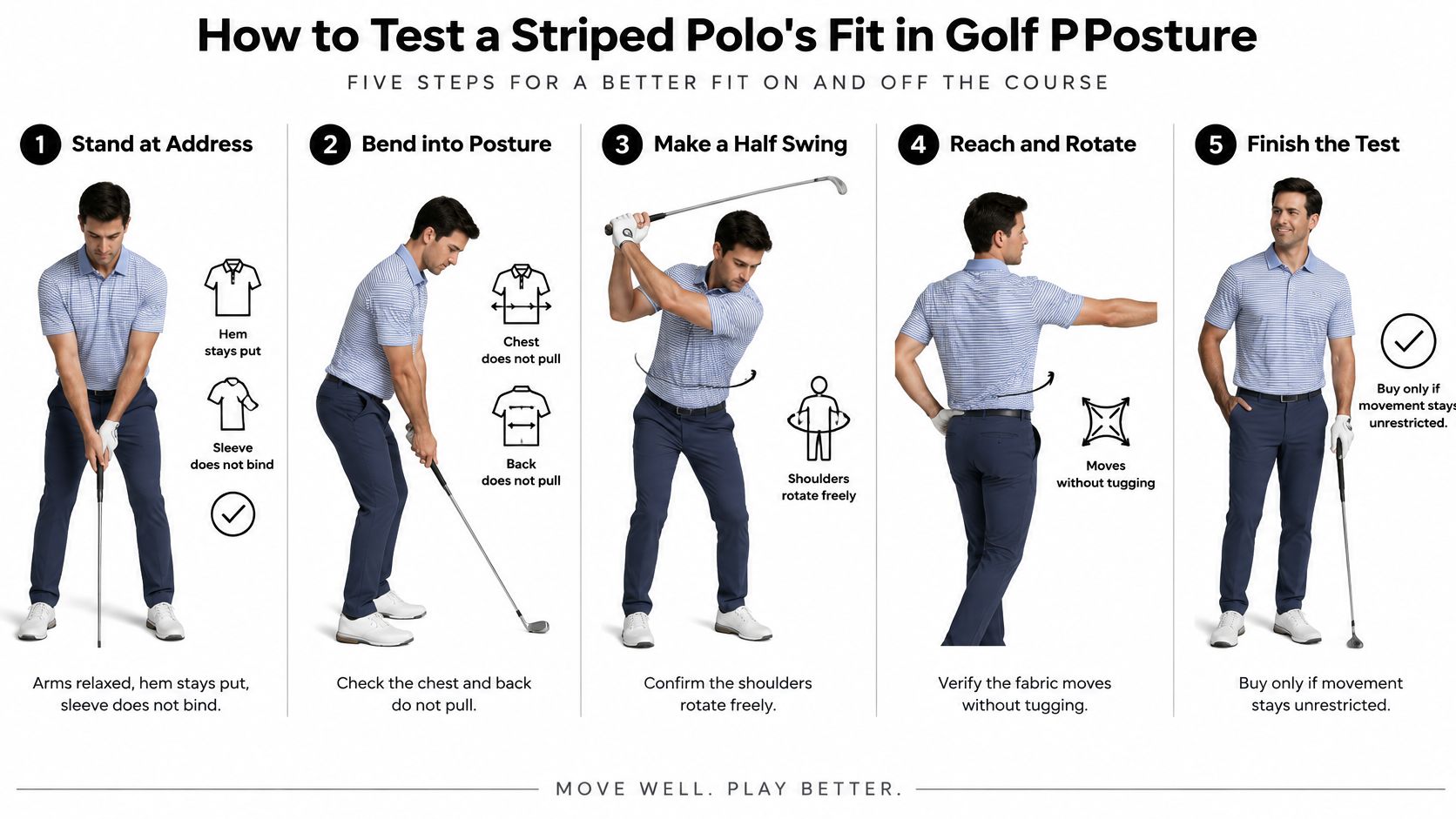
A shirt that passed every spec check can still grab across the shoulder blades the moment you hinge over the ball. Stretch is a fabric property. Unrestricted movement is a fit outcome. So run this test in the fitting room, at home with the tags on, or in front of a mirror before the first wash. You don't need a club. Cross your arms as if you're holding one, keep your normal posture, and move slowly enough to feel where the shirt pulls first.
The Five-Step Dynamic Fit Test
- Stand at address. Hinge from the hips with your arms relaxed and hanging. The hem should stay put, tucked or untucked, and the sleeve shouldn't bind at the underarm. If the placket gaps or the collar pulls away from your neck here, the chest or body length is already wrong before you've moved.
- Raise to the top of the backswing. Turn your shoulders fully and lift your arms to your normal top position. Watch the hem in the mirror and feel across your shoulder blades. A shirt that rides up two inches or pulls hard across the back will distract you on every tee shot, and stripes make that rise easy to spot against your belt line.
- Hold the impact position. Unwind to where your hands would meet the ball, arms extended in front of your hips. Check for pressure at the armhole and seams pressing into the front of your shoulder. A tight armhole shows itself here, because the joint is loaded and the fabric has nowhere to borrow from.
- Finish the follow-through. Rotate through to a full finish with your chest facing the target. The fabric across your chest and upper back should extend and then settle cleanly. If you have to tug the shirt back into place after one finish, expect to do it forty times in a round.
- Sit, reach, and walk. Sit down as you would in a cart, reach to the floor as if teeing a ball, then walk two laps of the room. Note any bunching at the elbows, pulling when you crouch, or the body twisting as you stride. Golf is mostly walking and waiting, so a shirt that only passes the swing steps still isn't done. I'd call this the deciding step, because it catches what a static mirror never will.
Why Tight Can Quietly Restrict You
Fabric tension can eat the mobility that stretch promises. In a controlled pilot study reported in the SAGE Journals golf shirt and compression top study, golfers wearing a compression top beneath a golf shirt had a mean X-factor of 33.76 degrees versus 35.46 degrees when wearing only a golf shirt, and the layered condition slightly restricted trunk motion early in the downswing without significantly reducing peak club velocity. Club speed can hold while turn and comfort drop. If you wear a base layer during rounds, wear it under the polo during this test.
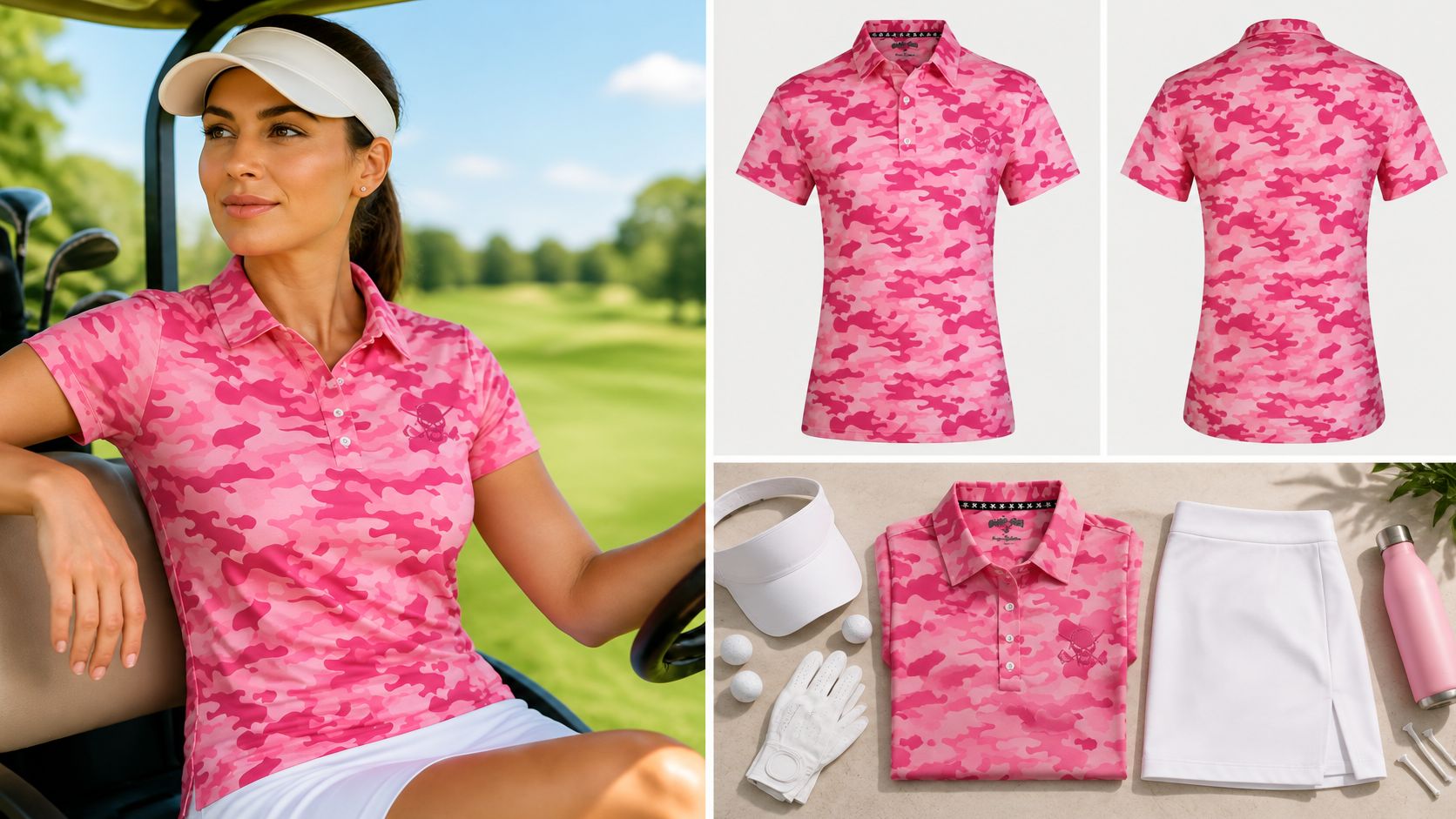
Size charts built on static chest and waist numbers can't predict any of this. That gap hits women, larger-bodied golfers, and anyone whose torso-to-arm proportions differ from the fit model, because the swing loads the back and shoulders in ways a tape measure doesn't capture. A specific example like the Ladies Camo Cool-Stretch Golf Shirt (Pink) uses 92% polyester and 8% spandex in an 8 oz fabric, and that blend still needs the same five steps on your body.
Practical rule: if the shirt rides up, try a different armhole cut or a longer body before you size up. If it pulls across the shoulders, size up in the body rather than choosing a longer sleeve.
For the standing measurements that get you into the right size range in the first place, see our breakdown of how a men's golf shirt should fit. Start there, then let the five steps make the final call. What you're buying is controlled extension that preserves your turn without compression you didn't ask for.
Outfit Formulas and Finishing Accessories
A striped polo arrives at the first tee already doing a job. It gives the eye a pattern, a rhythm, and usually two or three colors, so the rest of the outfit has one assignment: stay quiet. Run one loud element per look. Put a bold striped shirt next to a patterned belt and a bright hat and the pieces compete for attention, and the outfit reads as noisy rather than intentional.
The stretch in the knit handles your movement. The styling handles everything else. Neither should fight the other, which is why the formulas below pair each stripe weight with bottoms and accessories that support it instead of stacking on top of it.
Outfit formulas by occasion:
| Occasion | Stripe Choice | Bottoms | Belt and Hat |
|---|---|---|---|
| Morning round on the course | Fine navy-and-white stripes | Charcoal or khaki tapered stretch pants | Navy woven belt; visor |
| Tournament or club event | Tonal stripes in one color family | Navy or grey chinos | Brown or black leather belt; six-panel cap |
| Hot-weather round | Light-blue or white stripes in a lightweight knit | Khaki performance shorts | Canvas belt; wide-brim visor |
| 19th hole after the round | Bold multicolor stripes | Dark denim or dark chinos | Leather belt; flat cap or no hat |
| Cooler morning or fall round | Heavier-knit stripes in darker tones | Stretch chinos | Braided belt; knit cap |
Building Each Look
For a morning round, fine navy-and-white stripes with charcoal tapered stretch pants and a navy woven belt read as golf without looking like a uniform. The charcoal grounds the white in the shirt, and the woven belt adds texture without a second pattern. A visor keeps the look light and lets heat escape off the top of your head. Swap the charcoal for khaki when you want a warmer tone, and keep the belt navy so it ties back to the stripe instead of introducing a new color.
Tournament and club events call for restraint. Tonal stripes in one color family, such as two shades of blue or grey, give you pattern at a distance that settles into a solid up close. Pair them with navy or grey chinos and a brown or black leather belt. Match the leather to your shoes, not to the stripes. A plain six-panel cap finishes it cleanly and will not argue with a club logo policy or a team photo. This is the formula I'd choose when you're a guest somewhere and don't know how strict the room is.
Hot weather changes the fabric decision before the color one. A lightweight, open knit in light-blue or white stripes with khaki performance shorts keeps air moving, and a canvas belt won't suffer when it gets damp with sweat the way leather can. A wide-brim visor shades your face and neck better than a standard bill. If you prefer a long sleeve for sun coverage, it works in heat only with a lightweight, breathable knit. A heavy long sleeve in July is a mistake no amount of stretch will rescue.
The 19th hole is where bold multicolor stripes earn their place. Dark denim or dark chinos calm the shirt down enough for a patio or a bar stool, and a simple leather belt keeps the waist clean. Wear a flat cap if you like one, or skip the hat entirely. You've been under a brim for four hours. The bold shirt is the statement now, so let it stand alone instead of stacking accessories on top of it.
Cooler mornings and fall rounds take a heavier-knit stripe in darker tones with stretch chinos. A braided belt adds texture that suits the weight of the knit, and a knit cap keeps you warm on the first tee. Keep the cap plain, because a patterned knit cap over bold stripes pulls focus with shape while the shirt pulls it with color. Dark, quiet stripes handle the pairing without that fight.
Belts, Hats, and the Stacking Rule
Belts for standard trouser loops run about 1.25 to 1.5 inches wide. Match the belt to the darkest tone in your stripes or your bottoms, never to a bright accent stripe. A belt that picks up the one red line in a navy shirt turns a detail into a theme. Woven and braided belts suit casual rounds and give you fine adjustment between holes. Smooth leather suits club events and the clubhouse after. Canvas earns its spot in heat and humidity.
Hats follow the weather first and the outfit second. A visor suits a sunny course and ventilates well. A six-panel cap suits wind and a more traditional setting. A knit cap suits cold mornings only. Then apply the stacking rule:
- Loud polo, plain accessories: bold or multicolor stripes get a solid belt and a solid hat in a tone already in the outfit.
- Plain stripes, one accent: fine or tonal stripes can carry a brighter hat as the single accent, with the belt kept dark and quiet.
- Match the hat to a fixed point: pull the hat color from the collar, the darkest stripe, or the bottoms, so it connects instead of floating.
Watch the edge case with pale stripes. Light colors show sweat marks across the back and under the arms on hot, humid days, and horizontal stripes frame those marks neatly. Choose mid-tone or darker stripes for humid rounds and save the pale shirts for shaded courses or cool mornings. Sweat marks on a pale shirt come down to color choice, and you can settle that decision in the closet rather than on the back nine.
Carry a spare belt for travel rounds. One dark leather belt covers most outfits and saves the scramble when your match runs long and dinner follows. For a deeper run through coordinating the full kit, our guide on matching golf accessories with your golf shirt works through gloves and hats as well. Keep it simple. One loud element, the rest in support, and the stripes do the work they're supposed to do.
Seasonal Wear for a Full Round
Knit weight and layering do most of the seasonal work. The same stripe family can run all year when the fabric weight and the layers change with the forecast.
Knit weight and layering by season:
| Season | Knit Weight | Layering | Stripe Palette |
|---|---|---|---|
| Spring | Mid-weight knit | Light quarter-zip over the polo | Pastel or navy stripes |
| Summer | Lightweight, open knit | Polo alone | White, sky-blue or coral stripes |
| Fall | Mid-to-heavy knit | Lightweight vest or jacket | Earth tones, burgundy or forest green |
| Winter in mild climates | Heavy or brushed stretch knit | Mock-neck layer underneath | Charcoal and navy stripes |
Comfort Across Four Hours, Not Four Swings
A shirt can pass a practice swing and still wear badly by the fourteenth hole. The 2024 peer-reviewed study of a stretch performance top in Fashion and Textiles found no statistically significant difference in mobility satisfaction between the tested garments despite differences in fabric composition, fit, and breathability, and the novel garment was rated tighter than the control. Fiber choice matters less than the label implies while you're moving; the differences between fabrics show up when effort stops and sweat begins to cool.
That rest period is most of a round.
You walk, wait on a tee, sit in a cart, stand over a putt in the wind, then swing hard for two seconds. Comfort shifts every time your output drops. Managing that cycle falls to breathability, drying speed, seam comfort, and whatever you pull over the polo. A stretch label won't improve your mechanics or cut your fatigue. Its job is narrower: stay out of the way for eighteen holes while the layers around it handle the temperature.
Start warm, shed by the turn, and keep a dry layer for the 19th hole.
Say a spring morning starts at 10 degrees Celsius. Wear a mid-weight striped polo under a light quarter-zip, peel the layer off by the turn as the sun climbs, and you finish in the polo alone. Summer calls for a single moisture-wicking shirt: a Cool-Stretch option like the 2-Tone Cool-Stretch Men's Golf Shirt (Blue/White) Small Only, knit with 8% spandex, holds its shape through a hot round while the fabric moves sweat off your skin. Two striped polos in different knit weights, backed by one quarter-zip and one vest, cover the whole calendar without rebuilding your wardrobe each season.
Confirm the Fit Before You Buy
Buy the polo only after it passes both checks, the fabric check and the fit test. A shirt that snaps back in your hands but rides up at the top of your swing will cost you a return.
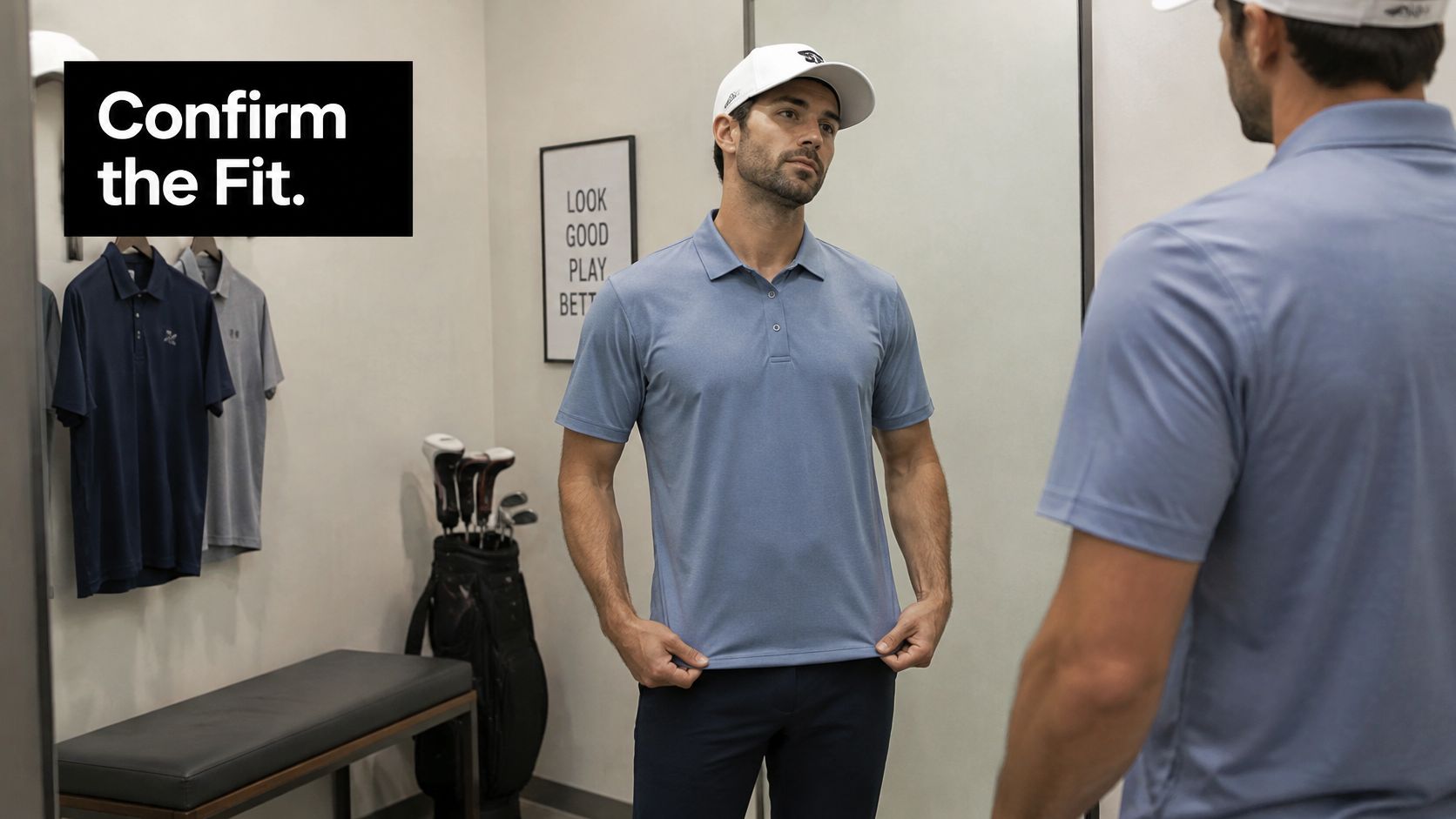
Work through the purchase in this order:
- Read the spec sheet for warp and weft stretch, elastic recovery, and elastane percentage. Our Cool-Stretch fabric is 8 oz with 8% spandex, rated UPF 50+, and built to hold shape after 50+ washes, so use stated numbers like those as your comparison point.
- Try it on with tags attached and run the dynamic fit test in a mirror, in full golf posture. If a size letter confuses you, this explainer on what clothing size labels actually mean is a useful reference before you blame your measurements.
- Keep tags and packaging until the swing test is passed, and confirm the return window before the first wash. We offer returns and exchanges within 60 days of purchase on items that are new, unworn, and unwashed with original tags attached, so the test has to happen first.
If the polo fails a step, apply the fix that test prescribes for the specific failure before you give up on the shirt.
After purchase, protect the recovery you paid for. Turn the garment inside out before washing, skip fabric softener because it can clog moisture-wicking fibers, and air dry or tumble dry on low while avoiding hot dryers when possible. Then do the concrete thing: choose one striped polo, one belt, and one hat, and wear the combination on your next round.
Shop Cool-Stretch polos, shorts, pants, belts, and hats built for a full turn and a long walk, and put your pick through the five-step swing test before the first wash. Find your size and your stripe at Tattoo Golf.
Share:
Black Performance Low Cut Golf Socks - 3 Pack (Black) Guide