

You're standing over a six-foot putt when you notice the problem. Your waistband has been tugging every time you bend, the fabric behind your knees has started to sag, and the pants that felt soft in the fitting room now feel warm and restrictive. Your swing hasn't changed, but your clothing has become part of the distraction.
The best golf pants for comfort, stretch and performance aren't the softest pair on the rack. They're part of an all-day comfort system that combines fabric stretch, shape recovery, breathability, fit, weather protection and sensible layering. That system has to work while you walk, rotate, crouch, sit in a cart, climb hills and finish the round in changing conditions.
Why Comfort and Stretch Make or Break Your Round
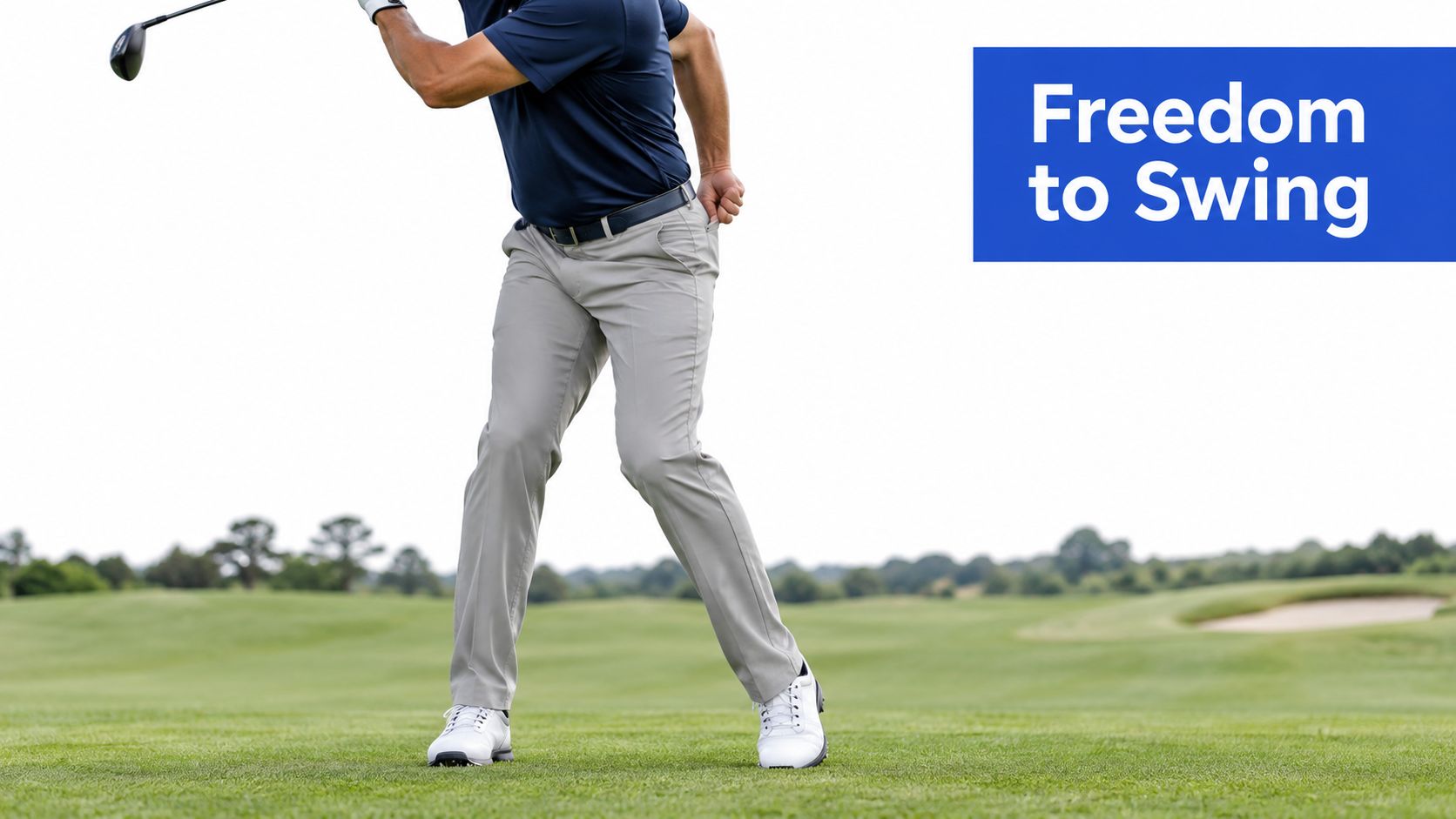
The first tee can hide a poor pair of pants. By the turn, the clues become clearer. A stiff waistband presses into your stomach as you hinge forward, a tight thigh tugs at your hips during rotation, and fabric with weak recovery begins to sag around the knees. Those distractions can alter your stance, shorten your backswing or pull your attention away from the target.
Golf pants work more like equipment than ordinary casualwear. They must follow hip rotation, knee flexion and walking, then keep their shape for the clubhouse or a post-round meal. Softness helps at the fitting-room mirror, but it does not explain how the fabric handles heat, sweat, repeated bends or hours in a seated cart position.
Golf clothing also serves different routines. The National Golf Foundation's estimate of 41.1 million Americans involved in golf-related activities in 2024 reflects a market that includes walkers, riders, occasional players, competitors and golfers who wear the same trousers away from the course. That breadth means pants must serve walkers covering 5+ miles and riders sitting for hours in the same round.
Comfort is a system, not a single feature
Your pants sit between your skin and changing weather. Stretch gives your body room to rotate, recovery brings the fabric back into shape, and breathability helps release heat during the walk. The cut connects these features: it should leave space at the hips, seat and thighs without creating fabric that bunches or catches.
Cold weather adds another test. The same trousers need enough room for a base layer, while their waistband and upper leg still allow a natural setup. A comfortable pair is like a well-tuned suspension system. It absorbs movement, returns to position and stays composed as the terrain and temperature change.
On-course rule: If you notice the pants during your setup, they're already affecting your round.
Use construction details and current silhouettes in a guide such as best golf trousers for 2026 to create a shortlist. Then test each pair with a forward bend, squat and full rotation. The goal is not maximum softness in one position. It is steady comfort from the first tee through the final green.
Understanding What Comfort Stretch and Performance Really Mean
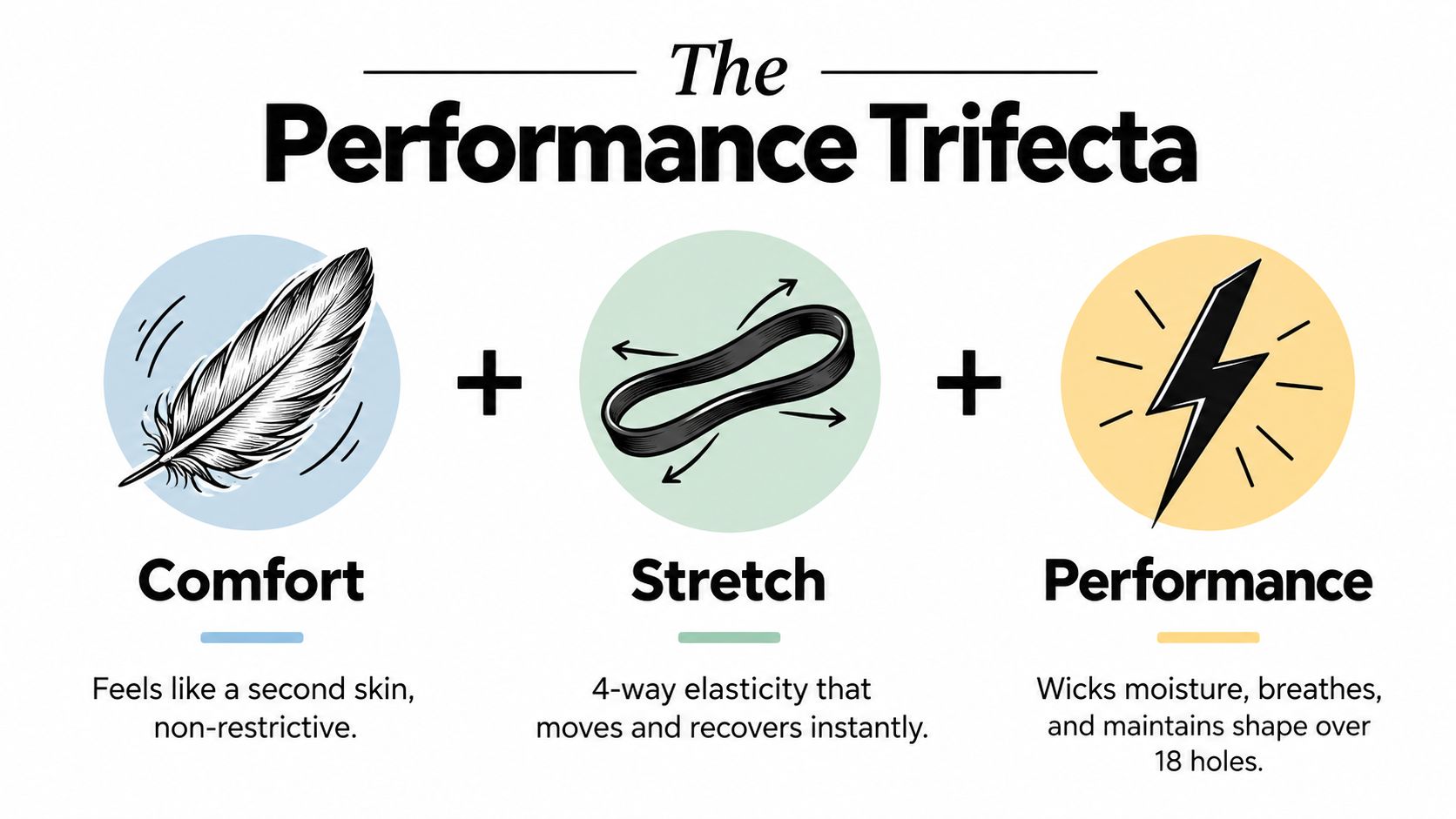
Golf apparel language can sound interchangeable, but each term describes a different job. Comfort is how the pants feel after hours of movement. Stretch is how far the fabric gives. Performance is how well the garment manages moisture, heat, shape and repeated wear.
Start with the movement
Four-way stretch means the fabric gives across both the width and length of the garment. That matters because a golf swing isn't a single straight-line action. Your hips rotate, your knees flex and your seat shifts as you move from setup to finish.
A useful analogy is a rubber band. It needs to extend when you pull it, then return to its original shape when you release it. Golf pants need the same two-part behavior. Stretch without recovery can produce knee bagging and a loose seat, while strong recovery without enough give can feel restrictive.
Moisture management works differently. Instead of holding perspiration next to your skin like a heavy cotton fabric can, a synthetic performance weave moves moisture toward the outer surface, where it can evaporate more readily. That won't make a hot round feel cool by itself, but it can reduce the damp, sticky feeling that builds during walking and repeated movement.
Separate the marketing words
- Comfort: A non-restrictive feel at the waistband, hips, seat and knees, even after hours of wear.
- Stretch: Elastic movement that supports the swing rather than forcing the fabric to pull at the seams.
- Recovery: The ability to return to shape after sitting, bending and repeated knee flexion.
- Breathability: How readily heat and air move through the fabric and construction.
- Quick-dry performance: How quickly moisture leaves the surface instead of remaining against the body.
- Wrinkle resistance: A practical travel benefit that helps trousers maintain a polished appearance after packing.
Softness belongs on the list, but it shouldn't lead the list. A very soft pant can still be too warm or too loose through the knee. For a broader look at women's proportions, rises and movement needs, comfortable golf pants for women can help you compare options beyond a generic unisex fit.
Fabric and Tech That Deliver All Day Mobility
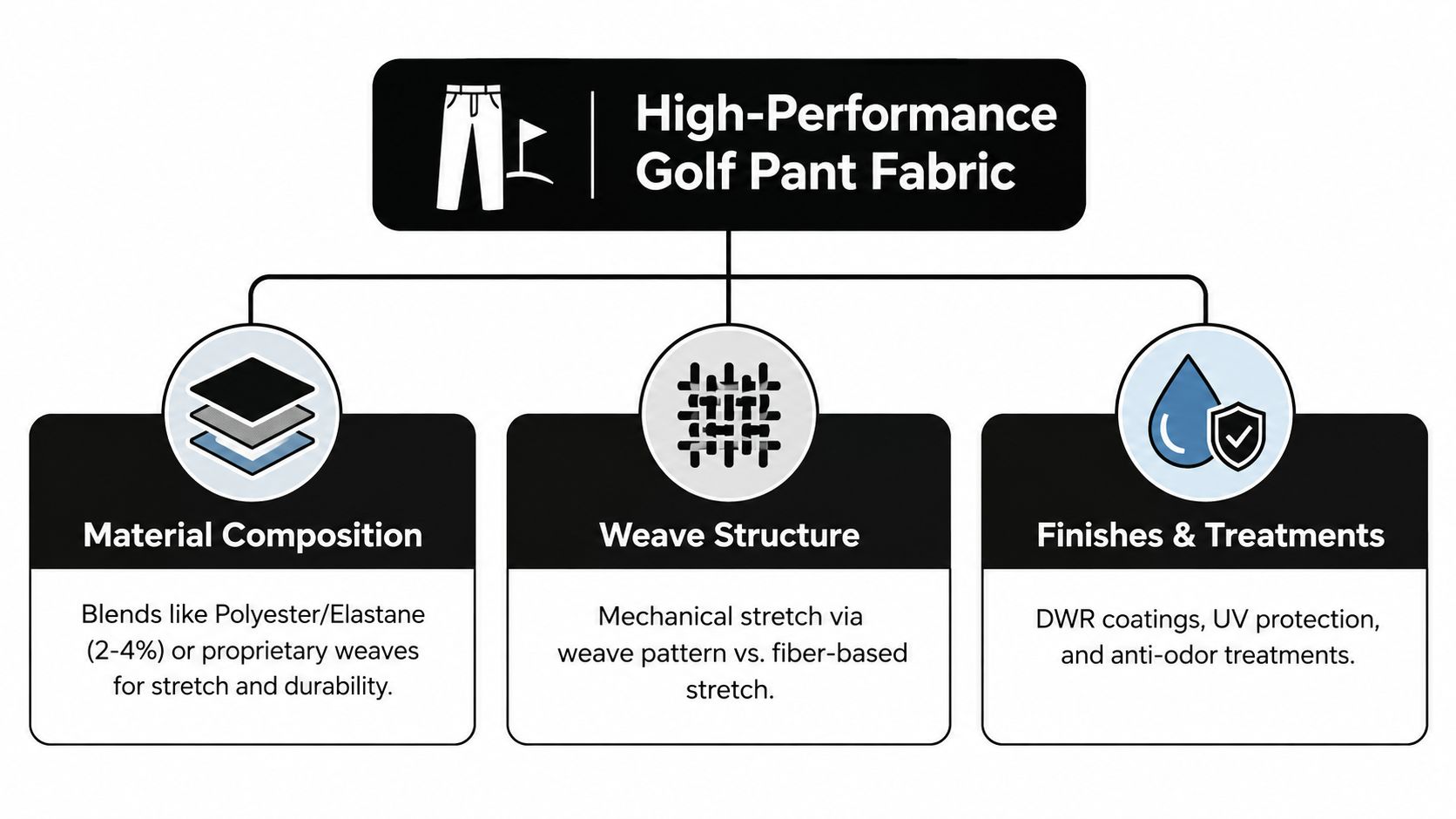
The fabric blend sets the foundation for movement. Performance golf pants are typically built with a polyester- or nylon-dominant base and about 5–10% elastane, according to this golf-specific fabric technology guide. The synthetic base helps maintain structure and move moisture toward the surface, while elastane supplies the elastic response needed through a swing.
The practical lower range matters because a fabric can feel flexible in your hands without delivering reliable mobility on the course. A blend with around 5–8% spandex or elastane is described as a practical lower range for dependable golf performance in the same guide. More stretch isn't automatically better. If the fabric becomes overly elastic, it may feel unstable, cling to the body or lose the polished look many golfers want.
Read the spec sheet like a gear coach
Polyester-spandex is a common all-round choice. It can offer quick drying, shape retention and a clean surface, but low-quality versions may feel overly slick or synthetic. Nylon-spandex often provides a smoother handfeel and a technical character, though a shiny finish can make the pants look more like training gear than trousers.
For cooler rounds, double-weave or brushed constructions can add structure and warmth. The tradeoff is obvious once you start walking. A heavier fabric can feel reassuring on a cold first tee but become too warm later, especially when paired with a thermal base layer.
The performance golf apparel market reached an estimated $5.8 billion in 2025 and is projected to reach $10.2 billion by 2034, with a projected 6.5% compound annual growth rate. Synthetic materials held 52.6% of the material share in 2025, or about $3.05 billion, which helps explain why polyester, nylon and elastane-style blends dominate many best-selling designs. These figures come from DataIntelo's performance golf apparel market analysis.
Look beyond fiber content
Fiber content tells you what the garment is made from, but construction tells you how it behaves.
- Weave: A tightly built weave can improve structure and opacity, while a lighter construction may feel airier.
- Finish: Water-repellent, UV-protective or anti-odor treatments can add useful functions, but check the care label and wash performance.
- Seams: Low-profile or flat seams can reduce rubbing during walking and repeated flexion.
- Waistband: A stable, slightly flexible waistband can prevent shirt pull without digging in at address.
For a simple explanation of how moisture moves through technical textiles, see this guide to moisture-wicking fabric. The best pair combines the right blend with a construction that suits your climate, walking habits and preferred silhouette.
Finding Your Best Fit Without Sacrificing Movement
A practice swing can expose a fit problem faster than a fitting-room mirror. Stretch helps, but it cannot correct a rise that is too short, a thigh that is too narrow or a waistband that sits in the wrong place. The same fabric may feel easy in one cut and restrictive in another, so fit should be judged as part of an all-day comfort system, alongside heat release, recovery and freedom through an 18-hole round.
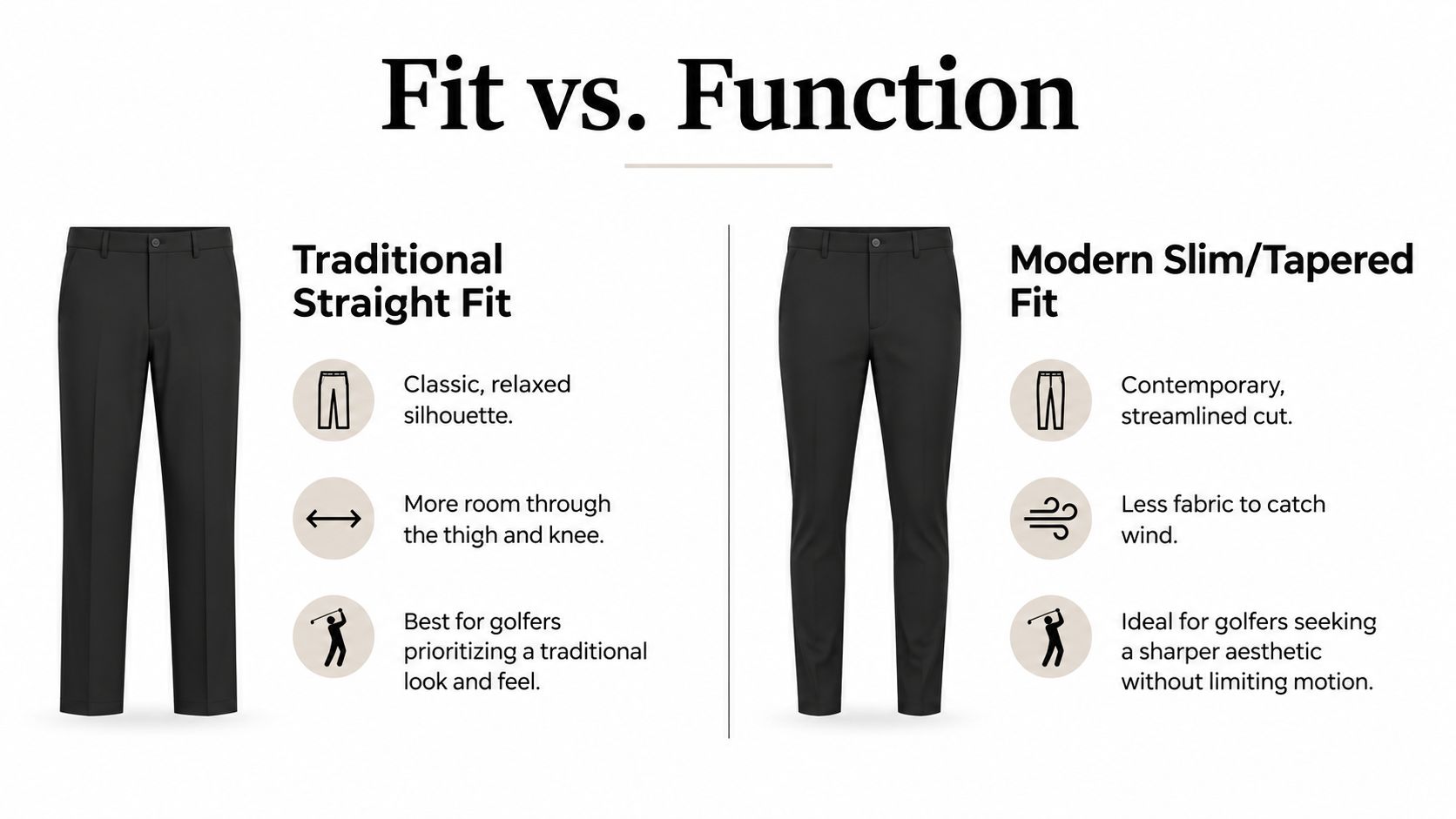
A modern straight fit leaves more room through the thigh and knee before keeping a fairly consistent leg line. It suits golfers who walk, bend often or prefer a traditional trouser shape. A slim fit removes extra fabric and creates a sharper outline, though it still needs room at the seat and thigh for a full rotation. A narrow cut should feel like a supportive base, not a clamp around the hips.
Compare the important fit points
| Fit attribute | Modern straight fit | Slim tapered fit |
|---|---|---|
| Waist rise | Balanced and forgiving | Cleaner profile, but sensitive to rise length |
| Seat and thigh | More room for bending and walking | Closer fit, requiring accurate sizing |
| Knee mobility | Less likely to feel restrictive | Depends heavily on fabric recovery |
| Leg opening | Straight, traditional line | Narrower, more contemporary taper |
| Off-course styling | Classic and versatile | Dressier and more tapered |
| Main risk | Extra fabric catching on shoes during walking | Fabric pulling at the seat when rotating through the swing |
Put on the pants with your golf shoes. Stand naturally, hinge at the hips, squat slightly and rotate through a controlled practice swing. The waistband should not fold sharply into your stomach. Watch for diagonal pulling from the crotch toward the knees, which often signals that the cut is limiting rotation rather than the fabric lacking stretch.
Walking and riding change the answer
Walkers often benefit from a little more thigh room and fabric that releases heat efficiently. Riders may prefer a cleaner seated fit, but the waistband still needs to flex when you bend to pick up a ball or read a putt. That balance matters because comfort changes during the round. A pair that feels neat at address can become tiring after hours of sitting, walking and repeated bending.
Length affects movement as well. Heavy bunching over the shoe can catch while walking, while a very short hem may expose the ankle when seated and look overly casual. Check the hem in both standing and seated positions. If your legs need added support after play, products such as sleeves and braces for legs belong in the recovery routine, not as a replacement for correctly fitted golf pants.
Building a Cold Weather Layering System Around Your Pants
Cold-weather comfort rarely comes from one thick garment. It comes from coordinating layers so each one performs a clear job. Your base layer manages moisture, the pants provide movement and some insulation, and an outer layer blocks wind or light precipitation without crowding the hips.
Start with a close-fitting base layer that doesn't bunch behind the knees or inside the waistband. A smooth synthetic or merino-style layer can sit under performance trousers more comfortably than bulky cotton. The key is a flat, low-friction fit. If the base layer folds at the hip, your pants will feel tighter even when the outer garment fits correctly.
Match warmth to the round
A brushed or double-weave pant can provide useful warmth on a cool morning, but it may become uncomfortable as activity increases. A lighter stretch pant with a wind-resistant outer layer can be more adaptable because you can remove the outer piece without changing the fit around your legs.
Practical rule: Add warmth in removable layers before buying the heaviest pant you can find.
Wind protection deserves attention because moving air can make a moderate temperature feel much colder. A lightweight outer shell or pull-on rain trouser can block gusts, but look for enough room to move over your golf pants without compressing the knees. Water resistance can help during damp conditions, while true waterproof protection typically involves a more structured garment and may reduce breathability.
Your upper-body layers affect your swing too. A bulky vest, stiff jacket or oversized glove can make you feel restricted, which may lead you to blame the pants. Keep the full outfit in mind. Performance pants should coordinate with your base layer, mid layer, outer shell, gloves, hat and footwear.
For outfit ideas that connect course utility with personality, explore fun golf pants. The same principle applies in cold weather: choose one expressive element, then keep the rest of the system functional and easy to move in.
Packing Checklist and Care to Keep Performance Fresh
Performance fabric stays useful when you treat it as technical clothing rather than ordinary trousers. Before a golf trip, pack around conditions instead of outfits alone. A lightweight pair can cover warm rounds, while a cooler-weather option and a weather shell create flexibility without filling your case with bulky layers.
Pack for changeable conditions
- One versatile neutral: Grey, navy or black can work with several polos and reduce overpacking.
- One weather option: Add a wind-resistant or water-resistant layer when the forecast may shift.
- A clean travel fold: Fold along the main crease, place heavier items beside rather than on top, and unpack soon after arrival.
- A fit backup: If your trip includes several rounds, bring a second cut or fabric weight rather than relying on one pair for every condition.
- A care check: Review the label before washing because finishes and stretch fibers can respond differently to heat.
Most stretch golf pants benefit from washing cold with similar colors and using a low-heat drying setting when the care label permits it. High direct heat can stress elastic fibers, affect finishes and shorten the life of printed or embroidered details. Avoid ironing directly over embroidery, and turn garments inside out when the label recommends it.
Moisture-wicking and odor-control treatments also deserve careful handling. Strong detergents, fabric softeners and excessive heat may reduce the feel or function of technical finishes over time. For brand-specific garment guidance, use Tattoo Golf's clothing care information rather than guessing.
Travel habit: Don't leave damp golf pants compressed in a suitcase or car bag. Let them air out before washing or packing them again.
Real World Examples That Pair Style With Performance
Your best outfit depends on how the pants must work across the day. On a warm municipal course, a lighter trouser with moisture management and useful stretch can keep walking more comfortable. For a private club or travel day, a cleaner silhouette, matte finish and neutral color can pair with a button-down or lightweight sweater without looking overly athletic.
Color also changes how often you can wear the same pair. Grey anchors a bright polo without competing with it. Black creates stronger contrast and gives patterned tops a controlled base. Navy sits between the two, working naturally with light neutrals and many bolder course colors.
The Tattoo Golf OB Performance Men's Golf Pants in Grey show how these choices can work together. The product description specifies Cool-Stretch fabric made from 92% polyester and 8% spandex, along with UPF 50+, four-way stretch and moisture-wicking performance. A modern straight fit and stretch waistband support movement, while the embroidered Skull and Crossing Clubs detail adds character to the restrained grey trouser.
Three practical outfit directions
Muni to clubhouse: Pair grey performance pants with a bold polo and low-profile golf shoes. The neutral base stays easy to wear, and the stretch waistband accommodates movement from the opening tee through the final green.
Private-club polish: Choose black or grey with a quieter polo, a clean belt and minimal visible accessories. A matte surface and controlled leg line help technical trousers look refined rather than gym-oriented.
Travel and tournament practice: Combine a moisture-managing polo with a lightweight overshirt or vest. The pants should remain comfortable while driving, walking through an airport and practicing on the range. That makes stretch recovery and wrinkle resistance as important as freedom during the swing.
Golf apparel increasingly serves more than the round itself. One pair may need to handle course movement, clubhouse plans, travel and everyday wear, so comfort depends on the complete system. Stretch provides room to move, recovery helps the fabric return to shape after sitting, and breathability keeps heat from building under a layer.
Choose by testing the pants in the positions your day requires. Check the feel at address, notice whether the fabric recovers after sitting, and assess comfort after heat, sweat and repeated movement enter the round.
Tattoo Golf offers performance golf pants and coordinated apparel built around four-way stretch, moisture-wicking and quick-dry comfort, with distinctive designs such as the OB Performance line and signature graphic details. Visit Tattoo Golf to compare course-ready pants, polos and accessories, then use the size chart to build an outfit that moves comfortably from the first tee to the 19th hole.


Share:
Best Men’s Golf Shorts for Hot-Weather Golf
What to Wear Golfing: A Complete Guide for Men