
You're on the 13th tee, your shoes feel fine, and your heel starts to burn. By the 15th green you're walking differently to protect a hot spot, and by the clubhouse you're blaming the socks you grabbed from the drawer that morning. That's the usual way golfers learn that a sock isn't separate gear. It's the layer between skin and shoe, and it decides whether moisture, pressure and movement stay manageable or turn into a blister.
Sizes and Specs for the Black Three-Pack
Start with your shoe size. The listing gives ranges, not foot measurements, so matching the range is your first filter before you judge fabric or cushioning.
| Spec | Listed value | What it means for you |
|---|---|---|
| Men's Large | Shoe sizes 7 to 10 | Choose if your shoe size falls in this range |
| Men's XL | Shoe sizes 10 to 13 | Choose for larger men's shoe sizes |
| Women's | Shoe sizes 8.5 to 11.5 | Choose for women's shoe sizes in this range |
| Pack | Three pairs, black | Three pairs to rotate between rounds |
| Fabric | 65% cotton, 30% nylon, 5% spandex | Breathable stretch with durability |
| Cut | Low-cut, ankle height | Pairs with athletic and golf sneakers |
| Care | Machine wash cold, tumble dry low, no bleach | Keeps shape and cushion through washing |
| Price | $19.99 for the three-pack | About $6.66 per pair before any other costs |
Why a three-pack fits how golfers actually play
Socks wear out, get damp and need washing far more often than clubs or shoes. A three-pair pack lets you rotate instead of rewearing a pair that hasn't dried fully, which matters in a sport with heavy repeat play. The National Golf Foundation state of industry summary recorded 28.1 million Americans playing on-course golf in 2024, the highest total since 2008, with roughly 545 million rounds played.
Black helps the rotation work harder. It pairs with shorts, trousers and most performance golf shoes, and it doesn't show fairway dust the way white does, so each pair stays presentable longer between replacements.
The sizing decision most buyers face is the boundary at size 10, which appears in both men's ranges. Treat the overlap this way: pick Large if your golf shoes fit snug, because a longer sock adds fabric your shoe has to absorb. Pick XL only if your shoes run roomy or your foot sits at the top of the range. A sock that fits the shoe is part of the fit system, not just the label.
Practical rule: If your shoe size sits right on a boundary in the table, try the socks in your actual golf shoes first. A range on a label can't tell you how much volume your shoe leaves for your toes.
Check the table, pick the range that contains your shoe size, and don't size up hoping for extra cushion. Extra length usually ends up bunched under your arch or toes.
What the Fabric Blend Does for Your Feet
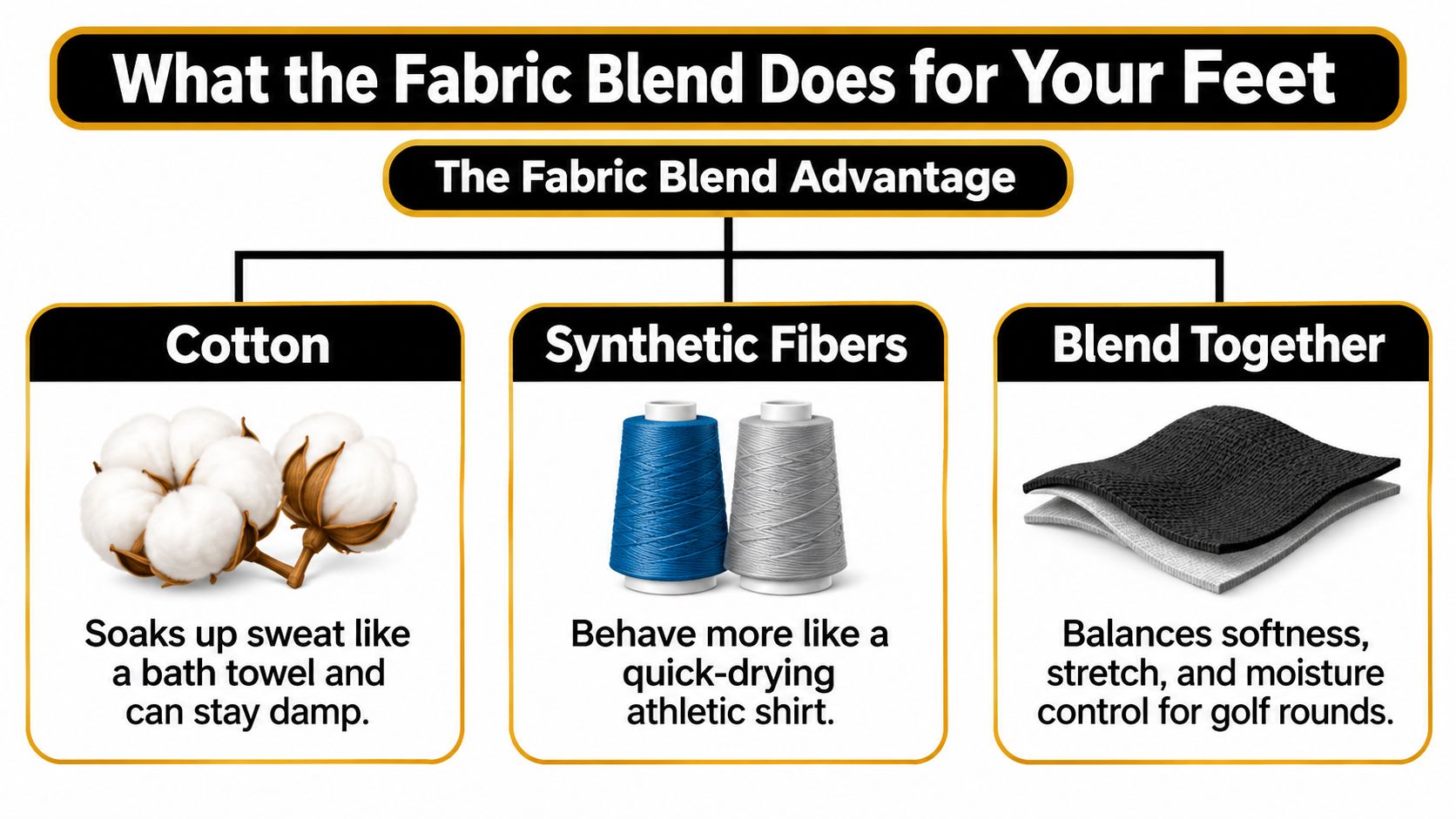
Think of a cotton sock as a bath towel. It soaks up sweat, feels soft at first, then stays damp against your skin. A synthetic athletic sock behaves more like a running shirt. It doesn't hold as much water in the fiber, so moisture can move outward and evaporate. This blend sits between those two behaviors, and the split matters.
Each fiber has a job
Cotton at 65% provides the soft hand feel typically expected from an everyday sock. It is absorbent and comfortable for short, dry wear. Its weakness is drying speed. Once cotton is wet, it tends to stay wet inside a closed shoe.
Nylon at 30% is the workhorse. It adds strength where the sock rubs against the shoe lining at the heel and toes. It also helps the knit survive repeated washing without thinning as fast as a mostly cotton sock would.
Spandex at 5% provides stretch and recovery. That's what lets the sock hug your foot and spring back after you pull it off, instead of relying on a tight elastic band at the ankle to stay up.
Why moisture raises blister risk
Friction blisters need three things together: shear force, pressure and moderate moisture. Shear is your foot sliding slightly inside the shoe with each step and swing. Pressure concentrates that movement at the heel and ball of the foot. Moisture then increases friction between skin and textile, so the skin grips and tears internally instead of sliding harmlessly.
The American Academy of Podiatric Sports Medicine sock guidance ranks acrylic, polypropylene and CoolMax-type polyester above cotton for moisture transport, and reports that acrylic socks produced fewer and smaller blisters than cotton in athletic testing. That doesn't make a cotton blend unusable. It tells you the ceiling. With 65% cotton, you shouldn't expect the drying speed of a mostly synthetic sock.
For a plain-language breakdown of how wicking fabrics are built to move sweat, our guide to moisture-wicking fabric covers the mechanism. The Thermo Recovery Wear fabric guide is also useful if you want the antimicrobial side of fabric treatment explained alongside wicking.
A breathable shoe upper matters as much as the sock. Moisture that moves out of the sock still needs somewhere to go.
The listing doesn't publish a wicking rate or drying test. I would treat that carefully. On a hot walking round, carry a spare pair in your bag. Changing into dry socks at the turn does more for blister prevention than hoping a damp cotton blend will dry inside your shoe.
Construction Details That Decide Comfort on 18 Holes
Fiber percentages tell you what a sock is made from. Construction tells you how it behaves under your foot. Two socks with identical blends can feel completely different over 18 holes: one puts cushioning under the heel and forefoot where pressure peaks, the other spreads a flat knit everywhere and lets the shoe do all the work.
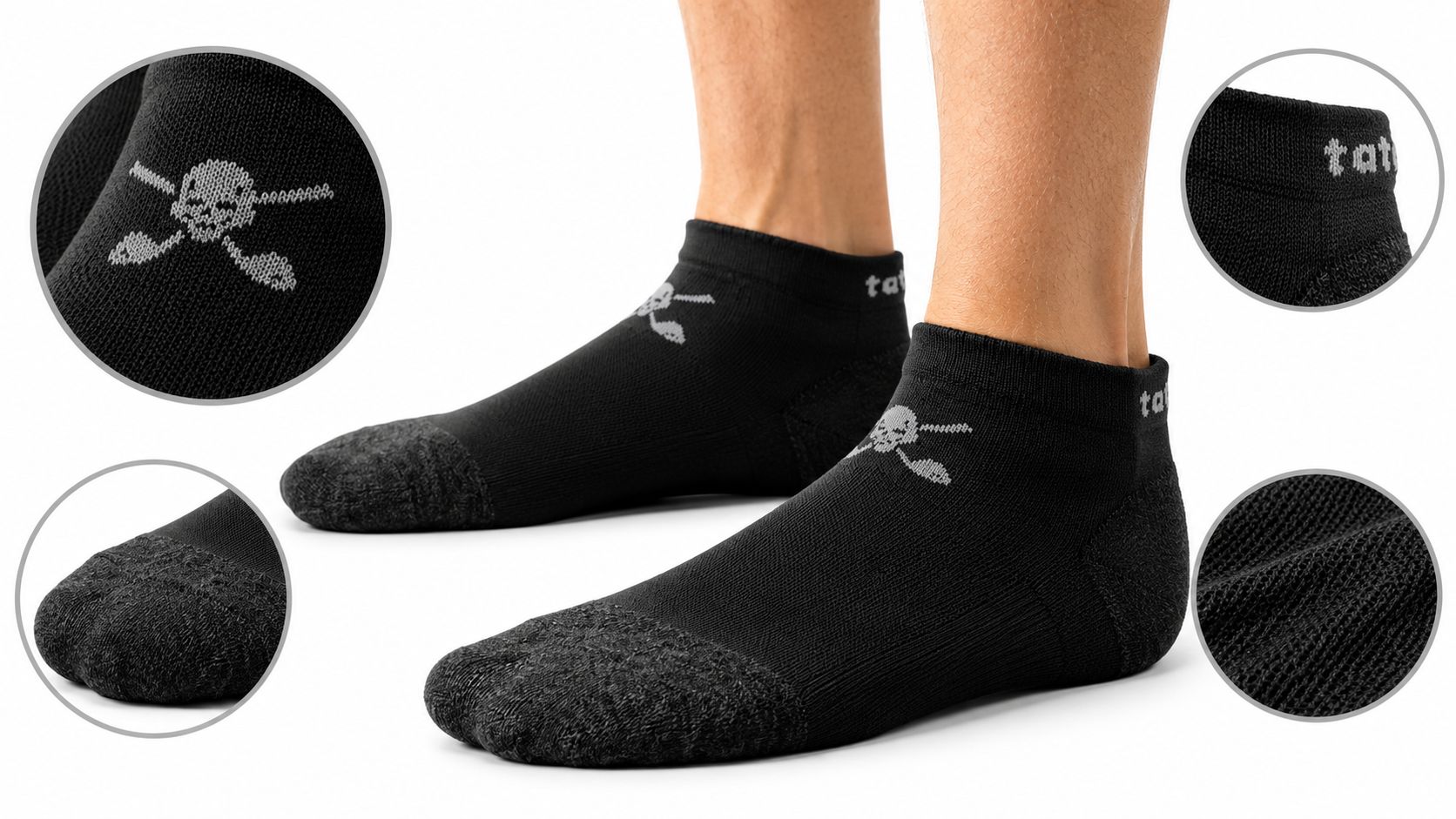
The Black Performance Low Cut Golf Socks - 3 Pack (Black) comes as three black low-cut pairs. What the listing doesn't publish is padding thickness or a zone map showing where the cushioning sits, so confirm placement in hand rather than assuming it from the photos. Cushioning in the wrong spot is padding you paid for and can't use.
A 2024 review of foot-blister research found that fabric structure, wicking, thermal dissipation and pressure reduction all influence performance, and that laboratory wicking results don't always translate directly to socks worn inside footwear during real activity. Related evidence in that review links high-density terry cushioning to lower blister rates than flat-knit construction. Lab numbers alone won't settle it for your feet and your shoes.
Check a pair in five minutes
- Press the heel pad. It should sit under your heel bone when the sock is on, not trail off at the back edge where it only pads the shoe.
- Find the forefoot padding. It should line up with the ball of your foot. Padding that ends before that point leaves your highest-pressure area unprotected.
- Run a thumb along the toe seam. It should lie flat. A raised ridge across your toes becomes a pressure line during your follow-through.
- Pull the cuff up and wait. The cuff should hold at your ankle. If it leaves a deep red band after half an hour at home, it'll annoy you for four hours on the course.
- Wash one pair before judging all three. Check whether the cushion still feels springy and whether the heel pocket still matches your heel after drying.
In-hand test: Turn the sock inside out. Terry loops, seam bulk and thin spots are far easier to see from the inside than from the outside.
Rotation protects construction, too. A pair worn again while still slightly damp compresses faster and bunches more easily. Spread across three pairs, the elastic and cushioning in each sock take roughly a third of the punishment a single pair would absorb, which is where the three-pack earns its cost per pair. That only holds if each sock dries fully and recovers its shape between rounds.
Fit, Shoes and Fixes for Slipping or Blisters
A low-cut sock can't hold your foot inside a shoe. The shoe does that job. If your heel lifts and slides in the heel pocket, the sock gets dragged with each step, and that repeated movement is what builds a blister. Slipping also grinds the heel fabric thinner, so the pair reaches the end of its life sooner. When a sock slips in a roomy shoe, I would fix the shoe fit first. It's the cheaper diagnosis and usually the correct one.
A third-party retail listing for this pack, on the Pink Golf Tees product page, makes a general moisture-management claim but says nothing about heel-grip construction, arch compression, toe-seam comfort or slippage after several hours of walking. It also doesn't say how shoe volume, or the overlap at men's size 10, affects which size to pick. The way past those gaps is a fit test you run yourself before a long round.
Match the symptom to the cause
| Symptom | Likely cause | Fix |
|---|---|---|
| Heel slips out by the back nine | Loose heel pocket or roomy golf shoes | Recheck shoe volume and heel-pocket fit before blaming the sock |
| Hot spot on the ball of the foot | Bunching at the forefoot or a sock pulled out of position | Smooth the sock flat and reseat it before lacing |
| Blister on heel or toe | Moisture plus friction in a damp sock | Change to a dry pair at the turn, dry feet and check the toe seam |
| Ankle feels tight or leaves a mark | Cuff too tight for comfortable circulation | Roll the cuff evenly; if numbness continues, try the next size in the listed range |
| Sock bunches under the arch | Sock length does not match foot length | Choose the size that matches your shoe range and avoid folding the cuff |
Try the socks with the golf shoes you'll wear, laced the way you lace them on the first tee. Do it late on a warm afternoon if you can. Feet swell slightly through the day, and a fit that feels perfect at 8 a.m. at home can feel crowded by the 14th hole. Our overview of golf socks and fit covers height and shoe pairing in more detail.
A useful independent test would cover 18 walking holes and report heel movement, bunching, hot spots, shrinkage after washing and drying time, in both snug and roomy shoes. Until that test exists, run your own shorter version. Walk nine holes first. Note any heel movement and exactly where you felt it. That one round tells you more than any label claim.
How to Wash and Rotate the Three Pairs
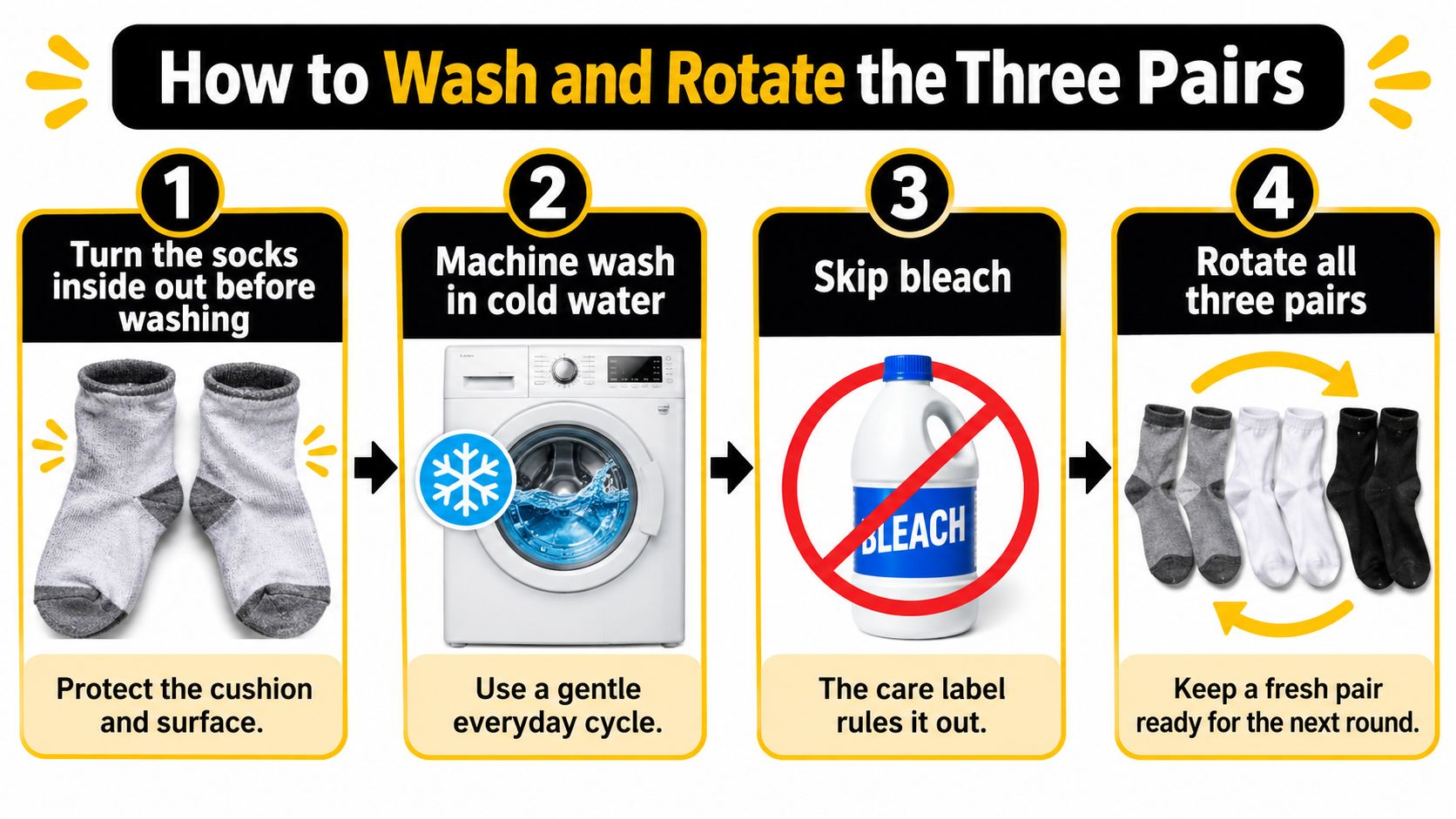
Care is simple, but doing it consistently is what keeps cushioning and elasticity alive. Heat and bleach are the two things that shorten a blended sock's life fastest.
The routine
- Turn the socks inside out. This protects the outer surface and lets water reach the cushion loops where sweat sits.
- Machine wash in cold water. Cold water limits shrinkage in a cotton-rich blend.
- Skip bleach. The care instructions rule it out, and bleach weakens fibers and fades black unevenly.
- Tumble dry on low. High heat degrades spandex recovery, which is what keeps the cuff and arch snug.
- Rotate all three pairs. Give each pair at least a full day to dry and rebound before wearing it again.
- Retire a pair on clear signs. A loose cuff, flattened cushion or a thin spot at the heel means it's done, even if there's no hole yet.
Our clothing care guidance applies the same cold wash and low heat logic across performance apparel.
What the price doesn't tell you
At $19.99 for three pairs, you're paying about $6.66 per pair. The key question is cost per round. A pair that survives a full season of weekly walking rounds is cheap. A pair that loses its cuff grip in a month isn't, whatever the sticker said.
The collection listing on the Tattoo Golf ladies apparel collection shows the price and sizing but doesn't state expected wash life, colorfastness, pilling resistance or odor retention. That makes a clean comparison with cheaper everyday athletic socks impossible from specs alone.
Test it yourself. Track one pair across 20 to 30 wash cycles. Note elasticity, drying time, odor after a round and visible wear at the heel. Keep walking rounds separate from cart rounds in your notes, because they punish socks very differently.
Which Rounds Suit These Socks and Whether to Buy
Say you're walking 18 holes in 30°C heat and muggy air. By the turn, your heels feel damp and the sock starts to grip instead of glide. That's the cotton share holding moisture. The fix is a dry interface: sit down, dry your feet, pull on the spare pair from your bag and finish the back nine fresh. The three-pack earns its keep in that moment, because you own a spare worth carrying.
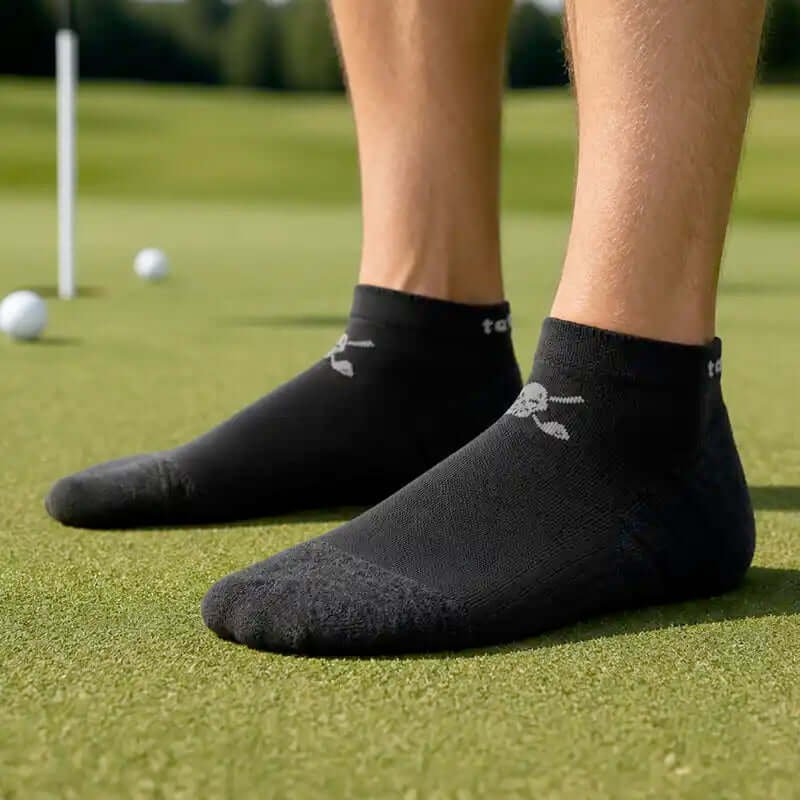
Cart rounds play differently. You're stepping in and out, walking short stretches, never building up serious sweat. The low cut keeps your ankle cool, sits cleanly with athletic golf shoes and disappears under your outfit. For that round, the blend's drying limit barely matters. Comfort and a tidy look carry the day.
A range or simulator session is easier still. You're mostly standing, walking a few steps between shots, and any of the three pairs handles that for weeks of practice. If you also practice putting at home, the R.E. and Sons Landscaping turf guide is worth a look for how home green surfaces are built and maintained, since surface speed changes how useful that practice is.
Where these socks are the wrong tool
Loose shoes cause most heel-slip complaints, and the sock takes the blame. The shoe is moving, the sock just goes along for the ride. If your heel pocket runs big, the shoe-fit fixes covered earlier in this guide matter more than any sock swap.
Choose a different sock when the round demands it:
- Cold weather: A crew height covers your ankle and lower calf, which a low cut leaves exposed to wind.
- Rocky or hilly walking: A thicker, heavily cushioned pair spreads pressure better over uneven ground.
- Long days in heavy shoes: More padding underfoot helps when the shoe itself is stiff and unforgiving.
- Heavy sweating in heat: A mostly synthetic sock will dry faster than a 65% cotton blend, even with a mid-round change.
Judge the sock, shoe and foot as one system. Changing only the cheapest part and expecting it to fix the other two leads to bad conclusions and sore heels.
My verdict
Buy the three-pack if you play warm-weather golf, want all-black low-cut socks for athletic golf shoes, and your shoe size falls squarely inside a listed range. The honest measure is rounds per pair. Rotate all three, carry the spare, and a pack that holds its elasticity through a full season of regular play costs little each time you tee it up. A pair that loses its cuff grip inside a month is a bad buy at any price.
Hold off if you need published wicking data before buying, or if you already know you blister easily in cotton blends. Hold off if you want heavy cushioning, because the listing doesn't specify padding thickness. You'd be buying on hope in exactly the area that matters most to you.
If you do buy, do it in this order. First, check your shoe size against the size table. Second, put a pair on with your golf shoes and confirm the heel stays put when you walk and swing in place. Third, wear one pair for a full round and write down heel movement, hot spots and how damp they felt at the turn. Fourth, wash that pair cold, dry it low and check the fit again. Only then decide whether the remaining pairs, and a second pack, are worth it. The Tattoo Golf product page lists the full specs if you want to confirm sizing before ordering.
If you want black low-cut socks that match bold, performance-driven golf apparel instead of plain clubhouse basics, take a look at what Tattoo Golf offers across socks, polos, shorts, hats and accessories. Check your size against the table, order the three-pack, and put one pair through a full walking round before your next big tee time.
Share:
OB Performance Men's Golf Pants (Orange): Fit Guide 2026