Search for advice on men's golf hats and nearly every guide hands you the same checklist: UPF 50 or higher, moisture-wicking fabric, ventilated panels, done. That checklist measures the wrong thing. A UPF rating describes the patch of fabric sitting on the top of your head. It says nothing about the two inches of earlobe and the strip of neck that a standard cap leaves in direct sun for four hours.
The cap became the default for reasons that had little to do with protection. Golf headwear started as formal dress: flat caps tied to northern England, newsboy styles that spread through the late 19th and early 20th centuries, and Panama hats as the game went international, as this history of golf hat styles lays out. By the 1990s, televised tournaments had normalized the baseball cap, partly because the brim shades the eyes over a putt. Fashion followed television, and the cap has been the safe answer ever since.
Meanwhile the fairway got busier. The National Golf Foundation counted 28.1 million Americans playing on a course in 2024, the highest on-course participation level since 2008. More rounds, more midday tee times, and the same short-brim cap on most heads.
Judge a hat by two things instead: which body areas it shields and how much heat it traps. Fit comes third, because it decides whether the shade stays where you put it.
Which Men's Golf Hat Style Fits Your Round
Sort a pro shop wall by brim shape and the stock falls into four silhouettes: the six-panel cap, the visor, the bucket hat and the wide-brim. Color and logo do the rest. What separates them is measurable. Brim geometry sets which body areas get shade, and crown construction sets how much heat stays trapped against your scalp.
| Style | Brim and crown | Body areas shielded | Best for | Main trade-off |
|---|---|---|---|---|
| Six-panel baseball-style cap | Short, stiff front brim, closed crown | Forehead and eyes; little for ears and neck | Walking rounds, classic look, close-fitting swing | Minimal ear and neck coverage |
| Performance visor | Brim only, open crown | Face and eyes; scalp exposed | Hot, humid courses where airflow matters | No scalp or ear cover |
| Bucket hat | Full brim all the way round, closed crown | Face, ears, neck and scalp | Midday rounds and high-UV courses | Can feel warm; swing fit varies by model |
| Wide-brim golf hat | Broad brim, closed or lightly vented crown | Face, ears and neck | Long exposure, desert or high-UV play | Heavier and less common in golf catalogs |
Reading the Table by What It Covers
Every row answers one question: after four hours, which patches of skin never saw direct sun? A six-panel cap shades the forehead and eyes and stops there. The ears sit outside the brim line, the neck sits behind it, and the gap at the back of the crown takes light whenever your brim tilts down. The closed crown also seals in heat, which is why the same cap feels fine at 8 a.m. and stifling at noon.
A visor shields less still. It covers the face, leaves the scalp open, and makes sense only if you have hair, sunscreen and a real reason to want airflow over the crown. On heat it leads the four. Nothing traps warm air like a closed crown, and a visor has none.
Bucket and wide-brim styles change the equation because the brim wraps. A bucket drops shade onto the ears, the back of the neck and the cheeks, and pays for it in warmth plus a looser feel through the swing. A wide-brim pushes coverage furthest for desert rounds and long practice sessions, and pays in weight.
Wide brims are also the hardest to find, because the cap is the familiar default and catalogs stock what golfers already recognize. Demand isn't the bottleneck. U.S. golf apparel headwear sales rose 5.0% year over year in June 2024, per Golf Datatech, so the thin selection of wide brims is a catalog decision rather than weak interest.
The quick verdict: a tee time between 11 a.m. and 2 p.m. is the worst case for a short-brim cap. An early round or a shaded cart round makes the same cap perfectly sensible.
How Much Sun Each Hat Style Really Blocks
Judge a golf hat by two measurements: which body areas sit in its shade, and how much warm air it holds against your head. The hangtag tells you about the first only indirectly, and nothing about the second.
The brim difference is measurable rather than rhetorical. Compared with a baseball-style cap, a summer wide-brim hat cut sun exposure to the neck by 25% and to the ears by nearly 50%, according to sun-protection research on golf apparel. That is the whole case for a wrap-around brim, stated in two numbers.
The trade is heat. A brim that circles the crown shades more skin and also holds more of the warm air your head produces, so the best-protected hat is rarely the coolest one to wear on a back nine in August.
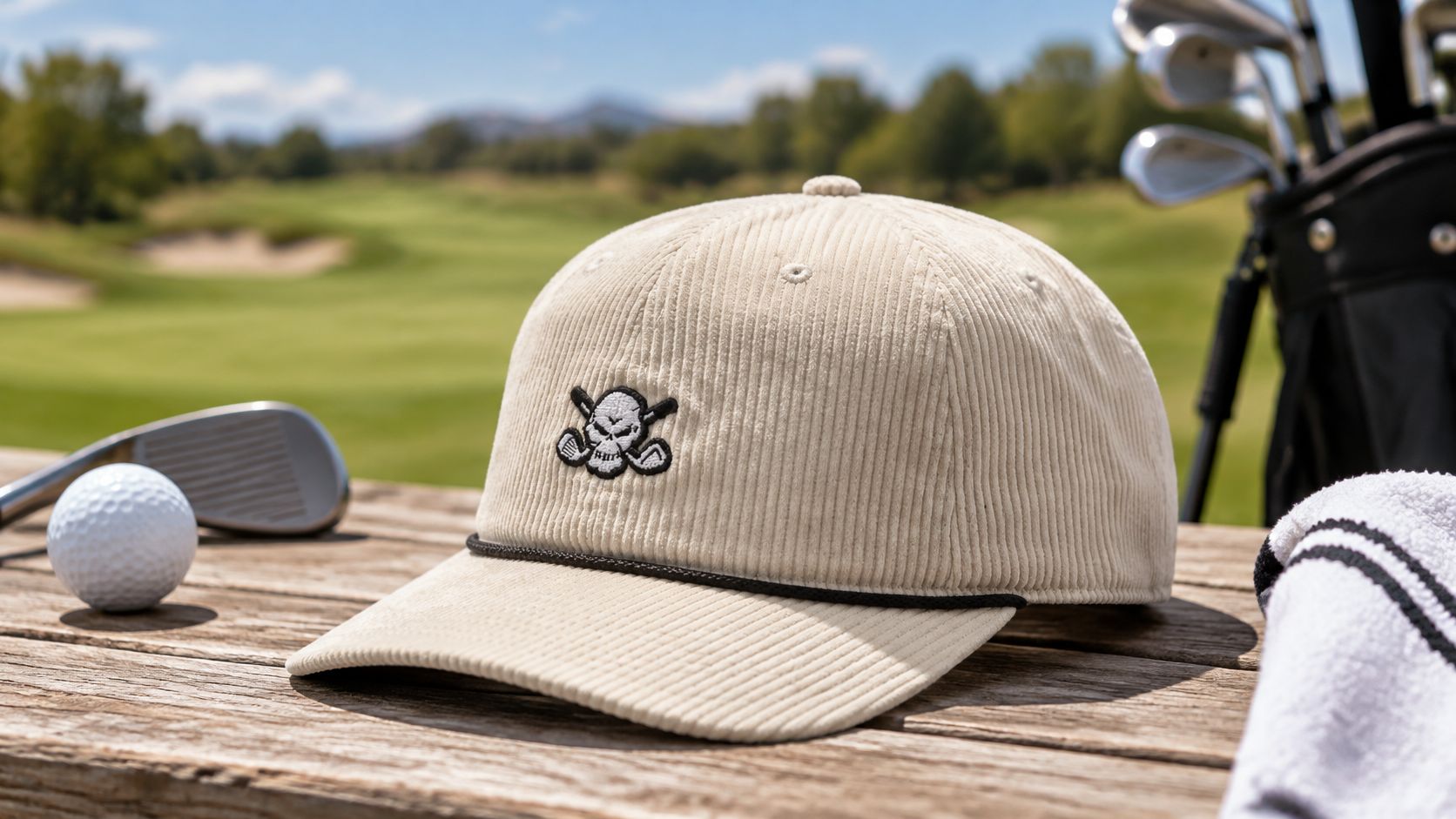
Take the rope-and-cord adjustable hat below, the short-brim shape filling most pro-shop walls:
Shade has been the job of golf headwear since the flat-cap era, and the reasons golfers wear hats still come down to the brim. What changes with tee time is how much skin that brim has to cover. A 7 a.m. start asks little of a short brim; a midday slot puts everything behind and beside it in direct light for four hours.
What a UPF Rating Actually Covers
A UPF rating is a tested number and worth respecting. A UPF 50 tag certifies that the fabric blocks nearly all ultraviolet radiation where it covers, and the certification stops at the fabric's edge. Ears, jawline and neck get whatever the brim gives them and nothing from the label.
That's the trap. A cap can carry a genuine UPF 50 rating and leave the skin around it bare. Color, thickness and price tell you nothing reliable here; the hangtag or product page does. UPF labeling is still uncommon on golf apparel, so a missing rating means untested, not unsafe.
A Three-Part Check Before You Pay
- Rating: UPF 50 or higher printed on the label, not "sun-friendly" in the marketing copy.
- Brim reach: wide enough that your forehead and the tops of your ears sit in shade when you face the sun at address.
- Fit lock: the brim holds position through the swing and doesn't creep up when you look down at the ball.
The Part No Hat Solves
Some skin never sits under any brim: under the jaw, the tops of the ears at a low sun angle, the cheeks when you turn into the light. Sunscreen handles those zones, but only if it goes on.
Apply before the first tee and reapply at the turn. The hat is the first layer of sun management, not the whole system.
Fabric and Color Choices for Hot Rounds
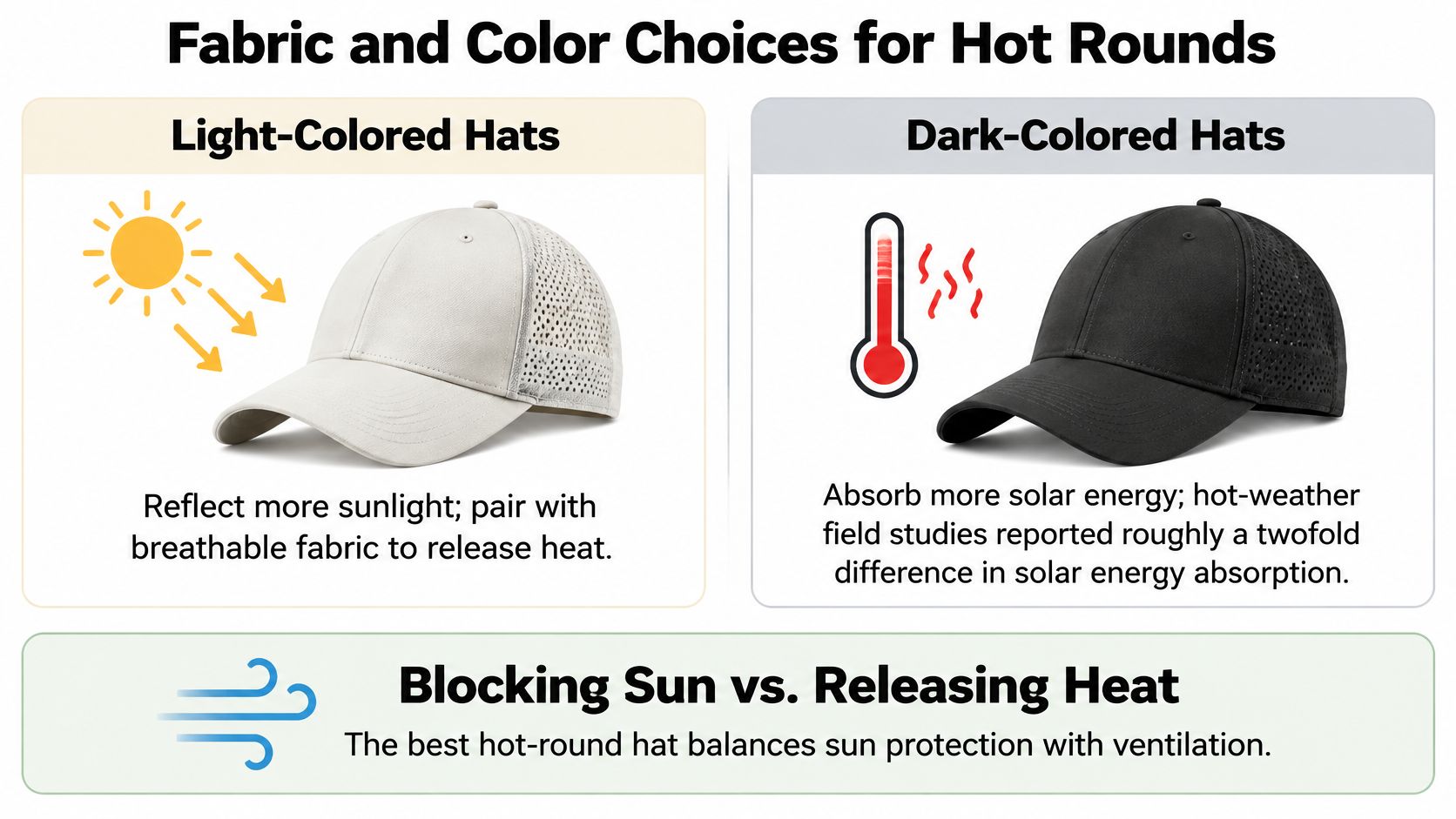
In hard sun, wear the light color and the breathable crown. That verdict holds for most rounds played between May and September, and it beats any logo on the front panel.
Why Black Runs Hotter
Solar absorptance isn't a matter of opinion. The breakdown of golf hat fabrics and designs at Independent Golf Reviews reports roughly a twofold difference in solar absorptance between light and black helmet shells, with an earlier field study putting surface temperatures up to 49°F apart between dark and light hard hats.
Those tests used helmets and hard hats rather than caps, so treat the figures as direction rather than a promise about your scalp. The direction is consistent. Dark absorbs, light reflects.
Why a Tight Light Hat Can Still Cook You
Color sets how much radiant heat arrives. Construction sets how much leaves. A closely fitted, unvented cap in pale gray traps the sweat it generates and blocks the airflow that would carry heat off the crown, which is why a black cap with open mesh panels can feel cooler than a tight white one with none.
Every hat runs that double trade. It shields the skin it covers from radiant load, and it chokes the convection and evaporation that would cool the skin underneath. The shade you gain at the crown is only worth what the venting lets you keep, so judge a hat by which areas it shades and which it suffocates.
Fabric That Lets Sweat Do Its Job
Polyester, polypropylene and nylon move moisture and dry faster than cotton, which matters over four hours in humidity. Cotton holds the sweat, saturates the band and shuts down cooling right when you need it. The piece on how moisture-wicking fabric works covers the mechanism behind the label.
A cap like the Rope & Cord Adjustable Golf Hat (Bone) is built around that logic: moisture-wicking fabric and an adjustable fit that keeps sizing simple, currently on sale for $14.99 down from $34.99. Bone also sits at the right end of the color scale for a sunny tee time.
Mesh is not the same as UV protection. An open weave lets air through and ultraviolet with it, so vent the crown and keep solid fabric over the areas that need shade.
The Test That Beats the Label
Check five things instead of the word "cooling" on the box:
- Fabric color against the sun you play in.
- Crown ventilation you can feel with a hand held over the top.
- Sweatband drying time after 18 holes, not at the register.
- Brim stability at the top of the backswing.
- Comfort after a full round, which is the only test that counts.
Sizing and Fit That Stays Put on Every Swing
Coverage only counts if the brim stays where you put it. Hat sizing runs on head circumference, and the standard chart moves a quarter inch per size.
| Hat size | Head circumference (inches) |
|---|---|
| 6 3/4 | 21 1/2 |
| 6 7/8 | 21 3/4 |
| 7 | 22 |
| 7 1/8 | 22 1/4 |
| 7 1/4 | 22 1/2 |
| 7 3/8 | 22 3/4 |
| 7 1/2 | 23 |
| 7 5/8 | 23 1/4 |
Measure Once, Properly
Wrap a soft tape around your head just above the eyebrows and ears, keeping it level across the back of the skull. Read the number against the chart and round to the nearest size. Measure twice, because a tape that rides up at the back hands you a size too small and a pressure headache by the 12th hole.
Three Fit Systems and How They Behave
Fixed sizes with a structured crown give the cleanest profile and no strap to fiddle with. You get exactly one size, so a haircut or a growth spurt changes the fit with no remedy.
Adjustable back straps cover a range of heads, which is why they dominate the market. Recheck the strap after a few rounds, since the fabric relaxes and the closure creeps.
Stretch-fit blends, such as a 92% polyester and 8% spandex build, flex with the head and hold tension through the swing. The trade-off is that repeated washing loosens the stretch, so spot clean rather than machine wash.
The On-Course Test
Shake your head, look up, then turn your shoulders into your address posture. If the brim shifts, go down a size or take in the strap before you tee off.
Fit is a moving target. Hair volume, sweat and a hot afternoon all change how a hat sits, so check it on the first tee rather than assuming the fit from the shop held.
A hat that's too loose lifts on the backswing and loses its shade exactly when you need it. One that's too tight leaves a red band across your forehead and pushes sweat down into your eyes.
Features Worth Checking Before You Buy
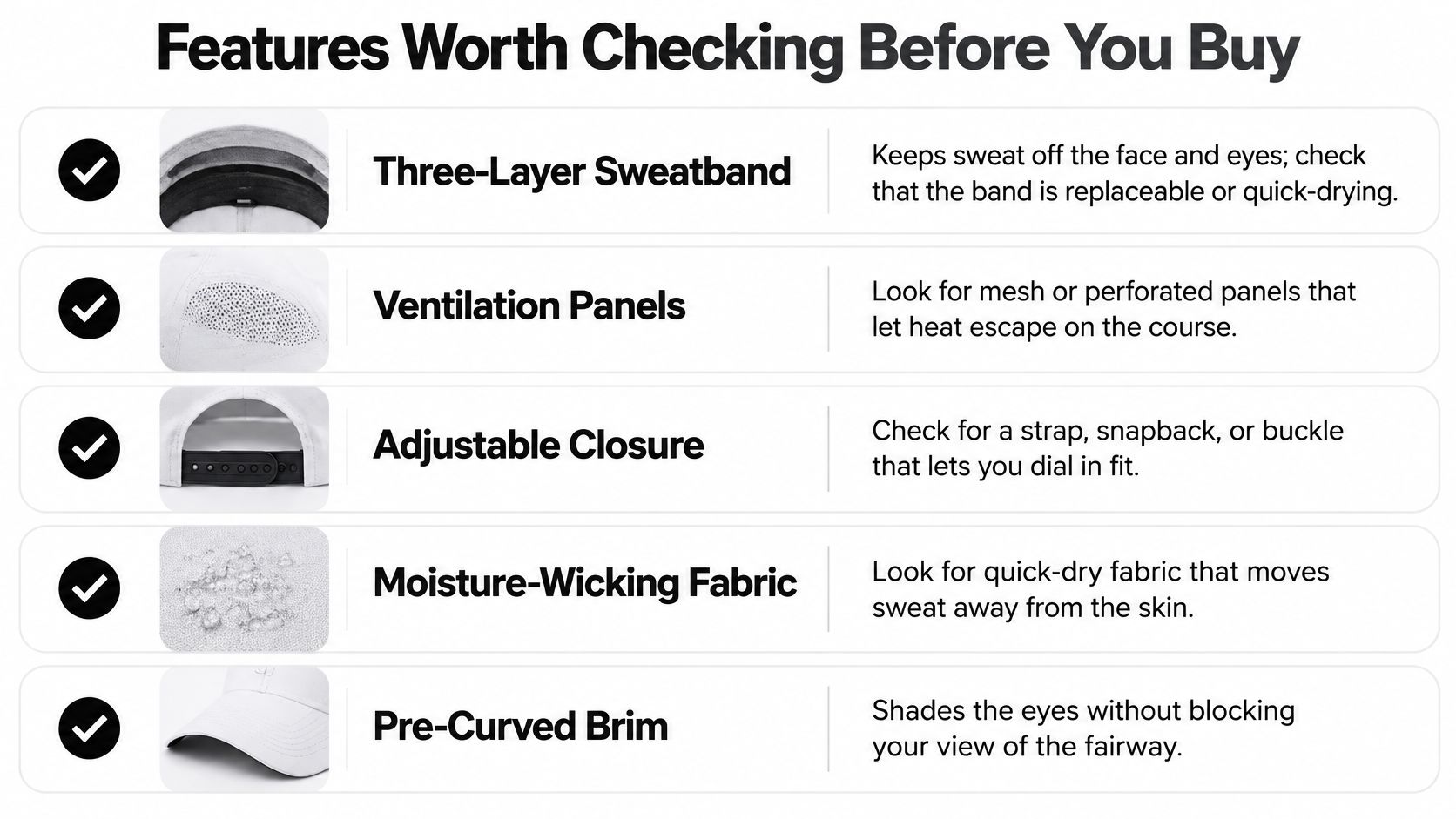
Five details separate a hat that survives a season from one that collapses in the wash.
A three-layer sweatband keeps sweat off your face and out of your eyes. Check that the band is replaceable or dries fast, because a saturated band pushes salt into the brim where it sets into a permanent tide line. A pre-curved visor holds its shape so the brim stays level at address; if it sags after one wash, the visor was never built for a season of rounds.
A stain-block or water-repellent finish stops sweat marks setting after hard rounds, and it's listed on the product page rather than implied by the photo. Bonded construction gives a cleaner profile with less stitching bulk where the brim meets the crown, which matters on a close-fitting swing hat.
Hybrid feature sets beat single features. A pre-curved visor combined with moisture management, water-repellent coating and stain-block protection covers four failure modes in one hat instead of one.
Care decides how long any of it lasts. Spot clean with cool water and mild soap, air dry flat, and skip the machine and the dryer, which warp the crown and break down performance finishes. The other golf accessories in your bag follow the same rule.
Hat Problems and How to Fix Them
A hat that slides, stains or runs hot is a coverage or fit decision showing up late. Match the symptom to the cause before you replace it:
| Symptom | Likely cause | Fix |
|---|---|---|
| Hat slides off on the backswing | Loose fit or round crown | Go down one size or tighten the back strap |
| Sweat stains set into the brim | Saturated sweatband, untreated fabric | Use a stain-block or water-repellent model and spot clean |
| Head feels hot after the middle holes | Dark colour, close fit, closed crown | Choose a light colour, a vented crown or an open-crown visor |
| Sunburned ears or neck | Brim too short for the sun exposure | Switch to a bucket or wide-brim style and apply sunscreen |
| Hat loses shape after washing | Machine washed or tumble dried | Spot clean and air dry flat |
Three of those five cost nothing to fix today. Strap adjustment, a size down and a spot clean are immediate. The other two mean the hat is wrong for the round, and no amount of tugging makes a short brim longer. The sizing and sweatband checks from the earlier fit and features sections cover prevention; what follows is the part they do not reach.
Whether you walk or ride decides which failure shows up first. Walking adds sweat, movement and friction, so the strap and the band get tested on every hole. Riding shields you from wind and reflected heat, and the face shade from a standard cap often feels adequate until the neck burns on the back nine.
When a hat fits and your head stays cool but you still come in pink, look for the one body area with no brim over it. The neck and ears are the usual gaps, and they are the reason a second hat with a wider brim earns its space in the bag.
Choose Your Hat Before Your Next Round
Five checks, in order, before you spend anything.
- Audit your usual round. Note whether your tee times fall near midday and whether you walk or ride. That single answer rules out half the market.
- Pick the brim by body area. Match the coverage table from the opening section to the skin that burns on you. A cap shields the crown and face; ears and neck need a brim that runs the full circle.
- Pick the color by climate. Light for intense sun, darker only where shade and wind are strong and the round is short.
- Measure your head with a soft tape above the eyebrows and ears, then choose the size or strap from the sizing chart.
- Test on the range or the first hole. Watch the brim at the top of the backswing and judge comfort after several holes before buying a second hat.

Tattoo Golf's hats run from classic snapbacks to performance tech hats built with sun protection, so the five checks apply whether you want a flat brim for casual rounds or a vented crown for walking in the heat. If a hot destination round is on the calendar, Golf Gift Vouchers round options let you book the course while you sort the kit. Keep sunscreen on the neck and ears regardless, and size up to a bucket or wide-brim style when a cap leaves those areas pink.
Tattoo Golf has built course-ready headwear since 1999, from classic snapbacks to breathable performance hats. If this guide has you rethinking the cap in your bag, browse the hats at Tattoo Golf and choose the brim that matches the rounds you play. Start with the coverage you need and the color your climate demands, then let the logo follow.

Share:
How to Clean Leather Golf Gloves: Steps That Protect Fit