You've got the hat in your cart, the group round is Saturday, and the only thing standing between you and checkout is a size chart that lists 22.75 inches twice. Or maybe you already own it, wore it for 18 holes, and spent the back nine squinting because the brim shaded your face but not your ears. Both problems are predictable, and both are fixable before you spend a dollar.
Read a typical bucket hat product listing and you'll find a detailed description of the graphic with a single line on sizing, if that. A golf bucket hat is a fit purchase and a sun-protection purchase that happens to carry a graphic. Get the circumference wrong and no amount of skull embroidery saves the round. Assume the white fabric blocks UV and you'll come home with a red neck.
The Premium Bucket Golf Hat w/ Skull (White) sits in a specific place in that trade-off. It's a fitted, unconstructed bucket with an embroidered skull and crossed clubs, a double-layer small brim, and two size options. That spec list is honest as far as it goes. What it leaves out is where the size boundary sits at 22.75 inches, how much shade a small brim delivers, and whether the white shell carries a tested UPF rating. What follows is the version of that information a shop fitter would give you across the counter.
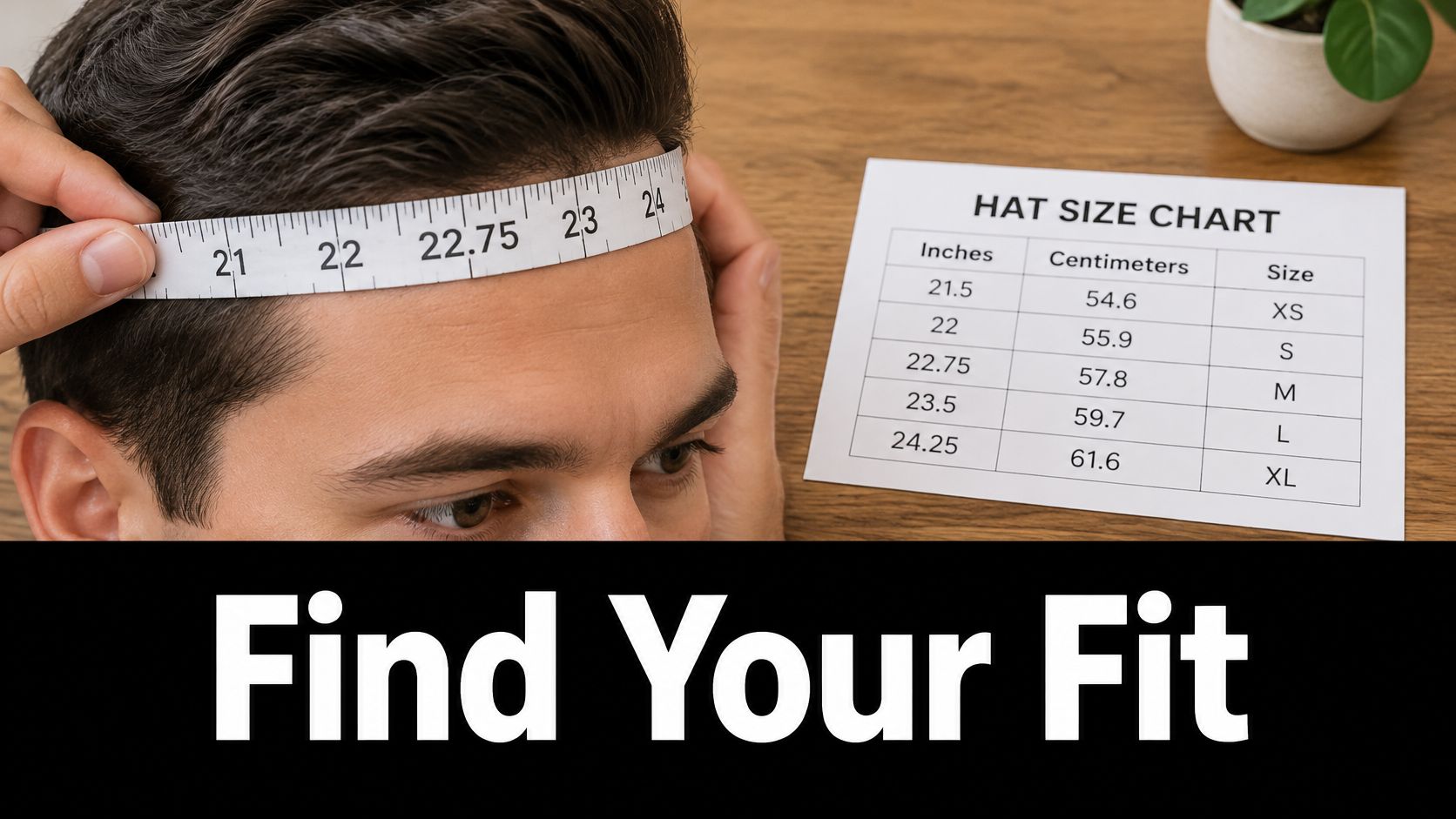
Measure Your Head and Find Your Size
The single biggest cause of a returned bucket hat is a tape measure held too tight. A tight tape reads small, you order down, and the hat arrives with a sweatband pressing a red line across your forehead by the third hole. Do it properly and once.
- Wrap a soft tape about one inch above the ears, running across the brow line. That's the band the hat sits on, not your hairline and not your forehead.
- Keep the tape level the whole way around. Angling it up at the back adds length you don't have and pushes you into the wrong size.
- Snug, not tight. The tape should touch the skin all the way around without compressing it.
- Read the number in inches and round to the nearest quarter inch. Half-inch guessing is how buyers land in the wrong bracket.
- Write the number down before you open the size chart, so you're matching a measurement rather than a memory.
Now match it. The size chart for the Premium Bucket Golf Hat w/ Skull (White) lists approximate head ranges of 21.25 to 22.75 inches for Small/Medium and 22.75 to 24 inches for Large/XL. Notice that 22.75 appears in both. That's not a typo. It's the seam where the two sizes meet, and it's where most of the confusion lives.
| Size option | Head circumference | Fit note |
|---|---|---|
| Small/Medium | 21.25 to 22.75 inches | Suits smaller to average heads; upper edge meets Large/XL at 22.75 inches |
| Large/XL | 22.75 to 24 inches | Suits larger heads and fuller hair; confirm the lower bound on the live chart |
The 22.75-Inch Rule
If your measurement lands exactly on 22.75 inches, both sizes claim you. Decide on hair and preference, not on the number.
Choose Large/XL if you have thick hair, braids, a fuller style, or you want breathing room and don't mind a slightly relaxed fit. Choose Small/Medium if you want the closest fit and wear your hair short or flat. There is no third option and no half size. The buyers who end up unhappy are the ones who split the difference by ordering down for a cleaner look and then find the band digs in after nine holes.
One more trap: the numbers printed on a hat tag are not head measurements. Hat sizes run on a different scale from circumference, and plenty of golfers read a tag figure as inches and order wrong. Work only from the inch ranges on the size chart.
You'll also see the Large/XL lower bound written more than one way across listings, and the ranges disagree right at the boundary. Check the live size chart on the page you're buying from before you order, especially if your measurement sits near that edge.
Practical rule: measure again on the morning you plan to wear the hat. A sweatband feels different on a head that's already warm from a bucket of balls.
Fit Questions the Product Page Doesn't Answer
The listing is clear on sizes and quiet on the things buyers ask in the shop. Does the unconstructed crown suit thick hair or braids? An unconstructed crown has no stiff interfacing, so it drapes and gives. That usually works in your favor with volume, but it also means the hat follows the shape of your head rather than holding its own, so a borderline-small hat on thick hair will sit higher and show more forehead.
Does it stay put on a walking round? A fitted crown with no back closure has nothing to cinch. That's a clean look and a secure one when the size is right, and an annoying one when it's not, because there's no strap to save you. Before a tournament, wear it for a breezy practice nine. If it lifts at the brim on exposed tees, you're between sizes and should size down rather than fight it.
Confirm the white colorway is in stock on the live product page before you build an outfit around it. If your measured size isn't available, the decision is patience rather than style: wait for the restock or take another colorway in the same cut. Ordering the wrong size because it's the one in stock is the worst trade in the category. For a wider look at how hat construction affects fit and comfort, see this guide to performance golf hats.
How Brim Width and Fabric Set Your Sun Protection
Start with the benchmark every golf hat gets measured against. The CDC's skin cancer guidance notes that the head and neck are common sites for skin cancers and recommends a wide-brimmed hat to shade the face, ears, scalp and neck, naming a four-inch brim as the measure that provides the most protection. Four inches is a real hat, the kind you see on a fishing boat. Most golf bucket brims run considerably shorter.
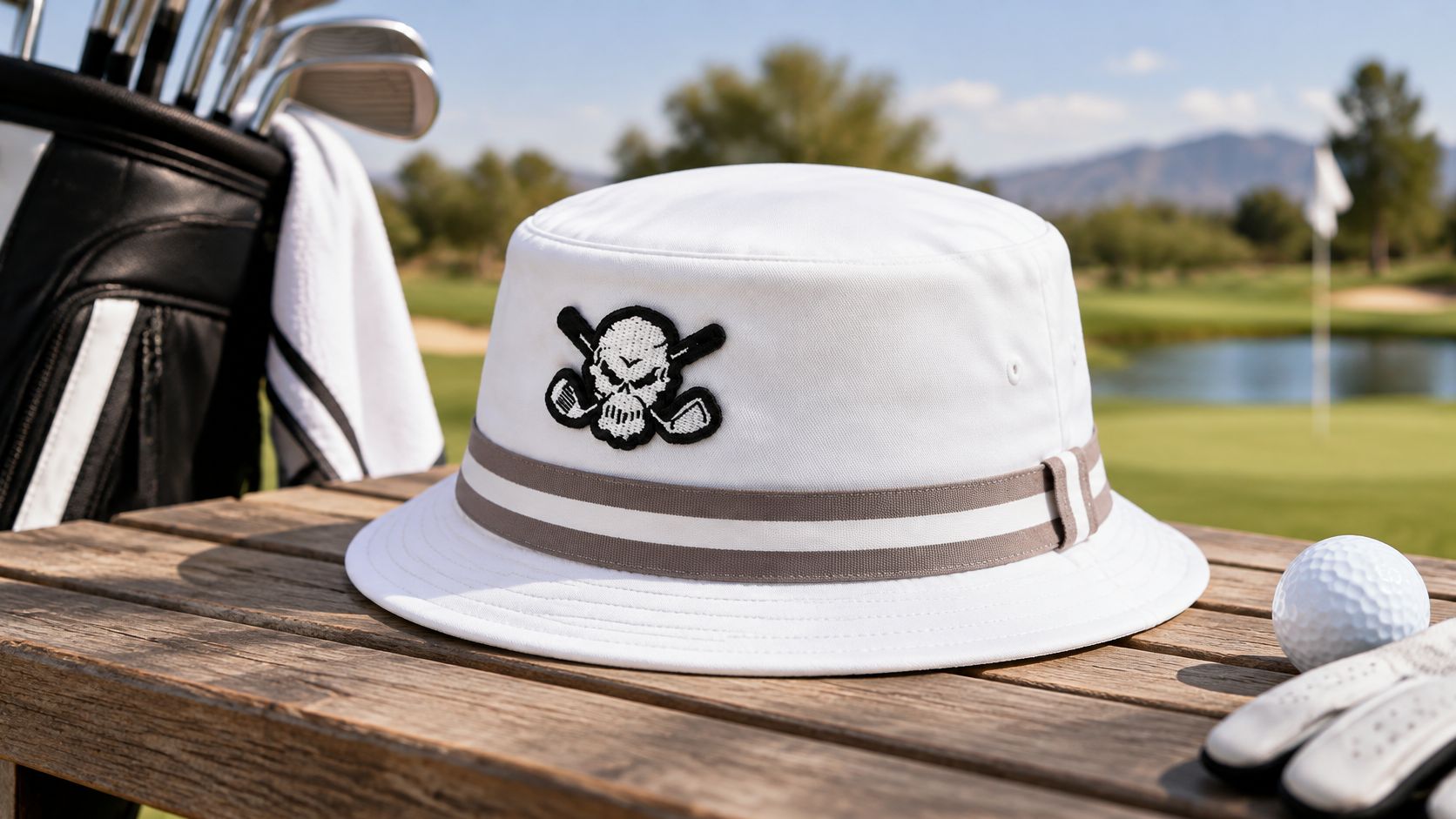
The Premium Bucket Golf Hat w/ Skull (White) pairs an unconstructed crown with a double-layer small brim. Small is the operative word. The second layer adds body and stops glare passing through the fabric, which helps. It adds no width. Expect solid shade across the face and the tops of the ears, thinner coverage on the sides of the neck, and almost none on the back of the neck once the sun drops behind you.
Two numbers matter here, and the product page publishes neither. There's no brim depth and no UPF rating, so both are on you to chase down. Measure the brim yourself if the figure matters: run a tape from the crown seam to the outer edge, straight, on the front and the side. If the seller won't publish that number, ask before you buy. A hat described only as "small brim" gives you nothing to compare.
Ask one question before any sunny-round purchase: what is the brim depth in inches, and is there a tested UPF rating? A seller who can answer both is selling a hat. A seller who can answer neither is selling a logo.
White Fabric Is Not the Same as UV Protection
White bucket hats often get oversold. Independent testing of clothing found that darker cotton and polyester fabrics frequently exceeded UPF 50, while lighter fabrics, especially white cotton, generally produced lower protection, often below UPF 40, according to photoprotection research on clothing fabrics. Protection tracks fabric construction, fiber type, weight and any treatment applied. Color is a weak proxy.
| Fabric and color | Typical UPF pattern | What to verify |
|---|---|---|
| Darker cotton or polyester | Frequently above UPF 50 | Labeled UPF value on the product or care label |
| White or light cotton | Generally lower, often below UPF 40 | Tested UPF value before assuming high protection |
| Lighter fabrics in general | Depends on weight and treatment | Fabric weight, weave and any UV treatment named in the material description |
So treat the white shell as a shade structure first. The brim blocks direct sun from reaching your face and ears. It does nothing about the UV that bounces off water, sand or pale cart paths and hits the underside of your chin and nose. White fabric can also transmit more than a dense dark weave, which is why a labeled UPF value is the only claim worth trusting. If a hat has no tested rating, don't assume one.
Three edge cases catch golfers out on the course. A low sun in the late afternoon gets under almost any brim, so tilt the hat or turn your face. Wind lifts a light brim and exposes the ear on the windward side. Reflected light off a pond or bunker reaches skin the brim never covered. The fix for all three is the same: keep wearing the hat, and stop treating it as total coverage.
One Protection Plan That Holds Up on the Course
Build the round around layers rather than a single item. The hat handles face, ears and scalp. Sunscreen on the neck, ears, nose and any exposed part of the face covers what the brim misses. Sunglasses cut glare and protect the eyes. Shade breaks on the long, exposed walks between holes do more work than they get credit for.
The gap shows up clearly in the CDC's sun-protection survey data: about 67% of men and 73% of women reported using at least one sun-protection method when outdoors for more than an hour on a sunny day, while only 21% of men and 41% of women reported using sunscreen in that situation. Plenty of golfers own a hat. Far fewer reapply lotion at the turn.
For a tournament, an all-day charity scramble or a summer round with a midday tee time, a labeled UPF value stops being optional. That's the one scenario where I'd steer you toward a hat with a published rating over a hat you like the look of. For anything shorter, the brim plus sunscreen is a workable plan. The rest of the hot-weather checklist, from crown vents to sweatband fabric, is laid out in this guide to choosing a golf hat for hot weather.
Fabric Choices That Keep You Dry on the Course
Polyester is a fiber name, not a performance spec. On a humid August morning, the word on a hangtag tells you almost nothing about whether the hat will keep sweat out of your eyes.
Polyester is hydrophobic, so it holds very little water on its own. Technical polyester has to be engineered or chemically treated to move sweat away from skin, and untreated or poorly wicking polyester can increase skin wetness and thermal discomfort in hot, humid conditions, as sportswear moisture research describes. The fiber name is only the starting point.
What moves the needle is airflow and wicking. Mesh panels and other high-air-permeability constructions let heat and humidity escape from the microclimate trapped under the crown, and a yarn that wicks well holds less sweat against your skin. Translated to a hat: a venting crown plus a wicking sweatband will out-perform a heavier hat with better-sounding fiber copy every time.
What to look for: a sweatband or crown panel with documented wicking, drying and air-permeability performance. A hangtag that only says "polyester" tells you none of that.
The practical layout of a good golf bucket is a ventilated crown that lets heat escape during a walking round and a well-fitted sweatband that stops sweat migrating down into your eyes on the back nine. A hat with neither still works. It just gets uncomfortable late in a hot round. If you want a benchmark for what a moisture-wicking golf hat looks like on paper, the '99 Cool-Tech Performance Golf Hat (White) lists Cool-Tech wicking fabric and an adjustable back strap, which is the more technical end of the category.
The white exterior deserves a word of its own. Sweat marks, sunscreen residue and turf dust all show more on white than on charcoal or black. That visibility is the cost of the color. Plan for spot cleaning rather than treating the hat as machine-fresh forever.
Care matters more on a structured or semi-structured hat than people expect. The listed instructions are machine wash cold on a gentle cycle, then air dry, with no dryer and no ironing, and storage in a cool, dry place to hold the shape. Heat is what kills a brim. Confirm the care instructions on the live product page when you order, since the details on any listing can change between seasons.
Pair the Hat With Festive Shirts and Group Outfits
Start with the rule that solves most group-photo problems: pick one shared shirt color and let the hat be the accent. Four players in the same shirt and the same white hat read as a team. Four players in four different loud shirts and the same hat read as strangers who happen to own the same headwear.

| Outfit element | How it works with the white hat | Best for |
|---|---|---|
| White or cream polo | Crisp, matching group look that keeps the skull logo visible | Holiday scrambles and group photos |
| Navy or charcoal polo | Clean contrast that makes the white hat stand out | Tournament days and mixed-age groups |
| Bold festive or Hawaiian print shirt | Keep the hat plain and let the print lead | Themed rounds and holiday outings |
| Black or charcoal shorts or pants | Logo stays the focal point of the outfit | Gift sets and everyday rounds |
Working Through the Pairings
White or cream polo. This is the cleanest group look and the one I'd recommend for a holiday scramble. The white hat sits on a near-matching field, the embroidered skull reads clearly, and nobody's shirt fights anybody else's. Cream softens it if pure white head-to-toe feels too uniform.
Navy or charcoal polo. Best when the group spans ages and you want definition rather than uniformity. Dark shirts make the white hat pop, and the skull graphic carries the outfit without a single print. For a mixed foursome where two players own white hats and two don't, this is the safest shirt choice.
Bold festive or Hawaiian print. Prints and graphics on the same body compete. If the shirt is doing the talking, keep the hat plain. The white bucket is already plain enough to sit under a loud shirt, which makes it a working piece for themed rounds rather than a shelf item.
Black or charcoal bottoms. This is what keeps the logo the focal point. Cream top, charcoal shorts, white hat is a formula that photographs well and works for a gift set you're assembling in one order.
A group that picks one shirt color and stops there usually looks better than a group that coordinated everything. Two variables are plenty. Three start to look like a uniform.
The skull graphic suits the golf market better than it might seem. The USGA's 2024 participation reporting makes the point in three numbers: 3.35 million U.S. golfers held a Handicap Index and posted more than 77 million scores, up more than 6% from 2023 and nearly 30% from 2020; nine-hole play set a record at 13,798,174 posted scores, an 8% year-over-year rise; and 94.5% of all posted scores were recreational, with only 25.4% of men and 23.7% of women posting at least one competitive score.
Most rounds are casual rounds. A hat with a skull on it fits that reality.
Holiday scrambles and gift exchanges are the rounds this hat is built for. It wraps easily, reads as a considered gift rather than a novelty, and sits under almost any shirt already in a golf wardrobe. Agree on the shirt color before ordering, keep the hat as the constant across the group, and the foursome photo takes care of itself.
Choose a Gift Hat for Someone Else
Do not guess a hat size. A gifted hat that doesn't fit is worse than no hat, because the recipient now has to find your receipt or pretend it fits.
- Get the measurement covertly. The sizing section above shows where the tape goes on the head, but a gift rarely allows that. Measure the inside sweatband of a hat they already wear, end to end around the band, and work from that number instead.
- Settle a borderline measurement before ordering. If the number sits between sizes, find out whether they wear thick hair or braids. Fuller hair argues for the roomier option. When you can't ask at all, size up. A slightly loose bucket hat still gets worn; a tight one doesn't.
- Measure each person separately for a group gift. Assuming one size covers a foursome is how two hats end up in a drawer. A foursome measuring 22.0, 22.5, 23.0 and 23.5 inches needs two Small/Medium and two Large/XL, not four of anything.
- Confirm the color before adding a matching polo. A coordinated set lands well, but a shirt in a color they won't wear drags the hat down with it.
- Read the exchange terms and ask for a gift receipt. A size miss is a quick fix when the return window and paperwork are in place. Without them, the hat sits in a bag until someone re-gifts it.
- Choose an adjustable closure when no measurement is possible. Tattoo Golf sells fitted buckets alongside snapbacks and adjustables, and the Rope & Cord Adjustable Golf Hat (Bone) is on sale at $14.99, down from $34.99. A closure takes the sizing gamble off the table entirely.
The bucket silhouette also helps the gift case. The brim shades the ears and neck in a way a snapback doesn't, so it reads as a practical gift rather than a novelty, and at $39.99 the Premium Bucket Golf Hat with Skull in White sits comfortably inside most gift budgets.
For a wider set of options at different price points and styles, this roundup of golf gifts for players who like bold style covers the rest of the category.
Gift rule: if you can't get a measurement, buy a style with an adjustable closure instead of a fitted crown. Fit certainty beats a bolder graphic every time.
One more thing about gifting a fitted hat. The person who receives it will wear it in front of you, on a course, for four hours. A hat that's a half size tight will be visible in the photos. Get the number first. It takes one text message.
Confirm Your Size and Decide on the White Hat
A noon scramble is where this hat either earns the bag or comes off by the third hole. The group wants white crowns in the photos. The listing still has not told you whether the size boundary matches the head, or whether the brim is rated sun gear or just shade. Fit and coverage come first. The skull is the reason it looks intentional once those two are settled.
The Premium Bucket Golf Hat with Skull in White is $39.99. That is a fair price for a fitted bucket with the graphic if the live size chart agrees with the measurement and the color works with shirts already packed. A bold front does not fix a crown that sits wrong for four hours.
Color is the decision buyers rush. White in this cut stays the clean choice against dark polos, and the skull reads from a few yards in group photos. Another colorway of the same crown is the better call when light shirts dominate the bag or you want sweat less obvious on a still afternoon. Match the hat to the shirts you will wear. Do not pick the tile that looks loudest on the product page.
One order can cover more than the bucket. The Lucky 13 Cool-Stretch Men's Golf Polo & Tattoo CC Hat set is $99.98, a polo and a hat together, not a second bucket. Order that set only after the shirt color is a yes. A polo nobody will wear drags the hat down with it.
The Verdict
Buy the white hat for casual rounds, holiday scrambles, group photos, and everyday golf once the measured size is in stock. The fitted crown, two size options, and the skull make the outfit look planned rather than thrown on.
For a long midday round in high sun, I would keep a separate hat with a labeled UPF rating and a wider brim in the bag, and wear this one when the group is dressed up and the round is social. For most golfers I would fit, that split is the honest kit: style hat for the photos, technical hat when the forecast is harsh and the tee time is noon.
Tattoo Golf has been putting skull-and-clubs graphics on performance golf gear since 1999, and the Premium Bucket series keeps that mix in an unconstructed crown, a double-layer brim, and two fitted sizes. White is the colorway to lock to the shirt plan. Visit Tattoo Golf to check current stock, confirm the sizing chart and build the rest of the outfit.
Share:
Couples Matching Golf Shirts