
You're on the first tee in a quarter-zip that looked fine on the hanger, and the zipper climbs your chin the moment you take the club back. The hem lifts. The shoulders stall halfway through the turn. Comfort while you're standing still doesn't tell you how that top will behave once your hips and chest are moving in opposite directions.
A quarter-zip earns its place in the outfit only if it stays quiet through a full backswing and a full follow-through. Build the stack from the skin out: a base, the quarter-zip as the warmth layer, then a shell only if the air asks for one. Color and graphics come after the layers move.
What follows is that order. Temperature bands first, then what the garment is beside the tops you already own, then fabric checks, layering, and a swing test you can run in a shop or on the range.
Quarter-Zip Outfit Formulas by Temperature
Judge the air at the first tee, not the afternoon high on your phone. On a mild day the default is simple: a performance polo under a thin quarter-zip worn open at the chest, with shorts or light pants. You keep a collar, you get a little wind break, and you can close the zip if a cloud sits on the fairway.
As the air cools, add warmth under the zip before you pile bulk on top of it. The bands below run from warmest to coldest.
| Temperature | Base top | Quarter-zip role | Bottoms |
|---|---|---|---|
| Above 24°C (75°F) | Performance polo | Lightweight quarter-zip worn open as sun cover, or left in the bag | Performance shorts |
| 16 to 24°C (60 to 75°F) | Performance polo | Thin quarter-zip worn open at the chest | Shorts or lightweight pants |
| 10 to 16°C (50 to 60°F) | Light base, or the polo alone | Quarter-zip partly zipped as the warmth layer | Performance pants |
| 4 to 10°C (40 to 50°F) | Light thermal base | Mid-weight quarter-zip closed at the tee | Performance pants |
| Below 4°C (40°F) | Thermal base layer | Mid-weight quarter-zip under an insulated vest | Thermal-lined pants |
How to read the bands
The left column is the feel when you walk off the cart path, not the forecast high. Wind or damp air moves you one band colder. A dry 12°C morning with a crosswind plays like the 4 to 10°C row, because moving air strips heat faster than a still morning at the same number.
Practical rule: If you're warm after three holes, drop one layer. Don't keep a jacket on that you already know you won't need.
The table can't choose the cut of the zip, the fabric weight of the quarter-zip, or whether the outfit needs a tested sun rating. Those decisions sit in the checks that follow. For shirt and bottom pairings that change with the calendar and sit under this stack, look through men's golf outfit ideas for every season.
What a Quarter-Zip Is and How It Differs from Your Other Layers
A quarter-zip is a pullover with a zip that runs about a quarter of the way down the chest, usually 6 to 10 inches, and a collar that either stands up or lies flat. Treat that short zip like a thermostat. Open it when you warm up. Close it when the wind picks up. You adjust the top without changing garments.
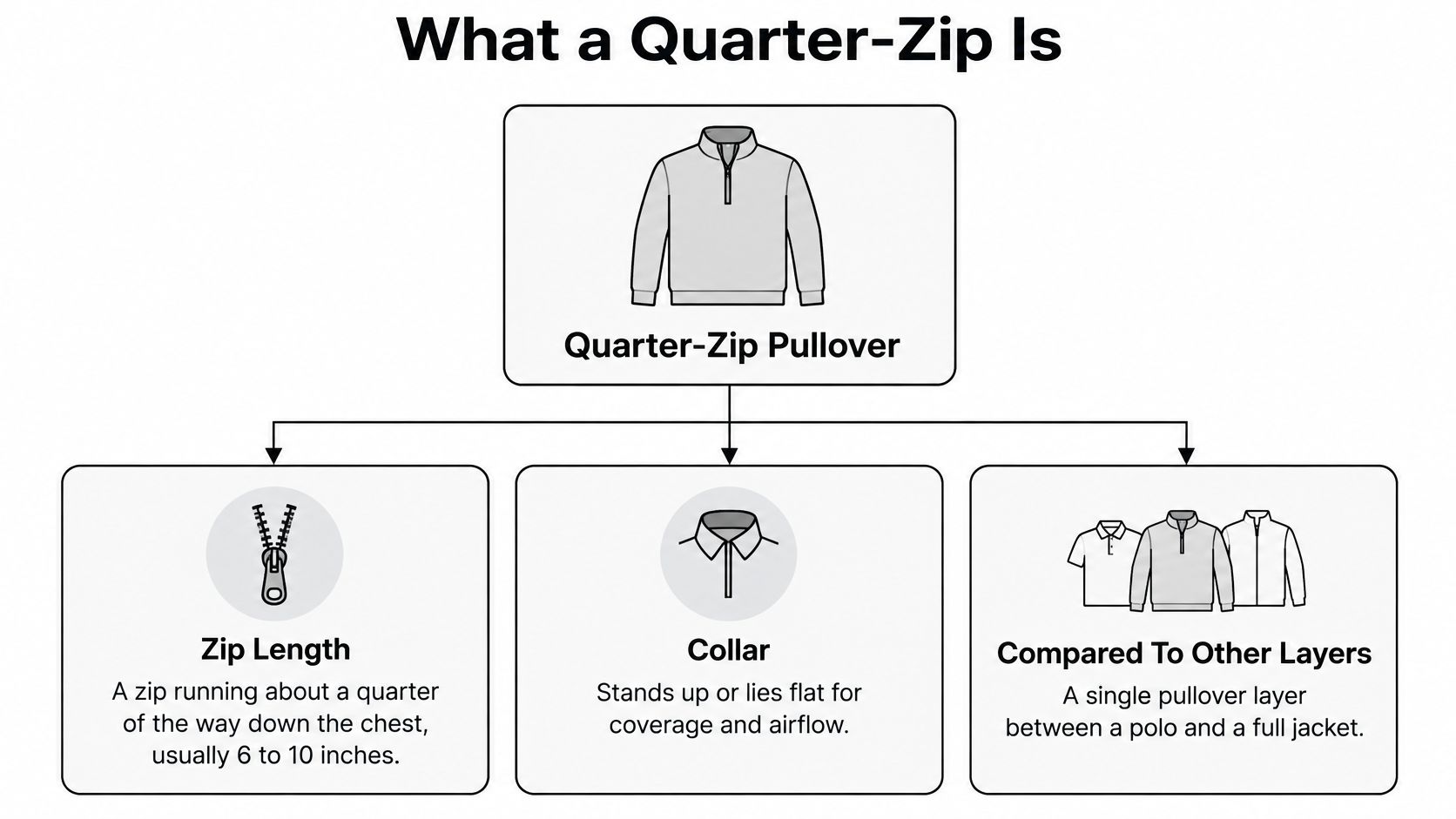
Set it next to the three tops most golfers already own.
- Polo: Buttons and a fold-down collar. Clubs like the collar. Wind likes to flap it, and a polo alone is a poor warmth layer.
- Full-length fleece: Zips the whole way, which is handy in a parking lot and clumsy in a swing. The long placket bunches across the chest as you turn.
- Hoodie: The hood can catch on the backswing or the collar of a shell. It also reads as casual wear at plenty of clubs.
The quarter-zip keeps the collared look courses expect and adds warmth a polo can't give, without the bulk of a full zip.
Golf clothes have been doing this job for a long time. In the 1930s, players helped popularize René Lacoste's polos because a collar met course rules and felt cooler than heavier traditional clothing, a shift Business of Fashion traces through later decades. Arnold Palmer's bright polo-and-trouser combinations became tied to golf fashion nearly 70 years ago, and Tiger Woods's red-and-black outfit at the 1997 Masters showed how a coordinated kit could be recognizable and still built for play. Through the 1990s and 2000s, tour players normalized moisture management, stretch, and light construction next to those collars. In the year ending May 2019, NPD Group data reported by Business of Fashion showed golf-apparel sales to non-white customers increased 26%, while sales to white customers declined 16%. Making it a golf outfit means a full, coordinated kit, not a required shirt plus any pair of trousers.
A coordinated example is the Hazard Men's Golf Outfit - Purple/Charcoal/Purple: a purple Cool-Stretch polo in an 8 oz, 92% polyester and 8% spandex blend, charcoal performance shorts, and a purple ratchet belt, with four-way stretch and a stated UPF 50+ rating on the shirt. That polo is the base. The quarter-zip sits over it when the tee time is cooler.
Place the quarter-zip in the middle of the order. A thermal or performance base goes against the skin. The quarter-zip is the warmth layer. A wind shell or rain jacket goes on top, and comes off when you don't need it.
Performance Features Worth Checking
Rank features by how much they change 18 holes, not by how they read on a hangtag.
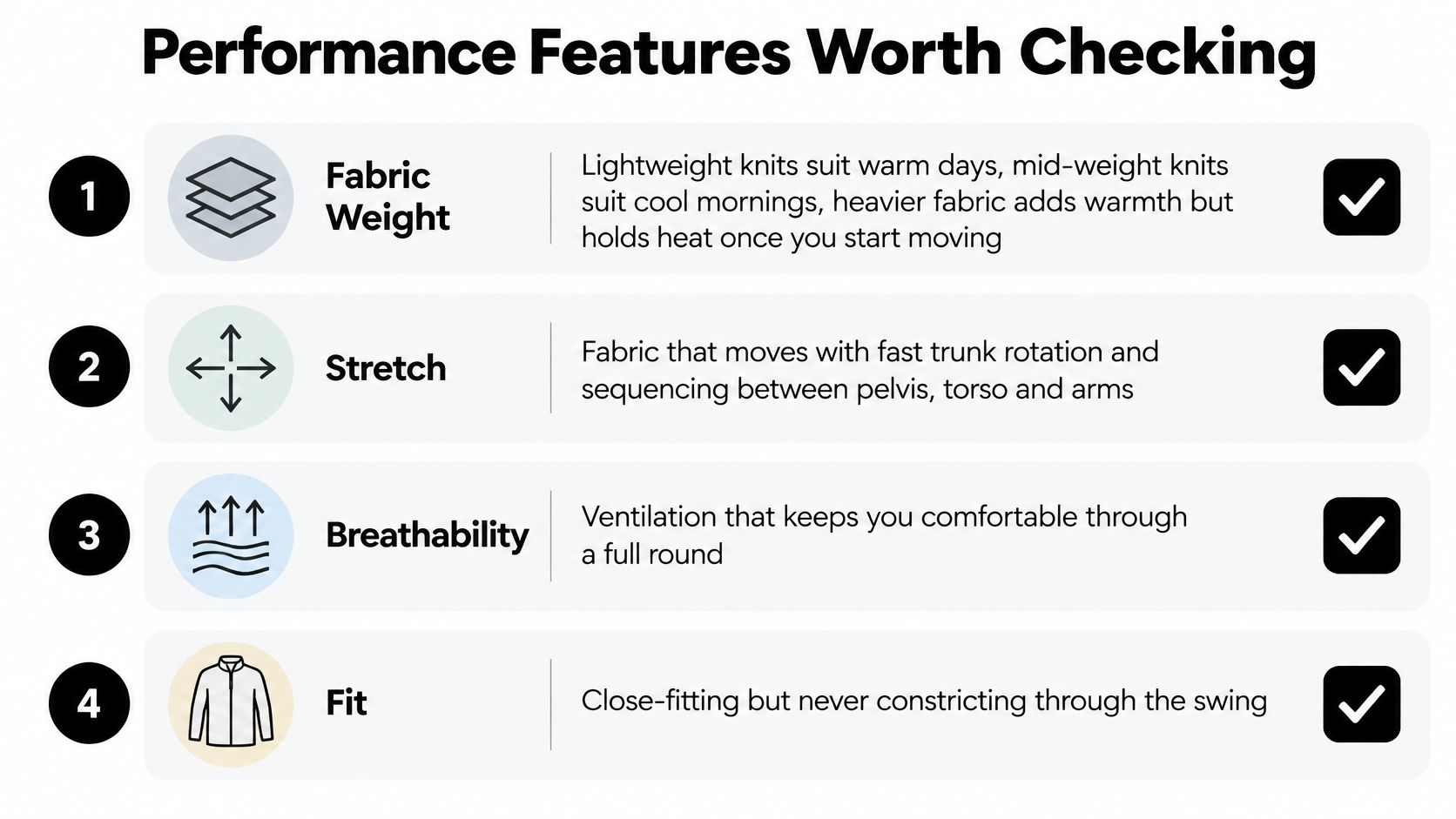
Fabric weight comes first. Lightweight knits suit warm days. Mid-weight knits suit cool mornings. Heavier cloth adds warmth, then holds heat once you're walking and swinging. If you overshoot the weight, you'll be peeling the top off by the fourth hole.
Stretch is next. Look for four-way stretch from elastane so the knit can extend across the back and shoulders. Treat any stretch percentage on a tag as a starting point, and confirm it against the brand's own test notes before you buy. A fabric that stretches on a pull test can still lock up if the panels don't cross the turn.
Moisture control matters on the back nine. Polyester that wicks, plus a quick-dry finish, moves sweat off the skin. An anti-odor treatment helps when the same top sees several rounds between washes. None of that replaces a base layer that already manages sweat. It keeps the quarter-zip from feeling clammy once the zip is closed.
Sun protection you can measure
Sun protection is a number, not a guess from color or a light hand-feel. UPF compares erythemally weighted ultraviolet radiation hitting a textile with the amount that gets through. A textile study published through Springer notes that UPF 30 permits approximately 3.3% of erythemally effective UV to pass, while UPF 50+ permits less than 2%.
Denser, thicker, heavier cloth with lower porosity generally raises UPF, and the same construction can cut air and water-vapor flow, so you carry more heat. Pair a tested rating with moisture-management yarns, ventilation zones, and enough coverage. Don't chase the heaviest fabric and call it protection.
Stretch and wet fabric can both lower the measured rating, so a label from a dry, unstretched swatch is the best case. The label should name the standard: AATCC TM183 in the United States, EN 13758 in Europe, or AS/NZS 4399 in Australia. A polo, a hat, and a light overshirt cover more skin on an open fairway than a polo alone.
Before you pay, run this shop list.
- Weight: Match it to the tee-time band, not to the coldest day you might ever play.
- Stretch: Four-way, and placed where you rotate.
- Wicking: Polyester or a stated quick-dry finish.
- UPF: A number plus the named test standard.
- Seams: Flat construction where the fabric crosses the shoulders.
- Wind: A tighter face fabric if the course sits in the open. Skip it if you already carry a shell.
Layering a Quarter-Zip Without Losing Your Swing
The layer that matters most should be close-fitting but never constricting. A golf swing needs fast trunk rotation and a quick sequence from pelvis to torso to arms to club. A top that feels fine while you stand at address can still change that sequence once you start down.
A controlled study of golfers, published in the Clothing and Textiles Research Journal, found that a compression top under a golf shirt slightly restricted trunk motion early in the downswing and affected X-factor stretch, the extra shoulder-to-hip separation at the top. The overall X-factor did not change. Restriction showed up in the move, not in a mirror check.
Three stacking rules follow from that.
- Keep the base close to the body without compression tightness across the shoulders and ribs.
- Put stretch across the back, shoulders, waist, and seat. Elastane can supply extension. Panel placement, seam direction, and pattern ease decide whether that extension is still there when you rotate.
- Keep thick seams and rigid waistbands off the zones that twist. A stiff band at the waist fights the same turn the shoulders are trying to make.
The same idea shows up off the course. Riders sorting choosing sweaters for horseback riding are also looking for a layer that stays close without fighting the movement. Golf asks for the same honesty from a quarter-zip.
Three mornings, three stacks
On a 7°C morning, wear a thermal base, a mid-weight quarter-zip, and a wind shell zipped to the chest. Take the shell off after the first three holes if you're warm. Leave the quarter-zip on. Cold-morning kits are easier to plan when you've already looked at golf clothing for cold weather and know which piece is the one you'll remove.
On a drizzle day, the quarter-zip sits under a light rain jacket cut with room for that extra layer. Stow the hood in the collar so it can't catch the club on the way back. If the jacket is sized only for a polo, the zipper will pull as soon as you turn.
On a hot afternoon, wear the quarter-zip open as sun cover over a polo. It is not a second heavy layer. If the cloth is mid-weight, leave it in the bag and keep the polo.
Take ten slow full swings in the full stack before the first tee. Watch hem lift, shoulder pull, and bunching through backswing, transition, downswing, and follow-through. If a layer grabs, fix it before you keep score.
For men's, women's, or matching outfits, keep those movement allowances in every cut. Don't scale one pattern up or down and assume the turn still works.
Fit Checks for a Comfortable Quarter-Zip
Fit is what the top does while you swing, not how it hangs. Hold a full backswing and see whether the shoulder seam pulls toward the back of the arm. Then follow through and see whether the hem climbs above the waistband. The chest zip should lie flat while you turn, and the placket should not gape.
| Fit point | Check during a swing | Warning sign |
|---|---|---|
| Shoulders | Full backswing reach held at the top | Shoulder seam pulls toward the back of the arm |
| Chest | Rotation without tugging the zip | Zip pulls open or fabric pulls across the chest |
| Body length | Hem stays down through follow-through | Hem lifts above the waistband |
| Sleeve length | Arms extended at address and through impact | Cuffs ride up past the wrist |
| Collar and zip | Zip lies flat at the neck while turning | Placket gapes or the zip rubs the chin |
| Stretch | Four-way stretch across back and waist | Fabric feels taut at the bottom of the swing |
Work the rows in that order. Shoulders fail first on a lot of quarter-zips because the yoke is cut for standing, not for a turned chest. Sleeve length is next: cuffs that cover the wrist at address and vanish at impact will fight a watch or a glove. Collar and zip come last, because a gaping placket is often a chest that's already too tight.
What a size chart leaves out
One number does not travel across brands. Bust proportion and torso length change where a quarter-zip sits, and a shirt that looks like a good fit in a mirror can still lock your rotation or ride up. GII Research coverage of the golf apparel market treats inclusive sizing and gender-responsive construction as growing needs as more women play. Most outfit roundups still stop at "polo plus shorts, skort, or pants."
Check the details those roundups skip.
- Liner coverage: On a skort, the liner should stay put when you bend to read a putt.
- Pockets: A pocket that gapes at address will spill a tee on the backswing.
- Bra compatibility: Straps shouldn't show at the collar or fight the shoulder seam at the top of the swing.
- Security: Shorts or a skort should stay seated while you bend, not only while you stand.
The Ladies 19th Hole Cool-Stretch Golf Shirt (Neon) is a lightweight polo in 95% polyester and 5% spandex, with a tag-free neck label, a three-button placket, and women's sizes from Small through 2XL. Use it as the base under a quarter-zip, and still run the swing checks. A broader size run is not the same thing as a cut that fits your torso.
Compare each brand's chart with your chest and torso measurements. Prefer the garment that passes the swing over the one that flatters in the mirror. A body-inclusive cut shapes the shoulder and the body length for the person wearing it. Moving up a size often adds fabric through the waist and does nothing for a short torso or a narrow shoulder. If you want a shell over this top, a golf jacket should be cut for the layer underneath, not for the polo alone.
Choose Your Quarter-Zip Before the Next Round
Run four checks before you commit to the top for the next round. Each one points at a decision you can make in the shop or on the range, without repeating the whole fitting session.
- Pick the temperature band from the feel at your tee time, and set the base, the quarter-zip, and the bottoms to match.
- Read the UPF number and the named test standard on the label. If either is missing, don't treat the color as protection.
- Swing in the top, in the shop or on the first few holes. Fail it if the shoulder pulls, the hem climbs, or the placket gapes.
- Confirm the base doesn't compress the shoulders. Ten slow swings in the full stack will show it.
Choose mid-weight when your region stays cool and the course is exposed to wind. Choose lightweight when rounds are warm, humid, or both, and use the quarter-zip as open sun cover rather than as insulation. A coastal links asks for more wind resistance than a tree-lined park course at the same temperature.
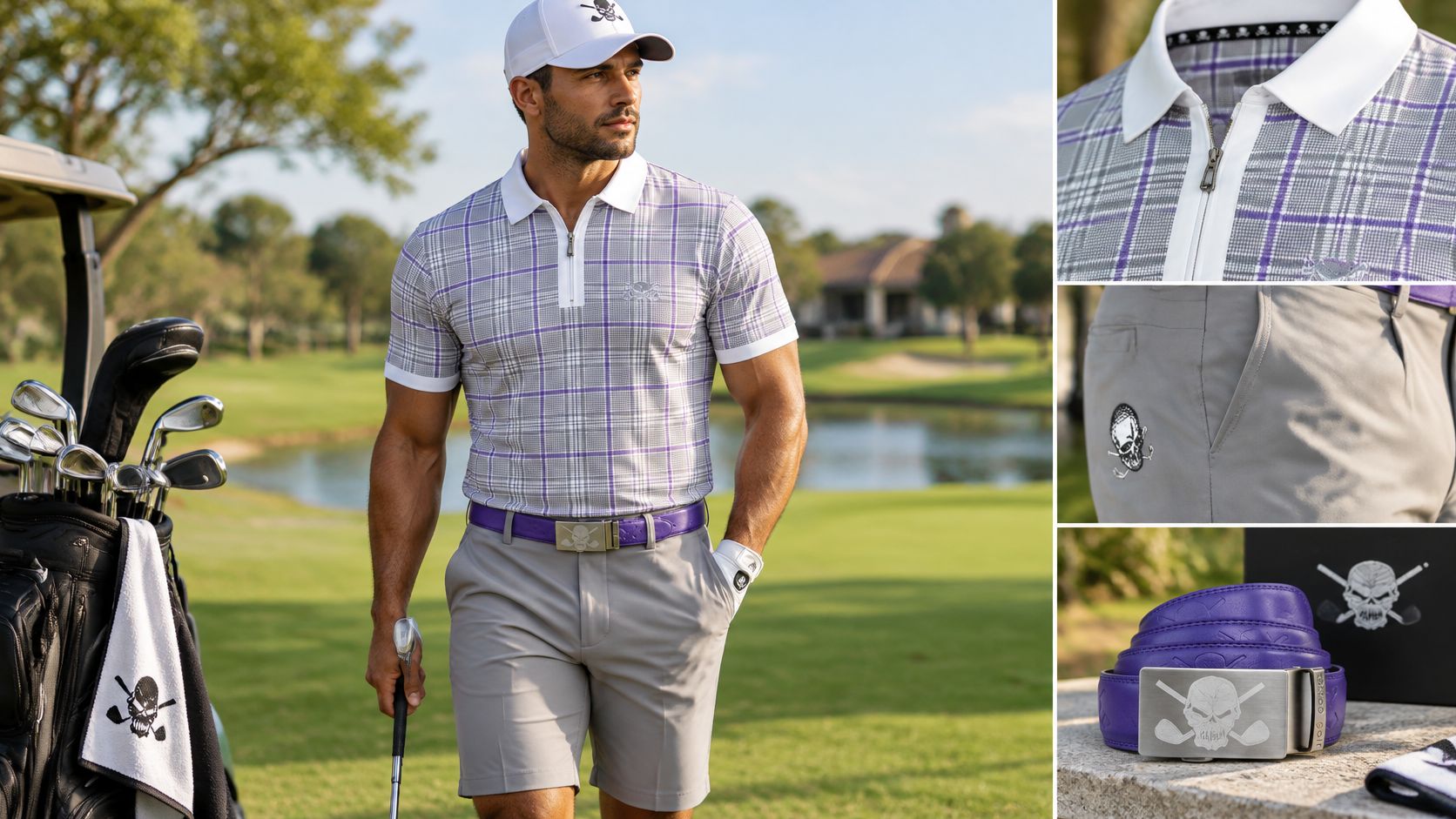
Our men's apparel collection lists golf shirts, shorts, pants, hats, accessories, cold weather gear, and golf outfits, and our golf shirts use lightweight, moisture-wicking fabrics so you stay cool and dry. The Aloha Mens Cool-Stretch Golf Shirt & Zuma Golf Shorts (Teal/Zuma Grey) is one warm-weather stack you can set beside those checks: a teal polo and grey shorts in an 8 oz, 92% polyester and 8% spandex blend. No single brand is required. Any shop works if the checks pass.
A quarter-zip earns its place when it keeps you warm without limiting your swing.
Tattoo Golf builds golf outfits around performance polos, shorts, cold-weather layers, and coordinated kits you can swing in, with lightweight moisture-wicking shirts and room to add a quarter-zip when the tee time cools off. Use the temperature bands, the label checks, and the swing test here, then compare what you find with pieces cut for a full turn. Visit Tattoo Golf and put the next outfit through the same backswing before you take it to the first tee.

Share:
Tiki Cool-Stretch Men's Golf Shorts - Multicolor Guide 2026
Couples Matching Golf Shirts