
A pair of golf shorts can carry a UPF 50+ rating and still be the wrong buy for a humid Saturday. Sun protection and drying speed are separate properties, tested by separate methods, and a product page that opens with flamingos and tikis will usually be loud about one and quiet about the other.
The Tiki Cool-Stretch Men's Golf Shorts - Multicolor make a solid case on the numbers that are printed. At $69.99, in waist sizes 30 through 44, the listing gives an 8-ounce fabric of 92% polyester and 8% spandex, four-way stretch, moisture-wicking and quick-dry behavior, and a UPF 50+ rating that the listing describes as blocking 98% of UV rays. That is specific enough to compare against any competing pair on the rack.
What the listing does not give you is the evidence behind the comfort claims: no drying time, no wicking measurement, no vapor transmission figure, no stretch recovery percentage. That gap is where most buying decisions go wrong. A spec sheet tells you what the fabric is. It stays silent on how it performs by the back nine in August.
Judge these shorts on three things before paying. Whether the stretch holds through a full turn. Whether the fabric sheds sweat in humidity rather than just spreading it. And whether the cut survives 18 holes on foot with a phone and a rangefinder in the pockets.
Tiki Shorts at a Glance and What the Specs Mean
These are a technical warm-weather short that happens to wear a tropical print, not a novelty garment with a stretch label sewn onto it.
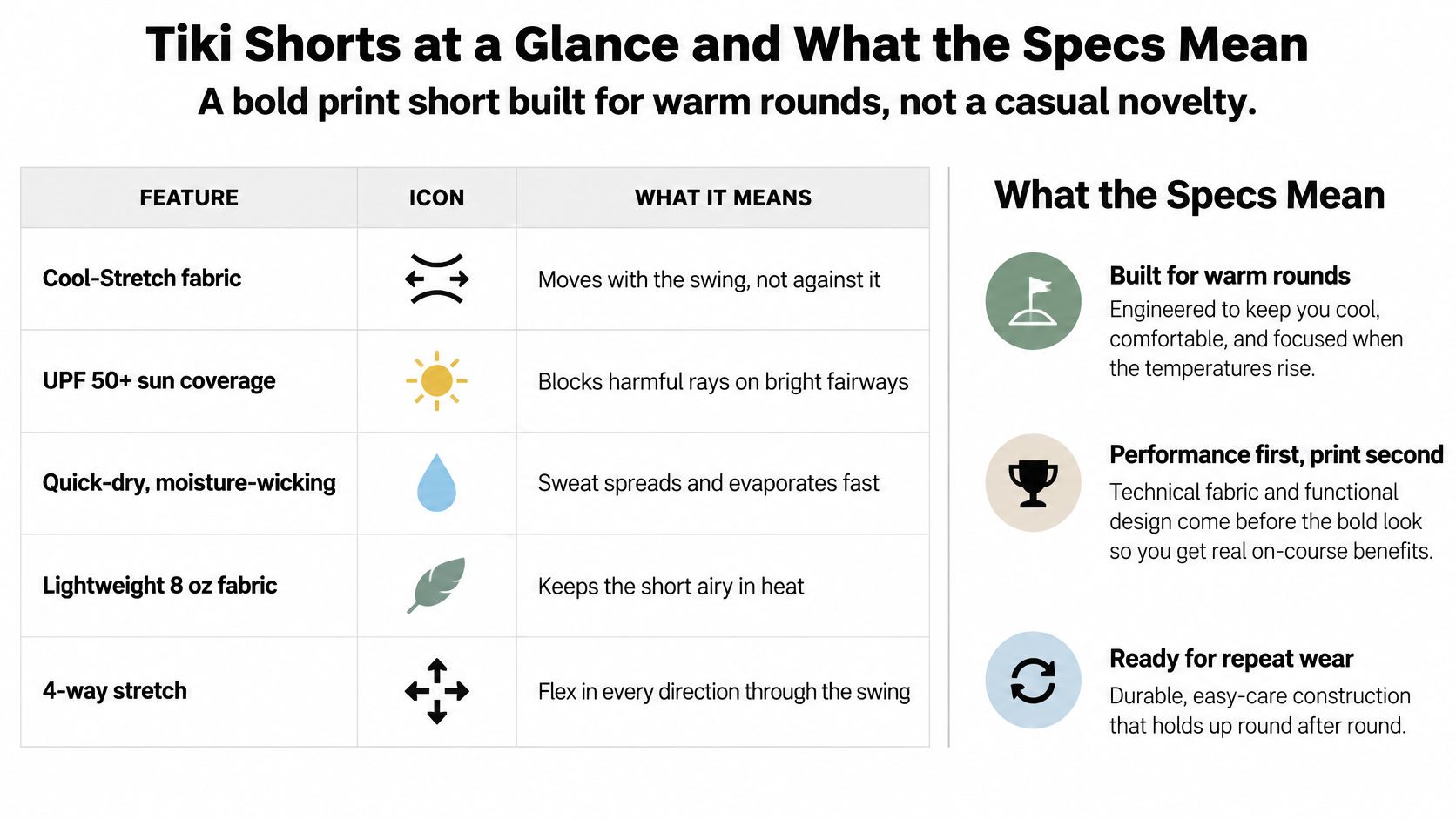
Every row below is a listed specification, not a reinterpretation. Read the right-hand column as the on-course consequence of the middle one.
| Feature | Listed spec | What it does on the course |
|---|---|---|
| Fabric | 8 oz, 92% polyester / 8% spandex | Balances durability with stretch |
| Stretch | Four-way stretch | Moves in multiple directions for swing, walking and sitting |
| Sun protection | UPF 50+, blocks 98% of UV rays | Coverage across roughly 18 holes outdoors |
| Moisture management | Moisture-wicking and quick-dry | Moves sweat off the skin and speeds drying |
| Odor control | Anti-odor and antimicrobial finish | Helps keep shorts fresher through a full round |
| Wrinkle resistance | Wrinkle resistant | Easier packing for golf travel |
| Seams | Flat-lock | Less rubbing on long walking rounds |
| Inseam | Approximately 9 inches | Modern straight fit length |
Eight ounces is a substantial weight for a golf short, and that's a feature rather than a compromise. A fabric at this weight hangs cleanly from the waistband, holds a crease through a round, and doesn't cling when you sweat. The 92/8 polyester-to-spandex ratio does two jobs at once: polyester supplies the durability, the wrinkle resistance and the low moisture uptake, while spandex supplies the give that lets the short follow a hip turn instead of fighting it, per the Tattoo Golf product page.
The UPF 50+ rating is the row most buyers skim and should not. A round means roughly 18 holes and several hours of direct exposure, and fabric coverage on the thighs and seat is protection you can't reapply, unlike sunscreen on your arms and face.
The rows that decide a round
Three of these eight rows change how the shorts feel on a specific day, and the rest are conveniences.
- Stretch: four-way construction is what lets you take a full turn without the waistband pulling down at the top of the backswing.
- Sun coverage: the listed UV blocking matters most for midday tee times and bare legs.
- Fit: the stretch waistband, zip fly and belt loops sized for standard 1.5-inch golf belts determine whether the short stays where you put it.
The remaining details earn their place over a season. Flat-lock seams sit flatter against the skin, which matters more the longer you walk. An anti-odor and antimicrobial finish buys you a second wear on a golf trip. Front slash pockets and two rear pockets give you somewhere to put a card and a glove. None of them will rescue a poor fit, and none of them will fail you either.
Waist Sizes and Fit for Walking Rounds
The size run is straightforward: waist sizes 30 through 44 in even steps, each with the same listed inseam. That's a wider range than many golf shorts offer, and it removes the guesswork of letter sizing.
| Waist size | Listed inseam |
|---|---|
| 30 | Approximately 9 inches |
| 32 | Approximately 9 inches |
| 34 | Approximately 9 inches |
| 36 | Approximately 9 inches |
| 38 | Approximately 9 inches |
| 40 | Approximately 9 inches |
| 42 | Approximately 9 inches |
| 44 | Approximately 9 inches |
How to read the chart
Measure your natural waist at navel level with a soft tape, relaxed, over light clothing. Don't cinch it to reach a number you prefer. Compare that reading to the chart rather than to the size you wear in another brand, because the same nominal size measures differently from label to label.
If you land between sizes, decide by behavior, not by the number. Put the smaller pair on, bend into a crouch and sit down. A stretch waistband that digs at the crease or rolls over itself under the belt is the wrong size, even if the tape said otherwise. Our guide to how golf shorts should fit walks through rise, thigh ease and leg opening in more detail, and those three measurements decide comfort more than waist alone.
Fit rule: Size for the seat and the thigh first, then manage the waistband. You can belt a slightly generous waist. You can't belt your way out of a seat that binds through the turn.
The walking fit boundary
Independent testing draws a useful line for walkers: legs should not be so wide that they flap in the wind, or so tight that they ride up while walking, as Independent Golf Reviews puts it. A modern straight fit sitting between those extremes is the target, and roughly a 9-inch inseam lands just above the knee on most builds.
What the listing doesn't publish is exactly what that review calls for: front rise, leg opening, thigh width and pocket dimensions. Ask for them if you're between sizes.
The carry test
Load the pockets the way you play. Phone in one front slash pocket, scorecard and tees in the other, rangefinder in a rear pocket. Walk a few hundred yards, then crouch as if reading a putt. Items that shift, bounce or press into your hip through the fabric will do the same thing for four hours.
Crouch and stand three times in a row. Bind at the knee or the seat is the most common failure on a walking round, and it shows up in the fitting room long before it shows up on the 14th fairway. If the shorts are headed into a travel bag for a trip built around tee times, the logistics in this guide to private golf trips for couples are easier to plan once you've confirmed the fit at home.
Stretch and Range of Motion Through the Swing
Golf doesn't test a short while you're standing at a mirror. It tests it at the top of the backswing, in the crouch over a putt, and on the walk up a slope between shots.
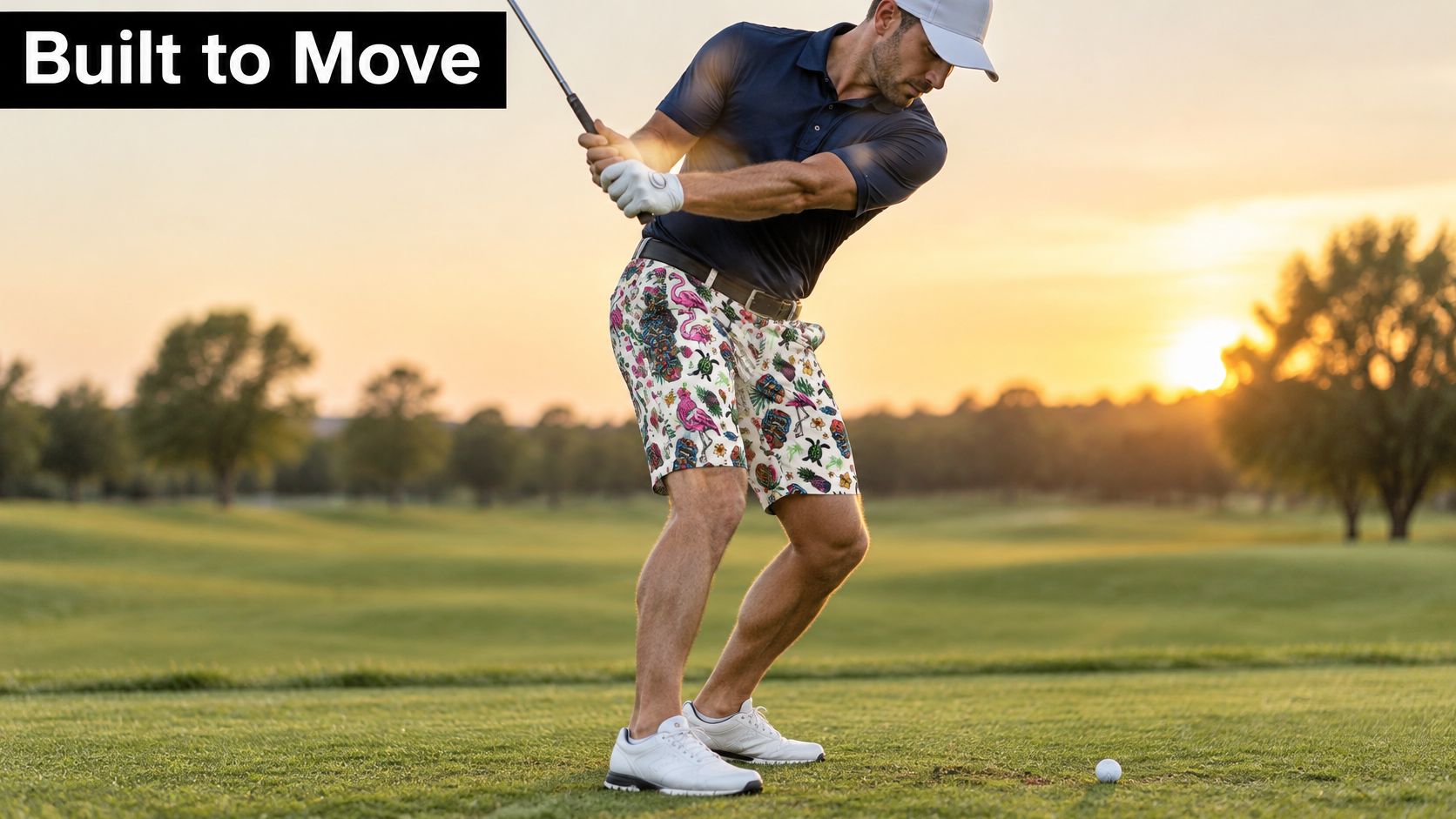
The loads are real. Musculoskeletal modeling reported in peer-reviewed swing research puts knee axial rotation at approximately 25 to 31 degrees during the swing, with maximum knee compression reaching about 329% of body weight near impact. Your shorts don't carry that load, but the fabric across your seat, hips and thighs has to accommodate the rotation that produces it.
Restrictive tension shows up in predictable places. Across the front of the hip at address. Under the waistband at the top of the backswing. Across the seat as you finish. From the swing biomechanics study, the practical takeaway is that a four-way stretch construction can reduce that tension, provided the waistband doesn't bind during trunk rotation.
Three checks to run with the tags on
Do these in order, at home, while a return is still simple.
- Deep address position. Settle into your setup and hold it for ten seconds. The waistband should not dig into your midsection, slide down, or need a tug when you stand back up.
- Three slow backswing turns. Rotate to the top at half speed, then at full speed. Watch whether the waist pulls down at the front or rides up at the back. Either one means the rise or the waist size is wrong for you.
- Sit and stand, three times. Take a normal seated position, cross one leg, and rise. Check the seat for tightness and the hem for whether it stays where it started.
Practical rule: If the waistband needs adjusting after three turns, no amount of stretch in the fabric will fix it. Change the size or change the cut.
What you can't verify from the listing is how well the fabric returns to shape after repeated loading. Product-level stretch and recovery percentages weren't published in the sources reviewed, so don't infer a figure beyond the stated 8% spandex. Real validation comes from elongation and recovery testing after repeated extension cycles. For why recovery matters more than the stretch label, see our explanation of why stretch golf shorts make every round more comfortable.
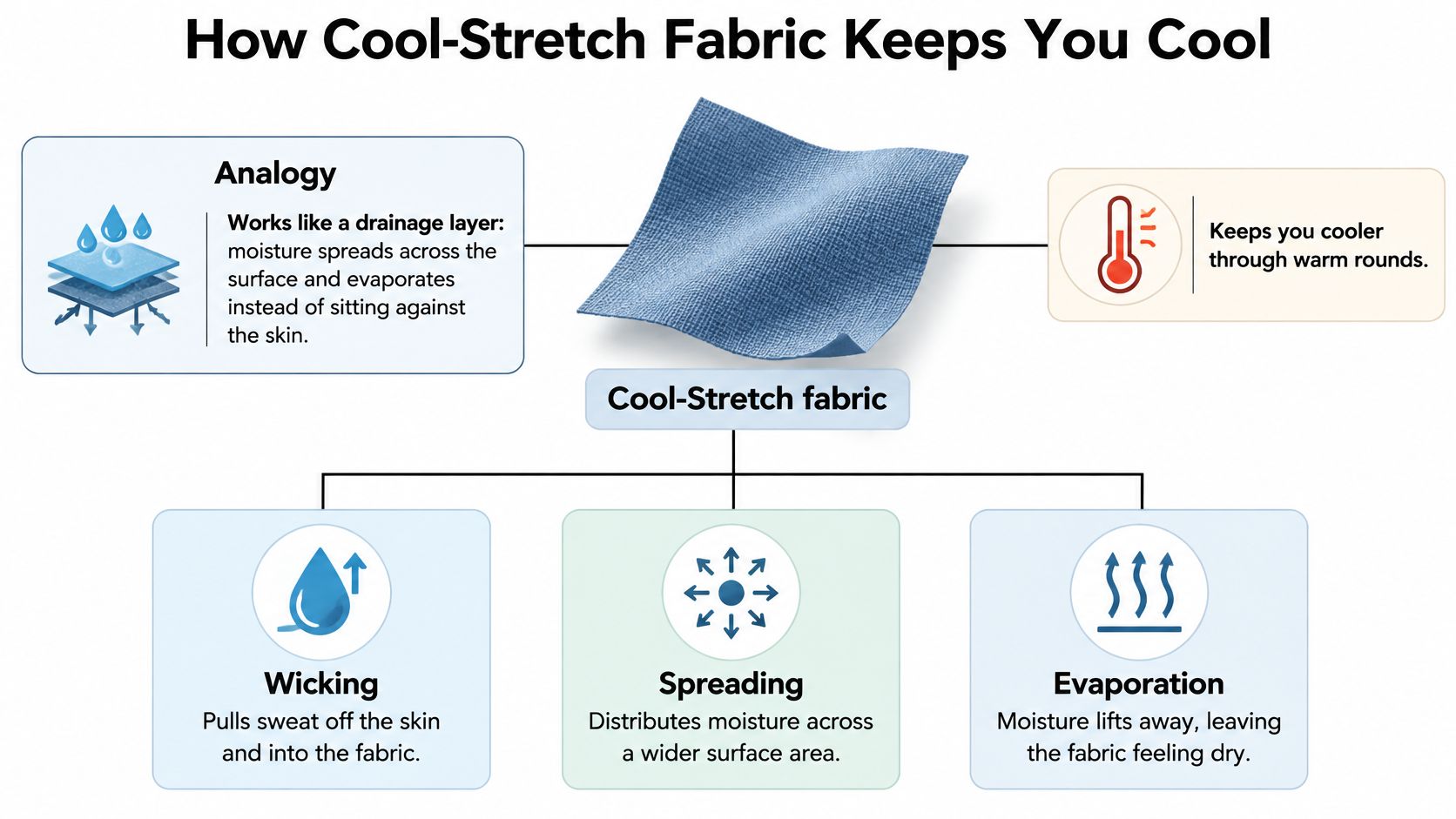
How Cool-Stretch Fabric Keeps You Cool
A waistband that still feels wet at the turn tells you more about cooling than any hang tag. Moisture has to move off your skin, spread across the fabric surface, and evaporate. On a still, humid afternoon that last step slows to a crawl, and sweat pulled away from your skin at the third hole is still sitting in the cloth three hours later. Spreading moisture without drying it only stores the problem against you.
Three words that get used as one
Wicking, drying and breathability describe different measurements, and the Manufacturing Solutions Center's moisture management testing overview keeps them apart.
- Wicking describes how liquid is absorbed and distributed through the fabric, measured as vertical or horizontal wicking.
- Drying rate describes how quickly that liquid leaves the fabric once it's there.
- Vapor transmission describes how much water vapor passes through the material, assessed with methods such as ASTM E96.
Strong wicking paired with a slow drying rate produces damp fabric spread over a larger area. Evaporation is what produces cooling, so the benefit depends on airflow, humidity and how much you sweat. The same shorts can feel airy at 8 a.m. and heavy at 2 p.m., and that gap is the environment's doing as much as the fabric's.
Why laundering history changes the answer
Washing can alter both absorbency and drying behavior, which is why credible protocols test after laundering as well as on new fabric, and report results under controlled temperature and humidity. A drying time quoted on virgin fabric tells you very little about the pair on its fortieth wash. The laundering figure attached to Cool-Stretch is a shape-retention claim past 50 washes, and that answers a different question: whether the shorts hold their cut. Drying speed is a separate measurement entirely.
Request the test method, the elapsed time, the fabric mass and the laundering history behind any quick-dry claim. A drying time missing those four details can't be compared across brands.
Your own round supplies the verdict a spec sheet can't. Track three things across a hot afternoon: how fast moisture leaves your skin, how far it spreads through the fabric, and how quickly the material gives it back to the air.
Heat, Print Color and Sun Protection
Color affects heat, so the darker ink panels are the variable to test. Lighter colors reflect more sunlight and darker colors absorb more, a point repeated in cooling-apparel coverage such as CNN Underscored's look at how cooling clothes work. On this print, the white base does part of the work; the tikis, flamingos and florals create small zones that may read warmer after an hour in direct sun.
The published spec gives fixed points: 8 oz fabric, 8% spandex and a UPF 50+ rating. It gives no tested air-permeability number and no thermal comparison between printed and unprinted areas, so those remain wearer tests. Hold a printed panel and a plain white area to the light, then repeat the comparison on the course; a panel that looks denser and feels hotter is the one to plan around.
Keep the two terms separate
Cool-Stretch describes moisture handling and hand feel. UPF 50+ describes ultraviolet transmission through the fabric. They are different measurements, and protection can shift when a knit is tensioned, wet or worn thin, which is exactly the load a golf short sees across a season. Use the rating as the listed sun value, then let the checklist below judge heat and airflow.
A three-condition check
Run this over three rounds and write each answer down, because memory blends days together.
- Hot and humid. Note how long the fabric takes to feel dry after the walk to the 10th tee, and whether the waistband still feels damp after nine holes. That waistband is where sweat gets trapped with no airflow.
- Dry and sunny. After an hour in direct sun, compare how the printed panels feel against the plain white areas. If the darker ink reads noticeably warmer, plan your midday rounds accordingly.
- Cool morning. At a slow walking pace in 12 to 14 degrees Celsius, note whether the fabric feels cold against the skin. An 8-ounce short has limited insulation, so layer underneath rather than expecting warmth from it.
Round counts are rising in some markets: Great Britain recorded 14% more rounds in 2025 than in 2024, while U.S. rounds reportedly reached a record for the fourth time in five years, according to the CNN Underscored report on cooling fabrics. That makes the printed-panel test worth running before midday tee times.
Styling and Care for the Print
Let the print lead and keep everything else quiet. The shorts carry tikis, pink flamingos, sea turtles, pineapples and tropical florals across a white base, which is already four colors competing for attention. A solid black, white or pink polo gives the pattern a frame; a second busy print turns the outfit into a costume.
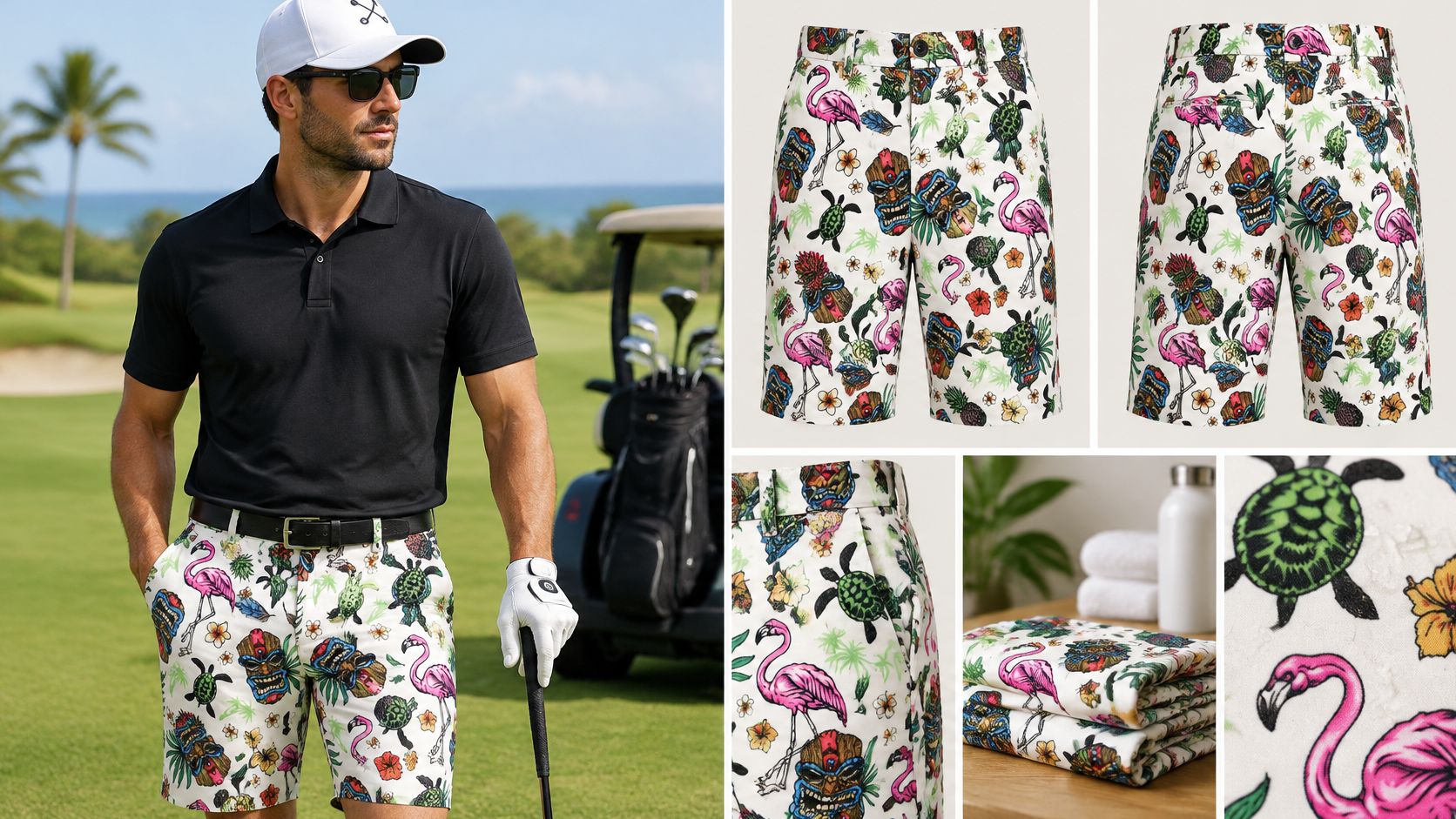
The Tiki Cool-Stretch Men's Golf Shorts - Multicolor put that island artwork on a four-way stretch short with a zip fly, front slash pockets and two rear pockets, built for warm-weather rounds rather than display.
Check the dress code before you check the mirror
Private clubs and leagues don't share one policy on print, and many don't publish a policy at all. Read the club's website, then call the pro shop and ask specifically about pattern restrictions rather than length alone. A bold short can pass on length and still be questioned at check-in on pattern. If the answer is "conservative," ask conservative compared with what.
Care steps that protect the print
Heat and chlorine are the two things that shorten the life of a printed stretch short. The care routine is short, and each step maps to something you paid for.
| Care step | Instruction | Why it matters |
|---|---|---|
| Washing | Machine wash cold with like colors | Protects print color and stretch |
| Drying | Tumble dry low or hang dry | Limits heat exposure to the blend |
| Bleach | Do not bleach | Protects the print color |
| Ironing | Warm iron if needed, never directly over prints or trim | Keeps print and trim intact |
Cold water limits stress on the elastane that supplies the stretch, and it slows the dye loss that shows up first on white-ground prints. High dryer heat is the faster killer: sustained heat weakens elastic fibers, so the waistband and seat you tested in the fitting room soften sooner. Bleach attacks both the fiber and the moisture and odor finishes, which is a poor trade for a stain you could have blotted out. Direct heat on a printed panel can crack or lift the design, so iron around it or skip the iron entirely.
Hang drying costs nothing and protects the property that's hardest to restore. Our care guide for Tattoo Golf clothing covers the wider range if you're washing shirts from the same collection.
From the course to the rest of the day
Wrinkle resistance does real work here. Folded into a travel bag, the shorts come out ready to wear, which is why they suit golf trips where the same pair covers a morning round and a casual afternoon. Belt loops sized for a standard 1.5-inch belt mean your existing ratchet or leather belt sits flat instead of bunching the waistband.
The print still sets the tone for the whole outfit. That's the trade you're making, and it's worth making deliberately.
Decide Whether to Buy These Shorts
The Tiki shorts were listed at $69.99 on Tattoo Golf's multicolor collection page. Whether that price makes sense for you depends on how the published spec lines up against the rounds you play, and that is the comparison worth running before you order.
The verdict by situation
Buy them if you play most of your golf in warm weather, you walk rather than ride, you want a print that reads as deliberate rather than generic, and your home course allows patterned shorts. The published spec sheet supports that use: 8-ounce fabric, four-way stretch, UPF 50+, a waistband built to move, and a size run from 30 to 44.
Think twice if your club or league enforces a conservative dress code, you play mostly in cold or shoulder-season conditions, or you need measured drying and recovery data before you commit. Each is a legitimate reason to wait. The unpublished test figures are the strongest argument for holding off.
Consider an alternative if the print is the sticking point rather than the construction. The Zuma Cool-Stretch Men's Golf Shorts (Zuma/Grey) run on the same Cool-Stretch fabric rated UPF 50+, set on a grey ground that reads quieter at a stricter club. Same fabric, different conversation at the first tee.
Four steps before you pay
- Confirm your waist against the size table. Measure at navel level, relaxed, and match the reading rather than the size you wear elsewhere.
- Run the three stretch checks. Deep address, three backswing turns, sit and stand. Any failure means a different size.
- Pack the pockets and walk. Phone, card, tees, rangefinder. Then crouch and stand to check the seat and hem.
- Decide what you need proven. If drying speed or stretch recovery is the reason you're buying, ask for the test results behind those claims. If fit and print are the reason, the checks in step two already answered your question.
Buy the pair that passes the checks on your body. A bold print that binds in the crouch becomes a drawer item by July.
Waist sizes, colorways and stock change over time. Confirm the current price and available sizes on the live product page before you order.
Tattoo Golf has been building bold, performance-first golf apparel since 1999, and the Cool-Stretch range runs from printed shorts to moisture-wicking polos and matching couples sets, all designed to move through a full swing in warm conditions. If you want the island print on a short you've already validated for fit and sun coverage, start with the Tiki Cool-Stretch shorts and check the waist chart before you order. Head to Tattoo Golf to see the full Cool-Stretch collection and find the pair that matches the rounds you play.
Share:
Tattoo Original Performance Golf Hat (Black): Buyer's Guide
Make It a Golf Outfit: Quarter-Zip Guide for 2026