

Forty-eight degrees at the first tee, so you zip up. Nine holes later you're walking into full sun with a damp polo underneath, and the quarter-zip is either stuck to your back or tied around your waist by the 12th.
That's not a wardrobe failure. It's a buying failure. Most golfers pick a performance quarter zip the way they'd pick a sweater: how it feels in the shop, how it looks in the mirror, whether the shoulders pinch when they reach for the sleeve. Then they play 18 holes in it through a 20-degree temperature swing and find out what the fabric and the cut do.
On a big and tall frame the gap between the dressing room and the back nine is wider. A garment that fits the chest but not the torso length rides up on every swing. Fabric that traps heat turns a cool morning into a sweaty middle nine. Fit and fabric aren't separate purchases. They're one decision, and you can make it before you spend anything.
Five Checks That Decide a Good Quarter-Zip
A quarter-zip sits between a polo and a jacket, and it earns its place only by working across a whole round. The market behind it is mature: the Grand View Research performance-fabric market report valued the global performance-fabric market at USD 80.70 billion in 2024 and names moisture-wicking, antimicrobial resistance, UV protection, stretchability and breathability as the attributes buyers now expect. On a product page, all of that reduces to five checks.
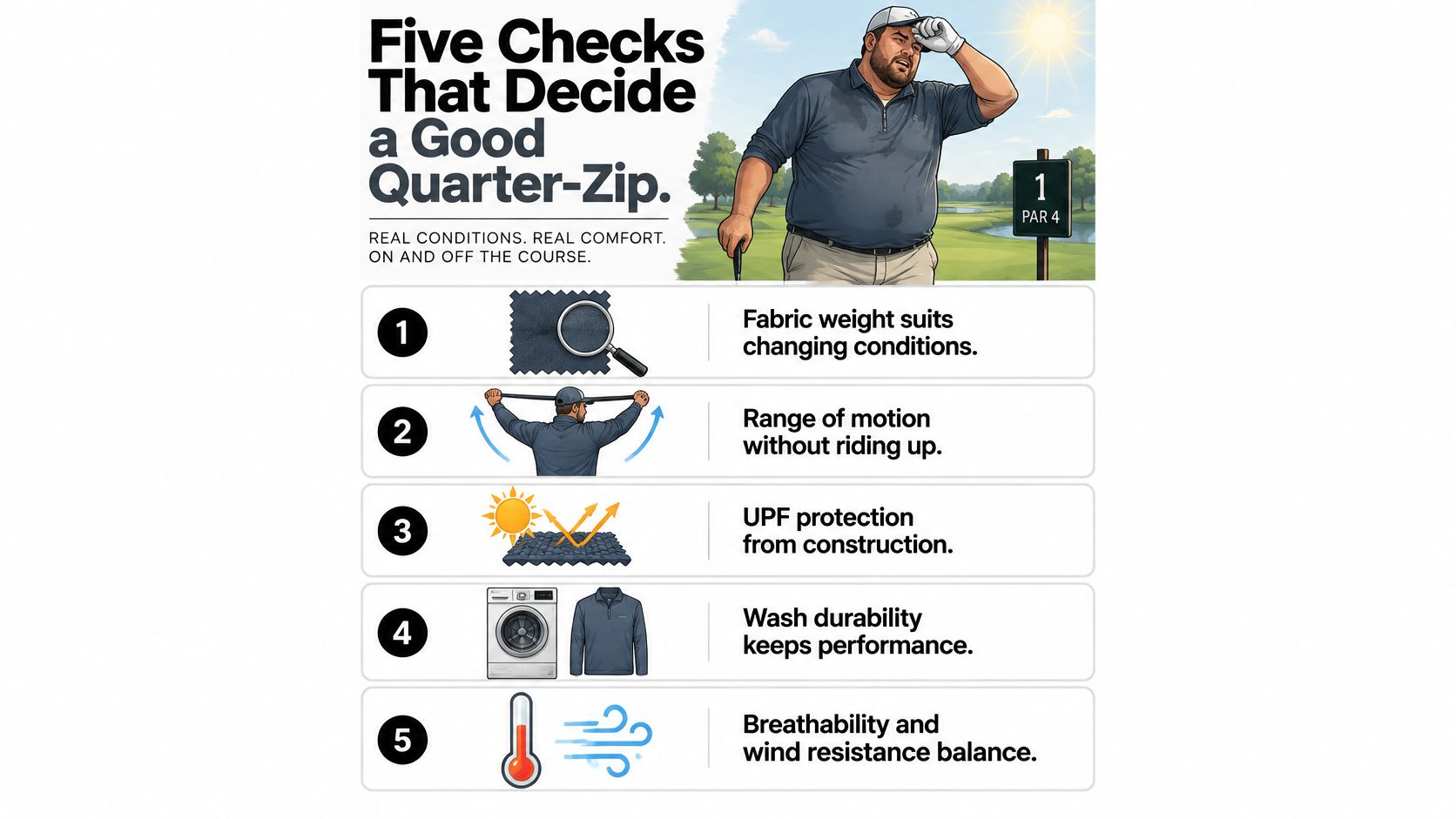
- Fabric weight, in grams per square metre. A published gsm figure beats a photo of a knit every time. Ask what a light double-knit weighs versus a brushed mid-layer, and buy the number that matches the rounds you play.
- Moisture management with proof behind it. "Moisture-wicking" on a hang tag is a claim. What you want is the measurement that backs it.
- Stretch and recovery through the shoulders and back. Reach both arms forward as if you're settling over the ball. The hem shouldn't climb, and the fabric shouldn't stay stretched out when you drop your arms. Recovery matters as much as the stretch itself, because a knit that bags out is a mid-layer that fits worse on 18 than it did on 1.
- A stand collar and a partial front zip. The collar should hold its shape without pressing on your throat, and the zip should open far enough to dump heat without the placket gaping open.
- Body and sleeve length for a tall frame. On a big and tall golfer this is a performance feature, not vanity sizing. The hem needs to clear the belt line through a full rotation, and the cuff needs to stop at the wrist bone rather than halfway up the forearm.
Run all five against any listing before you read a single review. A page that answers none of them is a page you're buying from on hope, and the return postage is the tuition fee.
Find Your Big and Tall Size Before You Buy
Letter sizes lie. A 3XL from one brand measures like a 4XL from another because the two brands cut on different blocks, and the block is the only thing that matters once you're past XL. Ignore the tag and work from three numbers.
The Only Three Measurements Worth Taking
Use a soft tape, wear a thin polo, stand relaxed. Have someone else read the tape for the chest.
- Chest: around the fullest part, tape level under the arms, arms hanging down. Don't puff up and don't hold your breath.
- Body length: from the high point of the shoulder, right beside the neck, straight down to the bottom hem of a quarter-zip you already own and like.
- Sleeve from shoulder: from the shoulder seam to the wrist bone with the arm slightly bent, because a straight arm reads about an inch short.
A tall cut buys extra room where tall golfers need it: more hem and more cuff, while the chest often stays close to the standard block. The added length is not consistent across brands, so measure the garment rather than trusting a T in the size label. Athletic cuts also run slimmer through the chest than relaxed cuts at identical measurements, so the same tape number can fit two ways.
Use this working grid to sanity-check a published chart before you order. It is a starting point for measuring, not a universal standard.
| Working sizing grid for big and tall quarter-zips | Chest (in) | Body length (in) | Sleeve from shoulder (in) |
|---|---|---|---|
| 2XL | 50-52 | 31-32 | 26-27 |
| 3XL | 53-55 | 32-33 | 27-28 |
| 4XL | 56-58 | 33-34 | 28-29 |
| 5XL | 59-61 | 34-35 | 29-30 |
| 6XL | 62-64 | 35-36 | 30-31 |
Read your own result this way: a chest measurement that lands in the middle of a range fits better than one sitting at the top edge, because the top edge leaves nothing for a base layer and nothing for a full turn. A quarter-zip should clear the swing without billowing at the waist, so if the body length is right and the chest is at the ceiling of the range, size up and accept a slightly roomier torso. If your tape says 5XL and the line stops at men's 4XL, as Tattoo Golf's Lucky 13 does, the honest answer is to keep looking rather than hope the shoulders stretch.
Comparing cuts is easier when a brand publishes measurements next to each product, which is what our designer golf wear for men pages do. Write your three numbers down before you open a single tab, and note which brands even list a size beyond 4XL. That last detail tells you more about who the brand cuts for than any fit guide does.
Why Moisture Management Beats Moisture-Wicking Claims
Every golf layer on the rack claims to wick. The word sits on $40 pullovers and $200 ones, on brushed fleece and on featherweight jersey, so it carries almost no information for a buyer comparing two garments. What separates them only shows up across 18 holes: which layer dries between one green and the next tee, and which one is still damp at the turn.
A credible fabric is judged on a standardised method rather than a marketing word. A Sage Journals study on moisture-management testing lays out AATCC Method 195, which runs fabric through a Moisture Management Tester to score wetting time, absorption rate, maximum wetted radius, spreading speed, one-way transport index and overall moisture-management capacity, with samples conditioned at approximately 21°C and 65% relative humidity so the results compare fairly. Conditioning carries real weight in that protocol, because a fabric measured hot and dry against one measured cool and humid was never a fair comparison in the first place.
Each of those scores maps to something a golfer feels on the course rather than reads in a lab summary, and together they explain what a single "wicking" label never could.
What the Tester Measures
| Metric | What it measures | Why it matters on the course |
|---|---|---|
| Wetting time | Seconds for the fabric to start absorbing a drop | Shorter times mean sweat is taken up before it runs down the skin |
| Absorption rate | How quickly the fabric takes up moisture | Controls the damp feeling during long walks |
| Maximum wetted radius | Area the moisture spreads across | Wider spread exposes more fabric to air for evaporation |
| Spreading speed | How fast moisture travels across the surface | Faster spreading speeds up drying between holes |
| One-way transport index | Moisture moving from the inner face to the outer face | Keeps the skin side drier during a sweaty round |
| Overall moisture-management capacity | Combined score across the other metrics | One number to compare two quarter-zips directly |
The pair that matters most for a walker is spreading and one-way transport. A fabric that spreads sweat across a wide area gives evaporation far more surface to work with, and one that pushes moisture to the outer face keeps the inner face dry against your back on the back nine. A fabric that absorbs heavily but transports poorly holds the moisture exactly where it started, which is why some layers feel soaked and cold even though they test well on absorption alone.
Practical rule: two garments can both say "moisture-wicking" and behave nothing alike. Ask for the overall moisture-management score and compare it directly. If there's no score, treat the claim as unverified and lean on the other four checks.
If you want the underlying mechanism in plain terms, our explainer on what moisture-wicking fabric actually does covers how the fibre and finish work together.
Fit, Collar and Comfort Details That Matter Most
Proportion decides fit on a tall frame long before size does. Two quarter-zips with identical chest measurements can hang completely differently depending on where the shoulder seam sits and how the body is tapered below it.
Start at the Shoulder Seam
The seam should sit at the edge of the shoulder, right where the arm turns down. A dropped seam looks relaxed on a mannequin and makes the chest read tight on a real body, because all the fabric that should be spread across the back is hanging off the arm instead. If the seam lands more than an inch down your arm, the garment will pull across the chest every time you take the club back.
Chest and waist come next. You need enough room to rotate without the front placket straining or the hem lifting when your arms go up. Raglan sleeves buy you some slack here because there's no shoulder seam to fight the rotation.
The collar and zip decide how the layer vents. A stand collar should hold its shape and stay off your throat, and the zip should run deep enough to open a real vent when you're walking uphill into the sun. Cuffs matter more than most buyers expect: an elasticated cuff seals warmth in and keeps the sleeve clear of the grip, but a cuff tight enough to leave a mark will annoy you by the 6th hole.
Finishes are the quiet part. Tagless necks, flat-lock seams and a smooth inner face prevent the chafe that shows up on the back nine of a long walk. This isn't a golf-only principle; the same logic behind choosing the right mtb jersey applies, because seam placement decides whether a layer moves with you or fights you.
Five checks in the fitting room: raise both arms overhead and watch the hem. Rotate your torso as if you're swinging through. Zip up to the chest and back down. Turn your head both ways with the collar up. Then walk 20 steps and listen for the rustle of a shell that's too stiff to play in.
Matching Fabric Weight to a Changing 18-Hole Round
One round is a timeline, not a temperature. Cool air and damp grass at the first tee. Heat building on the walk up the 6th. A gusty, exposed stretch of fairway on the back nine. A cool-down as the sun drops behind the clubhouse. Your mid-layer has to handle all four without coming off and going back on every three holes.
The trade-off bites fast. A garment that holds heat well is comfortable for about four holes and then becomes a problem, and the "warmest" quarter-zip is often the wrong pick for a cold start because it forces you to carry or shed bulk by the turn. Qiandao Apparel's guide to golf quarter-zips separates fabric weight from air permeability, stretch recovery and moisture management for exactly this reason, recommends smooth-face polyester-elastane, nylon-elastane, refined jersey or light double-knit for layering, and warns that bulky fleece traps excessive heat.
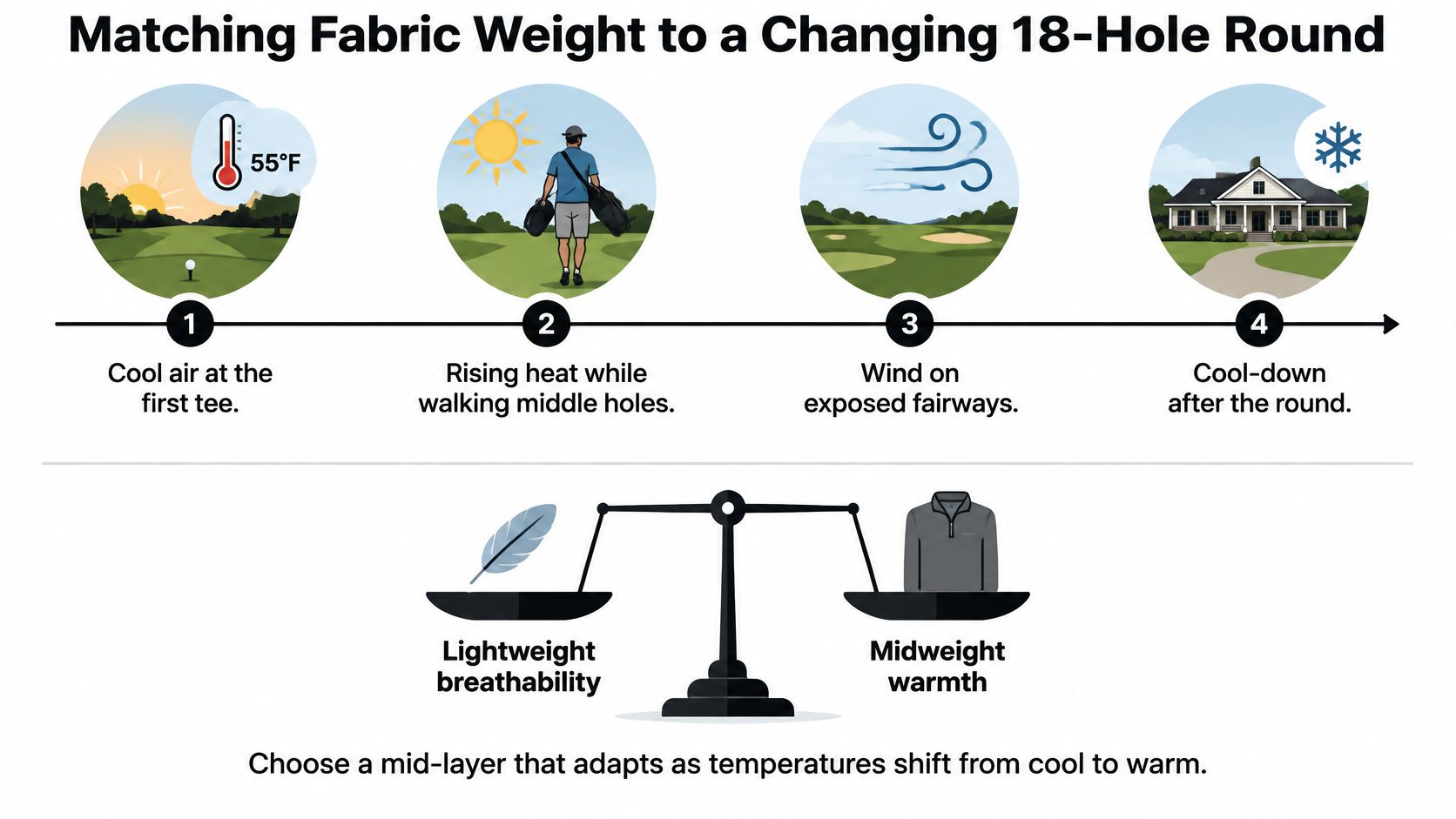
Notice what that list has in common: smooth faces, light knits, stretch blended with polyester or nylon. A smooth face slides under a vest or jacket and sheds wind better than a lofted knit. Weight is the number worth interrogating on a hangtag, because "thermal" describes insulation, not how the knit behaves once the round warms up. And keep the labels separate in your head: a stated UV rating says nothing about how cool a fabric feels, so breathability stays its own question.
| Conditions | Fabric to prefer | Layer weight | Watch for |
|---|---|---|---|
| Cold first tee, under about 50°F | Smooth-face polyester-elastane | Mid-weight stretch knit | Wind cutting through a loose knit |
| Cart golf, sun-exposed | Nylon-elastane with stated UPF | Light weight | UV protection that does not mean a cooler feel |
| Any round with bulky fleece | Avoid for layering | Heavy | Traps heat and adds bulk to the bag |
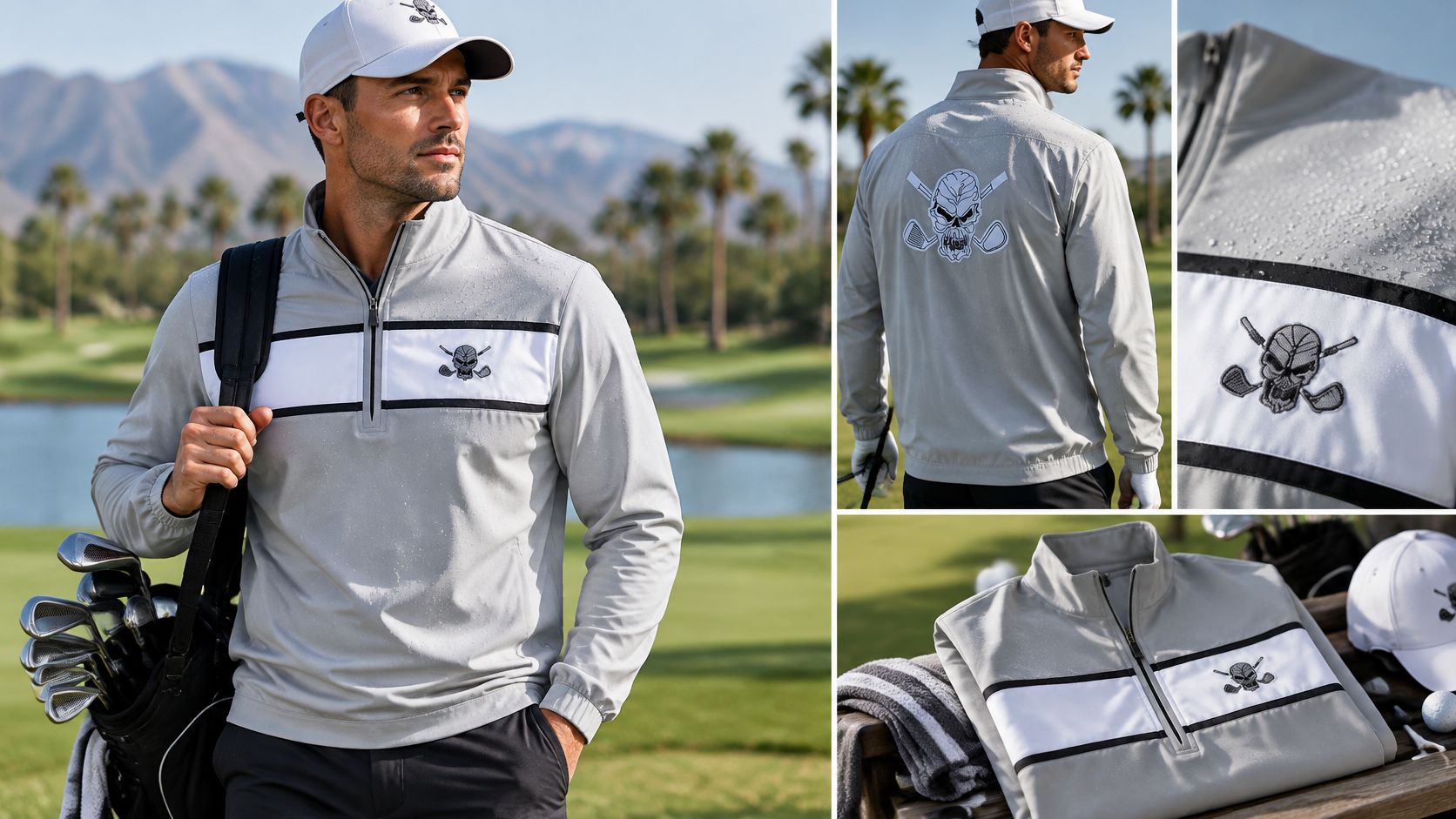
When wind rather than temperature is the problem, a shell does the job better than a heavier knit. The Windbreaker Quarter Zip Pull Over (Black) is built as a wind-resistant layer in stretch fabric, cut with a stand collar and elasticized cuffs, so it blocks gusts without adding the bulk a warmer knit would pile into your bag. That is the piece for an exposed back nine, where a heavier layer would spend more time tied around your waist than on your shoulders.
Unzip at the first sign of warmth, not the first sign of sweat. You're regulating before the fabric has to.
Keeping Performance Intact After Repeated Washing
Performance features are sold as permanent and behave like consumables. The distinction that matters is between protection built into the fabric and protection applied on top of it: construction-based UPF generally lasts longer, while treated protection can decline with washing. Druids Golf's guide to golf apparel fabrics draws that line and advises cool washing, no fabric softener and limited high-heat drying, because those habits preserve wicking performance, breathability, stretch fibres and treatments.
The nuance shoppers rarely hear is that a quarter-zip can stay fast-drying while its labelled UV performance, print quality or stretch recovery changes over time. Those are separate properties with separate lifespans.
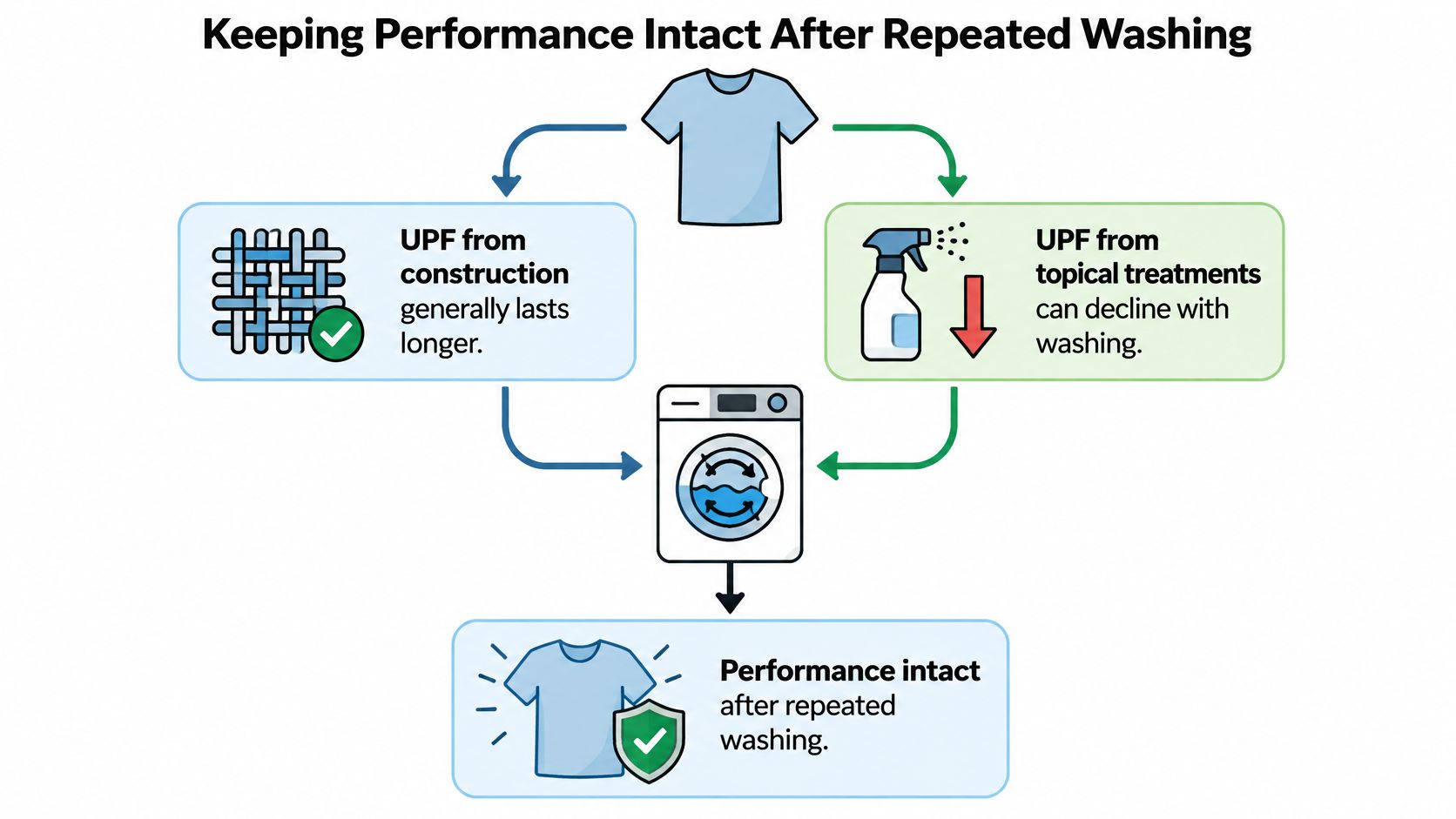
Check the stated UPF rating on the garment rather than inferring protection from polyester content, a dark colour or a moisture-wicking claim. Those three things tell you nothing about UV blocking.
A Care Routine That Preserves the Fabric
- Read the label for a stated UPF rating and the care instructions before the first wash, not after the print starts to dull.
- Turn it inside out and wash cold with like colours on a gentle cycle. Heat is the enemy of stretch fibre.
- Skip fabric softener entirely. It leaves a residue on the fibre surface that blocks wicking, which is the one thing you paid for.
- Tumble low or air dry flat. High heat sets wrinkles and ages elastane faster than wear does.
- Keep direct heat off embroidery and graphics. A warm iron on the reverse side only, if you must.
Watch for the signals that performance is fading: lingering clamminess after a wash cycle, stretch that no longer recovers at the shoulders, pilling on the inner face, or a dull, slightly sticky hand feel. Our care information for Tattoo Golf clothing covers the same routine in more detail.
Order One Size and Test It Through a Full Round
A spec sheet can clear every check and still fail somewhere around hole 14. Buy one layer and let a real round settle it.
Order the size the chart assigns to your measurements, then book a warm-weather tee time soon after the shirt lands. Wear it start to finish: zipped on a cold first tee, opened when the sun climbs, and judged on the back nine, where a weak layer turns clammy or starts pulling at the shoulders on a full swing. If the fit is off, Sales Rack items ship with the same 60-day return and exchange window as full-price gear, so you can correct a size once instead of guessing twice.
Our Lucky 13 Hybrid Zipper Cool-Stretch Golf Shirt (Black) shows what the checklist looks like in practice. It's an 8 oz, 92% polyester / 8% spandex Cool-Stretch fabric rated UPF 50+, with a quarter-length zip, a structured collar and four-way stretch, and the fabric is built to hold its shape after 50 or more washes. It comes in men's sizes S through 4XL, so anyone needing a 5XL or 6XL should find a brand with a larger chart before ordering anything.
Tattoo Golf has been building performance golf apparel with a rebellious streak since 1999, and its quarter-zip shirts are made for exactly this kind of round. Take your measurements, check them against the size chart on each product page, and order the one layer you'll wear from a cold first tee to the 19th hole. Browse the full collection at Tattoo Golf and put the five checks to work before your next tee time.

Share:
Women's Golf Clothes Rules: What Courses Allow in 2026