
A golf belt with ball marker carries a small removable marker on its buckle or strap, and it's legal under the Rules of Golf introduced in January 2019 when the marker is a suitable artificial object placed beside the ball and removed before the stroke. The useful question is whether that marker stays secure, comes off easily, and sits on a belt you'll enjoy wearing.
You're standing on the green, patting your pockets while everyone else gets ready to putt. Your coin is somewhere beneath the tees, or your marker has migrated into a bag pocket. Keeping it at your waist sounds sensible, but good hardware matters more than the promise of convenience.
What Is a Golf Belt With Ball Marker
A golf belt with ball marker combines clothing support with a dedicated storage spot for the small object you use to mark your ball's position. The marker detaches from the belt, goes onto the green, and returns to its holder after use. You don't put the whole buckle down beside your ball.
The holder might sit in the buckle face, on the keeper, the loop that holds the loose strap end, or on a separate dock attached to the strap. Those locations can feel quite different when you reach down wearing a glove or with your shirt tucked in.
Who benefits from waist-mounted storage
This isn't equipment reserved for tournament players. The R&A counted 108 million participants across its affiliated markets outside the United States and Mexico, including more than 43 million playing conventional courses, in its 2024 Global Golf Participation Report. The practical audience includes recreational golfers, juniors, walkers, and anyone who prefers less loose equipment in their pockets.
Consider your current habit before changing it. If you always retrieve a pocket marker without looking, belt storage might offer little improvement. If you regularly search through tees and receipts, a dedicated location could suit you.
- For walkers: Check that the marker dock doesn't rub against clothing or interfere with your bag.
- For cart users: Reach for it while seated as well as standing.
- For glove wearers: Try removing it without relying on a bare fingernail.
The marker can also express some personality. Browsing distinctive golf ball marker designs can help you decide what you'd enjoy carrying, but appearance shouldn't outrank visibility or easy handling.
Practical rule: Judge the belt as clothing and the marker holder as equipment. A clever attachment doesn't excuse an uncomfortable waistband.
A plain-looking system that works naturally is more useful than an elaborate buckle you have to wrestle with at every green.
Ball Marker Rules and Tournament Legality
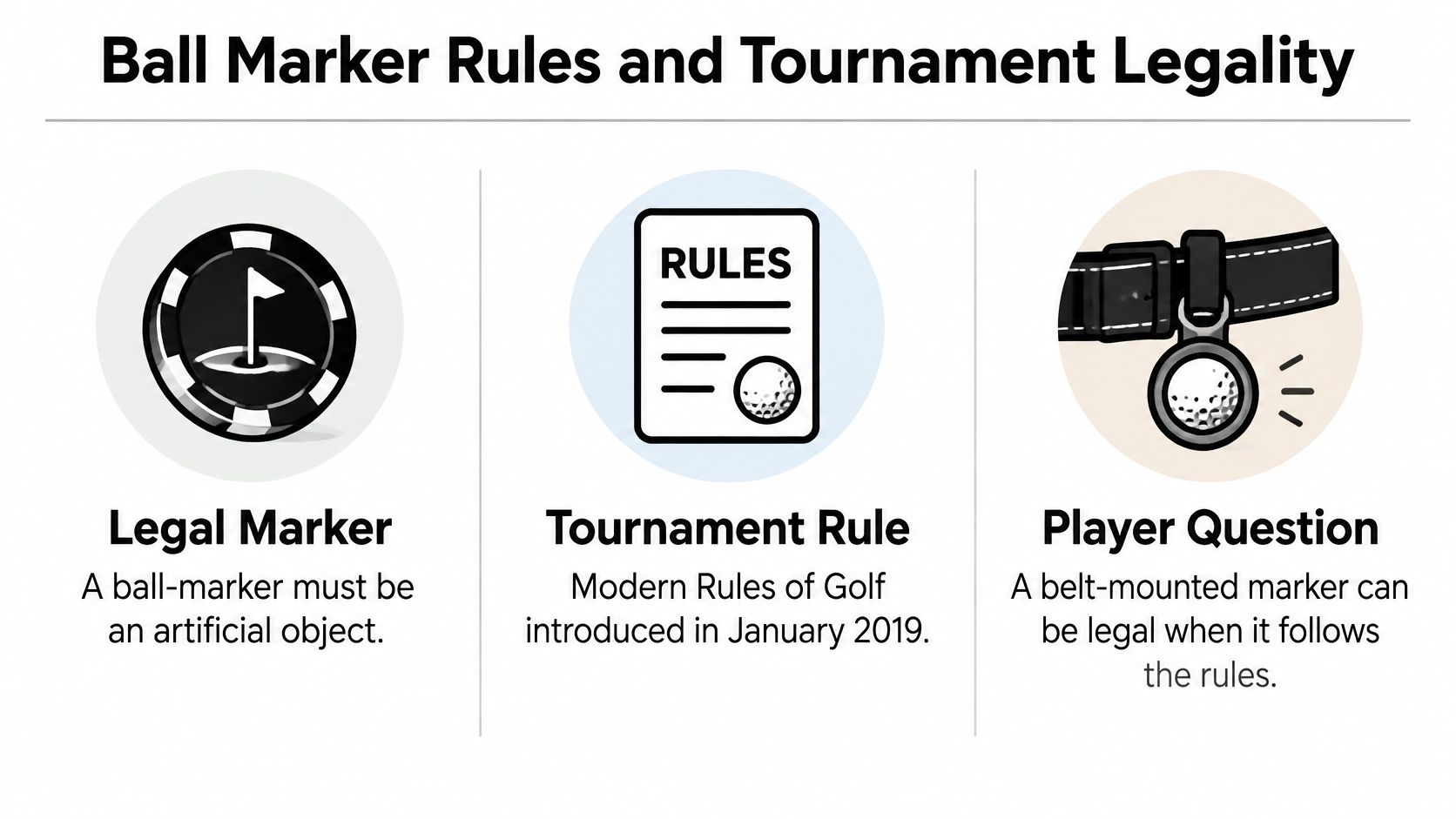
Belt storage isn't what determines legality. A suitable marker can live on your belt, hat, or in your pocket. What matters is the object you place on the green and how you use it, a distinction discussed in this belt-mounted marker rules guide.
Under the modern rules, a marker must be an artificial object. A coin, tee, or suitable small piece of equipment qualifies; a leaf or twig doesn't. The USGA's ball-marker guidance explains the equipment requirements and restrictions that matter when choosing a marker.
Translate the rules into a buying decision
Choose a compact marker that's easy to place accurately and pick up. A thin, coin-format design is a straightforward option because you're buying something to identify a position, not a miniature surveying instrument.
The USGA guidance cited above also addresses alignment devices. For a conservative shopping specification, keep markers with alignment lines or arrows under 1 inch high and under 2 inches horizontally, and avoid designs intended to measure slope, green speed, or other playing conditions, as detailed in that guidance.
- Artificial construction: Don't substitute something picked up from the course.
- Simple purpose: Favor a marker over a gadget with measuring functions.
- Clear separation: The removable piece should be obvious, so you aren't tempted to use bulky belt hardware.
- Readable details: Ask for dimensions and equipment information rather than accepting a tournament-ready marketing label.
Understand the penalty distinction
Don't treat every marking mistake as an identical rules situation. Failure to mark before lifting, or making a stroke with the marker still in place, generally brings a penalty stroke under the guidance above. Replacing and playing a ball from an incorrect position can involve a different rules consequence, so don't assume every replacement error costs only a stroke.
For an unfamiliar alignment-style accessory, ask the competition committee before using it. That's more sensible than trying to settle an equipment question while your group waits on the green.
A bulky buckle pressing into your stomach is a comfort problem, not automatically a marker-legality problem. Keeping those questions separate makes shopping much clearer.
Ratchet vs Buckle and Marker Attachment Mechanisms
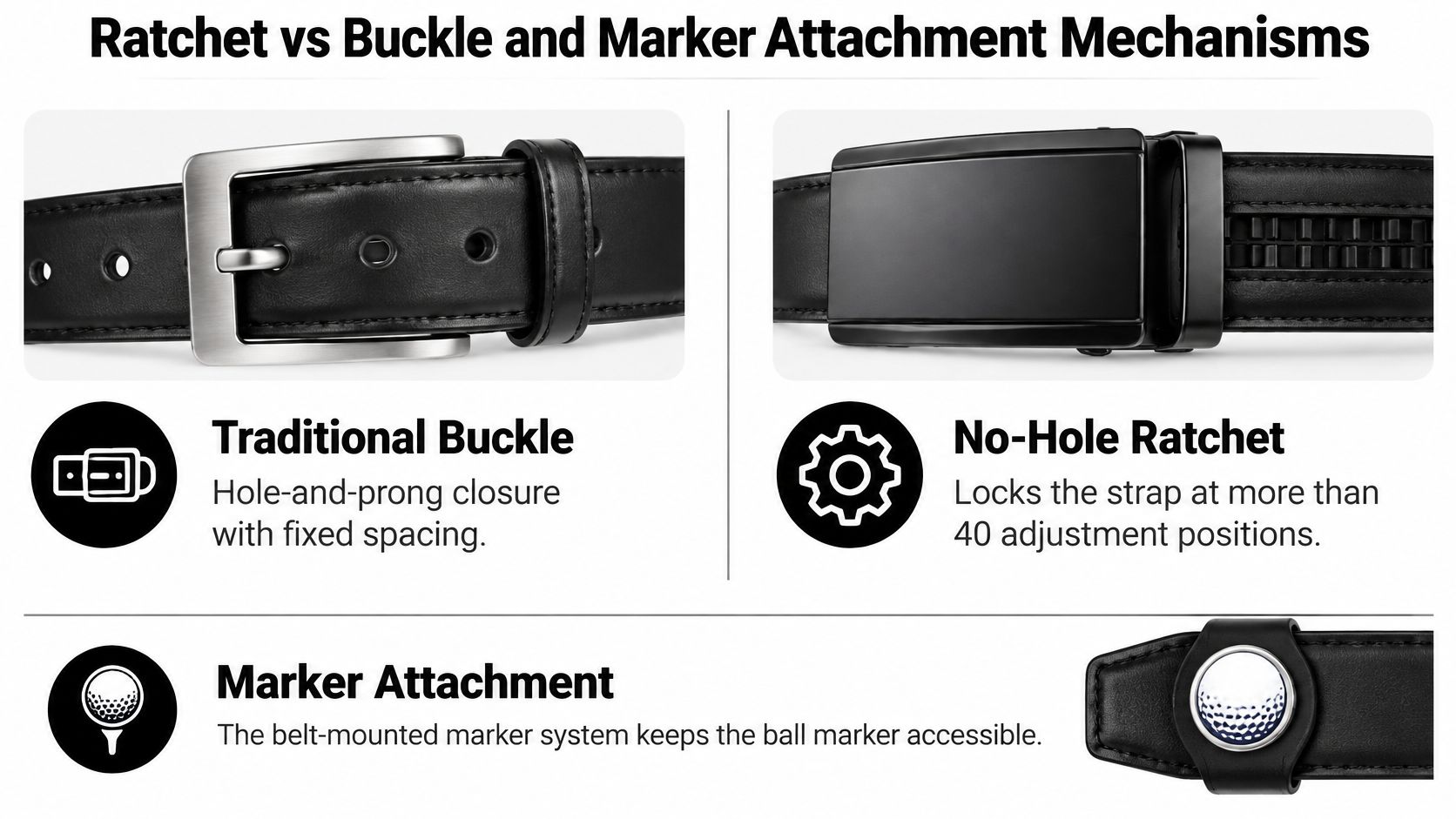
There are separate hardware decisions here: how the belt closes and how the marker attaches. A ratchet closure doesn't automatically include a marker, and a magnetic belt closure doesn't necessarily tell you how its marker is retained.
With a traditional hole-and-prong buckle, you pass the strap through the frame and seat the prong in a hole. A ratchet system instead engages a track on the strap. Depending on the model, you release that engagement with a lever or another designated control.
Compare fit separately from marker access
| Hardware choice | What to examine | Possible drawback |
|---|---|---|
| Traditional buckle | Whether the available holes give you a comfortable fit | You may want a setting between holes |
| Ratchet closure | Track engagement and access to the release | An awkward release can frustrate you |
| Magnetic marker dock | Retention and a usable lifting edge | Strong attraction can make removal difficult |
| Snap-fit holder | Whether the marker seats positively | Release may require more finger pressure |
| Recessed housing | How deeply the marker sits | A flush marker can be difficult to grip |
A recess is a shallow pocket around the marker. A detent is a small retaining feature that helps keep a part in position. Neither term guarantees a good design; you still need to try the mechanism.
Why stronger magnets aren't automatically better
Magnetic attraction helps keep a marker attached during bending and belt movement. Increase that attraction too far, though, and you may struggle to lift the marker with your thumb.
A shallow recess can resist sideways sliding while a raised edge gives your finger somewhere to work. That combination is worth examining because the magnet doesn't have to solve every mechanical problem by itself.
The useful test isn't whether the marker feels impressively stuck. It's whether you can remove it deliberately without it coming loose accidentally.
Before committing, try these checks:
- Reach naturally: Detach and replace the marker without watching your hand.
- Keep your glove on: Check whether you can grip the exposed edge.
- Bend and sit: Notice pressure, snagging, or movement.
- Check after travel: Confirm the marker remains seated after walking and cart use.
Don't accept claims about magnetic strength as a substitute for this practical handling test.
Leather vs Synthetic Golf Belt Materials
Choose the strap for the rounds you play. A golfer walking in humid weather has different priorities from someone riding in dry conditions and heading straight into the clubhouse afterward.
Leather offers a substantial hand feel and can provide long service life with appropriate care. Water exposure and maintenance deserve attention, while synthetic and recycled alternatives should be judged on their actual construction rather than assumed to be interchangeable.
Leather vs Synthetic Golf Belt Materials
| Factor | Full-Grain Leather | Synthetic or Recycled Webbing |
|---|---|---|
| Feel | A substantial, structured option | Check softness, flexibility, and edge feel |
| Wet-weather ownership | Plan for drying and leather care | Check the manufacturer's water-care guidance |
| Walking comfort | Test weight and bending comfort | Consider if you prefer a less substantial strap |
| Appearance | Suits a leather-accessory wardrobe | Can suit a more athletic outfit |
| Maintenance | Allow for occasional conditioning | Confirm cleaning instructions for the fabric |
| Sustainability questions | Ask about material sourcing and repair | Ask about recycled content and hardware replacement |
Don't read that comparison as a promise that every synthetic belt is lighter, waterproof, or maintenance-free. A thick coated strap can behave differently from flexible woven webbing, and the buckle can matter as much as the strap.
Match material to your playing conditions
For walking rounds, prioritize what you stop noticing after you've started moving. Try bending to retrieve a ball and rotating into a practice swing. If the buckle presses into you, changing strap material alone won't fix it.
For cart rounds, check seated comfort rather than assuming less walking means fit matters less. A buckle that feels fine standing in a shop may feel different when you sit.
- Wet conditions: Choose a material with care requirements you'll realistically follow.
- Dry conditions: Let comfort, appearance, and preferred hand feel carry more weight.
- Competitive play: Favor predictable adjustment and reliable marker handling.
- Casual rounds: You can prioritize style, but avoid hardware that makes basic use awkward.
Sustainability deserves specific questions, not vague labels. A golf equipment market analysis reports 42% willingness to pay a premium among golfers under 35 for recycled or bio-based equipment materials; that finding isn't specific to belts.
Ask how much recycled material a strap contains, whether you can replace a damaged buckle, and whether the maker provides clear care instructions. Those answers are more useful than choosing solely because a product is described as green.
Sizing, Fit, and Using Your Marker on the Green
Measure around your belt line while wearing golf pants, rather than ordering from your jeans label alone. The waistband position, fabric, and tucked shirt can all affect how you want the belt to sit.
For a trim-to-fit model, follow its cutting instructions and confirm which end is intended for trimming. Leave room to check the fit before removing more material, because you can shorten a strap again but can't restore what you've cut away.
Check the fit before you cut
Thread the belt through your usual golf trousers and make sure the buckle sits where you want it. Sit, bend, and make a practice swing before deciding on the final length.
- Check the loops: Confirm that the strap and buckle work with your trousers.
- Locate the release: Make sure you can reach it comfortably.
- Test the marker position: Your shirt shouldn't hide or catch the holder.
- Allow useful adjustment: Don't trim so aggressively that you lose flexibility for different outfits.
For help coordinating the finished setup, use this guide to choosing a golf belt that fits your outfit. Fit should come first, then color and styling.
Build a repeatable green-side routine
Detach the marker before lifting your ball. Place it immediately beside the ball, behind, in front, or to either side, then lift the ball once its position is marked.
If your marker interferes with another player's line, use a fixed reference and move it laterally by a putter-head length, or additional lengths as needed. Reverse that move to restore the original position before replacing your ball. The belt-marker rules guide cited earlier discusses this practical situation.
After replacing the ball correctly, pick up the marker before making your stroke. Return it to its dock and check that it's seated rather than merely touching the holder.
Routine over speed: Accessible storage helps only if you remember where the ball belongs and finish the marking process correctly.
Keep cart organization separate from your putting routine. If loose paperwork is another distraction, Solana EV provides a resource to help you find a dash-compatible scorecard holder; check compatibility with your cart before choosing one.
The aim isn't to rush. It's to handle familiar equipment without searching or second-guessing.
Why Tattoo Golf's Ratchet Belt Stands Out
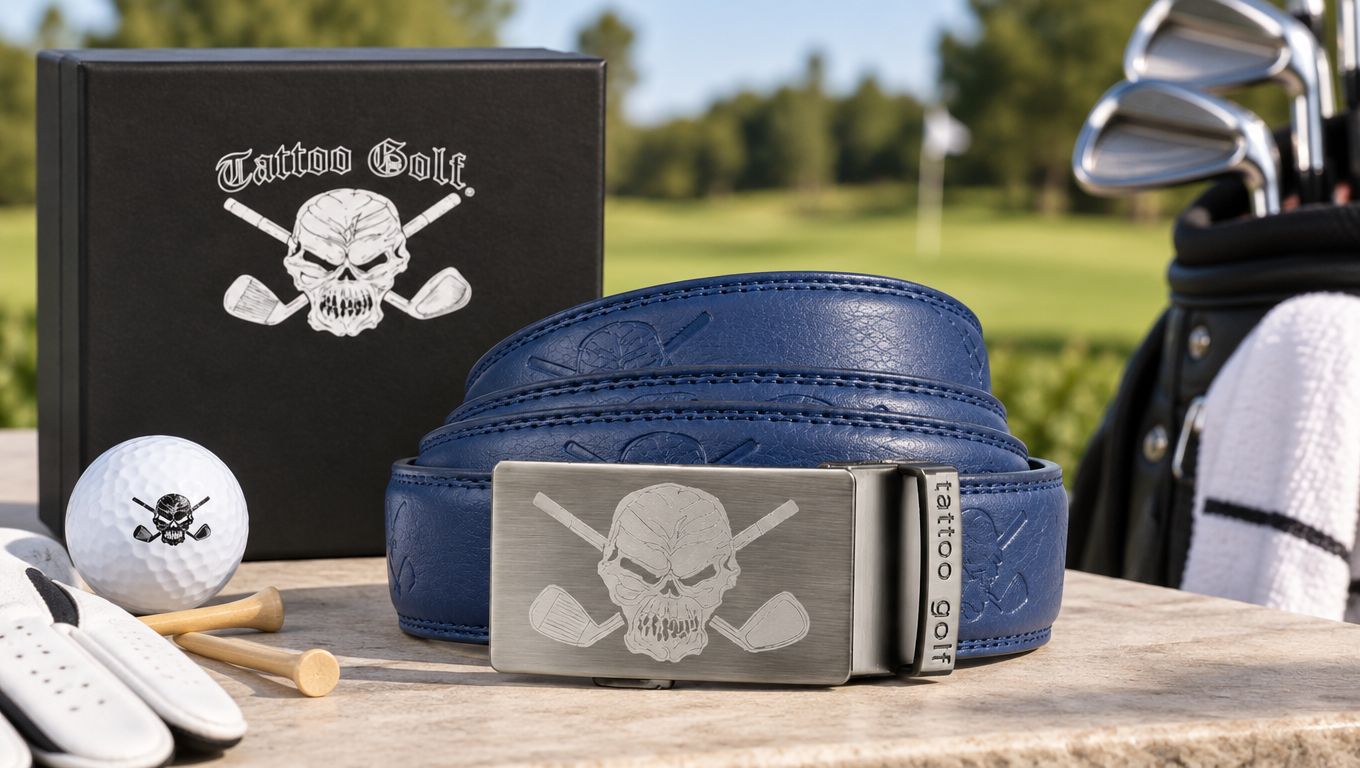
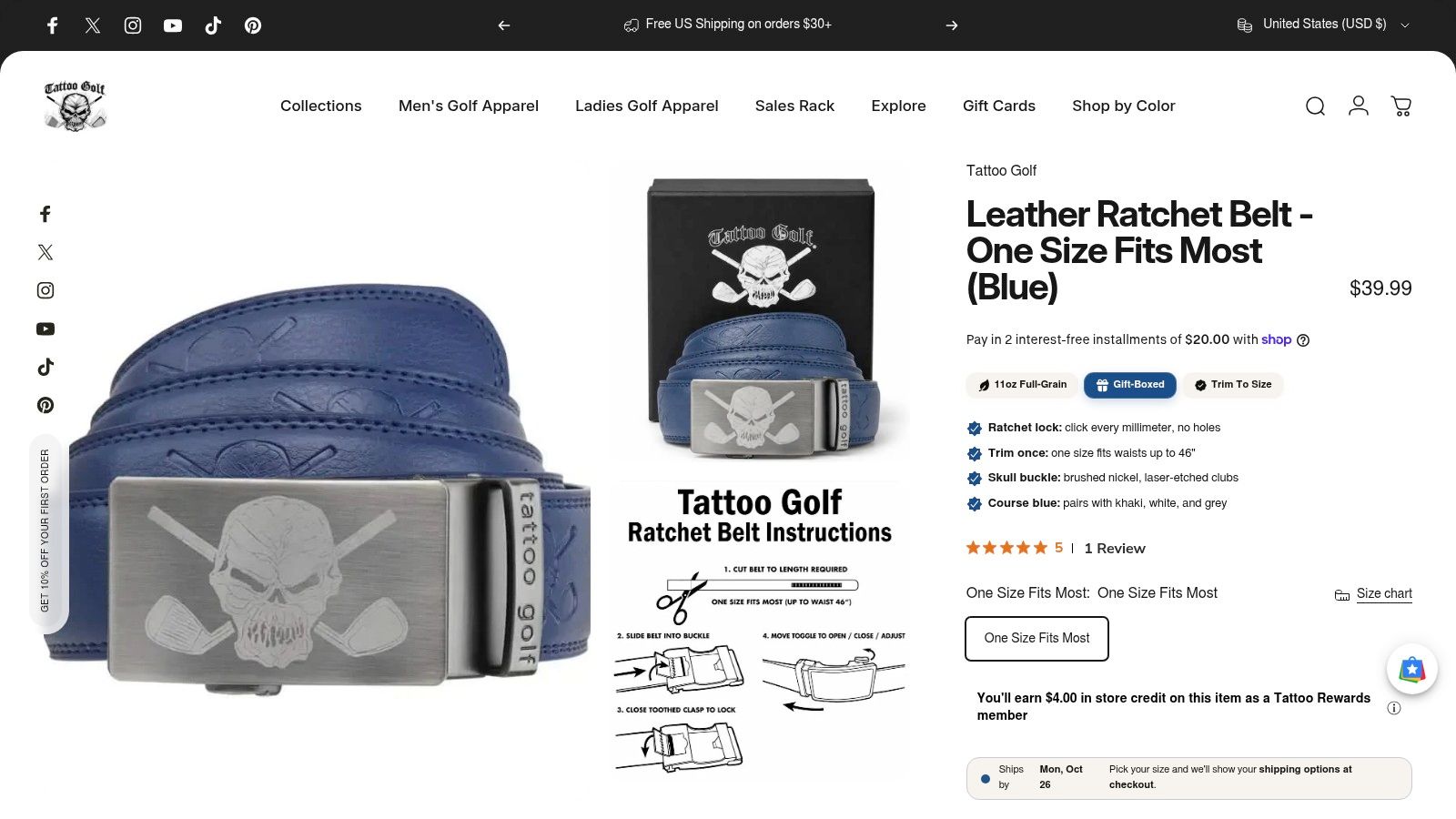
The Leather Ratchet Belt - One Size Fits Most (Blue) is a concrete option for golfers who prioritize leather construction and adjustable fit. Its catalog specifies full-grain 11-ounce leather, a no-hole ratchet mechanism, and a brushed nickel buckle with a laser-etched Skull & Crossing Clubs design.
There's an important limit to that comparison: the product description doesn't establish an integrated removable ball marker. Treat it as a belt option, not as a verified all-in-one marker system.
What the specified hardware offers
The catalog describes adjustment through a ratchet mechanism, with a hidden release lever beneath the buckle. That gives you a defined control to locate and test, rather than leaving you to guess how the buckle opens.
Its trim-to-fit strap accommodates waists up to 46 inches, according to the product listing linked above. That's a maximum sizing specification, not a guarantee that every golfer should cut the strap to the same length or use their trouser label as the cutting measurement.
| Selection criterion | What the catalog establishes |
|---|---|
| Strap material | Genuine full-grain leather |
| Closure | No-hole, micro-adjustable ratchet |
| Release | Hidden lever beneath the buckle |
| Appearance | Blue strap and brushed nickel skull-design buckle |
| Packaging | Premium gift box |
| Integrated marker | Not established in the description |
The blue color offers a deliberate alternative to a neutral belt without requiring a loud print. The catalog suggests pairing it with khaki, white, or grey bottoms, which gives you a useful starting point when checking your existing wardrobe.
Who should consider it
This option makes sense to evaluate if you prefer substantial leather and want to avoid choosing between fixed belt holes. It's less directly aligned with a shopper who requires a factory-integrated marker dock.
Color choice can also help you use a belt more often. The brand's purple and orange leather ratchet belt update provides another reference for matching stronger colors with your golf clothing.
- Choose it for the stated features: Leather, ratchet adjustment, and distinctive buckle styling.
- Ask before assuming compatibility: Don't presume a separate magnetic accessory will attach securely to the buckle.
- Keep marker storage independent if needed: A familiar pocket or hat holder may remain the simpler choice.
That's the honest distinction between an appealing golf belt and a confirmed golf belt with ball marker. Neither category needs exaggerated claims to be useful; they solve different parts of your setup.
Caring for Your Belt and Planning Your Next Round
Good ownership starts with a small habit after the round. Remove surface dirt, check the hardware, and put the belt away properly rather than leaving it tangled inside damp clothing.
For the leather option described above, the catalog recommends a dry or slightly damp cloth, occasional quality leather conditioner, and avoiding prolonged soaking. Store it hanging or loosely coiled to help preserve its shape.
Give the marker holder its own inspection
If you choose an integrated system, inspect the dock separately from the strap. Clear visible grit before reseating the marker, and check whether it sits flat in its intended position.
Don't compensate for a dirty or damaged holder by pressing harder and hoping it stays attached. Look for an obstruction, worn retaining feature, or loose component, then follow the manufacturer's maintenance guidance.
- Inspect the edge: Make sure you still have a reliable place to lift the marker.
- Check the recess: Remove trapped debris without scratching the finish.
- Confirm engagement: Test the holder over a safe surface before heading out.
- Review replacement options: Ask whether a lost marker or damaged component can be replaced separately.
Make the final choice around your round
Your shortlist should answer practical questions rather than repeat marketing labels. Is the removable marker suitable for play? Does the holder release deliberately? Can you adjust the belt comfortably, and will you maintain the material?
You don't need every feature in the same product. A comfortable belt with separate marker storage may suit you better than an integrated buckle that feels cumbersome.
Before your next round, measure at the belt line and try your preferred setup with your actual golf trousers. Choose a color you'll wear, test the complete marker routine, and settle on equipment that feels straightforward in your hands.
The right accessory should earn its place through repeated use. If you can reach the marker naturally and forget about the belt between greens, you've made a sensible choice.
Tattoo Golf offers genuine-leather ratchet belts with adjustable fit and distinctive skull-and-clubs styling. Visit Tattoo Golf to compare belt colors and accessories, then confirm your chosen marker-storage setup before your next round.



Share:
Golf Shorts Women Should Buy: Fit, Fabric and Length