

You've got a tee time booked, a polo that works with almost anything, and a pair of bright orange pants in your cart that you can't quite commit to yet. The colour isn't the question. You need to know whether the OB Performance Men's Golf Pants (Orange) will fit your seat and thigh, move through a full swing, and still feel dry on the back nine. That's how you should judge them.
What the Orange OB Performance Pants Are
The OB Performance Men's Golf Pants (Orange) are a performance trouser from Tattoo Golf where the visible difference is colour and the work is done by fabric and cut. Orange is a style attribute. It doesn't make the pant stretchier, cooler, or quicker to dry. Those jobs belong to the fibre blend, the fabric construction, and the garment design.
That distinction matters more than most product pages admit. A bold pair can look sharp on the first tee and still fail you by the twelfth if the seat bags out, the waistband digs in, or sweat stays trapped against your skin. I would judge this pant the same way you'd judge a plain black one, only with extra attention to how the shade looks in daylight and what it pairs with.
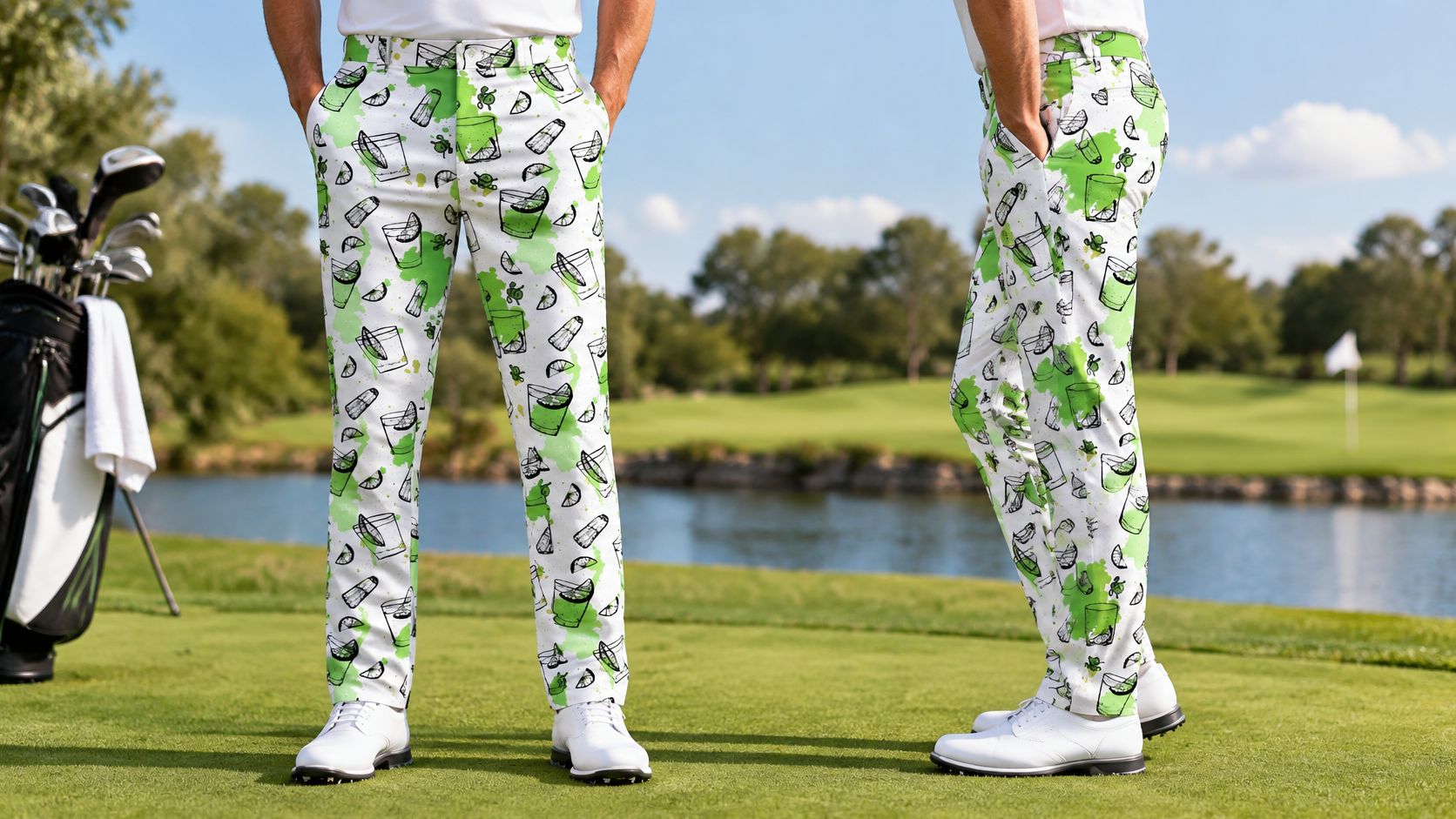
What the listings show and what they don't
Men's trousers are not a fringe category. Men represented approximately 70% of golf participants in the cited market analysis from the Grand View Research golf apparel market report, so a men's performance pant sits at the core of what golfers buy, not at the edge of it.
OB Performance Men's Golf Pants (Orange) at a glance
| Attribute | What the listings show | What to verify before buying |
|---|---|---|
| Colour | Orange | Compare the shade in daylight photos against your other pants |
| Fabric | Performance fabric; fibre blend not published | Request the exact fibre composition |
| Stretch | 4-way stretch described | Check recovery after repeated squats and twists |
| Fit | Modern tailored fit | Measure waist, seat, thigh and inseam yourself |
Read that table as two different kinds of information. Colour, stretch description, and fit label are claims you can see. Fibre composition and true garment measurements are facts you'll need before you can predict drying speed or swing comfort. Without them, you're guessing from marketing words.
Three checks before you order
Before you add the pants to a golf trip packing list, alongside logistics like booking transport with room for players, clubs, and weekend bags, run three simple verifications.
- Fibre content: Ask for the exact blend, including any elastane percentage, so you know what's supposed to provide stretch and wicking.
- Stretch recovery: Plan to test the pant after repeated squats and twists, not only when you first pull it on.
- True measurements: Check your own waist, seat, thigh, and inseam against the live size chart rather than relying on a letter size alone.
If those three answers line up, the orange becomes what it should be, a confident colour choice on top of a pant that already works. If they don't, no shade of orange fixes a tight seat or a fabric that stays clammy.
How to Choose the Right Fit in Four Steps
Fit a golf pant for movement first and appearance second. A close-cut silhouette looks clean standing still, but golf asks you to rotate, crouch to read a putt, bend to tee the ball, and walk for hours. A pant that looks sharp in a mirror can turn restrictive the moment your hips turn.
You'll need a soft tape measure, a pair of golf pants that already fits you well, and a few minutes without shoes. Measure over light clothing, stand naturally, and don't hold your breath or pull the tape tight to get a number you prefer. Honest numbers prevent returns.
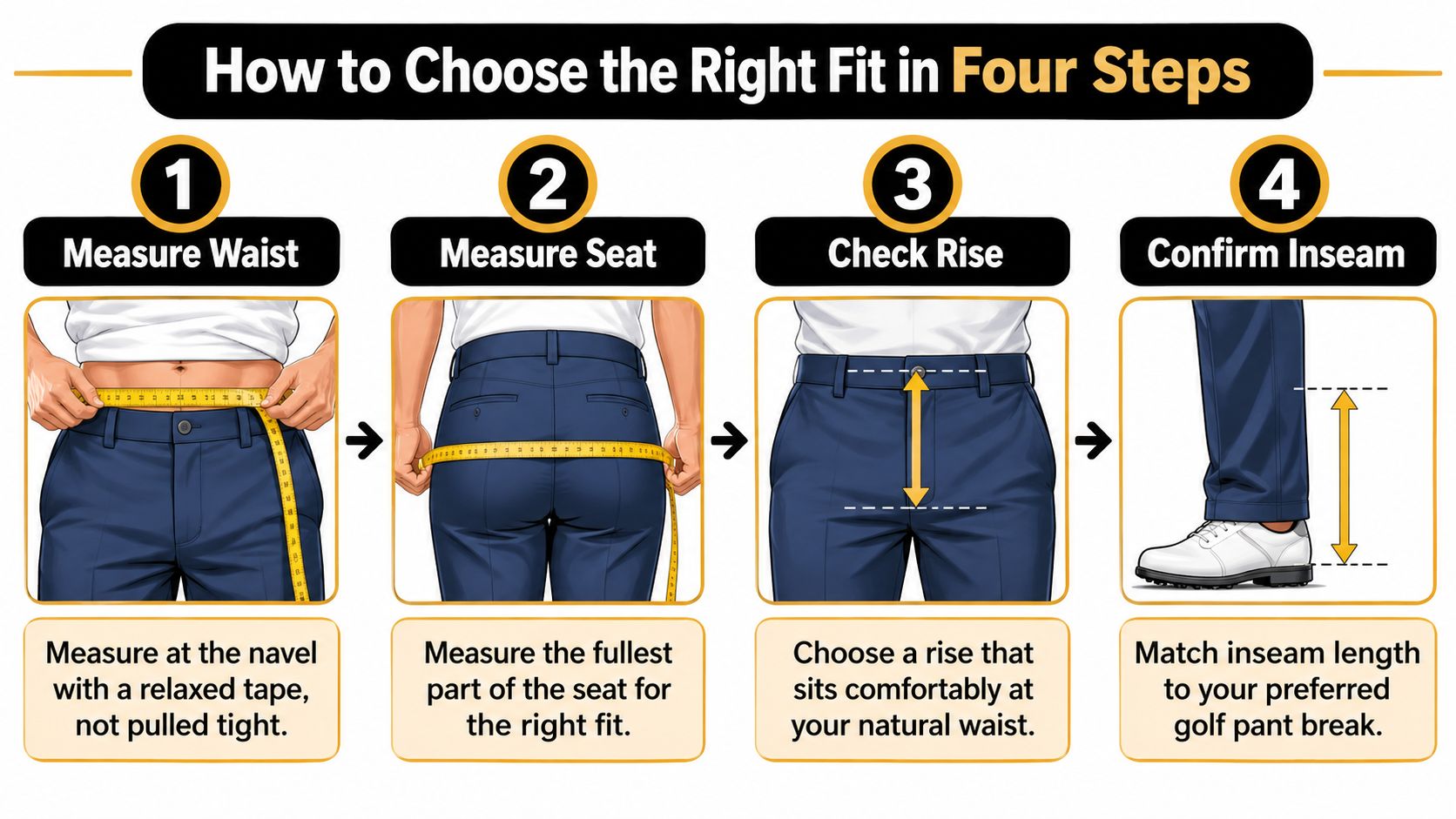
Step 1 Measure your waist at the navel
Wrap the tape around your natural waist at navel level, keeping it level and relaxed. Don't cinch it. A tape pulled tight gives you a smaller number and pushes you toward a waistband that'll dig in when you bend forward or sit in a cart between shots.
Golf pants sit at the natural waist, so this reading is your baseline, not your jeans size. If your usual trouser size and your tape reading disagree, trust the tape.
Step 2 Measure your seat at the fullest point
Run the tape around the fullest part of your hips and seat, keeping your feet together and the tape level. This is the measurement golfers skip and regret. Pulling, binding, and that worn look at the back usually start here, because the seat takes stress every time you crouch, rotate, and walk uphill.
It's also the hardest measurement to fake with stretch. Fabric can forgive a small waist difference with a belt. It can't create seat room that isn't cut into the pattern, so write this number down carefully.
Step 3 Measure your inseam from pants that already work
Lay a pair of golf pants you like flat, smooth the leg, and measure from the crotch seam to the hem where you want the pant to end. Measuring a garment that already breaks the way you like over your golf shoes beats measuring your leg and guessing.
Decide the hem before you measure. Some players want a clean break just above the shoe, others accept a little more length. Bright orange draws the eye downward, so excess fabric pooling at the ankle is more obvious than it is on navy or black.
Step 4 Compare numbers and choose by seat and thigh first
Put your waist, seat, and inseam against the chart for the orange OB pant. If you fall between sizes, choose by seat and thigh first. A slightly generous waist is manageable. A tight seat restricts hip rotation, pulls across the front of the thigh, and gets worse as you warm up.
For contrast, pull up a comparable pant like the Dancing Skulls ProCool Men's Golf Pants (Black/Charcoal) and compare your numbers with any numeric size chart you can check on the live product page. A chart with actual waist and inseam figures makes this step concrete. When a listing gives you only letter sizes, your tape measurements carry more weight.
Between sizes rule: Size for the seat and thigh, then manage the waist. You can't belt your way out of a seat that binds through the swing.
Edge cases that change the choice
A close cut may pinch a muscular thigh even when the waist reading looks right, so check thigh room before ordering if you lift, cycle, or carry size in your quads. Walkers in summer heat should leave a little extra room, because sweat, heat, and mild swelling over 18 holes change how a close pant feels by the fifteenth tee. In cold weather, decide now whether you'll wear a base layer underneath, because a pant that fits perfectly over bare legs may feel snug over thermals.
Do the home fit check
When the pants arrive, don't judge them standing at the mirror. Squat as if you're reading a putt. Rotate your hips both ways as you would through a backswing and follow through. Lift one knee toward hip height, then bend forward like you're teeing a ball.
Passing looks like this. The waistband stays put without digging. The seat doesn't sag after the squats. The front doesn't pull hard across the thigh, and the hem returns to place instead of catching at the calf. If any of those fail, the size is wrong for your build, whatever the label says.
Sizes Available and Where the Listings Disagree
Two golfers can open the orange OB pant on different Tattoo Golf pages and walk away with different impressions of the size run. One sees letters, another catches numeric waist sizing elsewhere in the catalogue, and a third finds their size greyed out entirely. None of that tells you which page is current, so the live size selector on the product page you're buying from is the only authority that counts at checkout.
The catalogue does use both systems. Numeric sizing shows up across the range, with the Tiki Cool-Stretch men's golf shorts running waist sizes 30 through 44. Letter sizing appears alongside it on other styles. For the orange pant, treat whatever you see as a signal to confirm, not a settled fact.
How to read each size signal
| What the page shows | What it actually means | What to do |
|---|---|---|
| Letter sizes | A rough band with no dimensions attached | Match it against the size chart, never memory |
| A numeric waist | A tape-measure target | Compare it to your relaxed waist reading |
| Your size greyed out | A stock question, not a fit one | Recheck later or ask about restock |
| No size detail at all | No data to work from | Contact the store before paying |
The measurement gap behind the letters
A letter size answers exactly one question: roughly which band you fall into. It stays silent on rise, thigh width, leg opening, and inseam, and two golfers who both wear an L can need very different trousers. An L cut for a straighter seat will bind on an athletic build whatever the tag says.
The fabric details have a similar gap. A listing won't always state how much give the Cool-Stretch build offers through the waistband, or whether the same blend carries across every colourway. If you're counting on stretch to cover a between-sizes difference, get the fibre composition confirmed in writing before you order.
Letters versus numbers at checkout
If the page you land on shows numbers, match the waist figure to your relaxed tape reading and hold the inseam against a pant that already fits you. If it shows letters, treat the letter as a starting guess and check it against the Tattoo Golf size chart before you pay. Resist converting letters to inches from memory or borrowing another brand's chart, because the same letter can measure out differently from one label to the next.
When to message the store first
Three situations justify a quick exchange before ordering. Your waist points to one size while your seat or thigh points to another. You need an inseam a letter size can't specify. Or your size appears on one page but sits missing on the one you're buying from. Browsing the men's golf pants collection gives you a view of the full range the store carries, which helps when a single listing looks thin.
Ask narrow questions and you'll get usable answers in one reply: waist circumference, front rise, thigh width, leg opening, and fibre content. Two minutes of that beats a return parcel.
The orange is the easy call. The size is where the homework goes.
How 4-Way Stretch and Moisture Control Work Together
Think of stretch fabric like a good door hinge. It moves freely in the direction you push it, then returns to its place without complaint. Stiff cloth acts more like a fence post. It doesn't refuse movement outright, but it resists every motion and makes you do the work.
4-way stretch means the fabric gives in both directions across the cloth, lengthwise and widthwise. For a golf pant, that matters because your movement isn't one directional. Your hips rotate, your knees flex, your weight shifts, and the fabric over your seat and thigh has to follow all of it without pulling you short at the top of the backswing.
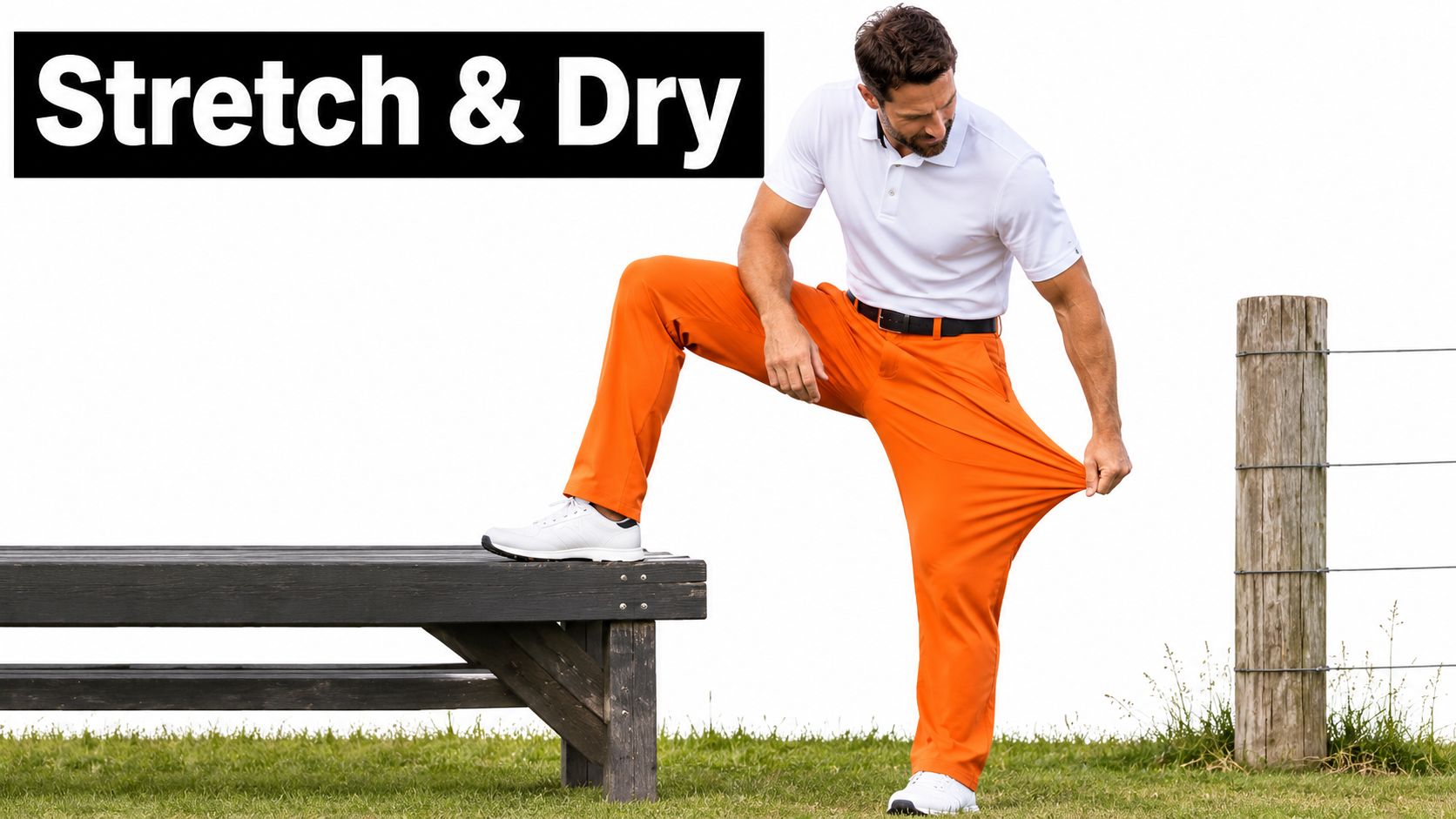
Recovery matters more than the label
Stretch gets the headline, but recovery decides how the pant looks and feels on the sixteenth hole. A fabric can extend generously and still be a poor golf fabric if it stays extended. That's how you get a seat that looks tired and knees that hold a bend after a few crouches.
The standard behind that judgement is ASTM D3107, which measures how stretch fabrics respond after defined tension and extension, including elongation and the fabric's ability to recover. Poor recovery shows up in golf as temporary seat or knee bagging after repeated crouching, rotating, and walking. You don't need laboratory equipment to spot the tendency. You need a before and after comparison.
Try this test at home. Note how the seat and knees sit when you first put the pants on. Do several deep squats, a set of hip rotations, and a short walk around the room. Check the same zones again. If the seat has grown visibly looser or the knees hold a pouch, expect that effect to be stronger after four hours on course. Low residual growth in those high motion zones is what you want.
How moisture control actually works
Sweat doesn't disappear because a label says wicking. It has to move. First the fabric takes moisture away from the skin, then it spreads that moisture across a larger surface, then airflow and heat let it evaporate. Break any link in that chain and the pant feels clammy even if the fibre itself is capable.
Wetted area and air movement set much of the drying speed. Moisture spread thinly over the thigh dries faster than moisture pooled against the skin. Sweat trapped under a tight waistband is the common failure point, because there's little airflow there and the fabric is pressed flat. That's why a waistband that digs isn't only uncomfortable. It also slows drying where you sweat heavily.
Say you're walking a humid afternoon round. The front of the thigh may feel fine in the breeze while the waistband and seat stay damp. That's not necessarily bad fibre. It's often fit and airflow limiting what the fibre can do. For more on how stretch construction affects a round, Tattoo Golf's guide to stretch golf pants is a useful companion read.
Why the two systems belong together
Stretch and moisture control support each other. A pant that moves with you doesn't cling in one stressed patch, so moisture spreads more evenly. A pant that stays dry keeps its weight and shape better, so the stretch you felt on the first tee is closer to the stretch you get later.
Neither benefit can be assumed from an unpublished fibre blend. A 4-way stretch label doesn't confirm recovery, and a wicking claim doesn't confirm drying speed. Test both in your first wear at home, while a return is still simple.
Stretch keeps the fit, moisture handling keeps you comfortable, and neither should be taken on a label alone.
Orange OB Pants Compared With Other Golf Pant Fabrics
Fibre choice drives most of the comfort difference between golf pants that look similar in a product photo. Orange changes what people notice at the first tee. Fibre changes whether you finish the round dry, whether the seat keeps its shape, and whether you can crouch to read a putt without thinking about your clothing.
A 2023 review of sports-textile materials characterises elastane as providing approximately 500% stretch recovery, along with resistance to perspiration, body oils, and detergents. The same review identifies specialized polyester fibres as capable of high-speed perspiration evaporation, moisture absorption, transport, and quick drying in products including trousers. Together, those properties explain why polyester and elastane combinations dominate serious golf pants.
Golf pant fabrics compared on the criteria that matter on course
| Fabric | Stretch | Moisture handling | Drying speed | Shape and wrinkles | Best for |
|---|---|---|---|---|---|
| OB Performance (orange) | 4-way stretch (claimed) | Wicking; fibre blend to verify | Fast if polyester-based | Holds shape with care | Walking and full 18-hole rounds |
| Cotton twill | Low, little give | Absorbs and holds sweat | Slow | Wrinkles; loses shape when wet | Dry, casual days |
| Standard polyester (non-stretch) | Low | Wicks well | Fast | Crisp, resists wrinkles | Hot days with limited movement needs |
| Poly-elastane blend | High, depends on elastane content | Wicks if polyester-based | Fast | Good recovery when new | Athletic fit and rotation |
| Nylon blend | Moderate to high with elastane | Quick-drying | Fast | Smooth and lightweight | Wet and windy rounds |
| Wool blend | Moderate | Breathable, buffers moisture | Slow | Holds shape; warm | Cool-weather rounds |
How to read the OB row honestly
The OB Performance row carries an asterisk the others don't. Its exact fibre blend isn't published, so its moisture and drying entries are claims to verify, not confirmed values. If the base fibre is polyester with some elastane, the fast drying and recovery in the table are realistic expectations. If it isn't, they aren't.
Ask one question before buying: what fibres are in the blend? Then run the home stretch and drying checks when the pants arrive. Don't transfer confidence from the poly-elastane row to the OB row without the fibre label. The same logic applies anywhere fibre and construction decide comfort after colour catches the eye, including when you're choosing fabrics for bulk golf caps.
Cotton, wool, and the honest trade-offs
Cotton twill feels familiar and looks tidy at the first tee, but it absorbs sweat and holds it. On a dry, casual nine holes that's acceptable. On a humid walking round it gets heavy, dries slowly, and wrinkles where it bends. I wouldn't choose it if drying speed is your priority.
Wool blends solve a different problem. They breathe, buffer moisture, and keep warmth on cool mornings while holding their shape well. The trade-off is slow drying and more weight than a summer golfer wants. Keep wool for shoulder season and early tee times, not August afternoons.
The synthetics, separated properly
Standard non-stretch polyester wicks and dries fast and resists wrinkles, but it gives you little help in rotation. It suits hot days in a cart better than a walking round with a full, aggressive swing.
Add elastane and the picture changes. A poly-elastane blend keeps the polyester drying behaviour and adds the recovery that protects the seat and knees. Nylon blends earn their place in wet or windy conditions. They're smooth, light, and quick to dry, and with elastane they move well too. If your home course deals you changeable weather, nylon is a sensible rotation partner rather than a replacement for your main pair.
A verdict by situation
- Walking and full swings: choose a stretch polyester or poly-elastane blend.
- Dry, casual days: cotton twill is fine if you accept slower drying.
- Cool mornings: reach for a wool blend.
- Wet or windy rounds: pick a nylon blend.
If the label confirms elastane over a polyester base, the orange pair is built for movement and quick drying, and the colour stays what it should be: a styling choice, not a performance claim.
Caring for Orange Pants So Stretch and Colour Last
Performance fabric doesn't usually fail in one round. It fades, loses recovery, and stops wicking gradually, mostly through washing habits. Bright orange adds one extra job, protecting a colour that shows fading sooner than black or navy would.
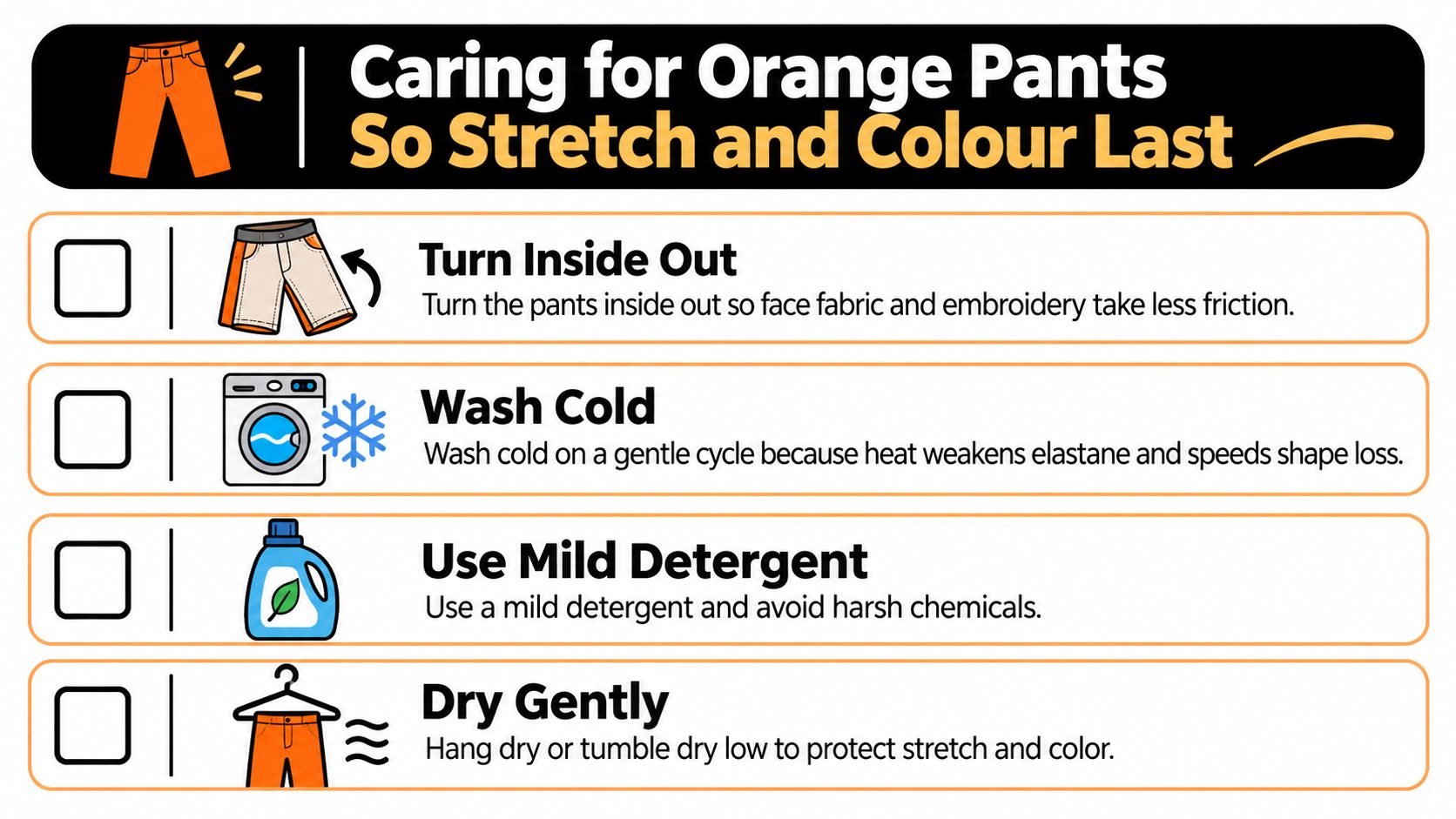
The six-step wash routine
- Turn the pants inside out. The face fabric and any embroidery take less friction, so the surface and detailing stay cleaner looking for longer.
- Wash cold on a gentle cycle. Heat weakens elastane and speeds shape loss, so cold water protects the recovery you bought the pant for.
- Use mild detergent and skip bleach. Chlorine damages fibres and can dull bright colours, and orange has no darkness to hide that damage in.
- Skip fabric softener. Softener coats fibres and reduces wicking, which undoes the moisture handling.
- Wash separately at first. Keep the orange pair away from light or white items for the first two or three washes to limit dye transfer.
- Air dry flat or hang them. Avoid the high-heat dryer setting, because sustained heat is the fastest way to tire out stretch fibres.
Tattoo Golf publishes its own guidance on care for your Tattoo Golf clothing, and it's worth matching this routine against the care label inside your specific pair. Where the label and general advice differ, follow the label.
Stains, pilling, and sunlight
Treat stains before the wash, not after. Work a little mild detergent into grass or dirt marks with cold water and let it sit briefly, because hot water sets many stains permanently. Don't scrub aggressively at a printed or embroidered area. Blot and rinse instead.
Expect light pilling where the pant rubs against rough bag straps, cart edges, or a towel clip. That's surface friction, not a fabric defect, and washing inside out with similar smooth garments slows it. Keep the pants out of prolonged direct sun when you store or dry them. A bright colour left on a sunny line after it's already dry is fading for no benefit.
If the waistband starts to sag or the seat loses recovery after several washes, suspect your heat settings before you blame the fabric.
Run the cold, gentle, air-dry routine consistently and the two things you paid for, stretch that returns and orange that still looks orange, will last well beyond the first season.
Measure your waist, seat, and inseam first, confirm the fibre blend and your size on the live chart, then put the OB Performance Men's Golf Pants (Orange) through the squat, rotate, and bend test at home before the tags come off for good. Tattoo Golf offers performance pants, polos, shorts, and coordinated outfits built around stretch, moisture control, and colour that doesn't apologise for itself. Visit Tattoo Golf to check the current orange OB listing and find the size that fits your swing.
Share:
VIP Cool-Stretch Men's Golf Shirt - Navy/White Camo Guide