
The most common advice on professional golf shirts with logo options is also the least useful. You're told to look for moisture-wicking fabric, pick a logo size that looks balanced, and order your usual size. None of that tells you whether the shirt will dry, protect you from sun, move through a swing, or pass the rules where you play.
A logo doesn't prove performance. It adds a second job to the garment, and sometimes a third. The shirt has to work as performance clothing, carry a club, sponsor, team, or event identity, and look right under the dress code for that setting. A shirt can pass on fabric and still fail because the graphic is too large, in the wrong place, or applied with a method that blocks airflow across the chest.
I would treat the purchase as one verification exercise. Check the finished garment, not the fabric swatch. Check the decorated zones, not just the undecorated body. Check the event rules before you approve artwork, not after a team order arrives.
Logo Golf Shirt Specs and Pre-Order Checklist
A professional golf shirt with logo detail performs when its specs are documented and tested, not when the listing repeats words like performance, premium, or moisture-wicking. Those words describe an intention. A test report, fabric sheet, placement diagram, and care label describe the shirt you're buying.
That distinction matters because a logoed shirt carries more than fabric. Logoed golf shirts became an established part of golf retail and club identity during the 1970s, according to Golf Digest's history of logoed golf apparel. The shirt became clothing, a club or sponsor platform, and a souvenir at the same time. You're still buying all three, so verify all three.
Six Specs to Verify Before You Order
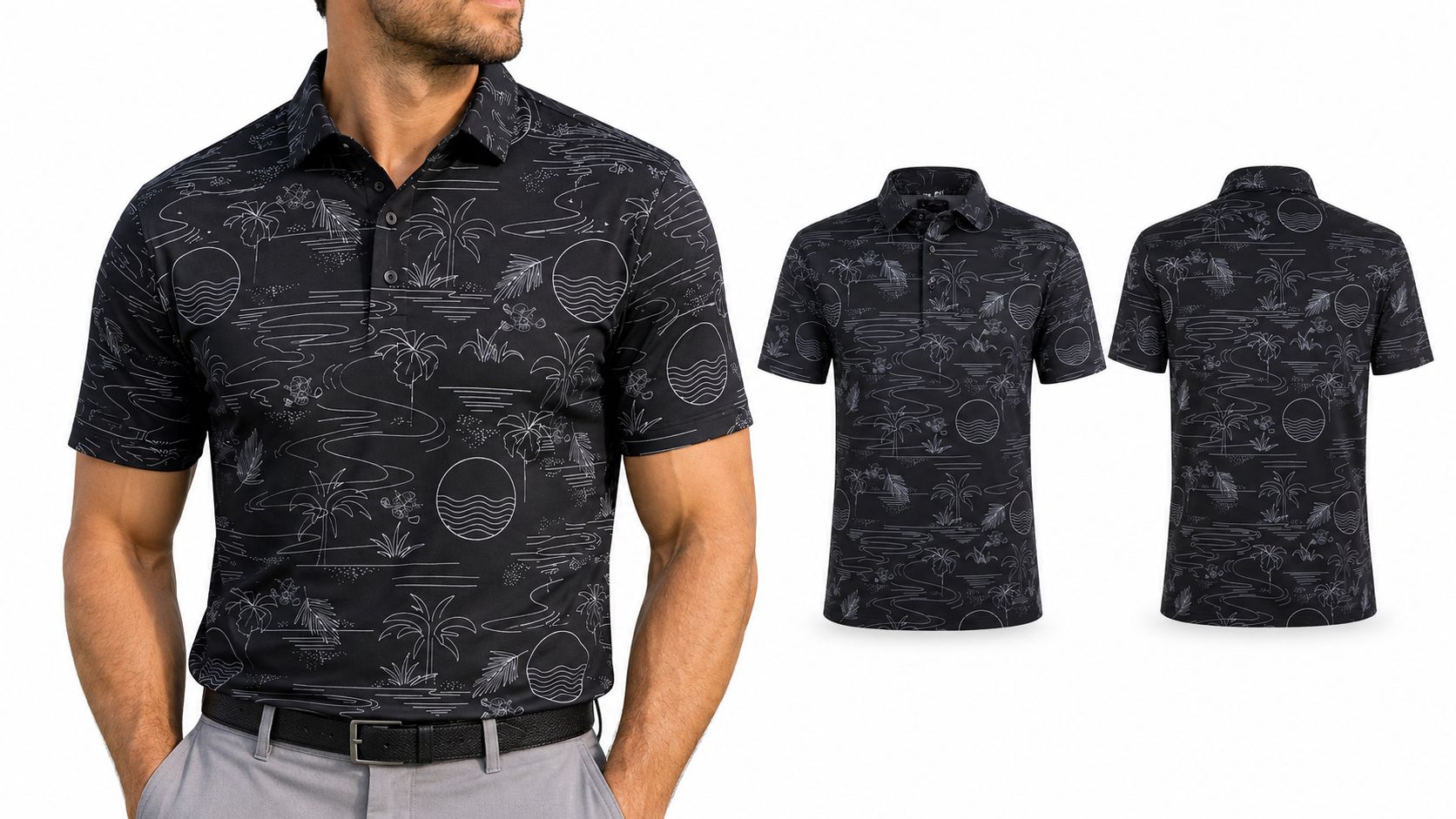
A well-documented listing is your starting point, not your proof. A useful one states concrete details: fabric weight in ounces or grams, the fiber blend, a UPF rating, the stretch construction, quick-dry or anti-odor finishes, collar construction, and seam type. That level of detail gives you something to check. It still doesn't replace the report behind each claim.
| Spec | Benchmark to look for | Why it matters | What to request |
|---|---|---|---|
| Sun protection | UPF 50+ on the finished garment | Blocks nearly all UVA and UVB reaching the fabric | Test result for each colorway |
| Stretch | Documented four-way stretch | Stops the shirt pulling across the shoulders | Recovery data after repeated extension |
| Moisture management | Named AATCC test results | Shows drying and spreading, not marketing claims | Test report covering body and logo zones |
| Fabric weight | A stated weight on the spec sheet | Lets you compare drape and cling across options | Fabric specification sheet |
| Logo placement | Breast, sleeve, collar or yoke | Matches accepted locations in tour and club settings | Placement diagram with logo dimensions |
| Care | A printed label on the garment | The wrong wash degrades print and fabric together | See the care section for wash and dry guidance |
Practical rule: If a supplier can't document a spec, mark it as unknown. Don't fill the gap with the product title.
The Pre-Order Sequence
- Confirm the setting first. Get the club, organizer, or tour's logo rules in writing before you approve artwork, not after production.
- Request the UPF result for the finished garment. Ask for it on each colorway you plan to buy.
- Ask for the moisture report. It should name the AATCC method and cover both the body and the logo-bearing zones.
- Check stretch and measurements. Compare recovery data and the size chart against your chest, shoulder, and torso measurements to confirm your usual size still holds.
- Order one sample. Wear it for practice swings and check shoulder pull, hem movement, collar position, and whether the logo zone feels stiff.
- Confirm the order in writing. Record quantities, sizes, artwork version, placement references, and finished logo dimensions before production.
For team, league, or shop orders, this sequence also protects the reorder. If the fabric, fit block, or decoration method changes later, you'll know which approved spec no longer matches. Buyers planning larger runs should review wholesale golf polo ordering considerations alongside the sample, because quantity doesn't fix an undocumented garment. It multiplies the problem.
Don't approve artwork from a flat mockup alone. A chest logo can sit correctly on screen and drift toward the armhole or placket when worn. Check the decorated sample buttoned as you'll wear it, arms relaxed and then in an address position.
UPF Ratings and Sun Protection on the Course
UPF is the share of ultraviolet radiation a fabric blocks. A higher number lets less UV through, and the practical gain shrinks as ratings climb. Treat UPF 50+ as the top of the scale, and never assume every panel on the shirt performs the same.
UPF 30 as good protection and UPF 50 or 50+ as excellent, with UPF 50 blocking approximately 98% of ultraviolet radiation. Use that scale when you read a listing, and ask which labeling scheme the seller uses if the words good, very good, or excellent appear without a number.
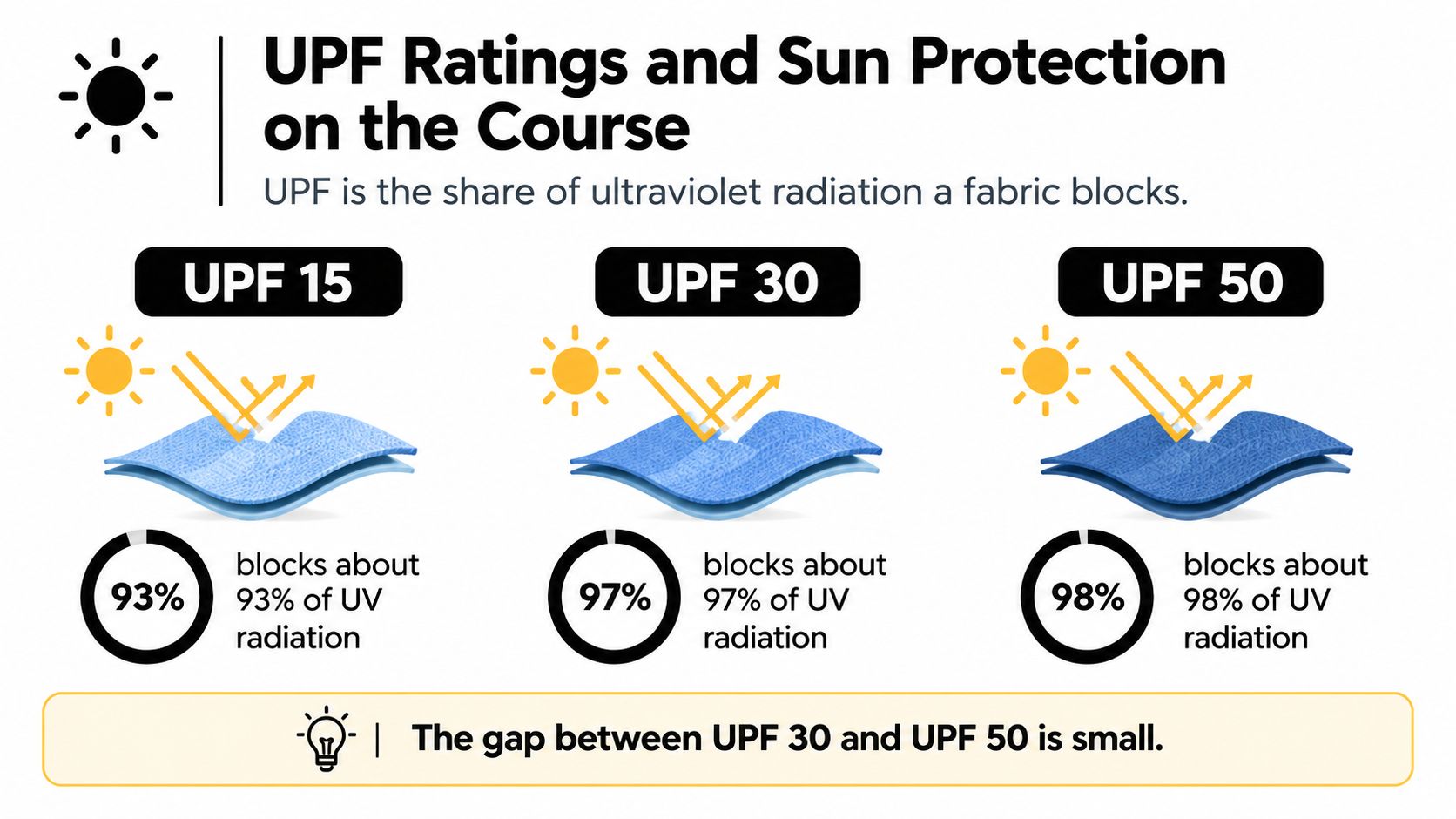
| UPF rating | UV blocked (approx.) | Typical label | Practical use |
|---|---|---|---|
| UPF 15 | Lowest share of the three | Acceptable | Short rounds in mild sun |
| UPF 30 | High share | Good | Most rounds, moderate sun |
| UPF 50+ | About 98% | Excellent | All-day sun, high altitude, exposed courses |
Each step up the scale blocks a smaller share of the UV that remains, so the early gains matter most. UPF 50+ still earns its keep on exposed courses. The point is that fit, coverage, and hours outside carry as much weight as the number during a multi-hour round with little shade.
Why Stretch Changes the Rating You Get
Tight fabric structures block more UV. Stretching opens the structure and can reduce protection. A shirt that sits comfortably when you're standing still may stretch across the shoulders, upper back, and torso during the backswing, so the lab result on unstretched fabric isn't the whole story.
That's why you should request a tested UPF rating for the finished garment rather than relying on the greige fabric result. Ask for results in the primary colorways, because dark, light, printed, and perforated panels may perform differently. Check size grading too. A golfer at the top of a size range loads more tension through the same panel than a golfer in the middle of it.
Logo application belongs in the same buying decision. A rigid chest, sleeve, or upper-back zone can restrict rotation, interfere with moisture transfer, and change how the surrounding fabric stretches under load. Move in the sample and feel whether the decorated area behaves like the rest of the shirt. A shirt can pass its UPF test and still be the wrong call if the decoration fights your swing or the setting's dress code.
Coverage ends at the collar. A shirt can't protect your face, ears, or neck, so pair it with a hat when sun exposure is the main concern. Check whether the brim shades those areas and whether the hat's own UPF label uses the same scale as the shirt.
When a listing spells out the spec, hold it to that standard. The Summertime Cool-Stretch Men's Golf Shirt (Black) shows the format to expect: fabric weight and blend, a stated UPF rating, stretch behavior, moisture handling, and finish. Verify each line against a finished-garment result, because a listed rating says nothing about how a specific printed panel behaves under tension.
A UPF number earned on relaxed fabric is a starting point. Your size, swing, colorway, and panel design decide the protection you wear.
Breathability and Moisture Tests That Matter
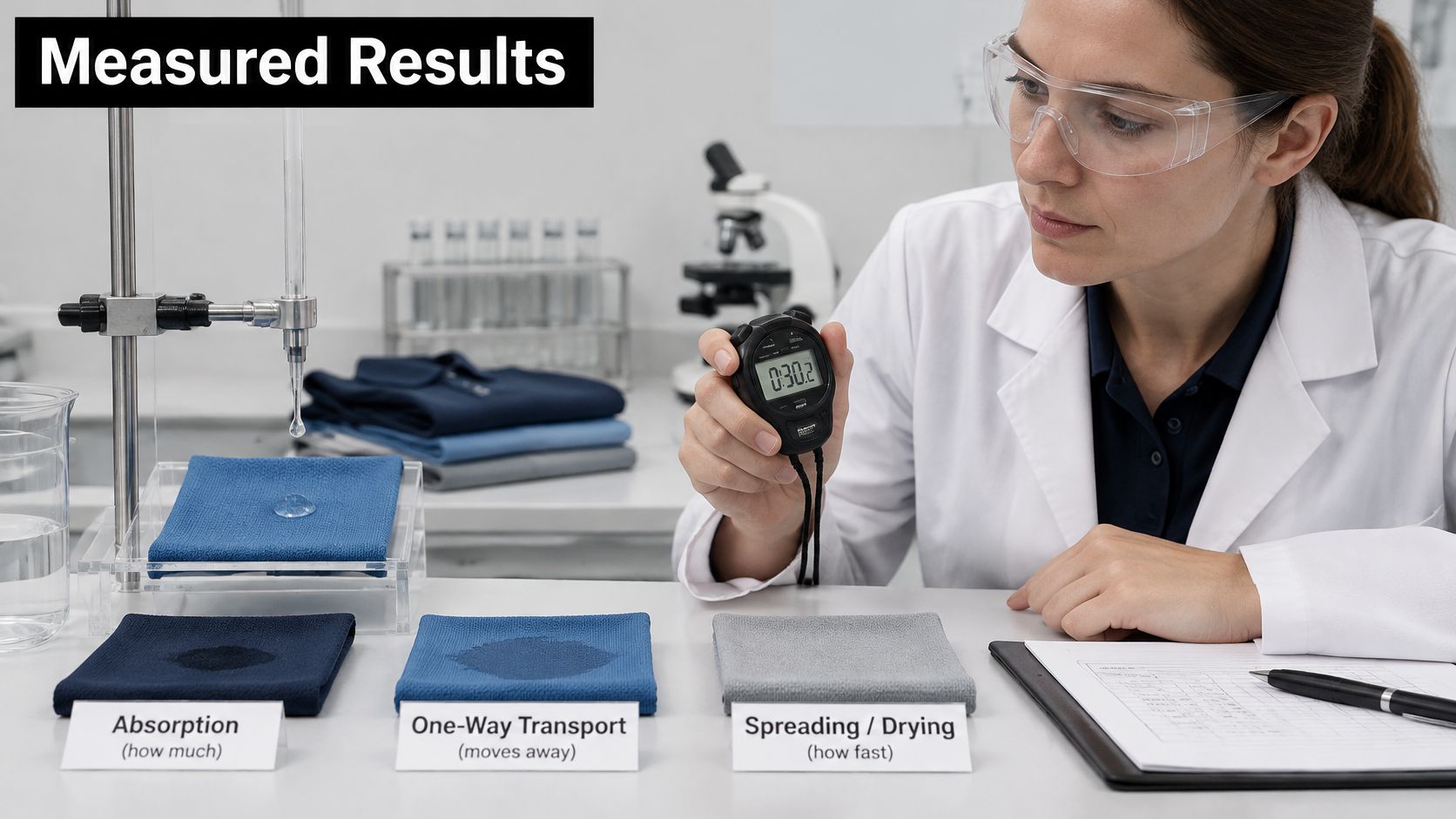
Moisture-wicking is not a test result. It's a claim that can describe several different behaviors, and a fabric can do one of them well while doing another poorly. A shirt might absorb sweat quickly but spread it slowly, leaving a wet patch. Another might move moisture outward but dry slowly in humid air.
Independent textile laboratories treat absorption, one-way transport, and spreading and drying as distinct dimensions, and Bureau Veritas moisture management testing guidance supports evaluating standardized results instead of generic claims. That's the level of detail you need when you're comparing professional golf shirts with logo application across sweat-heavy zones.
The AATCC Methods to Ask For
- AATCC TM195: Measures wetting time, absorption rate, spreading speed, one-way transport capability, and overall moisture-management capacity over a defined test cycle.
- AATCC TM197: Assesses vertical wicking, showing how liquid travels upward through the fabric.
- AATCC TM198: Assesses horizontal wicking, showing how liquid spreads across the fabric surface.
- Timed wicking distance: University textile testing may report wicking in centimeters over timed intervals under controlled laboratory conditions.
Ask the supplier for a report that identifies the fabric construction, test method, laboratory conditions, and results for both the shirt body and the logo-bearing zones. Without those details, you can't compare two suppliers fairly. A faster number under different conditions may not mean a drier shirt on the course.
Decoration Can Change the Fabric Under It
Embroidery, heat-transfer graphics, dense prints, and backing materials can locally change air permeability, liquid spreading, drying rate, and perceived cling. The effect is most noticeable across the chest and upper back, where sweat accumulates and the shirt rubs during rotation.
For a team or event order, compare the identical shirt with and without decoration. Put both through the same wear test if you can. Check whether the logo area stays damp longer, sticks to the skin, puckers the knit, or feels stiff when you turn. At this point, a small chest mark, a dense embroidered crest, and a large solid transfer stop being interchangeable design choices.
Breathability also depends on what the decoration covers. A small sleeve sponsor usually interrupts less of the torso than a broad upper-back graphic. If the event brief requires a larger mark, you need the decorated-zone result even more, not less.
Laundering is the final filter. Repeated washing can alter finish chemistry, fabric dimensions, and logo adhesion. Ask whether the moisture report includes post-wash testing and how many wash cycles the supplier used. I wouldn't approve a bulk order on a new-shirt result alone if the team will wear and wash those shirts all season.
Logo Placement and Event Rules by Setting
There's no single logo rule for golf. The setting decides what's acceptable, and the same shirt can be fine for a charity scramble, questionable at a private club, and noncompliant in a qualifying event. Placement, size, taste, and approval usually matter more than a simple count.
The 2025 LPGA Qualifying Series regulations require clothing to present a professional image, prohibit visible references to other golf tours or events without prior approval, and place marks in generally accepted locations such as the breast, sleeve, collar, or yoke. They use a 3-by-5-inch guideline for reasonable logo size and set no fixed limit on the number of sponsor logos.
| Setting | Sponsor logo count | Logo size guide | Placement and notes |
|---|---|---|---|
| Club and casual play | Set by the club | Keep it restrained | Check the club dress code, which may be stricter than tour rules |
| Corporate outing or charity event | Set by the organizer | Follow the event brief | Often specified in the sponsor brief |
| Amateur competition | Set by the event | Follow event guidance | Confirm before ordering team shirts |
| Professional qualifying (LPGA Q Series 2025) | No fixed limit | About 3 by 5 inches | Breast, sleeve, collar or yoke; no other tour references without approval |
| PGA Tour guidance cited in reporting | Up to four different sponsor logos | No size stated in cited guidance | Clothing and headwear combined |
Professional history explains why count alone is a weak rule. Reporting on sponsor headwear and shirts notes that John Daly was photographed in 2018 with six sponsor logos on his shirt, while PGA Tour guidance cited in NBC Sports reporting on Lou King's sponsor hats recommended no more than four different sponsor logos on clothing and headwear. Those examples don't create permission for your event. They show why you need the organizer's actual rule.
How to Specify Placement Without Ambiguity
Use the wearer's left and right, not the viewer's. Record finished width and height, then state whether measurements run to the logo center or nearest edge from references such as center front, the placket edge, a defined shoulder point, or the collar seam at center back.
Check the sample worn, not only flat. Sleeve logos can rotate out of view at address or wrap around the arm. Chest logos need clearance from the placket, armhole, stripes, and any existing brand mark. A back-yoke logo needs clearance from the collar so it isn't covered during play.
Before printing a bold skull, club crest, charity graphic, or sponsor layout, ask the club or event directly. Local policies can be stricter than tour guidance, and a structured collar doesn't settle the logo question by itself. This overview of golf dress code rules for what you can and can't wear is useful background, but the host's written policy controls your order.
Fit and Stretch for Women and Newer Golfers
Fit guidance hasn't kept pace with who's playing. Market reporting cited by Mordor Intelligence's golf equipment and apparel market report indicates U.S. female on-course participation increased 45% from 2020 to 2025, reaching 8.1 million golfers, a net gain of 2.5 million. A buying guide built around a men's standard block doesn't answer the questions that audience brings to a shirt.
Newer golfers hit the same wall from a different direction. They may not know whether a polo should feel close through the shoulders, how much hem movement is normal, or whether a shaped cut will ride up when they rotate. Fabric percentages don't answer that. Measurements and movement do.
A Fit Checklist That Goes Beyond Size
- Bust and chest room: The fabric shouldn't pull at the placket or across the back when you reach into a backswing.
- Sleeve mobility: The sleeve should move with the upper arm without dragging the side seam upward.
- Torso length: Check coverage at address and after a full finish, tucked and untucked if both are allowed.
- Hem behavior: Raise both arms overhead and watch whether the hem climbs or the body twists.
- Collar position: Rotate and check whether the collar gaps, shifts, or rubs.
- Layering room: Try the shirt under the vest or quarter-zip you wear most often, because a logo or seam can feel different under another layer.
A relaxed cut gives more room through the torso and usually tolerates layering better. A shaped cut follows the body more closely and looks cleaner untucked, but it leaves less margin at the bust, waist, and hip. Pick the relaxed cut when you layer often or need ease at the hip. Choose the shaped cut only when the garment measurements still leave reach room at the top of the backswing. The cut that lets you rotate without adjusting the shirt is the right one.
Ask whether the women's version uses its own fit block rather than a scaled men's pattern. Scaling down a men's shirt doesn't reliably place bust room, waist shaping, sleeve length, and hip ease where they need to be. Garment measurements tell you more than the size label.
Swing check: Take five full practice swings. If you're tugging the hem down or freeing a shoulder before the next shot, the size or block is wrong.
For couples, teams, and event groups, match color and graphic for visual consistency, then size men's, women's, and unisex pieces separately. Identical artwork doesn't require identical patterns. A fit description on the men's listing tells you nothing about where the women's pattern sits at the bust or hip, so pull the garment measurements from each style's size chart and compare them against a shirt the wearer already plays in comfortably. I'd order one sample in each pattern and run the swing check on it before committing to the full group order.
Care Habits That Keep Logos and Fabric Performing
Heat and bleach undo the specs you paid for. Follow the printed care label first. For the catalog example used here, the instruction is machine wash cold on a gentle cycle, tumble dry low or hang dry, no bleach, and don't iron directly over the graphics.
Cold, gentle washing reduces stress on stretch fibers, printed panels, and applied marks. Turn printed shirts inside out and wash similar colors together to limit abrasion and color transfer. Hang drying is the safer default when a shirt has a heat-transfer logo, because dryer heat can weaken the graphic and the adhesive behind it. If you use a dryer, keep it low and remove the shirt promptly.
Bleach can shift color on printed panels and damage finishes. An iron can flatten, crack, or lift a transfer and leave a shine on synthetic fabric. If the collar needs reshaping, smooth the collar and placket by hand while the shirt is hanging instead of pressing heat through the logo zone.
Repeated washing can also change fabric dimensions and finish chemistry, which is why buying documents matter after purchase. Compare the worn shirt with its original measurements and feel. Watch for lifting or cracking at logo edges, loss of recovery at the shoulders, a collar that no longer sits flat, or a body that suddenly clings. Those are signs to remove heat from the routine and inspect the decoration before the next wash.
For product-specific washing details, use the maker's care information for Tattoo Golf clothing rather than borrowing instructions from a different fabric or print method. Care isn't separate from performance. It's how long the performance lasts.
If you want a logoed shirt with documented UPF 50+, four-way stretch, quick-dry fabric, and graphics that don't look like everyone else's club uniform, start by checking the specs, sizes, and care instructions on the shirt itself. Browse the current men's and women's styles at Tattoo Golf, order one sample in your measured size, and run the swing, sun, and wash checks before you commit to a full team or event order.
Share:
Stretch Golf Pants: A Buyer's Guide to Fit and Fabric