
You're standing on the first tee, glove fastened, trying not to overthink the opening shot. Then someone in your group arrives wearing a crisp polo covered in dense, tattoo-style artwork across the shoulders and back. It doesn't look like a novelty shirt. It looks deliberate, athletic, and impossible to ignore.
That's the opportunity with tattoo-inspired golf polos. The graphic gets attention, but the garment still has to handle rotation, sweat, sun, washing, and the social rules of the course. A bold print can't rescue a polo that binds across your back or turns clammy halfway through the round. The right choice treats the artwork and the construction as one product.
Why Bold Golf Polos Are Having a Moment
Golf style has moved beyond a narrow idea of what a collared shirt should look like. Recent coverage describes a shift toward more expressive, streetwear-influenced golf clothing while noting that refined materials and neutral palettes still matter (Sports Illustrated's coverage of evolving golf fashion). That combination explains why tattoo-inspired designs feel timely rather than out of place.
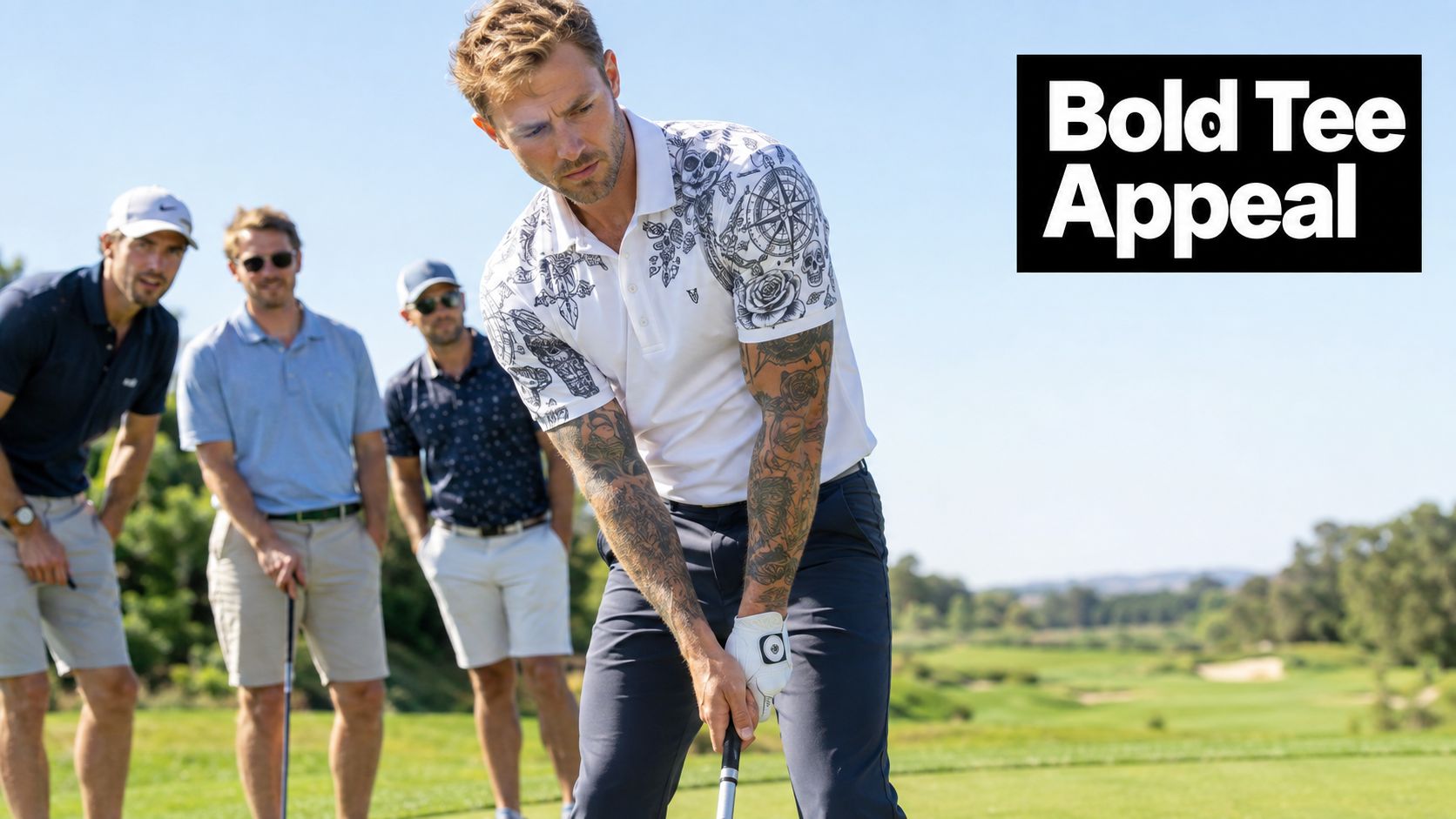
The appeal is personal. A solid navy polo says you understand the dress code. A sharp black-and-grey flash print says you understand the dress code and still have a point of view. That distinction matters as golf welcomes players who treat the course as both a sporting venue and a social setting.
Tattoo imagery also has more fashion history behind it than many golfers realize. Independent fashion-history coverage records Issey Miyake's tattoo-themed collection in 1971 and Jean Paul Gaultier's tattoo-like mesh and printed garments in 1994, establishing a runway lineage for the visual language (Tattoo-inspired fashion history). The polo isn't borrowing from a passing novelty. It's adapting a familiar graphic tradition to a performance garment.
Buyer's rule: If the design is loud, the fit and fabric have to be quieter. Clean construction keeps the print looking intentional.
The commercial logic is strong too. Polo and golf shirts represented 31.05% of 2025 revenue in one major golf-apparel market study, the largest product type in that category (Mordor Intelligence golf apparel market). Buyers want the recognizable polo silhouette, but they're less willing to accept blandness as the price of comfort.
The Fabric Behind Every Great Tattoo Polo
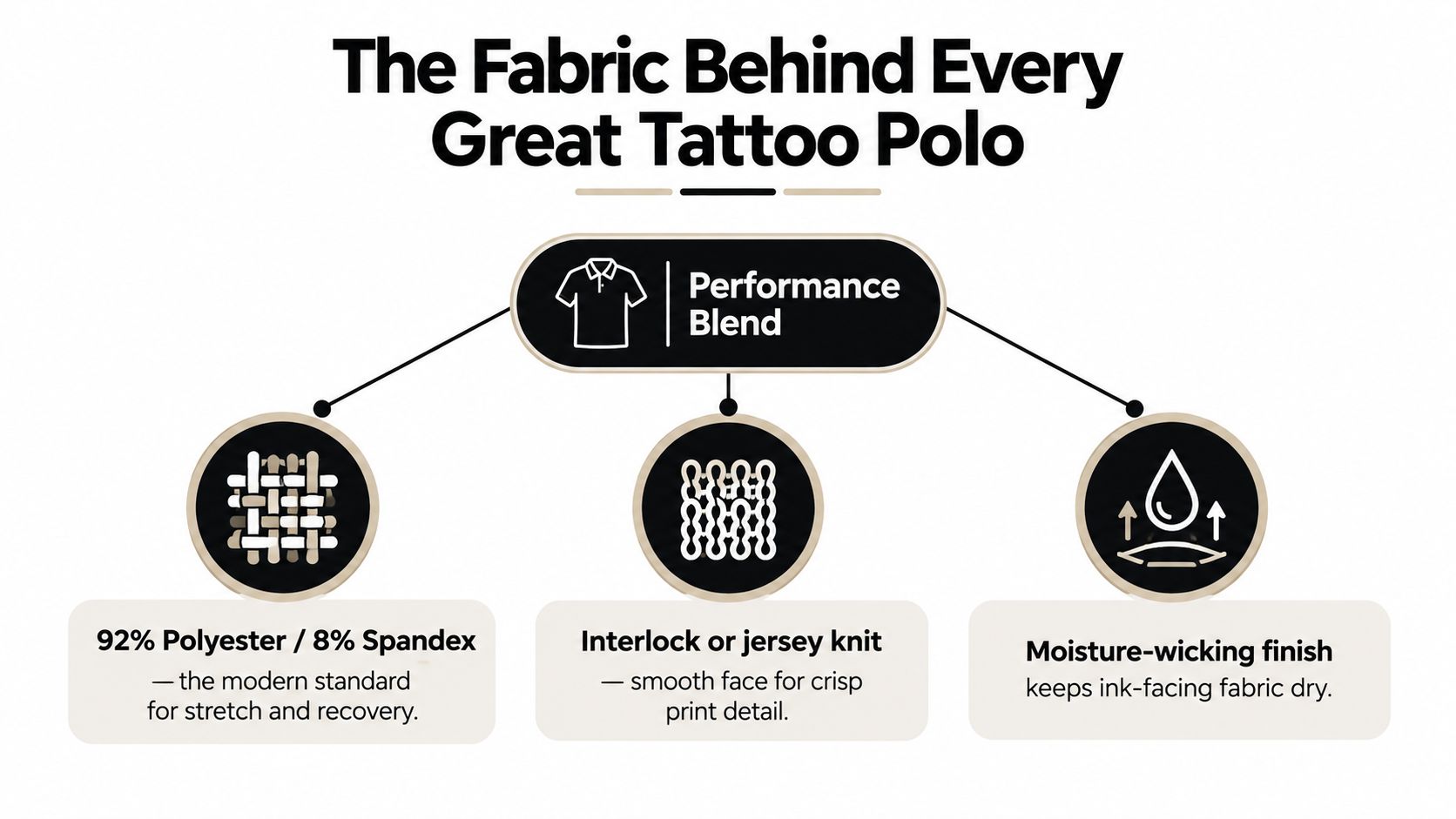
Start with the fiber blend, not the artwork. A performance polo worth wearing through a full round usually centers on polyester with spandex or elastane, because polyester absorbs less water than cotton and helps move moisture toward the outer surface. The added stretch lets the shirt follow rotation, bending, and reach rather than pulling against the shoulders.
A 92% polyester and 8% spandex composition is a practical reference point for buyers looking for stretch and recovery, but don't treat the percentage alone as a guarantee. The knit structure changes the experience. Interlock and smooth jersey constructions give printed artwork a cleaner face, while piqué can offer a more traditional texture and a slightly more structured hand.
What the blend does during the swing
Polyester helps transport sweat through capillary action across the fabric surface, where it can evaporate. Spandex contributes four-way stretch and shape recovery, so a shoulder graphic doesn't become distorted every time you reach the top of the backswing. A cotton-heavy lifestyle polo can feel pleasant at breakfast, but it's the wrong tool for a hot round if moisture management is a priority.
Textile research confirms that breathability depends on both fiber composition and fabric structure, not the mere presence of a “performance” label. In one comparative study, the most breathable tested sample reached 0.29 g/m²·Pa·h, while the least breathable measured 0.097 g/m²·Pa·h (textile moisture-management research). The lesson is simple: ask what the fabric is and how it's knitted.
what moisture-wicking fabric does
For graphic direction, a resource on wearable fabric tattoo designs can help you judge whether a concept needs fine linework, heavier contrast, or a simplified motif before it reaches a shirt. For a practical explanation of the moisture system itself, see this guide to what moisture-wicking fabric does.
Performance Features That Actually Matter
A striking print is only half the purchase. I rank the technical details this way: first, movement; second, moisture handling; third, sun protection; fourth, odor control. Buyers often reverse that order because marketing copy makes every feature sound equally important.
Fabric weight deserves a close look. A knit in the 150 to 170 GSM range can provide useful opacity for dense artwork without becoming unnecessarily heavy in hot conditions, but the best choice depends on the yarn, knit, and climate. A darker print may hide sweat marks, yet it doesn't automatically make a poorly ventilated fabric comfortable.
UPF is the feature I won't negotiate on for long, sun-exposed rounds. Choose a clearly labeled UPF rating rather than assuming a dark print provides dependable protection. Dye density may influence light transmission, but only a tested garment rating tells you what protection the shirt is designed to provide.
| Feature | What to Look For | Why It Matters |
|---|---|---|
| Fabric weight | A balanced midweight knit suited to your climate | Supports print opacity without making the shirt feel stifling |
| UPF protection | A stated UPF rating, ideally UPF 30 or higher | Reduces direct UV exposure during long rounds |
| Stretch | Four-way stretch with reliable recovery | Handles torso rotation better than basic two-way stretch |
| Odor control | Silver-ion or zinc-based treatment with care guidance | Helps manage odor during repeated wear |
Spandex stretch and mechanical stretch aren't interchangeable. Mechanical stretch comes from the knit's construction and can feel natural, while elastane provides more responsive extension and recovery. For golf, I prefer a blend that combines both rather than relying on a rigid fabric with a marketing claim.
Anti-odor treatment has practical value, especially for travel and consecutive rounds. Industry guidance commonly recommends polyester- or nylon-spandex blends, with 5–10% spandex often cited as enough for useful stretch without undermining moisture transport. Compare the complete package using this guide to what makes great golf apparel, then match it to your heat, humidity, and swing rather than choosing the most dramatic graphic.
Matching Graphic Intensity to the Occasion
The safest way to wear a bold polo is to grade the artwork before you grade the color. Not every course objects to vivid design, but every club has a social temperature. Read the room before you make the shirt the room.
| Intensity Tier | Typical Graphics | Best Occasions | Avoid At |
|---|---|---|---|
| Subtle ink | Small chest motifs, tonal linework, single-shoulder accents | Traditional clubs, corporate outings, formal lunches | Only settings that require solid colors |
| Mid-intensity | Sleeve graphics, script banners, partial-back artwork | Resort rounds, charity tournaments, casual skins games | Strict member-guest events without checking policy |
| Full statement | Full-back pieces, sleeve artwork, saturated panels | Buddy trips, summer leagues, public courses, themed scrambles | Pro-ams, conservative private clubs, unfamiliar guest rounds |
Subtle ink is the smart first purchase if you play across different venues. Tonal black-and-grey linework can feel modern without challenging a conservative collar policy. It also gives you more flexibility with trousers and jackets.
Mid-intensity works when the group expects personality. A sleeve graphic or partial-back design has enough visual presence for a resort round but won't dominate every conversation at the clubhouse.
Full statement belongs where the dress code and audience allow it. Check the written policy, ask the host, and pay attention to the players around you. Bold graphics should announce personality, not force an apology.
Finding the Right Fit for Your Swing
A printed polo that fights your swing is a bad polo, no matter how good the art looks. Fit the shirt in motion, not just in front of a mirror.
Start at the shoulder. The seam should land at the edge of the shoulder joint, around the acromion, rather than sliding onto the bicep or creeping toward the neck. An inward seam restricts rotation, while an outward seam makes the shirt look oversized and breaks the visual frame around the artwork.
Use this fitting checklist
- Shoulder seam: It should sit on the shoulder point without drooping.
- Placket: Two or three buttons should let you open the collar for heat release without exposing too much when you address the ball.
- Sleeve length: Aim for roughly mid-bicep, with enough room that the cuff doesn't grip the triceps at the top of the backswing.
- Torso drape: The body should follow your shape without billowing or clinging.
- Hem: It should stay tucked if you want a tucked look, and sit cleanly if you wear it untucked.
- Cuff: A relaxed sleeve hem usually handles sweat better than a tight band.
Mimic your address position before buying. Reach both arms forward, rotate as if you're taking the club to the top, and check for pulling across the chest or lower back. If the polo strains across the chest in that position, size up or choose a cut with more room through the shoulders.
Building Outfits Around a Statement Polo
The polo is already doing the talking. Don't make your shorts, belt, shoes, and hat compete with it.
For a saturated print or full-back design, use flat-front technical shorts or trousers in khaki, stone, charcoal, or black. Those colors support the graphic without creating a second focal point. A matte leather belt or restrained woven stretch belt looks sharper than anything glossy, especially when the artwork already has high contrast.
Shoes should stay low-profile. White, grey, and tan spikeless options keep the lower half clean and let the polo carry the color story. If you're building a coordinated look for a group or couple, repeat one accent color from the artwork in the belt or footwear rather than matching every detail.
Course-to-clubhouse combinations
- On course: Bold polo, neutral technical shorts, matte belt, simple cap, low-profile shoes.
- Cooler round: Statement polo under a solid vest or lightweight jacket, with no competing print.
- After golf: Dark denim or chinos, the same polo, and one understated accessory.
- Women's styling: Tuck the front hem into a pleated skort for a clean transition from course to lunch.
The formula is one statement, one silhouette, one supporting palette. For more combinations, use this practical guide to styling a bold golf polo outfit. If the outfit needs several extra accessories to feel finished, the polo probably isn't being given enough space.
Do Printed Polos Really Hold Up on the Course
The idea that printed polos automatically run hotter is too crude. Heat comes from the fabric system, including the knit, weight, fiber mix, finishing, and fit. A dense print can look visually heavy while the underlying polyester-spandex jersey still allows moisture to move across the outer face.
Sublimation is especially useful for polyester garments because the dye becomes part of the fiber rather than sitting as a thick surface layer. That reduces the risk of peeling and helps preserve the hand feel. The print method still matters, but it doesn't replace good fabric engineering.
| Concern | Reality | Why It Holds Up |
|---|---|---|
| Dense artwork traps heat | The base knit controls most airflow | Breathability depends strongly on structure and fiber mix |
| Printed shirts feel restrictive | Stretch comes from the garment construction | Elastane and knit recovery support rotation |
| Dark graphics always overheat | Color can affect heat absorption, but fabric remains decisive | Weight, ventilation, and fit determine comfort |
| Prints crack quickly | Sublimated polyester graphics don't sit as a brittle surface layer | The artwork is integrated into the fiber |
| UPF disappears under artwork | A garment needs a stated rating for dependable protection | Tested construction matters more than visual darkness |
| All prints fade quickly | Washing conditions are a major risk factor | Cold washing and low heat protect color and recovery |
Colorfastness is the concern I'd investigate before purchase. Ask about the print method, wash instructions, and fabric rating. Don't assume a heavy graphic is a performance problem, and don't assume a vivid graphic proves quality either.
The best printed polo feels like a golf shirt first. It moves cleanly, dries without becoming clammy, and keeps its shape after you've played hard in it. The art should remain the reason you chose it, not the reason you regret it.
Caring for Your Polo So the Art Stays Sharp
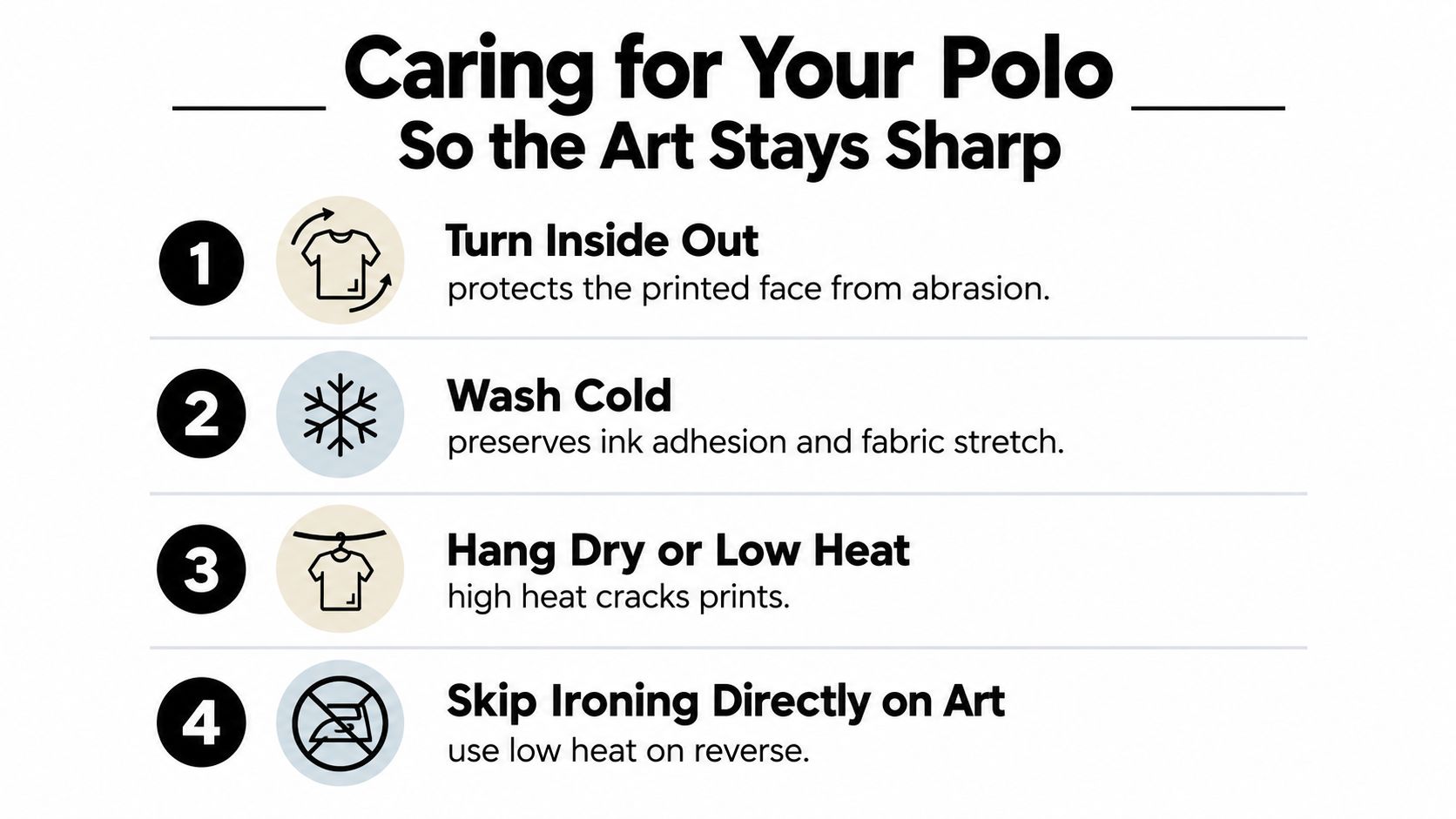
Treat a tattoo-inspired polo like technical activewear, not like a casual cotton tee. The goal is to protect three things at once: the printed face, the elastane, and the moisture-management finish.
Follow this wash routine
- Turn it inside out. This reduces abrasion from zippers, buttons, and other garments against the artwork.
- Wash in cold water. Use a gentle cycle and mild detergent without bleach or optical brighteners.
- Skip fabric softener. Softener can coat technical fibers and interfere with moisture movement.
- Dry gently. Hang dry or tumble dry on low. High heat can weaken stretch fibers and dull printed color.
- Avoid direct ironing. If wrinkles bother you, steam the shirt or iron it inside out on a low setting.
- Store with care. Use a wide hanger or fold the polo so the shoulder seams don't stretch.
Don't wash performance polos with rough towels or garments carrying exposed hardware. That abrasion is unnecessary, especially when the inside-out habit takes only a few seconds.
The care label still wins if it differs from general guidance. Follow it consistently, and your polo will keep its stretch recovery, color clarity, and course-ready shape through regular play.
Tattoo Golf Shirts to Explore
If you want to shop the look, here are a few Tattoo Golf collections worth browsing:
- Men's golf shirts for everyday performance fits with bold tattoo-inspired graphics.
- Women's golf shirts for course-ready styling with stretch and moisture management.
- Golf polos if you want more collared options with standout prints.
- Skull apparel if you want a louder, high-contrast statement piece.
Tattoo Golf offers performance polos and coordinated golf apparel built around bold tattoo-inspired graphics, including high-impact prints, skull motifs, and matching options. If you want a statement shirt with stretch, moisture management, and a course-ready collar, browse Tattoo Golf and choose the graphic intensity that fits your next round.
Share:
Wild Golf Shirts for Men: A Practical Style Guide
Funny Golf Shirts: The Ultimate Gift Guide for Women