
A leather belt can be strong enough for the job and still be wrong for your golf swing. Natural leather performed well in a comparative materials review, but strength alone doesn't tell you whether a buckle will dig into your abdomen or a strap will fit comfortably between adjustment points. A genuine leather belt for golfers needs to work as equipment first, holding your waistband securely through bending, walking and rotation, with appearance close behind.
Ratchet vs Prong: How Each Mechanism Carries Load
Pick the mechanism that matches how often you adjust your fit. A ratchet belt gives you fine adjustment without punched holes. A prong belt offers traditional hardware and fixed adjustment points. Either can work on the course, provided the strap, buckle attachment and buckle shape suit the job.
The key difference is where each belt locks and how you release it. That affects how precisely you can adjust the fit and which parts need regular inspection.
Ratchet vs prong belts compared
| Feature | Ratchet belt | Prong belt |
|---|---|---|
| Adjustment | Small locking steps without punched holes | Fixed steps set by the punched-hole spacing |
| Hole wear | No punched holes to elongate, though the track and attachment can wear | Loaded holes can stretch and eventually tear |
| Trimming | Trim the buckle end only when the design permits it | Usually unnecessary. Buy the correct fixed length |
| Typical sizing | Check the stated waist range and trim-to-fit instructions | Sold in fixed sizes. Check the maker's measurement convention |
| Best for | Golfers who want precise adjustment or whose waist fit changes | Golfers who want a classic look and easy in-store sizing |
How the mechanisms carry tension
A prong belt works like a ladder with fixed rungs. The buckle pin passes through a punched hole, while the strap loop holds the loose end. Your preferred fit needs to match one of the available holes unless a new hole is punched.
Under tension, the pin presses against the hole's edge. Repeated tightening can elongate the hole, especially if the surrounding leather is thin, damaged or repeatedly wet. An oval hole is a sign to inspect the strap.
A ratchet belt uses a locking bar beneath the buckle that engages a toothed track on the strap's underside. The strap moves inward in small steps and resists movement outward; pressing the release lever disengages the lock.
With no punched adjustment holes, the strap avoids that particular stress point. The track, its attachment, the buckle clamp and the release mechanism still carry load, so check them for wear or looseness.
What leather does and doesn't guarantee
Leather's established commercial use explains its familiarity, not the quality of any individual belt. The Food and Agriculture Organization's review of the hides and skins market estimated global bovine production at approximately 6.2 million tonnes of raw hides annually, measured on a wet-salted basis. That scale says nothing about a belt's leather grade, tanning, finish or construction.
Buying rule: Assess the strap and hardware separately. Good leather won't compensate for a buckle that slips.
Choose ratchet for a finely adjustable fit without punched holes.
Choose prong for traditional styling and straightforward fitting.
Both mechanisms can serve well. Prioritize the adjustment style you'll use, then check that the buckle stays secure and the contact points feel comfortable when you bend and move.
How to Measure Your Golf Belt Size
Measure where you wear the belt, not where a trouser label suggests your waist should be. Use a flexible dressmaker's tape, your usual golf trousers and a mirror so you can check the tape's position around your back.
A seller's belt size might describe the usable fit, the distance to a center hole or the complete strap length. Those aren't interchangeable measurements. Don't apply a universal add-on formula before checking the manufacturer's diagram.
Take the measurement before choosing the size
- Wear your normal golf clothing. Thread the tape through the waistband's belt-loop path, or hold it directly over that path. This measures the circumference the belt must secure.
- Keep the tape level and comfortably snug. Stand naturally, breathe normally and avoid pulling your stomach in. A tight tape produces a tight belt.
- Record the measurement and the clothing used. A tucked polo and lightweight shorts create a different fitting situation from layered cool-weather clothing.
- For a prong belt, check the center-hole measurement. Aim to use a hole near the middle of the available range so there's room to tighten or loosen.
- For a ratchet belt, confirm both ends of the usable range. A long strap isn't automatically suitable for every smaller waist. The buckle and track still need to meet correctly after trimming.
- Test before removing material. Fasten the belt, sit down and move naturally. Only cut a trim-to-fit strap after you've understood which end detaches and how much usable track remains.
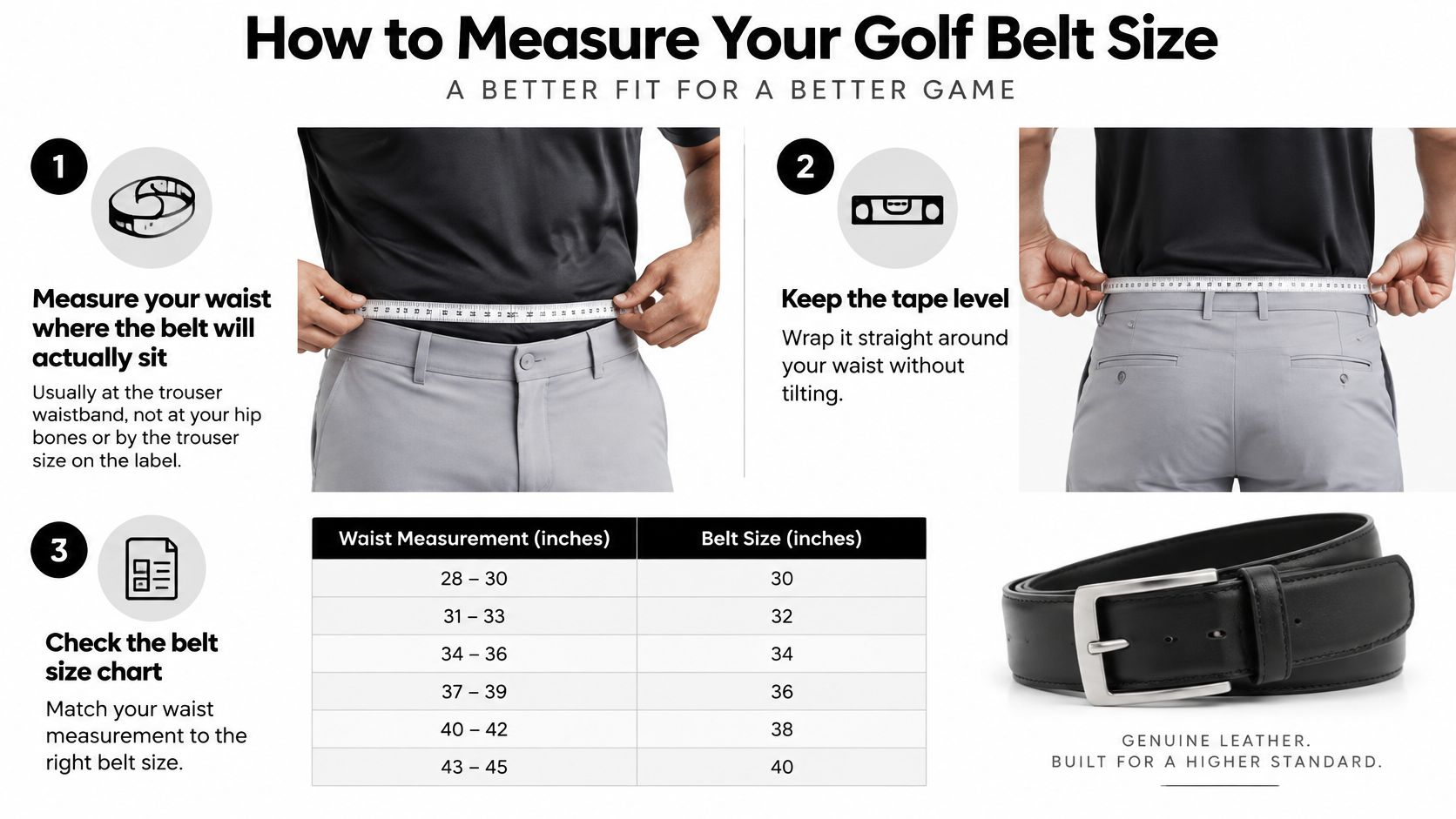
Use the right size chart
Trouser waist to prong belt length
| Trouser waist (inches) | Prong belt length (inches) |
|---|---|
| Trouser label only | Measure your actual belt-wearing circumference before ordering |
| Actual waistband measurement recorded | Choose the maker's size whose center-hole measurement matches |
| Between the maker's listed sizes | Check both usable hole ranges and choose the better-centered fit |
| Outside the published range | Request an extended, short or custom size rather than guessing |
This is a sizing lookup rule, not a universal numerical conversion. Adding a fixed allowance can confuse total strap length with wearable belt size, leaving you with an unnecessarily long tail or the wrong fastening range.
An existing belt can also help. Lay it flat and measure from the buckle's working contact point to your comfortable hole, then compare that measurement with the seller's illustrated method. Don't measure tip to tip unless the seller specifically sizes that way.
Leave a trim-to-fit strap long during the first fitting. You can remove more material later, but you can't put it back.
Re-measure before reordering after a meaningful change in weight or clothing. For seasonal outfits, use the actual waistband combination you'll wear, with golf clothing for cooler-weather layering as a guide to assembling the clothing before checking belt fit.
Leather Grade, Width and Buckle Choices
Leather grades for golf belts
| Grade | What it is | Durability and feel | What to check |
|---|---|---|---|
| Full-grain | Hide with the natural grain surface intact | Strong potential for long service and a developing patina | Confirm full-grain is stated, and inspect the complete strap construction |
| Top-grain | Grain leather whose surface may be sanded and finished | Smooth, durable when well constructed | Ask about backing, lining and surface finish |
| Corrected grain | Leather with surface defects corrected and often covered by a finish | Uniform appearance, with breathability affected by coating | Ask what the coating is and how it's applied |
| Bonded or reconstituted | Leather fibers combined with binders and pressed into material | More vulnerable to splitting or separation under repeated flexing | Avoid as the main structural strap for daily golf use |
“Genuine leather” tells you the hide is real, not how well the strap is built. Full-grain keeps the natural grain surface intact; sanding, splitting, backing and coating all affect how the finished strap flexes and wears. Retail categories can overlap, so check the stated construction rather than relying on the label alone.
The Leather Naturally comparison of leather against alternatives found that natural leather had the highest tensile and tear performance among the materials surveyed. That supports choosing sound leather for a strap under tension, but it does not establish that every leather belt will outperform every alternative.
Balance width, flexibility and hardware
Check the strap width against your actual belt loops. A broad strap can look balanced with golf shorts yet bind in narrower trouser loops, while a narrow dress-style strap may look undersized with substantial sportswear. Do not force a tight strap through the loops, particularly at stitched joins.
For a premium specification example, the Ace of Clubs black rustic weave golf belt listing describes top-grain cowhide at 1.5 inches wide. Use that as a concrete point of comparison, not a universal width recommendation.
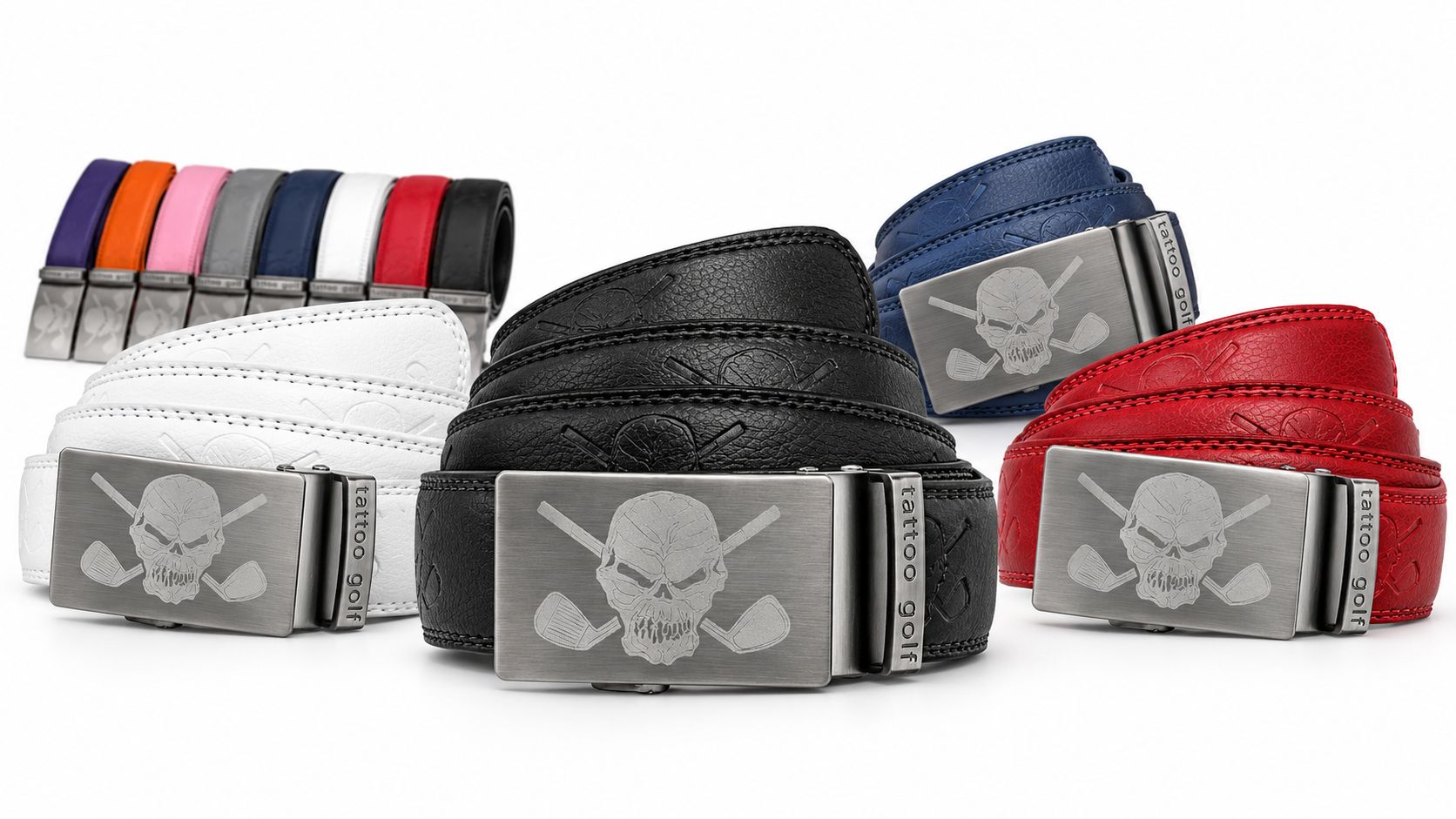
A ratchet option is the Leather Ratchet Golf Belt – No-Hole Click Belt with Skull Buckle, described as a genuine-leather, trim-to-fit strap with a zinc-alloy skull buckle. Apply the same questions about grade and strap construction as you would to a conventional prong belt.
Inspect the parts photographs can hide
- Edges and layers: Reject lifting edge paint, exposed adhesive or layers that are beginning to separate.
- Flex behavior: Bend the strap gently. It should curve without surface cracking or visible separation.
- Reinforcement: Inspect the buckle fold and nearby stitching, where repeated bending concentrates stress.
Choose a strap that flexes cleanly and threads through your loops without force. Extra thickness can make both jobs harder, so judge the belt by its construction and usable flexibility rather than bulk.
Fit on the Course and Across Dress Codes
A belt can fit while you stand and still press or shift when you move. Test it in your usual golf posture with pockets loaded as you normally play. A phone, scorecard or ball marker can change how the waistband sits.
Make a controlled practice swing and check whether your trousers stay secure without the buckle dragging across your abdomen. If you need to tighten the belt excessively, the trouser cut may be the underlying problem.
Then hinge forward as if placing a ball on a tee, and crouch into your usual putting-read position. A deep buckle face or sharp lower edge can press into your abdomen even when the strap circumference is right. Leather break-in will not resolve a hardware pressure point.
Test the less obvious positions
- Walking uphill: Raise a knee and step onto a low, stable surface. Check for sharp pulling at the buckle.
- Sitting in a cart: Sit fully. Notice whether the buckle contacts your abdomen or pushes the waistband down.
- Returning to address: Repeat your setup after sitting. The buckle should not need repositioning each time you stand.
Slightly loosening the belt may ease general compression. If the buckle still digs in, choose a shallower profile or a different shape.
Separate personal style from club permission
Dress rules still apply. A 2025 National Club Golfer survey of 3,250 club golfers found that more than 70% considered dress codes important or very important. The result reflects golfers' views on dress codes; individual club policies still vary.
A restrained leather strap in black, brown or tan can work from course to clubhouse and dinner. Bright colors and prominent motifs suit casual or resort golf, but a product's country-club styling claim does not replace a venue's policy. Check the club's written requirements before a first visit, especially for hosted events.
For event-specific clothing choices, use this golf tournament attire guide alongside the organizer's instructions.
Fit check: Keep trousers secure, movement unrestricted and buckle pressure localized nowhere.
No independent study sets an ideal belt stiffness, so judge fit by movement.
Styling Your Belt with Golf Apparel
Match the belt to your shoes first, then the trousers. This keeps the waistband visually connected to the rest of your outfit without requiring every shade to match exactly.
With white or multicolored golf shoes, use a dominant neutral or restrained accent as your reference. Bright belts draw attention across the middle of the outfit, so keep other strong colors in check.
Belt color pairings by setting
| Belt color | Pairs well with | Avoid | Best setting |
|---|---|---|---|
| Blue | Khaki, white or grey trousers | Navy trousers when the shades create muddy, low contrast | Public courses and casual rounds |
| Orange | Black, grey or white trousers | An orange or red polo competing for attention | Resort and casual rounds |
| Black | Navy, charcoal or khaki trousers | Strongly contrasting brown dress-style shoes | Clubhouse and private courses |
| Tan or brown | Khaki, olive or cream trousers | Black trousers when you want a conservative, continuous look | Traditional club dress |
Blue adds color with less visual intensity than orange. Orange works most predictably against neutral clothing. Neither requires you to repeat the color in your shirt, hat and glove.
Coordinate rather than copy
A belt that exactly matches a polo can make the outfit look overly assembled, especially when the shoes repeat the same bright shade. Connect the accessories through a shared neutral, then let either the shirt or the belt lead.
For a restrained clubhouse outfit, pair a white performance polo and navy trousers with a black leather belt and black shoes. For a casual resort look, swap in an orange belt, keep the shirt plain and avoid adding another strong accent.
Texture can add interest without another color. For a more decorative option, see this guide to choosing quality leather belts with studs. Keep embellishment suited to the venue, and check that the buckle remains comfortable when you move.
Finish with a full-length mirror check
- Check the shoes and waistband together: A belt can work beside a shirt but clash with the footwear.
- Check the trouser hem: Heavy bunching around the shoes can make coordinated accessories look untidy.
- Limit competing accents: A statement buckle, bright strap and heavily patterned polo rarely need equal emphasis.
Use this guide to matching golf accessories with your golf shirt when coordinating the wider outfit. Aim for a clear visual hierarchy rather than matching every accessory.
How to Care for Your Leather Golf Belt
Wipe down a golf belt after a wet or sweaty round, then let it dry naturally before putting it away. Repeated moisture and rapid drying can change the strap's feel and dimensions, even if the leather fibers remain intact.
The EN ISO 2419:2024 leather-conditioning standard specifies conditioning test pieces at 23 °C and 50% relative humidity, with dry specimens conditioned for at least 24 hours. Keep stored leather in a similarly moderate, dry environment, since moisture conditions affect how it feels and performs.
Use a gentle after-round routine
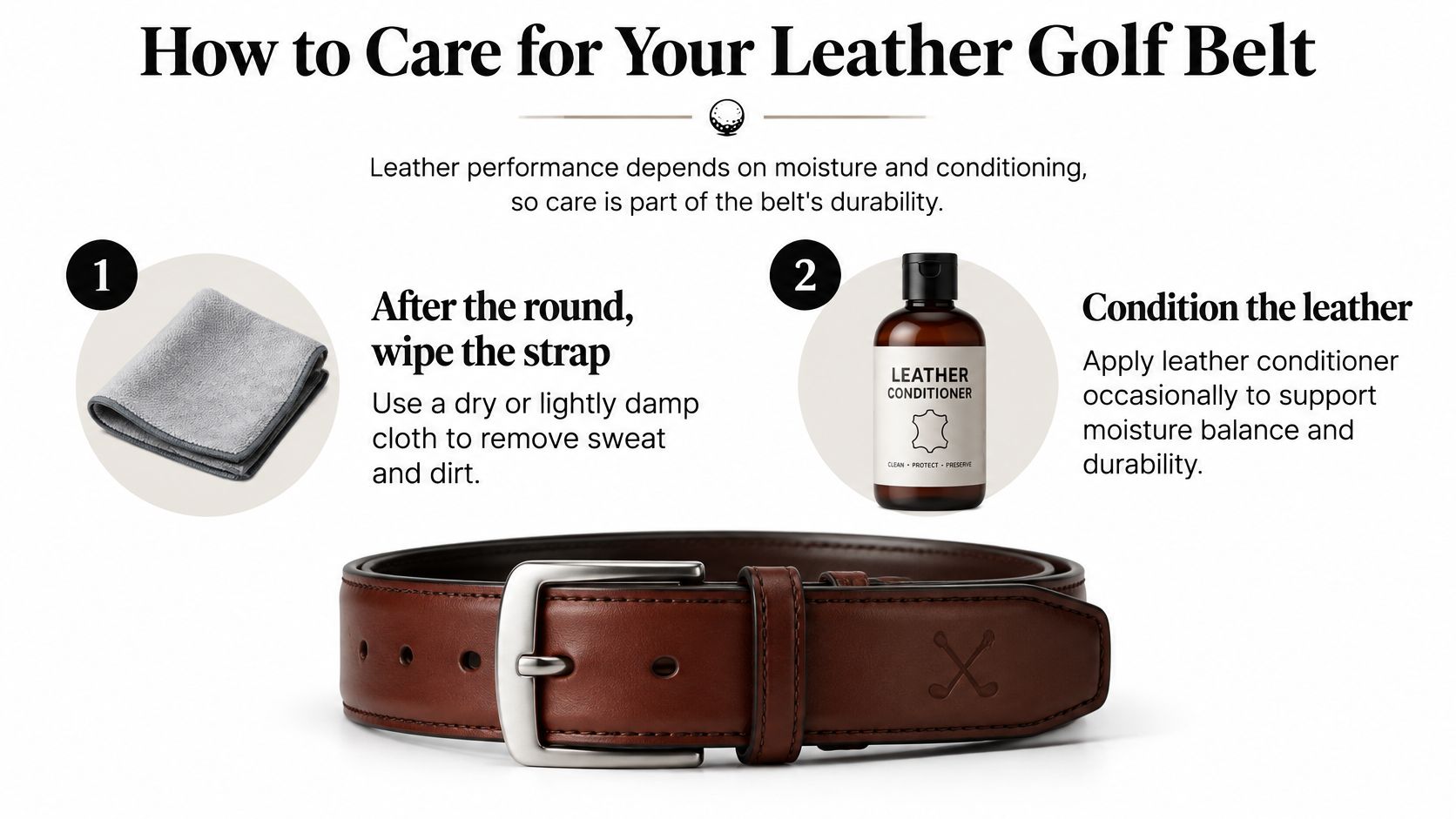
- Wipe away residue. Use a soft, dry or lightly damp cloth on the strap, including the underside where sweat collects. Don't soak the leather to clean it.
- Blot rainwater. Press a clean towel against the strap to remove surface moisture without rubbing a softened finish.
- Air-dry at room temperature. Keep the belt away from radiators, hair dryers and direct sunlight. Forced drying can leave leather stiff or damage its surface.
- Condition only when fully dry. Choose a product intended for the belt's finish, test it on an inconspicuous area and apply a light film with a cloth. Wipe away excess to avoid a greasy surface.
- Let the leather's condition guide you. A dry-feeling strap may need attention; a supple, heavily finished strap may not. Extra conditioner does not guarantee extra protection.
- Store without sharp bends. Hang the belt or coil it loosely, with the buckle positioned so it doesn't press into the finished face.
- Keep ratchet hardware clean. Brush loose grit from accessible areas with a soft, dry brush. Don't flood the mechanism with oil or force a jammed release lever.
Recognize when care won't fix damage
Stiffness and pale, dry-looking areas warrant inspection and cautious conditioning. Cracks, separating layers and elongated fastening holes point to structural damage. Conditioner won't restore torn leather or bond a failing strap.
If a belt stays damp or develops an odor, unthread it from the trousers and let air reach both faces before storing it. Skip fragrance and further conditioner until it is dry.
Don't use heat to make a wet belt ready for tomorrow. Let it dry naturally and wear another belt if necessary.
Follow finish-specific care instructions. A glossy coated strap, unfinished leather and a heavily textured surface can react differently to the same cleaning product.
Confirm the Tanning and Finish Before You Buy
Leather type alone does not tell you how a belt was processed or finished. If you have sensitive skin or play in humid conditions, ask about the specific strap's tanning method, testing and surface finish.
The Minnesota Pollution Control Agency's leather-industry review reports that chromium tanning accounts for roughly 90% of global leather production and explains that trivalent chromium can oxidize into hexavalent chromium, a toxic and carcinogenic substance associated with allergic skin reactions. Chromium tanning dominates production, so ask for documentation on the specific leather.
Ask the seller specific questions
- What is the complete strap composition? Request the leather grade, backing, lining and any bonded or reconstituted components.
- Where was the leather tanned? The country of final belt assembly may not identify the tanning location.
- Which tanning method was used? Ask whether the leather is chromium-tanned, vegetable-tanned or processed using another system.
- Is hexavalent chromium testing available? Request documentation relevant to the leather in the belt.
- Does the water-repellent finish contain PFAS? Ask for explicit confirmation if a PFAS-free finish matters to you.
- What documentation supports the material claims? Request details tied to the specific leather rather than relying on broad descriptions such as “natural.”
Vegetable tanning does not establish a universal safety or environmental advantage. Specific documentation is more useful than a reassuring label.
Before ordering, compare your measured waist range and preferred adjustment mechanism with the product specifications. If a seller cannot answer a question that matters to your skin comfort or sourcing priorities, factor that uncertainty into your decision.
Tattoo Golf offers genuine-leather ratchet belts with trim-to-fit straps and signature skull buckles. Visit Tattoo Golf to compare the options, check your measurements against the sizing information and ask for tanning and finish details before choosing.
Share:
Inappropriate Golf Polos: Bold Prints and the Dress Code